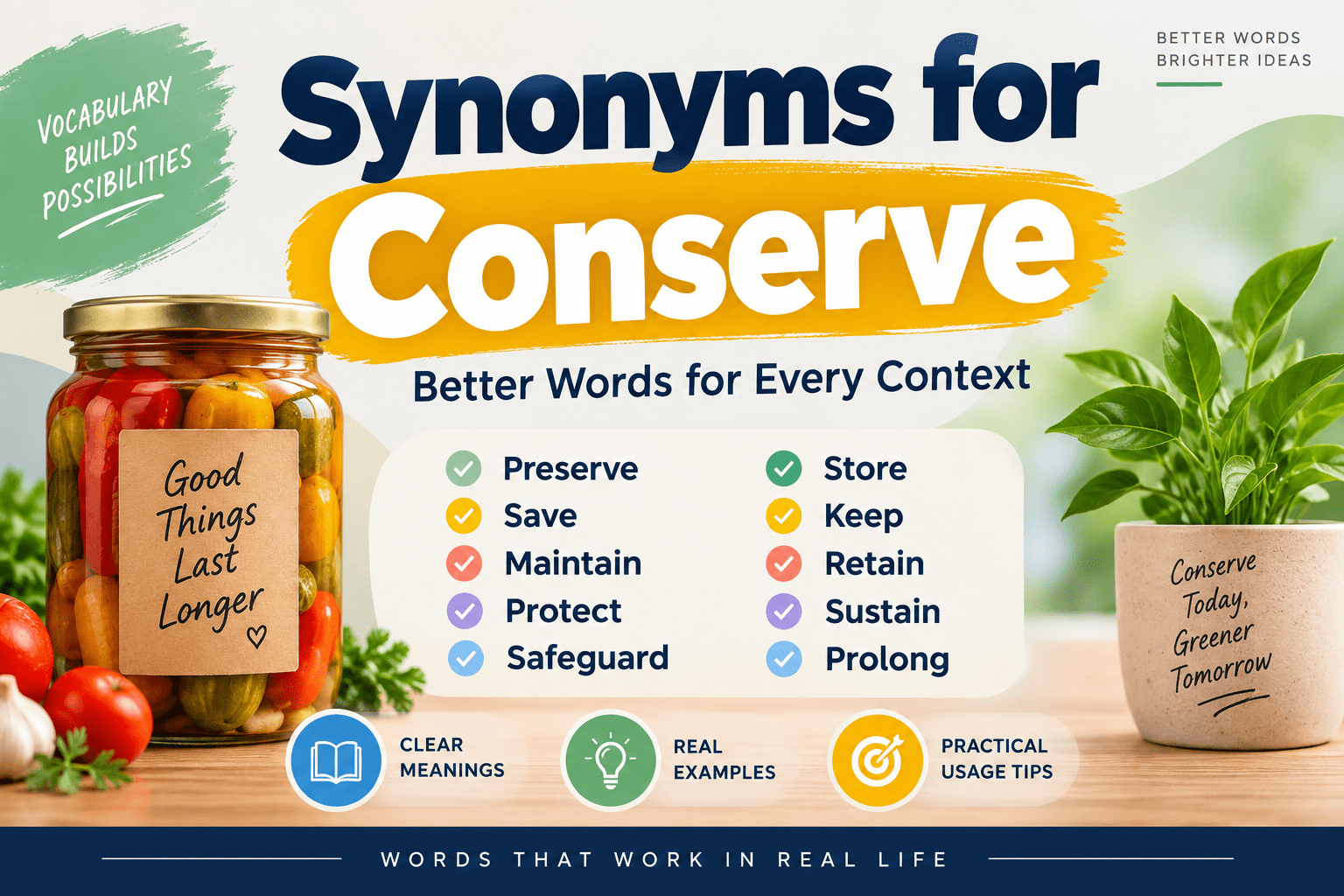
If you’re looking for synonyms of conserve, the best alternative depends on what you mean. Preserve is often the closest choice when the idea is protecting something from damage or loss. Save works well when you mean avoiding waste or keeping something for later. Protect emphasizes preventing harm, while economize, use sparingly, and husband focus on careful use of limited resources.
The distinction matters because conserve covers several related ideas: protecting something, avoiding waste, using a resource carefully, maintaining something in its existing state, and, in scientific contexts, keeping a quantity constant.
Quick Answer: What Are the Best Synonyms of Conserve?
The closest synonyms of conserve include preserve, save, protect, maintain, safeguard, husband, economize, use sparingly, sustain, and care for. Use preserve when protecting something from damage or change, save when avoiding waste or keeping something for later, and economize or use sparingly when emphasizing efficient consumption. Husband is a formal alternative for managing resources carefully.
What Does “Conserve” Mean?
Conserve is primarily a verb meaning to keep something safe or in good condition, or to use something carefully so that it is not wasted or depleted.
Cambridge defines conserve as keeping and protecting something from damage, change, or waste. It gives examples involving electricity, customs and language, energy, and physical strength.
The word commonly appears in two major everyday senses.
1. To avoid wasting or using too much
We need to conserve water during the drought.
Here, conserve means to use the available water carefully rather than unnecessarily consuming it.
2. To protect something from damage, loss, or change
The organization works to conserve endangered wetlands.
Here, conserve means to protect and maintain something so that it survives in good condition.
Merriam-Webster similarly defines conserve as keeping something in a safe or sound state, especially by avoiding wasteful or destructive use.
A specialized scientific meaning
In physics, chemistry, and related sciences, conserve can mean maintaining a quantity as constant during a process.
The reaction conserves energy.
This is a technical use and should not automatically be replaced by ordinary alternatives such as save or protect. Collins also identifies this scientific sense of maintaining a property constant during an interaction or process.
Core Synonyms of Conserve
| Word | Relationship | Strength | Formality | Best Context |
|---|---|---|---|---|
| Preserve | Near/direct synonym | Strong | Neutral/formal | Protecting something from damage or change |
| Save | Near synonym | Moderate | Neutral | Avoiding waste or keeping something for later |
| Protect | Near synonym | Strong | Neutral | Preventing harm or destruction |
| Maintain | Near synonym | Moderate | Neutral/formal | Keeping something in its existing condition |
| Safeguard | Contextual alternative | Strong | Formal | Protecting something valuable or vulnerable |
| Husband | Contextual alternative | Strong | Formal | Managing resources carefully |
| Economize | Contextual alternative | Moderate | Neutral/formal | Using money, time, energy, or resources efficiently |
| Use sparingly | Contextual alternative | Moderate | Neutral | Deliberately limiting consumption |
| Sustain | Contextual alternative | Moderate | Formal | Supporting something so it can continue |
| Care for | Contextual alternative | Moderate | Neutral | Looking after people, places, or things |
| Guard | Contextual alternative | Strong | Neutral | Protecting against harm or loss |
| Keep | Contextual alternative | Weak–moderate | Neutral | Retaining or maintaining something |
These categories reflect actual differences in usage. Cambridge’s thesaurus explicitly lists preserve, save, use less, use sparingly, husband, maintain, care for, and safeguard, while Merriam-Webster includes preserve, protect, save, husband, and economize.
The Closest Synonyms Explained
1. Preserve
Meaning: To keep something safe from damage, decay, loss, or unwanted change.
How it differs:
Preserve is probably the closest general alternative when conserve means protecting something so that it remains available or survives in good condition.
Example:
The museum uses special techniques to preserve the ancient manuscripts.
Best for: historical objects, buildings, traditions, ecosystems, records, food, and cultural heritage.
conserve a forest → preserve a forest
Both are possible, but preserve can put slightly more emphasis on keeping something intact.
2. Save
Meaning: To prevent something from being lost, wasted, damaged, or unnecessarily used.
How it differs:
Save is broader and more conversational than conserve. It can mean keeping something for future use or reducing consumption.
Example:
Turn off the lights to save electricity.
Turn off the lights to conserve electricity.
Both are natural. Conserve sounds somewhat more deliberate and resource-focused.
Cambridge and Merriam-Webster both identify save as a major synonym of conserve.
3. Protect
Meaning: To keep someone or something safe from harm or damage.
How it differs:
Protect emphasizes preventing harm rather than necessarily limiting consumption.
Example:
New laws were introduced to protect the wetlands.
Compare:
New laws were introduced to conserve the wetlands.
The second sentence has a stronger implication of preserving the wetlands as a resource or natural environment for the future.
4. Maintain
Meaning: To keep something in its existing condition or at a particular level.
How it differs:
Maintain focuses on continuity and condition rather than avoiding waste.
Example:
The park service works to maintain the historic gardens.
You can conserve a historic building, but you maintain it when the emphasis is on keeping it in good condition.
5. Safeguard
Meaning: To protect something from danger, loss, or damage.
How it differs:
Safeguard is more formal and often used for things considered valuable, vulnerable, or important.
Example:
The agreement was designed to safeguard the region’s water supply.
It works especially well in professional, governmental, legal, and policy writing.
6. Husband
Meaning: To use and manage a resource carefully and economically.
How it differs:
This is a particularly precise synonym when conserve means use a limited resource carefully.
Farmers must husband their water supplies during dry periods.
Cambridge identifies husband as a formal synonym of conserve, and Collins likewise uses it for careful management of supplies and resources.
Important: This verb is distinct from the noun husband meaning a married man. In modern everyday English, the resource-management verb is relatively formal and less common than conserve.
7. Economize
Meaning: To use money, time, energy, or other resources efficiently and avoid unnecessary expenditure.
How it differs:
Economize emphasizes efficiency and avoiding unnecessary expense rather than protecting something from environmental damage.
Example:
The company is trying to economize on energy costs.
Use economize when the idea of efficiency or reduced expenditure is central.
8. Use Sparingly
Meaning: To use only a small or limited amount.
How it differs:
This phrase is often more precise than a single-word synonym because it directly expresses limited consumption.
Example:
During the shortage, residents were asked to use water sparingly.
Cambridge explicitly includes use sparingly among the alternatives related to conserve.
9. Sustain
Meaning: To support something so that it continues to exist, function, or develop.
How it differs:
Sustain is not a universal synonym. It becomes appropriate when conserving something is intended to help maintain it over time.
Example:
The goal is to sustain healthy forest ecosystems.
Do not replace every occurrence of conserve with sustain. The latter emphasizes continuation rather than protection from waste.
10. Care For
Meaning: To look after and protect someone or something.
How it differs:
This is a broader, more personal expression.
Volunteers care for the historic site.
It can overlap with conserve when the context involves protecting a place, object, or environment, but it does not specifically imply resource conservation.
11. Guard
Meaning: To protect something against danger, damage, or loss.
Example:
The new barriers help guard the coastline against erosion.
Guard emphasizes defense. It is therefore a useful contextual alternative but not a complete replacement for conserve.
12. Keep
Meaning: To retain, preserve, or continue to have something.
Example:
We need to keep enough fuel for the journey.
Keep is extremely common but much broader than conserve. It works when the intended meaning is simply retaining something rather than carefully managing its use.
Synonyms by Meaning
One of the easiest ways to choose the right alternative is to identify the sense of conserve you mean.
When you mean “protect from harm or loss”
Best choices:
- preserve
- protect
- safeguard
- guard
- maintain
- care for
Example:
Scientists are working to conserve the coral reef.
Possible alternatives:
Scientists are working to preserve the coral reef.
Scientists are working to protect the coral reef.
Scientists are working to safeguard the coral reef.
Preserve is generally the closest replacement when the objective is keeping the reef intact for the future.
When you mean “avoid waste”
Best choices:
- save
- use sparingly
- use less
- economize
- husband
- manage carefully
Example:
Residents were asked to conserve water.
Natural alternatives include:
Residents were asked to use less water.
Residents were asked to use water sparingly.
Residents were asked to save water.
The exact choice depends on tone and context.
When you mean “manage a limited resource carefully”
Best choices:
- husband
- economize
- save
- use sparingly
- manage carefully
Example:
We must conserve our remaining fuel.
More formal:
We must husband our remaining fuel.
More conversational:
We need to save our remaining fuel.
When you mean “keep something in its existing condition”
Best choices:
- maintain
- preserve
- protect
- safeguard
- sustain
Example:
The project aims to conserve the building’s original character.
Here, preserve is usually a particularly natural choice.
Formal Synonyms for Conserve
For academic, professional, environmental, or policy writing, the most useful alternatives include:
- preserve
- safeguard
- maintain
- husband
- protect
- sustain
Formal example
Governments must conserve scarce water resources.
Possible formal rewrites:
Governments must preserve scarce water resources.
Governments must safeguard scarce water resources.
Governments must manage scarce water resources carefully.
The best choice depends on whether the emphasis is preservation, protection, or resource management.
Is “husband” formal?
Yes. In the resource-management sense, husband is formal and relatively uncommon in everyday conversation. Cambridge specifically labels it as formal in its entry for conserve.
Everyday Alternatives to Conserve
For ordinary conversation, these are often more natural:
- save
- use less
- use sparingly
- avoid wasting
- keep
- protect
For example:
We need to conserve electricity.
In casual speech:
We need to use less electricity.
or:
We need to save electricity.
In an environmental policy document, however, conserve electricity may be preferable because it is concise and established.
Conserve in Common Contexts
Conserve Water
Natural alternatives:
- save water
- use less water
- use water sparingly
- avoid wasting water
During the drought, residents were asked to conserve water.
Use “use less” when giving straightforward practical advice.
Use “conserve” when discussing resource management or environmental policy.
Conserve Energy
Natural alternatives:
- save energy
- use less energy
- reduce energy consumption
- economize on energy
The building was redesigned to conserve energy.
In technical or professional writing, reduce energy consumption can be more precise when the focus is specifically on lowering usage.
Conserve Natural Resources
Natural alternatives:
- preserve natural resources
- protect natural resources
- safeguard natural resources
- manage natural resources carefully
- use natural resources sustainably
We need to conserve natural resources for future generations.
Here, preserve and protect are close alternatives, while use sustainably changes the emphasis toward long-term responsible use.
Conserve Wildlife
Natural alternatives:
- protect wildlife
- preserve wildlife
- safeguard wildlife
- protect endangered species
The organization works to conserve wildlife habitats.
Protect is especially natural when the immediate concern is preventing harm.
Conserve Your Energy
Natural alternatives:
- save your energy
- preserve your strength
- pace yourself
- avoid exhausting yourself
You should conserve your energy for the final stage of the race.
In conversation, save your energy and pace yourself may sound more natural.
Which Word Should I Use?
Use preserve when:
You want to keep something from damage, decay, loss, or unwanted change.
The foundation aims to preserve the historic building.
Use save when:
You mean avoiding waste or keeping something for later.
We need to save enough fuel for the return journey.
Use protect when:
You want to emphasize preventing harm.
The regulations protect endangered species.
Use maintain when:
You mean keeping something in its current condition.
Regular maintenance helps maintain the building’s structural integrity.
Use safeguard when:
You want a formal word emphasizing protection of something valuable or vulnerable.
The policy safeguards public water supplies.
Use economize when:
You want to emphasize efficiency or reduced expenditure.
The business is trying to economize on fuel.
Use husband when:
You want a formal word for carefully managing a limited resource.
The community had to husband its remaining water supplies.
Use use sparingly when:
You want to explicitly tell someone to use only a limited amount.
Use the chemical sparingly.
Conserve vs. Preserve
These words overlap heavily, but they are not identical.
| Word | Main Meaning | Typical Emphasis |
| Conserve | Protect or use carefully to prevent waste | Resource management and long-term protection |
| Preserve | Keep safe from damage, decay, or change | Maintaining something in its existing state |
Compare:
The city wants to conserve water.
This emphasizes responsible resource use.
The museum wants to preserve the painting.
This emphasizes protecting an existing object from damage or deterioration.
Both words can occur in environmental contexts:
conserve forests
preserve forests
But conserve often carries a stronger sense of responsible resource management, while preserve can emphasize keeping something intact.
Conserve vs. Save
Save is broader and more common in everyday English.
Save water.
Conserve water.
Both are natural.
But save has many meanings unrelated to conservation:
She saved the document.
He saved the child.
I’m saving money for a car.
Conserve is more specifically associated with preventing waste, depletion, or damage.
Cambridge and Merriam-Webster both list save as a major synonym of conserve.
Conserve vs. Protect
Protect focuses on preventing harm.
Conserve can involve protection, but often adds the idea of avoiding waste or ensuring continued availability.
The law protects the forest from illegal logging.
The program conserves the forest by limiting resource use and protecting its ecosystem.
The second sentence presents a broader preservation strategy.
Conserve vs. Maintain
Maintain means keeping something at an existing condition, level, or standard.
The technicians maintain the equipment.
Conserve usually suggests preventing loss, waste, depletion, or deterioration.
The researchers conserve the historic materials.
The researchers maintain the laboratory equipment.
The verbs overlap in some preservation contexts but are not interchangeable everywhere.
Common Collocations with “Conserve”
Some combinations are especially natural:
- conserve energy
- conserve water
- conserve electricity
- conserve fuel
- conserve resources
- conserve natural resources
- conserve wildlife
- conserve forests
- conserve biodiversity
- conserve land
- conserve soil
- conserve heat
- conserve your energy
- conserve your strength
- conserve historic buildings
- conserve cultural heritage
These collocations reveal an important semantic pattern: conserve is especially useful when the thing being protected is limited, valuable, vulnerable, or important for future use.
Common Mistakes
Mistake 1: Treating “conserve” and “preserve” as identical
They overlap, but preserve often emphasizes keeping something intact, while conserve can emphasize preventing waste or managing a resource carefully.
Mistake 2: Using “economize” for every meaning of conserve
We need to economize endangered forests.
This is unnatural.
Better:
We need to conserve endangered forests.
Economize is primarily about using resources, money, time, or other supplies efficiently.
Mistake 3: Using “protect” when the meaning is resource efficiency
Turn off unnecessary lights to protect electricity.
This is incorrect.
Better:
Turn off unnecessary lights to conserve electricity.
or:
Turn off unnecessary lights to save electricity.
Mistake 4: Assuming “save” always has the same tone
Save is usually more everyday and general.
Conserve is often more deliberate and associated with environmental, scientific, governmental, or resource-management contexts.
Mistake 5: Confusing “conserve” with “conserve” as a noun
Conserve can also be a noun referring to a type of fruit preserve or jam. Cambridge and Collins both record this noun sense.
The recipe uses apricot conserve.
This is completely different from:
We need to conserve water.
Real-World Examples
Environmental writing
Governments are encouraging households to conserve water during prolonged droughts.
Best alternatives:
- save water
- use less water
- use water sparingly
- manage water resources carefully
Academic writing
Conservation programs aim to conserve biodiversity and protect vulnerable ecosystems.
Possible alternative:
Conservation programs aim to preserve biodiversity and protect vulnerable ecosystems.
Business writing
The company introduced energy-efficient equipment to conserve electricity.
Alternative:
The company introduced energy-efficient equipment to reduce electricity consumption.
The second version is more explicit and technical.
Everyday conversation
Turn off the tap so we can conserve water.
More conversational:
Turn off the tap so we don’t waste water.
Professional communication
Employees should conserve company resources wherever practical.
Possible alternative:
Employees should use company resources efficiently and avoid unnecessary waste.
Antonyms of Conserve
The most direct opposites depend on the intended meaning.
For avoiding waste:
- waste
- squander
- misuse
- use up
- dissipate
For protection:
- damage
- destroy
- neglect
- deplete
- endanger
Cambridge identifies waste and squander as antonyms of conserve, while Collins includes broader opposites such as waste, misuse, squander, use up, and dissipate.
Frequently Asked Questions
What is the closest synonym for “conserve”?
Preserve is often the closest synonym when conserve means protecting something from damage, loss, or change. Save is often closer when the meaning is avoiding waste or keeping something for future use.
What is another word for conserve energy?
Depending on context, you can say save energy, use less energy, reduce energy consumption, or economize on energy. Save energy is especially natural in everyday English.
What is a formal synonym for conserve?
Husband is a formal synonym when you mean managing a limited resource carefully. Safeguard, preserve, and maintain can also work in formal contexts, depending on the meaning. Cambridge specifically labels husband as formal.
Is “preserve” the same as “conserve”?
Not always. Preserve emphasizes keeping something safe or intact, while conserve can also mean using a resource carefully to avoid waste or depletion.
Is “save” a synonym for “conserve”?
Yes, in many contexts. For example, save water and conserve water are both natural. Save is broader and generally more conversational.
What is the difference between conserve and maintain?
Conserve often means preventing waste, loss, or depletion, whereas maintain means keeping something at its existing condition or level.
What is another word for “use sparingly”?
Depending on context, alternatives include economize, use economically, ration, limit consumption, cut back, or conserve. They are not interchangeable in every sentence.
What is the opposite of conserve?
The most direct opposite is waste. Other opposites include squander, misuse, deplete, dissipate, and destroy, depending on the sense.
Conclusion
The best synonym for conserve depends on the meaning you want to preserve. Choose preserve for keeping something safe or intact, save for avoiding waste, protect for preventing harm, maintain for keeping something in good condition, safeguard for formal protection, and economize, use sparingly, or husband for careful resource management.
The central distinction is simple: conserve often combines protection with careful use. Choosing the synonym that matches that specific idea makes your writing more precise, natural, and contextually accurate.

Sarah Williams is an ESL teacher and content writer with a passion for simplifying English vocabulary. She creates easy-to-understand synonym guides and learning resources that help beginners and intermediate learners build strong language skills.