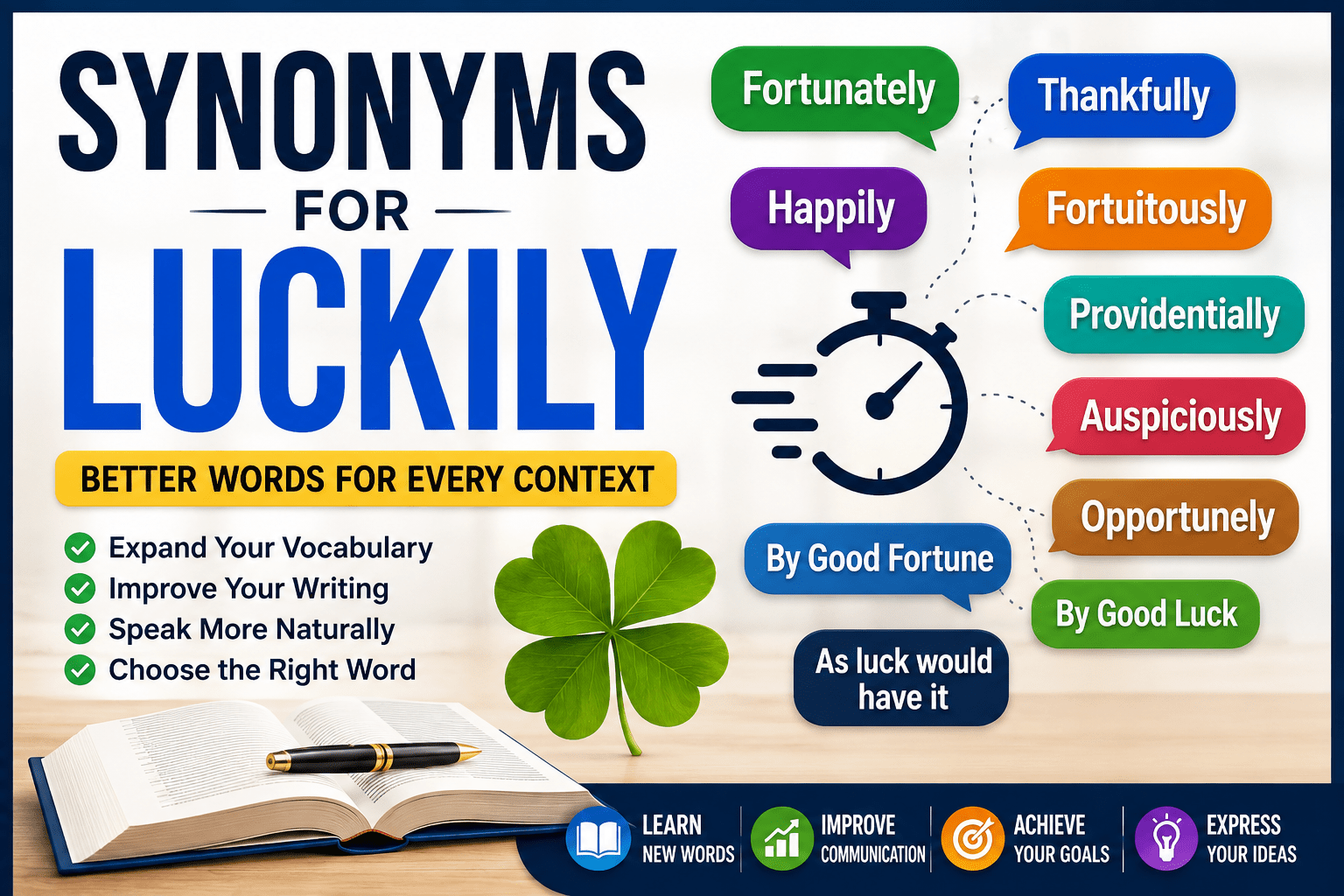
If you are looking for synonyms for luckily, the closest choices are fortunately, thankfully, happily, fortuitously, and providentially. However, these words are not interchangeable in every sentence. Fortunately is the safest general replacement, while thankfully adds a sense of relief or gratitude and fortuitously emphasizes a favorable result that happened by chance.
Understanding these distinctions matters because luckily is an adverb with a specific function: it tells the reader that a favorable situation happened because of good luck. Cambridge defines luckily as meaning “because of good luck” and lists fortunately as its direct synonym.
Quick Answer
The closest synonyms for luckily are fortunately, thankfully, happily, fortuitously, and providentially. Fortunately is the most direct and widely useful alternative. Use thankfully when you want to express relief or gratitude, fortuitously when something favorable happens by chance, and happily when the result is fortunate as well as pleasing.
Table of Contents
- What Does “Luckily” Mean?
- Best Synonyms for Luckily
- Closest Synonyms
- Contextual Alternatives
- Formal Alternatives
- Luckily vs. Fortunately vs. Thankfully
- Which Word Should You Use?
- Common Mistakes
- Examples in Real-World Contexts
- Antonyms
- FAQ
- Conclusion
What Does “Luckily” Mean?
Luckily is an adverb meaning because of good luck or fortune.
Luckily, nobody was injured in the accident.
The sentence means that the favorable outcome was due to good luck.
Cambridge classifies luckily as a B1 adverb and gives fortunately as a synonym. Merriam-Webster similarly defines it as “in a lucky manner” and “fortunately.”
Part of speech
- luck — noun
- lucky — adjective
- luckily — adverb
- luckiness — noun
Common position in a sentence
Luckily commonly appears at the beginning of a sentence:
Luckily, we arrived before the store closed.
It can also appear before the main verb:
We luckily arrived before the store closed.
Or after the subject:
We luckily found a parking space.
The first position is particularly natural when luckily comments on the entire situation.
Pronunciation
Luckily
US: /ˈlʌk.ə.li/
UK: /ˈlʌk.ə.li/
Cambridge gives the same basic pronunciation for both major varieties of English.
Best Synonyms for Luckily
Here are the strongest alternatives, organized by how closely they match the meaning of luckily.
| Word or phrase | Relationship | Strength | Formality | Best context |
|---|---|---|---|---|
| Fortunately | Direct synonym | Equal | Neutral-formal | General writing and speech |
| Thankfully | Near synonym | Equal | Neutral | Relief or gratitude |
| Happily | Near synonym | Moderate | Neutral-literary | Favorable outcome |
| Fortuitously | Contextual alternative | Strong | Formal | Favorable chance |
| Providentially | Contextual alternative | Strong | Formal/literary | Fate or divine guidance |
| Auspiciously | Contextual alternative | Moderate | Formal | Favorable signs or beginnings |
| Opportunely | Contextual alternative | Moderate | Formal | Favorable timing |
| Favorably | Contextual alternative | Moderate | Formal | Advantageous circumstances |
| By good fortune | Contextual equivalent | Equal | Neutral-formal | Explicitly emphasizing luck |
| By good luck | Contextual equivalent | Equal | Neutral | Everyday English |
| As luck would have it | Idiomatic alternative | Equal | Neutral | Unexpected coincidence |
| Serendipitously | Contextual alternative | Strong | Formal | Fortunate accidental discovery |
The first two are especially important. Cambridge directly identifies fortunately as a synonym for luckily, while its thesaurus groups words such as happily, auspiciously, favorably, opportunely, and providentially as related alternatives. Merriam-Webster’s current thesaurus also places fortunately and thankfully at the top of its synonym results.
Closest Synonyms for Luckily
1. Fortunately
Relationship: Direct synonym
Meaning: In a fortunate or favorable way; because of good luck.
How it differs: Very little. In many sentences, fortunately can replace luckily without changing the meaning.
Best used for: Almost any context where luckily would be appropriate.
Fortunately, we had enough food for everyone.
Luckily, we had enough food for everyone.
Both sentences communicate essentially the same idea.
Cambridge explicitly defines fortunately as something happening because of good luck and lists luckily as its synonym.
Best overall replacement: Fortunately
2. Thankfully
Relationship: Near synonym
Meaning: Fortunately, with an additional sense of relief or gratitude.
Thankfully, nobody was hurt.
This sentence does more than report good luck. It also conveys the speaker’s relief or gratitude.
Cambridge defines thankfully as an adverb used to show that someone is happy or grateful about something.
Compare:
Luckily, nobody was injured.
Thankfully, nobody was injured.
The first emphasizes fortunate circumstances. The second more clearly expresses relief.
Best used for: Accidents, problems, dangers, close calls, and situations where the speaker feels relieved.
3. Happily
Relationship: Near synonym
Meaning: In a fortunate or pleasing way.
Happily, the problem was resolved before the deadline.
In this use, happily can mean fortunately, but it also has a separate meaning connected with happiness.
That makes it less precise than fortunately.
Best used for: Literary writing, storytelling, and situations where the favorable result is also pleasing.
Contextual Alternatives
4. Fortuitously
Relationship: Contextual alternative
Meaning: In a way that happens by chance and turns out to be advantageous.
Fortuitously, we met the consultant at the conference.
This is more specific than luckily. The favorable outcome results from chance, and that chance has an advantage.
Cambridge labels fortuitously as formal and defines it as happening by chance rather than being planned, while being advantageous.
Use it when:
You want to emphasize fortunate coincidence.
Don’t use it simply as a fancy replacement for “luckily.”
For example:
Luckily, I remembered my keys.
is natural.
Fortuitously, I remembered my keys.
is possible but unnecessarily formal and changes the emphasis.
5. Providentially
Relationship: Contextual alternative
Meaning: In a way that appears fortunate because of providence or a guiding force.
Providentially, help arrived just when we needed it.
This word has a stronger religious, philosophical, or literary flavor than luckily.
It is therefore not a general everyday synonym.
Best used for: Formal, literary, religious, or philosophical writing.
6. Auspiciously
Relationship: Contextual alternative
Meaning: In a way that suggests a favorable future or good outcome.
The project began auspiciously with strong support from investors.
Auspiciously is about favorable signs or circumstances, not simply being lucky.
That distinction makes it unsuitable for many ordinary luckily sentences.
7. Opportunely
Relationship: Contextual alternative
Meaning: At a particularly suitable or advantageous time.
Opportunely, the manager arrived just as the discussion began.
The focus here is timing, not luck itself.
Use opportunely when something happens at exactly the right moment.
8. Favorably
Relationship: Contextual alternative
Meaning: In an advantageous or positive way.
The proposal was favorably received by the committee.
This does not mean exactly the same thing as luckily. It emphasizes a positive outcome or reception, not necessarily good luck.
Therefore, treat it as a contextual alternative rather than a direct synonym.
Idiomatic Alternatives to Luckily
9. By Good Luck
This phrase directly expresses the role of luck.
By good luck, we found the missing documents.
It is understandable and useful when you want to explicitly mention luck, although luckily or fortunately is often more natural in ordinary conversation.
10. By Good Fortune
By good fortune is slightly more polished.
By good fortune, the family had already left the building.
It works particularly well in formal or narrative writing.
The phrase focuses on a favorable result caused by fortune.
11. As Luck Would Have It
This is a natural idiomatic expression for an unexpected coincidence.
As luck would have it, I happened to sit next to an old friend.
It often introduces an event that happened unexpectedly and conveniently.
This expression is more stylistically distinctive than simply replacing luckily with another adverb.
12. Serendipitously
Serendipitously means that something fortunate happened accidentally or unexpectedly, especially when an unexpected discovery or connection proves useful.
We serendipitously discovered a small restaurant that became our favorite.
It is not a universal synonym for luckily. Its distinctive feature is fortunate accidental discovery or coincidence.
Use it when the accidental nature of the event matters.
Formal Alternatives to Luckily
If you are writing an academic, professional, literary, or formal text, these options may be appropriate depending on the intended meaning:
- Fortunately
- Fortuitously
- Providentially
- Auspiciously
- Opportunely
- By good fortune
However, formal writing does not automatically require a more complicated synonym.
In many professional contexts, fortunately is perfectly natural:
Fortunately, the issue was resolved before the meeting.
Replacing it with providentially simply to sound sophisticated would make the sentence less natural.
Casual Alternatives to Luckily
In everyday conversation, these expressions are especially natural:
- Luckily
- Fortunately
- Thankfully
- Good thing…
- As luck would have it
- By good luck
Examples:
Luckily, I brought an umbrella.
Thankfully, nobody was hurt.
Good thing I checked the address.
The last expression is not a direct grammatical synonym, but it communicates a similar idea in casual speech.
Luckily vs. Fortunately
These two words are the closest pair.
| Luckily | Fortunately |
| Everyday and natural | Slightly more polished |
| Strongly associated with luck | Associated with a fortunate outcome |
| Common in speech | Common in speech and writing |
| Informal-neutral | Neutral to formal |
Compare:
Luckily, the train was still there.
Fortunately, the train was still there.
Both are natural.
Which should you choose?
Use luckily for a straightforward, conversational tone.
Use fortunately when you want a slightly more polished expression, particularly in formal writing.
Neither is inherently “better.”
Luckily vs. Thankfully
This distinction is important.
Luckily
Focuses on good luck.
Luckily, we found a doctor quickly.
Thankfully
Focuses more on relief or gratitude.
Thankfully, the injury wasn’t serious.
A useful rule:
Luck → luckily
Relief/gratitude → thankfully
Sometimes both are possible, but they create a slightly different emotional effect.
Luckily vs. Fortuitously
Luckily
Broad and everyday.
Luckily, I found my wallet.
Fortuitously
More formal and emphasizes favorable chance.
Fortuitously, the two researchers met at the conference.
Fortuitously is especially useful when the event was unplanned but advantageous. Cambridge specifically describes it in terms of something happening by chance and being to someone’s advantage.
Which Word Should I Use?
Use “fortunately” when:
You want the closest general synonym.
Fortunately, everyone arrived safely.
Use “thankfully” when:
You want to communicate relief or gratitude.
Thankfully, the storm passed without causing major damage.
Use “fortuitously” when:
A favorable result happened by chance.
Fortuitously, the two experts happened to meet.
Use “happily” when:
The outcome is fortunate and pleasing, especially in literary or narrative writing.
Happily, the missing child was found safe.
Use “providentially” when:
You want a literary, religious, or fate-oriented nuance.
Providentially, help arrived at exactly the right moment.
Use “opportunely” when:
The timing is particularly advantageous.
Opportunely, the director arrived before the meeting began.
Use “as luck would have it” when:
You want to emphasize an unexpected coincidence.
As luck would have it, we had booked the last available room.
Synonym Strength and Nuance
These labels are editorial guidance rather than scientific measurements.
| Word | Approximate closeness | Main nuance |
| Fortunately | Very high | Good fortune |
| Thankfully | High | Relief or gratitude |
| Happily | Moderate | Favorable/pleasing result |
| Fortuitously | Moderate | Favorable chance |
| By good fortune | High | Explicit good fortune |
| By good luck | High | Explicit good luck |
| As luck would have it | High | Unexpected coincidence |
| Providentially | Moderate | Providence/fate |
| Auspiciously | Lower | Favorable signs |
| Opportunely | Lower | Favorable timing |
| Favorably | Lower | Positive outcome |
| Serendipitously | Context-specific | Fortunate accidental discovery |
The table illustrates why a long list of thesaurus entries can be misleading: some words preserve the core idea of good luck, while others overlap only in particular situations.
Natural Examples in Real-World Contexts
Everyday Conversation
Luckily, I remembered to charge my phone.
Fortunately, we caught the last bus.
Thankfully, I had some cash with me.
Workplace
Fortunately, the client approved the revised proposal.
Thankfully, the technical issue was resolved before the presentation.
Fortuitously, we found an experienced candidate through a professional contact.
Academic Writing
Fortunately, the researchers had access to the necessary data.
Fortuitously, the two studies produced complementary results.
In academic writing, fortunately is generally safer than a highly literary alternative.
Storytelling
Luckily, she noticed the warning sign in time.
As luck would have it, an old friend happened to be nearby.
Happily, the story ended without further complications.
Common Mistakes
1. Treating “thankfully” as identical to “luckily”
They overlap, but thankfully often expresses relief or gratitude.
Thankfully, nobody was injured.
sounds more emotionally relieved than:
Luckily, nobody was injured.
2. Using “fortuitously” everywhere
Fortuitously is formal and specifically emphasizes a favorable event occurring by chance.
Do not replace every occurrence of luckily with it.
Luckily, I remembered my password.
is much more natural than:
Fortuitously, I remembered my password.
3. Assuming “happily” always means “luckily”
Happily has several meanings. It can mean in a happy manner as well as fortunately in certain contexts.
She smiled happily.
Here, it does not mean luckily.
4. Confusing “opportunely” with “fortunately”
Opportunely emphasizes good timing.
Opportunely, the manager arrived.
It does not necessarily imply that the event was the result of luck.
5. Using unnecessarily fancy vocabulary
A more formal word is not automatically a better word.
Fortunately, the problem was solved.
is clear and professional.
Providentially, the problem was solved.
introduces an additional idea about providence or fate.
Choose precision over vocabulary complexity.
Antonyms of Luckily
The most direct opposites include:
- Unfortunately
- Unluckily
- Sadly — in some contexts
- Regrettably — when expressing an undesirable outcome
- Unfavorably — in certain contexts
The strongest direct antonym is usually unfortunately.
Cambridge lists unfortunately as the opposite of luckily, while Merriam-Webster gives unluckily as a synonym of unfortunately.
Compare:
Luckily, nobody was hurt.
Unfortunately, someone was injured.
FAQ
What is another word for luckily?
The closest general alternative is fortunately. Other options include thankfully, happily, fortuitously, and by good fortune, depending on the context.
What is the closest synonym for luckily?
Fortunately is the closest and most broadly interchangeable synonym. Cambridge explicitly lists fortunately as a synonym of luckily.
What is a formal synonym for luckily?
Fortunately is the safest formal alternative. Fortuitously and providentially can also work in specialized contexts, but they add specific nuances.
What is a professional alternative to luckily?
Fortunately is usually the best choice in professional writing.
Fortunately, the issue was resolved before the deadline.
It is clear, natural, and appropriately neutral.
Is thankfully the same as luckily?
Not exactly. Thankfully usually adds an idea of relief or gratitude, whereas luckily primarily emphasizes good luck.
What is the difference between luckily and fortunately?
They are extremely close. Luckily is slightly more conversational, while fortunately often sounds more polished and works especially well in formal writing.
What is the difference between luckily and fortuitously?
Luckily broadly means because of good luck. Fortuitously specifically emphasizes that something favorable happened by chance.
What is the opposite of luckily?
The most direct opposite is unfortunately. Unluckily is also an antonym, although it is less common in everyday English.
Conclusion
The best synonym for luckily is usually fortunately because it preserves the original meaning with very little change. Thankfully is better when the sentence expresses relief or gratitude, while fortuitously is appropriate when a favorable outcome happens by chance. Happily, providentially, opportunely, and auspiciously can work in narrower contexts but should not be treated as universal replacements.
For everyday English, keep it simple: luckily and fortunately are usually the strongest choices. Choose a more specialized alternative only when its additional nuance actually matters.

Michael Thompson is an English language specialist and experienced editor who focuses on vocabulary development and clear communication. He creates high-quality synonym guides, word comparisons, and writing tips to help students and professionals express their ideas more effectively. His work combines linguistic knowledge with practical SEO strategies to make learning both useful and engaging.