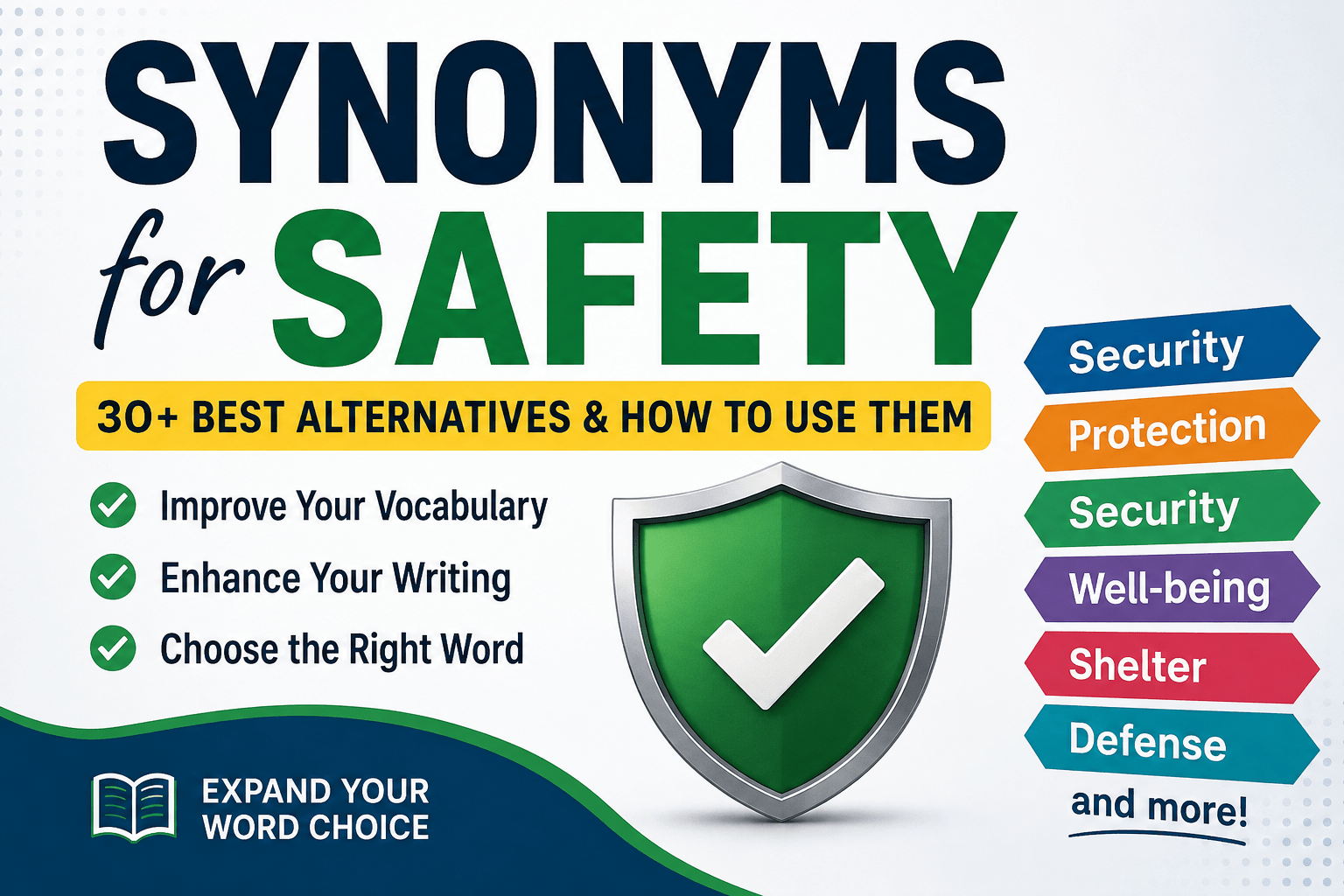
When you need another word for safety, the best choice depends on what you mean by it. Security is often the closest alternative when you mean freedom from danger or protection from threats. Protection emphasizes something that keeps a person or thing safe, while refuge, shelter, and sanctuary refer more specifically to a safe place.
This distinction matters because not every word associated with safety is interchangeable with safety. The right synonym depends on whether you are talking about physical protection, personal well-being, a secure environment, or a place of refuge.
Quick Answer
The closest synonyms of safety include security, protection, safeness, defense, refuge, shelter, sanctuary, safeguard, immunity, and haven. However, they are not exact substitutes in every sentence. Security is usually the closest general alternative, protection emphasizes defense from harm, and refuge, shelter, and sanctuary usually describe a place or condition offering safety.
Table of Contents
- What Does “Safety” Mean?
- Best Synonyms of Safety
- Closest Synonyms
- Context-Specific Alternatives
- Safety Synonyms by Context
- Safety vs. Security
- Safety vs. Protection
- Common Mistakes
- Antonyms of Safety
- Frequently Asked Questions
- Conclusion
What Does “Safety” Mean?
Safety is a noun meaning the state or condition of being protected from danger, injury, harm, or unwanted risk.
For example:
The children were moved to a place of safety.
Passenger safety is the airline’s highest priority.
We are concerned about the safety of the workers.
The word can refer to physical well-being, protection from danger, or a condition in which harmful consequences are unlikely.
It can also have specialized meanings. For example, safety can refer to a protective mechanism or device designed to prevent accidental operation, as in the safety on a firearm. Merriam-Webster treats this as a separate sense from the general condition of being safe.
Pronunciation
- US: /ˈseɪfti/
- UK: /ˈseɪfti/
Best Synonyms of Safety
Not all of the following words are interchangeable in every sentence. They represent direct, near, or contextual alternatives.
| Word | Relationship | Strength | Formality | Best Context |
|---|---|---|---|---|
| Security | Near/direct synonym | Strong | Neutral–formal | Protection from danger or threat |
| Protection | Near synonym | Strong | Neutral–formal | Defense against harm |
| Safeness | Direct synonym | Neutral | Neutral | General state of being safe |
| Defense | Contextual alternative | Strong | Neutral–formal | Protection against attack or harm |
| Refuge | Contextual alternative | Strong | Neutral–formal | A safe place from danger |
| Shelter | Contextual alternative | Strong | Neutral | Protection or a place of safety |
| Sanctuary | Contextual alternative | Strong | Neutral–formal | Protected or safe place |
| Haven | Contextual alternative | Strong | Neutral–literary | Peaceful place of safety |
| Safeguard | Contextual alternative | Strong | Formal | Something that prevents harm |
| Shield | Contextual alternative | Strong | Neutral | Protection from a threat |
| Guard | Contextual alternative | Strong | Neutral | Protective action or person |
| Immunity | Contextual alternative | Specific | Formal/technical | Protection from a particular harm |
| Assurance | Near synonym | Moderate | Formal | Confidence that something is safe |
| Well-being | Near synonym | Moderate | Neutral | General personal welfare |
| Cover | Contextual alternative | Moderate | Neutral | Protection or concealment |
| Harbor / Harbour | Contextual alternative | Strong | Neutral–literary | A place offering protection |
| Retreat | Contextual alternative | Moderate | Neutral | A place away from danger |
| Asylum | Contextual alternative | Strong | Formal | Protection or refuge, especially from persecution |
| Aegis | Contextual alternative | Strong | Formal/literary | Protection or sponsorship |
| Inviolability | Near synonym | Very strong | Formal | State of being protected from violation |
Major dictionaries and thesauruses similarly group words such as security, protection, safeness, defense, refuge, shelter, and sanctuary with safety, while distinguishing different senses.
Closest Synonyms of Safety
1. Security
Meaning: A state of being protected from danger, threat, or loss.
How it differs: Security overlaps heavily with safety, but it often emphasizes protection against threats, intrusion, instability, or loss.
Best used for: Personal security, national security, financial security, data security, and secure environments.
Example:
The new system was designed to improve passenger security.
Best replacement: When safety means protection from threats or danger, security is often the most natural alternative.
2. Protection
Meaning: The act or condition of keeping someone or something safe from harm.
How it differs: Protection focuses more on the means or action of keeping something safe, whereas safety usually describes the resulting condition.
Example:
The helmet provides protection against serious head injuries.
You can say:
The workers’ safety is our priority.
But:
The equipment provides workers’ protection.
sounds less natural in many contexts. The phrase protection for workers would usually be better.
3. Safeness
Meaning: The condition of being safe.
How it differs: It is one of the closest literal alternatives to safety, but it is considerably less common in everyday English.
Example:
The study examined the safeness of the procedure.
For most general writing, safety remains the more natural choice.
4. Defense / Defence
Meaning: Protection against attack, injury, or harm.
How it differs: Defense usually implies an active response or protective system rather than simply being free from danger.
Example:
The walls provided a strong defense against the storm.
Use defense when the idea of actively resisting a threat matters.
5. Refuge
Meaning: A place or condition that provides protection from danger or difficulty.
Example:
The hikers found refuge from the storm in a nearby cabin.
Refuge is particularly useful when safety means a place where someone can escape danger.
6. Shelter
Meaning: Protection from danger, weather, or difficult conditions; it can also mean a place that provides such protection.
Example:
The families were taken to a shelter for their safety.
Unlike safety, shelter commonly refers to a physical place or structure.
7. Sanctuary
Meaning: A protected or safe place.
Example:
The wildlife sanctuary provides a safe environment for endangered animals.
Sanctuary often carries an additional sense of protection, peace, or freedom from interference.
8. Haven
Meaning: A safe, peaceful place.
Example:
The small village became a haven for people fleeing the conflict.
Haven is more evocative than safety and often emphasizes a place offering peace and security.
9. Safeguard
Meaning: Something that protects against harm, danger, or loss.
Example:
Regular backups are an important safeguard against data loss.
A key distinction is grammatical: safeguard usually names a protective measure, not simply the condition of being safe.
10. Immunity
Meaning: Protection from a particular disease, effect, or consequence.
Example:
Vaccination can provide immunity against certain diseases.
Do not use immunity as a general replacement for safety. It is appropriate only when protection from a specific harmful effect is intended.
Context-Specific Alternatives to Safety
When You Mean “A Safe Place”
Use:
- refuge
- shelter
- sanctuary
- haven
- retreat
- asylum
Example:
The refugees finally found shelter from the violence.
Here, safety describes the condition, while shelter identifies the place providing it.
When You Mean “Protection”
Use:
- protection
- defense
- shield
- guard
- safeguard
- cover
Example:
The new regulations provide greater protection for employees.
When You Mean “Freedom From Threat”
Use:
- security
- safeness
- protection
- immunity
Example:
The company strengthened its cybersecurity measures to improve data security.
When You Mean “Personal Welfare”
Use:
- well-being
- security
- protection
Example:
The organization is responsible for the health and well-being of its staff.
Best Safety Synonyms for Different Contexts
| Context | Best Word | Why |
| Workplace | safety | Standard term for preventing injury |
| Cybersecurity | security | Focuses on threats, unauthorized access, and protection |
| Physical injury | protection | Emphasizes prevention of harm |
| Safe place | refuge / shelter | Refers to a place offering safety |
| Peaceful protected place | sanctuary / haven | Adds a sense of refuge or peace |
| Disease protection | immunity | Specific protection against disease |
| Protective measure | safeguard | Identifies a measure that prevents harm |
| Personal welfare | well-being | Broader than physical safety |
| Military protection | defense | Emphasizes resistance to attack |
| Financial stability | security | Refers to freedom from financial uncertainty |
Difference Between Safety and Security
Safety and security overlap, but they are not always interchangeable.
Safety generally concerns protection from accidents, injury, physical harm, or dangerous conditions.
Security often concerns protection from threats, crime, unauthorized access, attack, loss, or instability.
Compare:
The factory improved safety procedures to reduce workplace injuries.
The building improved security to prevent unauthorized entry.
There are contexts where the two overlap, which is why dictionaries list security among the principal synonyms of safety.
Simple rule
Safety = protection from harm or danger.
Security = protection from threats, intrusion, loss, or uncertainty.
The distinction is not absolute, however; context determines the most natural choice.
Safety vs. Protection
These words are closely related but have different grammatical and semantic focuses.
Safety is the condition of being safe.
Protection is the act, process, or means of keeping something safe.
Compare:
The company takes employee safety seriously.
The company provides protection against workplace hazards.
The first emphasizes the desired condition. The second emphasizes what prevents harm.
Safety vs. Refuge vs. Shelter
These words become especially important when describing a place.
- Safety = the condition of being protected from danger
- Refuge = a place or condition where someone escapes danger
- Shelter = a place or covering that provides protection
- Sanctuary = a protected place, often suggesting peace or freedom from interference
- Haven = a safe, peaceful place
For example:
They escaped to safety.
They found refuge in the mountains.
They took shelter from the storm.
The animals were moved to a sanctuary.
The island became a haven for displaced families.
These words are related, but replacing one with another can change the meaning.
Synonyms of Safety: How to Choose the Right Word
Use security when you mean protection from threats or danger.
Turn to refuge when someone escapes to a safe place.
Choose refuge when someone escapes to a safe place.
Use shelter when referring to a place or structure that protects someone.
Reserve immunity for protection from a particular disease, substance, or effect.
Use safeguard when referring to a specific measure designed to prevent harm.
Select sanctuary when the idea of a protected, peaceful place matters.
Consider haven when you want a warmer or more literary expression for a safe place.
Common Mistakes With Safety Synonyms
Mistake 1: Treating every related word as an exact synonym
Words such as shelter, safeguard, and immunity are related to safety but cannot replace it in every sentence.
Better approach: Identify the exact meaning you want before choosing the alternative.
Mistake 2: Using “security” everywhere
Although security is a major synonym of safety, it is not always the natural replacement.
Workplace safety is essential.
Changing this to:
Workplace security is essential.
can shift the meaning toward protection from crime, threats, or unauthorized activity.
Mistake 3: Using “safeness” in ordinary writing
Safeness is understandable and recognized as a synonym, but safety is far more idiomatic in most everyday and professional contexts. Cambridge and Merriam-Webster both list safeness among related synonyms.
Mistake 4: Confusing a safe place with safety itself
The refugees found safety.
The refugees found shelter.
Both can be correct, but the first emphasizes their condition; the second emphasizes the place or protection they found.
Natural Collocations With Safety
Common expressions include:
- public safety
- personal safety
- workplace safety
- road safety
- food safety
- fire safety
- passenger safety
- child safety
- safety measures
- safety standards
- safety regulations
- safety precautions
- safety concerns
- safety procedures
- safety equipment
- safety requirements
In these established phrases, replacing safety with a synonym is often unnatural.
For example, food safety is the standard expression; food security has a different meaning, generally concerning reliable access to sufficient food.
This is an important reason not to treat thesaurus lists as interchangeable word lists.
Antonyms of Safety
Common antonyms and semantic opposites include:
- danger
- risk
- peril
- jeopardy
- hazard
- insecurity
- vulnerability
- precariousness
- endangerment
Collins lists several of these—including risk, peril, vulnerability, insecurity, and jeopardy—as opposites or near-opposites of safety.
Frequently Asked Questions
What is another word for safety?
The closest general alternatives include security, protection, safeness, and defense. The best choice depends on the intended context.
What is the closest synonym for safety?
Security is often the closest general synonym, although the two words can emphasize different kinds of protection. Safeness is also a very close literal equivalent but is much less common.
What is a formal synonym for safety?
Depending on context, security, protection, safeguarding, or inviolability can work in formal writing. However, safety itself is often the clearest and most professional choice.
What is another word for a safe place?
Good alternatives include refuge, shelter, sanctuary, haven, retreat, and asylum. The most suitable word depends on the nature of the place and the reason it provides protection.
Are safety and security synonyms?
They overlap but are not exact synonyms in every context. Safety commonly concerns freedom from physical harm or danger, while security often emphasizes protection from threats, intrusion, crime, loss, or instability.
What is a synonym for safety at work?
In most workplace contexts, protection or security may describe particular aspects of safety, but workplace safety remains the standard phrase. Replacing safety indiscriminately can change the meaning.
What is the difference between safety and protection?
Safety describes a condition of being protected from harm, while protection generally refers to the act, process, or means of preventing harm.
What is the opposite of safety?
Common opposites include danger, risk, peril, hazard, jeopardy, insecurity, and vulnerability.
Conclusion
The best synonyms of safety depend on the meaning you want to emphasize. Security is a strong general alternative, while protection focuses on preventing harm. Refuge, shelter, sanctuary, and haven are better when safety refers to a place of protection. Safeguard describes a protective measure, while immunity is appropriate only for specific forms of protection.
For clear English, do not replace safety simply because another word appears in a thesaurus. Choose the alternative that preserves the exact meaning, context, tone, and collocation you need.

Emily Johnson is a linguistics graduate and vocabulary specialist. She writes detailed synonym explanations and helps readers understand subtle differences between words, improving both writing and speaking skills. Synonyms help express ideas more clearly and precisely in English.