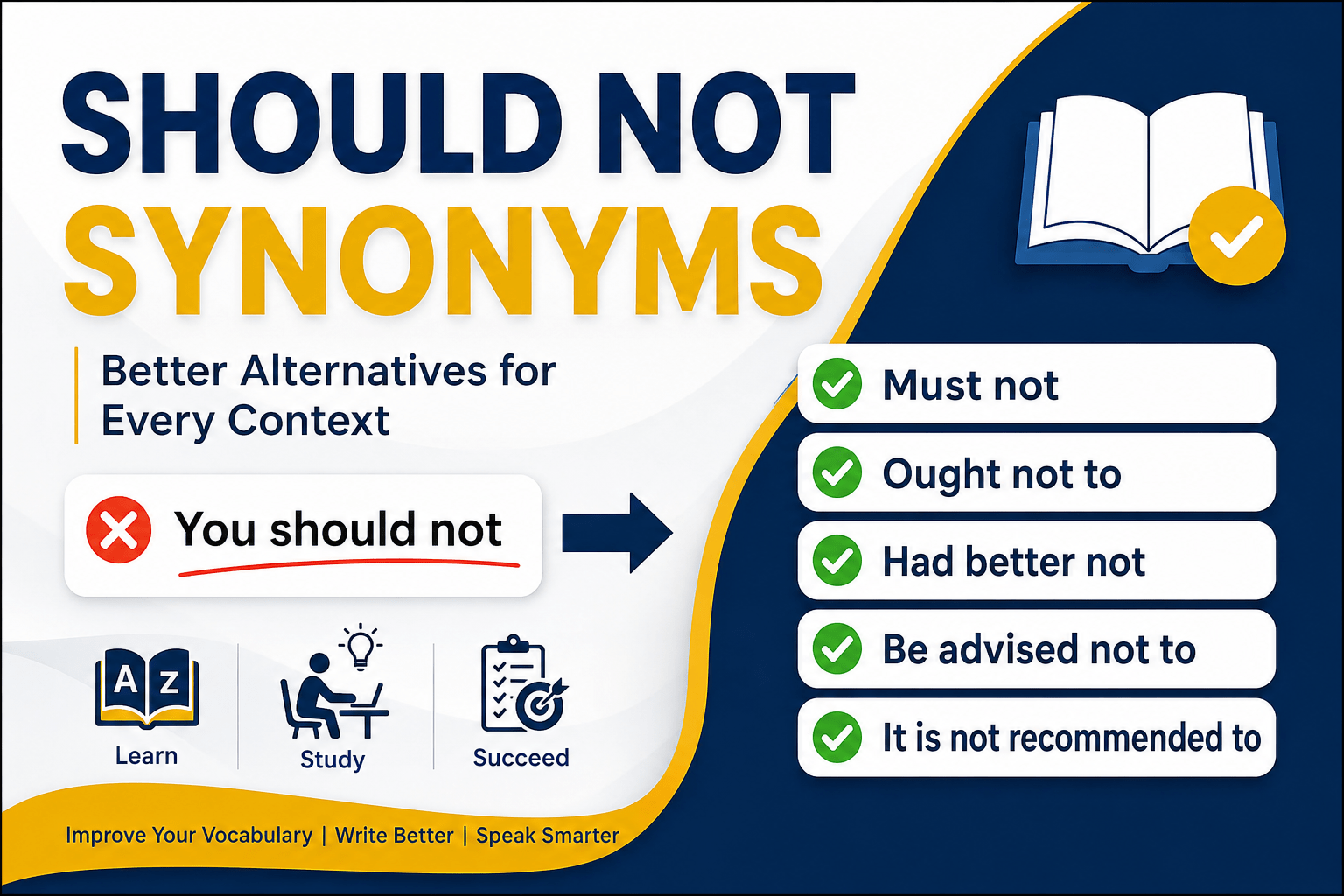
If you need a synonym for “should not,” the best alternative depends on what you mean. Must not is stronger and expresses prohibition; ought not is a close alternative that usually sounds more formal; may not can express prohibition or lack of permission; and phrases such as is not permitted to are useful in rules and professional writing. The key is not simply finding another phrase, but choosing one that preserves the intended level of advice, obligation, permission, or prohibition.
Quick Answer: What Are the Best Synonyms for “Should Not”?
The closest alternatives to should not include:
- ought not — closest modal alternative
- must not — stronger, expressing prohibition or strict necessity
- may not — often expresses prohibition or lack of permission
- shall not — formal, especially in rules, regulations, and legal language
- had better not — strong advice or warning
- better not — informal advice or warning
- is not advisable — formal and less direct
- is not recommended — professional and neutral
- it not permitted — clear statement of prohibition
- is prohibited — formal and authoritative
- is forbidden — strong prohibition
- is not allowed — straightforward prohibition
- is unacceptable — expresses disapproval rather than simply advice
- avoid — concise alternative when giving instructions
- refrain from — formal instruction to avoid an action
The important distinction is that these expressions are not interchangeable in every sentence.
What Does “Should Not” Mean?
Should not is the negative form of the modal verb should. Its contraction is shouldn’t. Cambridge defines should as a modal used, among other things, to discuss what is correct or best to do, while shouldn’t is the short form of should not.
For example:
You should not ignore the warning.
This normally gives advice or indicates that ignoring the warning would be inappropriate.
Another example:
The report should not contain personal information.
Depending on context, this can express an expectation, recommendation, or rule.
That flexibility is why replacing should not with a stronger word such as must not can change the meaning.
Core “Should Not” Synonyms and Alternatives
| Word or phrase | Relationship | Force | Formality | Best context |
|---|---|---|---|---|
| ought not | Near synonym | Similar | Formal | Advice, moral judgment |
| must not | Near synonym | Much stronger | Neutral–formal | Rules, prohibition |
| may not | Contextual alternative | Strong | Formal | Permission, regulations |
| shall not | Contextual alternative | Strong | Formal/legal | Rules, contracts |
| had better not | Contextual alternative | Strong warning | Neutral | Advice, warnings |
| better not | Contextual alternative | Strong warning | Informal | Conversation |
| is not advisable | Contextual alternative | Moderate | Formal | Professional writing |
| is not recommended | Contextual alternative | Moderate | Formal/neutral | Advice, guidance |
| is not permitted | Contextual alternative | Strong | Formal | Rules and policies |
| is prohibited | Contextual alternative | Very strong | Formal | Regulations |
| is forbidden | Contextual alternative | Very strong | Formal/neutral | Prohibitions |
| is not allowed | Contextual alternative | Strong | Neutral | Rules and everyday language |
| is unacceptable | Contextual alternative | Strong disapproval | Formal/neutral | Conduct and standards |
| avoid | Instructional alternative | Moderate–strong | Neutral | Instructions |
| refrain from | Instructional alternative | Moderate | Formal | Professional writing |
1. Ought Not
Ought not is probably the closest grammatical alternative to should not.
Example
You should not ignore your responsibilities.
You ought not to ignore your responsibilities.
The meanings are very similar. However, ought to is generally more formal and less common than should, and its negative form is especially uncommon compared with shouldn’t. Cambridge specifically notes that ought to and should have similar meanings, but should is much more common in negative statements and questions.
Best for: formal advice, moral judgment, and carefully written prose.
2. Must Not
Must not is one of the most useful alternatives, but it is not an exact synonym.
Compare:
You should not enter this room.
You must not enter this room.
The first can sound like advice or an instruction. The second normally communicates a much stronger prohibition.
Use “must not” when:
- something is prohibited a rule must be followed an action is unacceptable under the circumstances you want to emphasize necessity
Example:
Employees must not share confidential information.
Do not automatically replace every instance of should not with must not. You may unintentionally make a recommendation sound like a strict rule.
3. May Not
May not can be a useful alternative when the intended meaning involves permission.
Visitors should not enter this area.
Depending on context, this could mean entering is discouraged.
Visitors may not enter this area.
This more clearly communicates that visitors do not have permission to enter.
Because may has several modal meanings, context matters.
Best for: policies, regulations, permissions, and formal instructions.
4. Shall Not
It not is particularly associated with formal rules, regulations, contracts, and legal language.
Employees shall not disclose confidential information.
Sounds substantially more formal and authoritative than:
Employees should not disclose confidential information.
It should therefore not be treated as a universal replacement.
Best for: legal, regulatory, contractual, and institutional writing.
5. Had Better Not
Had better not gives strong advice, often with an implied negative consequence.
You should not miss the deadline.
You had better not miss the deadline.
The second sentence sounds more like a warning.
Best for: strong advice, warnings, and conversational situations.
6. Better Not
Better not is the shorter, more conversational version of had better not.
You better not tell anyone.
In standard formal writing, you had better not is safer grammatically, while better not is common in informal speech.
Best for: casual conversation.
7. Is Not Advisable
It not advisable provides a formal and relatively indirect way to express that something should not be done.
It is not advisable to share your password.
This is often more professional than:
You should not share your password.
It can be useful when you want to avoid sounding overly direct.
Best for: professional, academic, medical, technical, and advisory contexts.
8. Is Not Recommended
Is not recommended is another useful professional alternative.
You should not use this method on older equipment.
This method is not recommended for older equipment.
The second version focuses on the recommendation rather than directly instructing the reader.
Best for: manuals, reports, product guidance, professional recommendations, and technical writing.
9. Is Not Permitted
Is not permitted clearly communicates a lack of permission.
Visitors should not use the staff entrance.
Visitors are not permitted to use the staff entrance.
The second sentence is much closer to a formal rule.
Best for: policies, workplace rules, schools, facilities, and official instructions.
10. Is Prohibited
Is prohibited is stronger than should not.
Smoking should not be permitted inside the building.
Smoking is prohibited inside the building.
The second statement presents smoking as formally forbidden.
Best for: laws, regulations, policies, safety notices, and official documents.
11. Is Forbidden
Is forbidden also expresses prohibition.
Employees should not remove company equipment.
Employees are forbidden to remove company equipment.
The latter is considerably stronger and more authoritative.
Best for: explicit prohibitions, rules, and formal statements.
12. Is Not Allowed
Is not allowed is a straightforward way to express prohibition.
Students should not use phones during the examination.
Students are not allowed to use phones during the examination.
The second sentence makes the rule explicit.
Best for: everyday rules, schools, workplaces, public facilities, and general communication.
13. Is Unacceptable
Is unacceptable focuses on disapproval or violation of a standard, rather than simply advising someone not to do something.
You should not speak to customers that way.
Speaking to customers that way is unacceptable.
The second statement evaluates the behavior.
Best for: workplace standards, professional conduct, ethical discussions, and formal criticism.
14. Avoid
Avoid can replace should not when giving a concise instruction.
You should not use excessive jargon.
Avoid excessive jargon.
This is shorter and more direct.
However, the grammatical structure changes: avoid is an ordinary verb rather than a modal expression.
Best for: instructions, guides, recommendations, and educational writing.
15. Refrain From
Refrain from is a formal alternative that means to deliberately avoid doing something.
Please refrain from using your phone during the presentation.
This is particularly common in formal notices and polite instructions.
Best for: professional communication, notices, policies, and formal requests.
Which “Should Not” Alternative Should You Use?
The best choice depends on the intended meaning.
Use “ought not” when:
You want the closest formal alternative to should not.
You ought not to make assumptions.
Use “must not” when:
The action is prohibited or absolutely unacceptable.
Employees must not disclose confidential information.
Use “may not” when:
The issue is permission.
Visitors may not enter this area.
Use “shall not” when:
You are writing a formal rule, regulation, or contract.
The tenant shall not modify the property without written permission.
Use “is not advisable” when:
You want a professional and relatively indirect recommendation.
It is not advisable to make major changes without testing them first.
Use “is not recommended” when:
You are discussing professional guidance or best practice.
This procedure is not recommended for inexperienced users.
Use “is prohibited” when:
Something is officially forbidden.
Unauthorized access is prohibited.
Use “avoid” when:
You want a concise instruction.
Avoid unnecessary repetition.
Should Not vs. Must Not
This is one of the most important distinctions.
| Expression | Typical meaning | Example |
|---|---|---|
| should not | Advice or recommendation | You should not skip the introduction. |
| must not | Prohibition or strict necessity | You must not share your password. |
Should not leaves more room for judgment.
Must not presents the restriction as much stronger.
Cambridge describes should as expressing what is the correct or best thing to do, while Merriam-Webster includes obligation, propriety, and expediency among its uses.
Should Not vs. Ought Not
These two are the closest pair.
You should not ignore the evidence.
You ought not to ignore the evidence.
Both express that the action is undesirable or inappropriate.
The major difference is style. Should is considerably more common, while ought to tends to sound more formal. Cambridge notes that should is much more common in negative constructions and questions than ought to.
For most modern American English writing, should not will sound more natural.
Should Not vs. May Not
These expressions can have very different meanings.
You should not enter the laboratory.
This can mean entering is discouraged or inappropriate.
You may not enter the laboratory.
This normally communicates that you do not have permission.
Use may not when permission is the important idea.
Should Not vs. Is Not Recommended
These are often close in professional writing.
You should not install the software without backing up your files.
Installing the software without backing up your files is not recommended.
The second version sounds less like a direct command and more like professional guidance.
This makes is not recommended particularly useful in reports, manuals, technical documentation, and workplace communication.
Formal Alternatives to “Should Not”
If you are writing an essay, report, policy, or professional document, consider:
- ought not
- must not
- is not advisable
- Recommended Not
- is not permitted
- shall not
- is prohibited
- is unacceptable
- refrain from
But formal does not automatically mean better.
For example:
You should not overlook this evidence.
is often clearer than:
It is not advisable that this evidence be overlooked.
Choose the wording that communicates the idea most clearly.
Common Mistakes
Mistake 1: Treating “must not” as an exact synonym
Incorrect assumption:
should not = must not
They overlap, but must not is generally stronger.
Mistake 2: Using “may not” when you mean advice
If you mean:
It would be better not to do this.
then should not is usually more appropriate.
If you mean:
You do not have permission to do this.
then may not can be appropriate.
Mistake 3: Overusing “shall not”
“Shall not” can sound excessively legal or bureaucratic in ordinary American English.
For a normal recommendation, simply use:
You should not share this information.
rather than:
You shall not share this information.
unless the context genuinely requires formal rule-making language.
Mistake 4: Assuming “shouldn’t” is incorrect in formal English
Shouldn’t is simply the contraction of should not. Cambridge explicitly identifies shouldn’t as the short form or contraction of should not.
However, the full form should not can be preferable when you want emphasis or a more formal tone. Cambridge’s grammar guidance specifically notes that the full form is used in formal contexts or for emphasis.
Pronunciation
Should not
US IPA: /ʃʊd nɑt/
UK IPA: /ʃʊd nɒt/
Shouldn’t
US IPA: /ˈʃʊdnt/
UK IPA: /ˈʃʊdənt/
The exact pronunciation can vary slightly in connected speech.
FAQ
What is the closest synonym for “should not”?
Ought not is generally the closest modal alternative because it expresses a similar idea of what is undesirable, inappropriate, or advisable to avoid. However, ought not is more formal and less common than should not, particularly in negative constructions.
What is a stronger word than “should not”?
Must not is usually stronger. Should not commonly expresses advice or recommendation, while must not normally communicates prohibition or a strict requirement.
What is a formal way to say “should not”?
Depending on meaning, formal alternatives include ought not, is not advisable, is not recommended, is not permitted, shall not, and is prohibited. The correct choice depends on whether you mean advice, recommendation, permission, or prohibition.
Is “must not” the same as “should not”?
No. They can overlap, but must not generally expresses a stronger restriction. Compare “You should not park here” with “You must not park here.” The second sounds like a definite prohibition.
Is “ought not” a synonym for “should not”?
Yes, in many contexts. Both can express advice, propriety, or an undesirable action. However, ought not is less common and generally more formal.
What is another word for “shouldn’t” in formal writing?
Possible alternatives include ought not, is not advisable, is not recommended, or must not, depending on the intended meaning. You do not necessarily need to replace shouldn’t: should not itself is perfectly acceptable in formal writing.
Can I use “shall not” instead of “should not”?
Only when the meaning and context support it. Shall not is associated with formal rules, regulations, and legal or contractual language. It is usually too formal for an ordinary recommendation.
Conclusion
The best synonym for “should not” depends on the strength and purpose of the statement. Use ought not for a close formal alternative, must not for strong prohibition, may not for lack of permission, and is not advisable or is not recommended for professional guidance. For formal rules, shall not, is not permitted, and is prohibited may be more appropriate.
The most important lesson is simple: do not choose a synonym merely because it appears in a thesaurus. Choose the expression that preserves the original meaning, tone, and level of force.

Michael Thompson is an English language specialist and experienced editor who focuses on vocabulary development and clear communication. He creates high-quality synonym guides, word comparisons, and writing tips to help students and professionals express their ideas more effectively. His work combines linguistic knowledge with practical SEO strategies to make learning both useful and engaging.