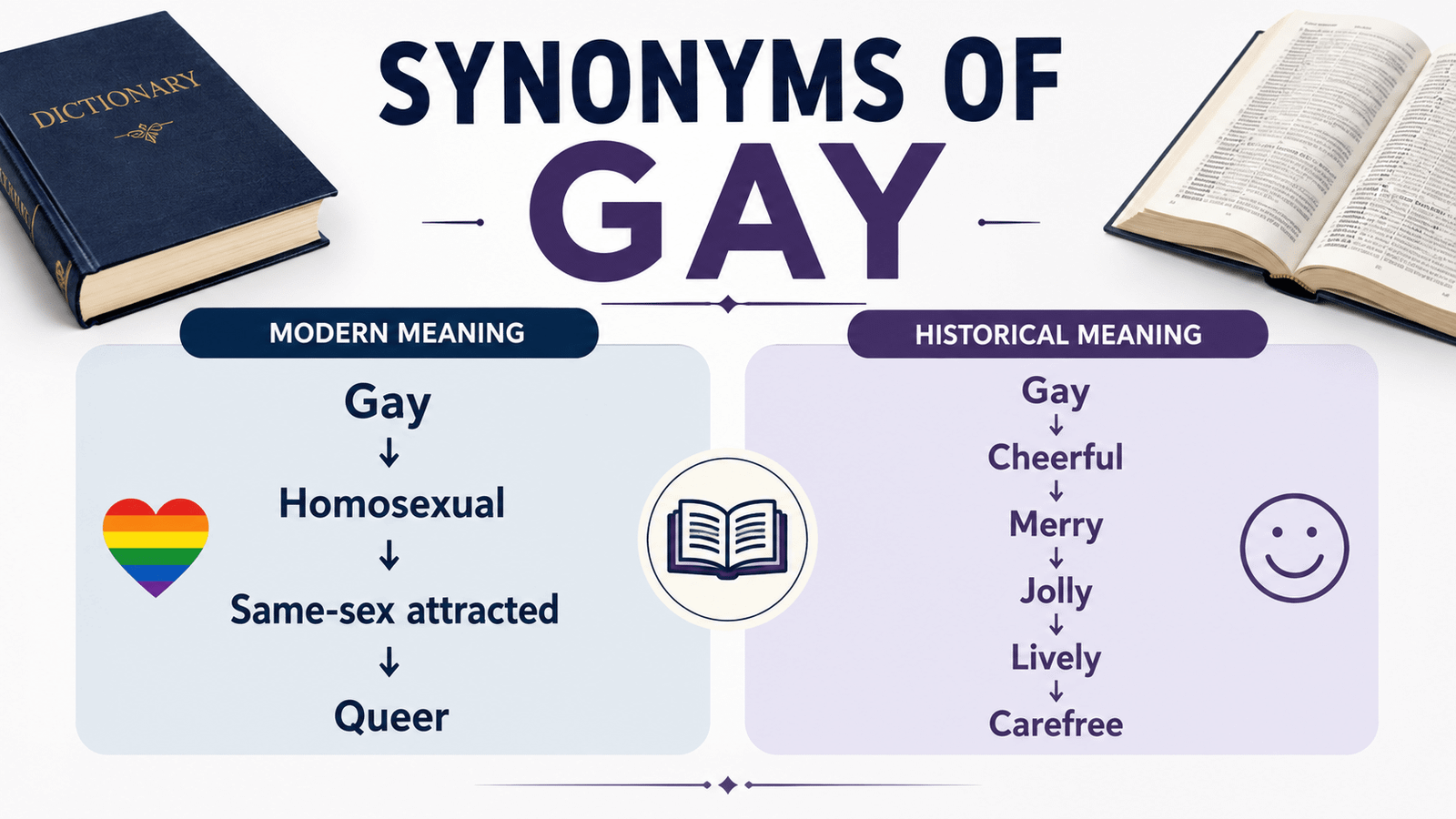
The word gay has more than one dictionary meaning, so the best synonym depends heavily on context. In modern English, gay most commonly describes someone who is sexually or romantically attracted to people of the same sex or gender. In older or literary usage, it can mean cheerful, merry, carefree, lively, or brightly colored.
That distinction matters because words such as homosexual, queer, cheerful, and merry are not interchangeable in every sentence. This guide separates the meanings and shows which alternatives are accurate, formal, casual, old-fashioned, or context-specific.
Quick Answer: What Are the Synonyms of Gay?
For the modern sexuality-related meaning, homosexual is the closest conventional synonym, although gay is generally the more common everyday identity term. Queer can overlap with gay but is broader and should not automatically be treated as an exact synonym. Lesbian is not a general synonym because it specifically refers to women attracted to women.
For the older meaning of gay as cheerful or carefree, useful alternatives include cheerful, happy, merry, joyful, jolly, lively, light-hearted, carefree, and festive. Older dictionaries also record gay as meaning brightly colored or showy.
Core Synonyms of Gay by Meaning
| Word | Relationship | Meaning | Register | Best Context |
|---|---|---|---|---|
| Homosexual | Closest conventional synonym | Sexually attracted to the same sex | Formal/clinical | Definitions, academic or medical contexts |
| Queer | Near synonym / broader identity term | An umbrella term for diverse sexual and gender identities | Identity-based, context-dependent | LGBTQ+ identity and community contexts |
| Same-sex attracted | Contextual alternative | Attracted to people of the same sex | Neutral/descriptive | Explanatory or formal writing |
| Cheerful | Synonym of older sense | Happy and positive | Neutral | Mood and personality |
| Happy | Near synonym of older sense | Feeling or showing pleasure | Neutral | General emotional description |
| Merry | Near synonym of older sense | Cheerful, festive, and full of enjoyment | Neutral/old-fashioned | Celebrations and lively situations |
| Jolly | Near synonym of older sense | Cheerful and good-humored | Informal/neutral | People, moods, social settings |
| Lively | Near synonym | Full of energy and activity | Neutral | People, events, conversations |
| Light-hearted | Near synonym | Free from worry or seriousness | Neutral | Mood, conversation, writing |
| Carefree | Near synonym | Free from worry or responsibility | Neutral | Lifestyle, mood, attitude |
| Joyful | Near synonym | Full of joy | Neutral | Celebrations and emotional states |
| Festive | Contextual alternative | Related to celebration | Neutral | Events, atmosphere, occasions |
| Colorful | Older/contextual sense | Bright or varied in color | Neutral | Older descriptions of objects or clothing |
| Vivid | Older/contextual alternative | Strong, bright, intense in color | Neutral | Colors and visual descriptions |
The distinction between these groups is important. Dictionary sources confirm that gay has separate senses relating to sexual orientation, cheerfulness, and, historically, bright or showy appearance.
What Does “Gay” Mean?
In contemporary English, gay primarily describes a person who is sexually or romantically attracted to people of the same sex or gender. It can also describe things associated with gay people, as in gay community or gay rights.
The word also has older meanings. Oxford lists happy and full of fun and brightly colored as old-fashioned senses. Collins similarly records meanings involving cheerfulness, liveliness, and bright color.
Because the modern sexuality-related meaning is now dominant, an old sentence such as:
“She was gay and carefree.”
may be interpreted differently from the historical meaning intended by the writer. In contemporary writing, cheerful, merry, or carefree will usually communicate the intended mood more clearly.
Synonyms of Gay Meaning “Homosexual”
Homosexual
Homosexual is the closest traditional lexical equivalent when gay refers to sexual orientation. Oxford explicitly gives homosexual as a synonym of gay.
However, the two words do not have identical style or usage.
Gay is widely used as an everyday identity term:
He is gay.
Homosexual tends to sound more formal, clinical, academic, or descriptive:
The study examined the experiences of homosexual adults.
For ordinary personal communication, replacing gay with homosexual can sometimes sound unnecessarily clinical.
Queer
Queer overlaps with gay, but it is not a perfect synonym.
It can function as a broader identity term encompassing people whose sexual orientation or gender identity falls outside traditional heterosexual and cisgender categories. Its meaning and acceptability can also depend on the speaker, community, and context.
Therefore:
- gay = more specific
- queer = potentially broader
- homosexual = more formal/descriptive
Do not automatically substitute queer for gay in every sentence.
Same-Sex Attracted
Same-sex attracted is a descriptive phrase rather than a simple one-word synonym. It can be useful when the writer wants to emphasize sexual attraction rather than identity.
For example:
The research examined same-sex-attracted participants.
It is more explanatory than conversational.
Lesbian
Lesbian is not a general synonym for gay.
A lesbian is a woman who is attracted to women. Gay can be used more broadly, including for men and, depending on context, people of other genders.
Therefore, replacing:
gay people
with:
lesbian people
changes the meaning.
Synonyms of Gay Meaning “Cheerful” or “Merry”
This is the older sense of gay, and it remains important when interpreting historical, literary, or deliberately old-fashioned writing. Oxford labels this meaning old-fashioned.
Cheerful
Cheerful is one of the safest modern alternatives when gay means happy and positive.
She had a cheerful personality.
It works especially well for people, moods, expressions, and attitudes.
Merry
Merry suggests cheerful enjoyment, often with a festive or social quality.
The guests were in a merry mood.
It is more traditional and sometimes more literary than cheerful. Collins identifies merry as a close synonym for the older cheerful sense of gay.
Jolly
Jolly describes someone or something cheerful, friendly, and good-humored.
He was a jolly old man who loved telling stories.
It is generally warmer and more informal than cheerful.
Lively
Lively emphasizes energy and activity rather than happiness alone.
The party was lively.
Merriam-Webster distinguishes lively from gay by emphasizing briskness, alertness, or energy.
Light-hearted
Light-hearted means free from worry or seriousness.
We had a light-hearted conversation after dinner.
It is an excellent modern replacement when the intended meaning is carefree rather than simply happy.
Carefree
Carefree emphasizes freedom from worry.
She spent a carefree afternoon by the lake.
Choose this word when the original meaning of gay involves a relaxed, unconcerned attitude.
Joyful
Joyful is stronger than ordinary cheerful and emphasizes genuine joy.
The ceremony was a joyful occasion.
It works especially well for celebrations and emotionally positive experiences.
Festive
Festive is more specific. It describes an atmosphere, event, or setting associated with celebration.
The streets had a festive atmosphere.
It should not normally replace gay when describing a person’s general personality.
Which Synonym Should You Use?
The best alternative depends on what you mean.
Use “homosexual” when:
You need a formal or technical term describing same-sex sexual orientation.
Use “queer” when:
You are referring to a broader LGBTQ+ identity or using a term that someone or a community explicitly identifies with.
Use “cheerful” when:
You mean happy and positive in ordinary modern English.
Use “merry” when:
You mean cheerful in a festive, playful, or somewhat traditional sense.
Use “jolly” when:
You want to emphasize friendliness and good humor.
Use “lively” when:
You mean energetic, animated, or full of activity.
Use “light-hearted” when:
You mean free from seriousness or worry.
Use “carefree” when:
You want to emphasize freedom from anxiety or responsibility.
Use “festive” when:
You are describing a celebration or celebratory atmosphere.
Gay vs. Homosexual
| Feature | Gay | Homosexual |
| Core meaning | Same-sex sexual/romantic attraction | Same-sex sexual attraction |
| Commonness | Very common in everyday usage | More formal |
| Identity use | Common | Less conversational |
| Tone | Generally neutral | Formal, clinical, or academic depending on context |
| Example | “She is gay.” | “The study included homosexual adults.” |
Both can refer to same-sex attraction, but gay is generally the more natural everyday term for someone who identifies that way. Oxford and Cambridge both define gay in terms of same-sex attraction.
Gay vs. Queer
These words overlap but are not identical.
Gay usually identifies a person as attracted to people of the same sex or gender.
Queer can operate as a broader umbrella identity encompassing different sexual orientations and gender identities. Because identity terminology is personal and context-sensitive, it is better not to assume that someone who identifies as gay also identifies as queer.
Gay vs. Cheerful
These are synonyms only in the older sense of gay.
She felt gay and carefree.
Here, gay means cheerful or carefree.
But in contemporary English:
She is gay.
normally refers to sexual orientation, not happiness.
Therefore, cheerful is a much safer modern replacement when you mean a positive mood.
Common Mistakes
1. Treating every thesaurus entry as an exact synonym
Large thesauruses may contain hundreds of related words. Merriam-Webster, for example, lists numerous alternatives across different senses of gay.
Words such as animated, sprightly, and vivacious can describe a lively mood, but they do not mean sexual orientation.
2. Calling “lesbian” a general synonym
Lesbian is more specific than gay and refers to women attracted to women.
3. Treating “queer” as an exact replacement
Queer can be broader than gay and carries identity and community considerations that gay does not always carry.
4. Using “gay” to mean cheerful in modern everyday writing
Although this meaning is historically legitimate, Oxford labels the cheerful sense old-fashioned.
For modern writing, use cheerful, happy, merry, carefree, or another precise alternative.
5. Using “homosexual” in every situation
Although dictionary sources recognize it as a synonym, it can sound more clinical or formal than gay. Context should determine which term is appropriate.
Related Words
These words are connected to gay but should not all be treated as synonyms:
- LGBTQ+ — a broad umbrella term for sexual and gender identities.
- Lesbian — a woman attracted to women.
- Bisexual — attracted to more than one gender.
- Straight — commonly used for heterosexual.
- Homosexuality — the noun referring to same-sex sexual orientation.
- Gayness — the noun form associated with being gay.
- Gaiety — a noun meaning cheerfulness or lively enjoyment, especially in the older sense.
Oxford lists gaiety among the related forms of gay, while modern dictionary entries distinguish the sexual-orientation meaning from the historical cheerful meaning.
Antonyms of Gay
The opposite depends on the meaning.
For the cheerful sense, possible opposites include:
- unhappy
- sad
- gloomy
- miserable
- mournful
- somber
- depressed
For the sexual-orientation sense, there is no simple emotional-style antonym. Straight is commonly used as a contrasting term for heterosexual orientation, but it is better understood as a contrasting identity/orientation term rather than an antonym in the ordinary lexical sense. Oxford lists straight as the opposite in this usage.
Pronunciation
Gay
- US IPA: /ɡeɪ/
- UK IPA: /ɡeɪ/
Cambridge and Oxford both give the pronunciation /ɡeɪ/.
Frequently Asked Questions
What is the closest synonym for gay?
For the sexual-orientation meaning, homosexual is the closest conventional synonym. However, gay is generally more natural as an everyday identity term. For the older meaning of cheerful, cheerful, merry, and happy are closer alternatives.
Is “homosexual” the same as “gay”?
They overlap substantially when describing sexual orientation, but their usage differs. Gay is widely used as an everyday identity term, while homosexual tends to sound more formal, clinical, or academic.
Is “queer” a synonym for gay?
Queer can overlap with gay, but it is not an exact synonym. It can be a broader umbrella identity term and may include people who do not identify specifically as gay.
What is a synonym for gay meaning happy?
Good modern alternatives include cheerful, happy, merry, joyful, jolly, light-hearted, and carefree. The best choice depends on the exact type of happiness or mood being described.
What is a formal synonym for gay?
Homosexual is the closest formal or technical alternative when discussing sexual orientation. In ordinary personal communication, however, gay is usually more natural.
Is “lesbian” another word for gay?
Not generally. Lesbian specifically describes a woman attracted to women, whereas gay can refer more broadly to people attracted to the same sex or gender.
What does gay mean in old English?
Historically, gay could mean happy, cheerful, merry, carefree, lively, or brightly colored. These senses still appear in historical and literary contexts, but the cheerful meaning is now considered old-fashioned.
Why does gay have two very different meanings?
The word originally developed with meanings connected to cheerfulness, liveliness, and brightness. Its sexual-orientation meaning developed later and became the dominant modern sense. Dictionary sources document this semantic history.
Conclusion
The best synonym for gay depends on which meaning you intend. For sexual orientation, homosexual is the closest conventional synonym, while queer is a broader, context-dependent identity term. For the older meaning of cheerful or carefree, choose cheerful, happy, merry, jolly, lively, joyful, light-hearted, or carefree according to the sentence.
The key is not to treat every thesaurus entry as interchangeable. A precise vocabulary choice should preserve the original meaning, tone, register, and context.

Michael Thompson is an English language specialist and experienced editor who focuses on vocabulary development and clear communication. He creates high-quality synonym guides, word comparisons, and writing tips to help students and professionals express their ideas more effectively. His work combines linguistic knowledge with practical SEO strategies to make learning both useful and engaging.