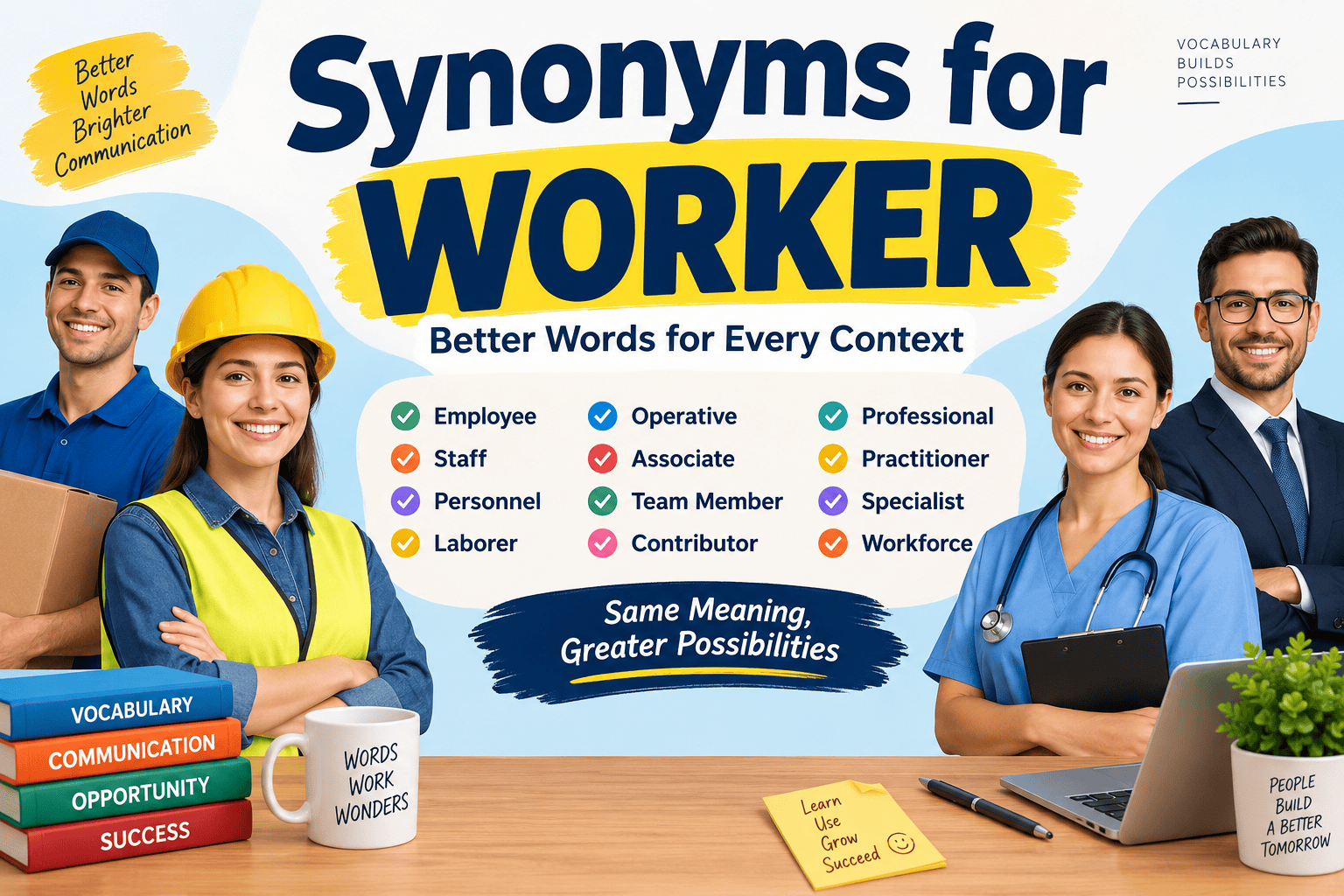
The best synonym for worker depends on what you actually want to emphasize: employment, physical labor, professional role, skill, teamwork, or effort. In many situations, employee is the most natural workplace alternative, while laborer is more specific to physical work. Staff member works well in organizational contexts, colleague emphasizes a working relationship, and artisan highlights specialized craftsmanship.
This guide separates genuine synonyms from words that are merely related to worker, so you can choose an alternative that sounds natural rather than simply replacing one word with another from a thesaurus.
Quick Answer
Common synonyms and close alternatives for worker include employee, laborer, staff member, wage earner, workman, workwoman, colleague, worker, hired hand, artisan, craftsman, and toiler. However, they are not interchangeable in every sentence. Use employee for an employment relationship, laborer for manual work, colleague for someone you work with, and artisan for a skilled craftsperson.
What Does “Worker” Mean?
Worker is a noun for a person who works, especially someone employed in a particular job or involved in a particular kind of work. It can describe people in offices, factories, construction, agriculture, healthcare, social services, and many other fields.
Cambridge gives examples such as factory worker, construction worker, farm worker, and social worker. It also notes that worker can describe someone who works for a company or organization without holding a powerful position.
Merriam-Webster gives a somewhat narrower core definition involving someone who works, particularly in manual or industrial labor, and also recognizes worker as a term for a member of the working class.
Part of speech
Worker is a noun.
- Singular: worker
- Plural: workers
Pronunciation
- US: /ˈwɝː.kɚ/
- UK: /ˈwɜː.kə/
The word has been in English since at least the 14th century.
The Best Synonyms for Worker
Not every word below is a perfect one-for-one replacement. The table distinguishes close synonyms from context-specific alternatives.
| Word | Relationship | Strength | Formality | Best Context |
|---|---|---|---|---|
| Employee | Near synonym | Neutral | Neutral/professional | Employment and HR |
| Laborer | Near synonym | Neutral | Neutral | Manual or physical work |
| Staff member | Contextual alternative | Neutral | Professional | Organizations and workplaces |
| Wage earner | Contextual alternative | Neutral | Formal | Income and employment discussions |
| Workman | Near synonym | Neutral | Traditional | Skilled/manual work; often dated in some contexts |
| Workwoman | Near synonym | Neutral | Traditional | Female worker; relatively uncommon |
| Colleague | Contextual alternative | Neutral | Neutral/professional | Someone you work with |
| Hired hand | Contextual alternative | Neutral | Informal/traditional | Manual or agricultural work |
| Artisan | Contextual alternative | Positive/specific | Neutral/formal | Skilled craftwork |
| Craftsman | Contextual alternative | Positive/specific | Neutral | Skilled craft; gender-neutral alternatives may be preferable |
| Toiler | Near synonym | Stronger emphasis on effort | Literary/formal | Hard or sustained work |
| Jobholder | Contextual alternative | Neutral | Formal | Employment/status discussions |
Cambridge’s thesaurus lists words including laborer, toiler, employee, job holder, artisan, craftsman, wage earner, and hired hand as words related to worker. Merriam-Webster similarly distinguishes laborer and employee within its synonym group.
1. Employee
Employee is often the best professional alternative to worker when the important point is the person’s relationship with an employer.
Meaning: A person who works for an organization or another person, normally in return for wages or a salary.
Best used for: HR, business, contracts, workplace communication, and professional writing.
Example:
Every employee must complete the company’s annual safety training.
Worker vs employee
These words overlap, but worker is broader. Someone can be described as a worker without the sentence focusing on a formal employment relationship. Employee specifically highlights employment.
Compare:
The factory employs 800 workers.
The company provides health insurance to all employees.
The first sentence focuses on people doing work at the factory. The second focuses on their formal relationship with the company.
2. Laborer
Laborer is a strong choice when you mean someone who performs physical or manual work, particularly work requiring substantial effort.
Example:
The construction company hired several skilled laborers for the project.
It is less suitable for describing an accountant, software developer, teacher, or marketing specialist.
Worker: broad
Laborer: usually physical/manual work
3. Staff Member
Staff member is a professional and neutral alternative when talking about someone who works within an organization.
Example:
A staff member will be available to answer your questions.
It is especially natural in schools, hospitals, offices, nonprofits, hotels, government organizations, and other institutions.
Unlike employee, staff member emphasizes membership in an organization’s staff rather than the legal or contractual employment relationship.
4. Colleague
Colleague is not a direct synonym in every context. It means someone who works with you, particularly in the same profession or organization.
Example:
I discussed the proposal with a colleague from the finance department.
You would not normally replace every occurrence of worker with colleague.
The factory employs 500 workers.
does not naturally become:
The factory employs 500 colleagues.
Use colleague when the relationship between coworkers matters.
5. Wage Earner
Wage earner describes someone who earns money through employment or paid work.
It is more formal and socioeconomic in tone than ordinary worker.
Example:
The policy could affect millions of low-income wage earners.
This expression is particularly useful in discussions of employment, income, labor economics, and social policy.
6. Workman
Workman traditionally means a man who works, especially a skilled manual worker.
Example:
The experienced workman repaired the damaged machinery.
However, it can sound traditional or dated in modern general writing. In many contexts, worker, craftsperson, technician, or a specific occupational title is more natural.
7. Workwoman
Workwoman is the corresponding traditional term for a woman who works, especially in certain manual or skilled contexts.
It exists as a lexical alternative, but it is relatively uncommon in contemporary general English. A gender-neutral occupational term is usually preferable when gender is irrelevant.
For example:
The company employs skilled workers.
is generally more natural than deliberately dividing workers into workmen and workwomen.
8. Hired Hand
Hired hand is an informal or traditional expression for someone employed to perform manual work, particularly on a farm or ranch.
Example:
The ranch hired another hand before the busy season began.
It has a distinctly practical, rural, or traditional flavor. It would sound unusual in a modern corporate setting.
9. Artisan
Artisan is a more specific alternative. It refers to someone who makes things skillfully, especially by hand or through a traditional craft.
Example:
Local artisans produced the furniture using traditional techniques.
Do not use artisan simply to mean any worker. A factory employee assembling electronics is not necessarily an artisan.
10. Craftsman
Craftsman refers to a person skilled in a craft or trade.
Example:
The craftsman restored the wooden doors with remarkable precision.
The term is useful when expertise and craftsmanship matter. In contemporary writing, craftsperson or a specific occupational title may be preferable when gender neutrality is important.
11. Toiler
Toiler emphasizes hard, sustained, or demanding work rather than employment status.
Example:
The novel portrays the lives of ordinary toilers struggling to survive.
It has a more literary or rhetorical quality than ordinary worker. It is therefore not the best choice for routine business writing.
12. Jobholder
Jobholder means a person who holds a job or position.
Example:
The program provides financial assistance to jobholders affected by the economic downturn.
It is formal and relatively specialized. In everyday English, worker, employee, or employee in a particular role will usually sound more natural.
Synonyms for Worker by Context
For a professional workplace
The best choices are usually:
- employee
- staff member
- colleague — when referring to someone you work with
- associate — depending on the organization and role
- jobholder — in formal employment discussions
Example:
Every employee should receive clear feedback from their manager.
For business writing, employee is usually more precise than simply replacing worker with a more unusual word.
For manual work
Use:
- laborer
- workman
- hired hand
- hand
- toiler — when emphasizing difficult work
Example:
The contractor needs additional laborers for the construction site.
For skilled craftwork
Use:
- artisan
- craftsman
- craftsperson
- skilled worker
- a specific occupational title
Example:
The village is known for its skilled artisans.
For someone who works very hard
The most useful choices are often descriptive rather than exact synonyms:
- hard worker
- toiler
- workhorse — informal and metaphorical
- diligent employee
- dedicated worker
Example:
Maria is a remarkably diligent employee who rarely misses a deadline.
Be careful with workhorse. It can praise someone’s reliability and productivity, but it may also imply that a person is being relied upon excessively.
Which Word Should I Use?
Use employee when:
You are talking about a formal employment relationship.
The company has more than 200 employees.
Use laborer when:
You specifically mean someone doing physical or manual work.
The contractor hired additional laborers.
Use staff member when:
You are referring to someone working within an organization.
Please speak to a staff member at the reception desk.
Use colleague when:
You mean someone who works with you.
One of my colleagues helped me solve the problem.
Use artisan when:
The person’s work involves skilled craftsmanship.
Local artisans create handmade pottery.
Use toiler when:
You want to emphasize demanding or sustained effort.
The poem honors the toilers who built the city.
Use hired hand when:
The setting involves traditional manual or agricultural work.
The farmer hired another hand for the harvest.
Worker Synonyms: Strength and Nuance
There is no scientifically measurable “strength” scale for these synonyms. The following is editorial guidance about what each word tends to emphasize.
| Word | What It Emphasizes |
| Worker | General participation in work |
| Employee | Employment relationship |
| Laborer | Physical/manual labor |
| Staff member | Organizational membership |
| Colleague | Working relationship |
| Artisan | Skilled craftsmanship |
| Toiler | Hard or sustained effort |
| Wage earner | Earning income through work |
| Craftsman | Skill in a craft |
| Hired hand | Practical/manual employment |
The key lesson is that a more sophisticated synonym is not necessarily a better synonym. Worker is often the clearest choice because it is broad, familiar, and neutral.
Common Collocations with “Worker”
The noun worker commonly appears in occupational and descriptive combinations. Cambridge lists numerous combinations, including agricultural worker, ambulance worker, auto worker, and many others.
Common examples include:
- factory worker
- construction worker
- farm worker
- office worker
- social worker
- healthcare worker
- migrant worker
- seasonal worker
- temporary worker
- freelance worker
- skilled worker
- unskilled worker
- full-time worker
- part-time worker
- key worker
- manual worker
The best synonym often depends on the exact collocation.
For example:
construction worker → laborer may work in some contexts, but construction worker is often more precise.
office worker → employee or staff member may work, depending on the sentence.
social worker → do not replace this with laborer or employee. Social worker is an established professional occupation.
farm worker → agricultural worker or hired hand may work depending on the intended meaning.
This is why synonym selection should happen at the phrase and meaning level, not simply by replacing words mechanically.
Worker vs Laborer vs Employee
| Word | Core Idea | Example |
| Worker | Someone who works | The workers returned after lunch. |
| Laborer | Someone performing manual work | The laborers cleared the site. |
| Employee | Someone employed by an organization/person | All employees received an email. |
The simplest distinction
Worker = broadest everyday term
Laborer = emphasizes physical work
Employee = emphasizes employment
These distinctions are particularly important for ESL/EFL learners because the three words can overlap without being interchangeable in every sentence.
Worker vs Staff Member
Worker can refer to people doing a particular type of work:
Healthcare workers faced difficult conditions.
Staff member usually identifies someone as part of an organization:
A staff member will show you to your room.
The second expression therefore fits institutional and customer-service contexts especially well.
Worker vs Colleague
These words describe different relationships.
A worker is someone who works.
A colleague is someone who works with another person, generally in the same organization or profession.
The company hired 50 new workers.
My colleagues welcomed me on my first day.
The first sentence is about employment/workforce size. The second is about coworkers.
Common Mistakes
Mistake 1: Treating every related word as a direct synonym
Words such as colleague, artisan, and staff member are useful alternatives in particular contexts, but they do not replace worker everywhere.
Mistake 2: Using “laborer” for every employee
A software engineer, accountant, or teacher can be a worker, but calling them a laborer usually changes the meaning by suggesting manual work.
Mistake 3: Using “employee” when employment is not the point
A volunteer can certainly be a worker in the broad sense of someone doing work, but employee normally implies an employment relationship.
Mistake 4: Assuming unusual words are better
Words such as toiler, workman, and hired hand can be appropriate, but they may sound literary, traditional, regional, or context-specific. Natural English generally favors the simplest accurate term.
Mistake 5: Ignoring established occupational terms
Some expressions cannot be improved by replacing worker with a thesaurus synonym. Social worker, healthcare worker, and factory worker are established expressions whose meaning depends on the complete phrase.
Real-World Examples
Workplace
The company provides training for all new employees.
Construction
The contractor hired several additional laborers.
Customer service
Please ask a staff member if you need assistance.
Team environment
One of my colleagues helped me prepare the presentation.
Agriculture
The farm relies on seasonal workers during the harvest.
Skilled craftsmanship
Local artisans sell handmade furniture at the market.
Formal socioeconomic discussion
The policy could disproportionately affect low-income wage earners.
Literary description
The story celebrates the dignity of ordinary toilers.
Antonyms of Worker
The most useful antonyms depend on the intended meaning.
For someone who is not working:
- unemployed person
- idler
For employment status, employer can contrast with employee, but it is not a true antonym of worker in every sense.
Merriam-Webster lists words such as shirker, idler, loafer, and sluggard among antonyms or near-antonyms in relevant senses.
Frequently Asked Questions
What is another word for worker?
The best general alternatives include employee, laborer, staff member, wage earner, workman, and toiler. The right choice depends on context. Employee emphasizes employment, while laborer usually emphasizes physical work.
What is the closest synonym for worker?
There is no single perfect replacement in every context. Employee is often the closest alternative in workplace contexts, while laborer is closer when worker refers specifically to manual labor.
What is a formal synonym for worker?
Depending on context, employee, wage earner, jobholder, or staff member can work in formal writing. Employee is generally the most natural professional choice.
What is a professional alternative to worker?
Employee is usually the safest professional alternative. Staff member is also useful when referring to people who belong to an organization or institution.
Is employee the same as worker?
Not exactly. Employee specifically emphasizes a person who works for an employer, while worker has a broader range of uses and can describe someone according to the work they perform.
Is laborer a synonym for worker?
Yes, but it is a near synonym, not a universal replacement. Laborer normally suggests physical or manual work.
What is another word for a hardworking worker?
Depending on the tone, you could use hard worker, diligent employee, dedicated worker, industrious person, or toiler. Hard worker is the most natural everyday choice.
What is the opposite of worker?
There is no single antonym in every sense. Idler, loafer, and shirker can contrast with someone who works, while employer contrasts with employee in an employment relationship.
Conclusion
The best synonym for worker is determined by meaning, not by the number of words in a thesaurus.
Use employee when employment status matters, laborer for manual work, staff member for organizational contexts, colleague for coworkers, artisan for skilled craftsmanship, and toiler when hard work is the emphasis. In many ordinary sentences, however, worker remains the clearest and most natural choice.
The goal of good synonym selection is not to sound more complicated. It is to choose the word that expresses the intended meaning most precisely.

Sarah Williams is an ESL teacher and content writer with a passion for simplifying English vocabulary. She creates easy-to-understand synonym guides and learning resources that help beginners and intermediate learners build strong language skills.