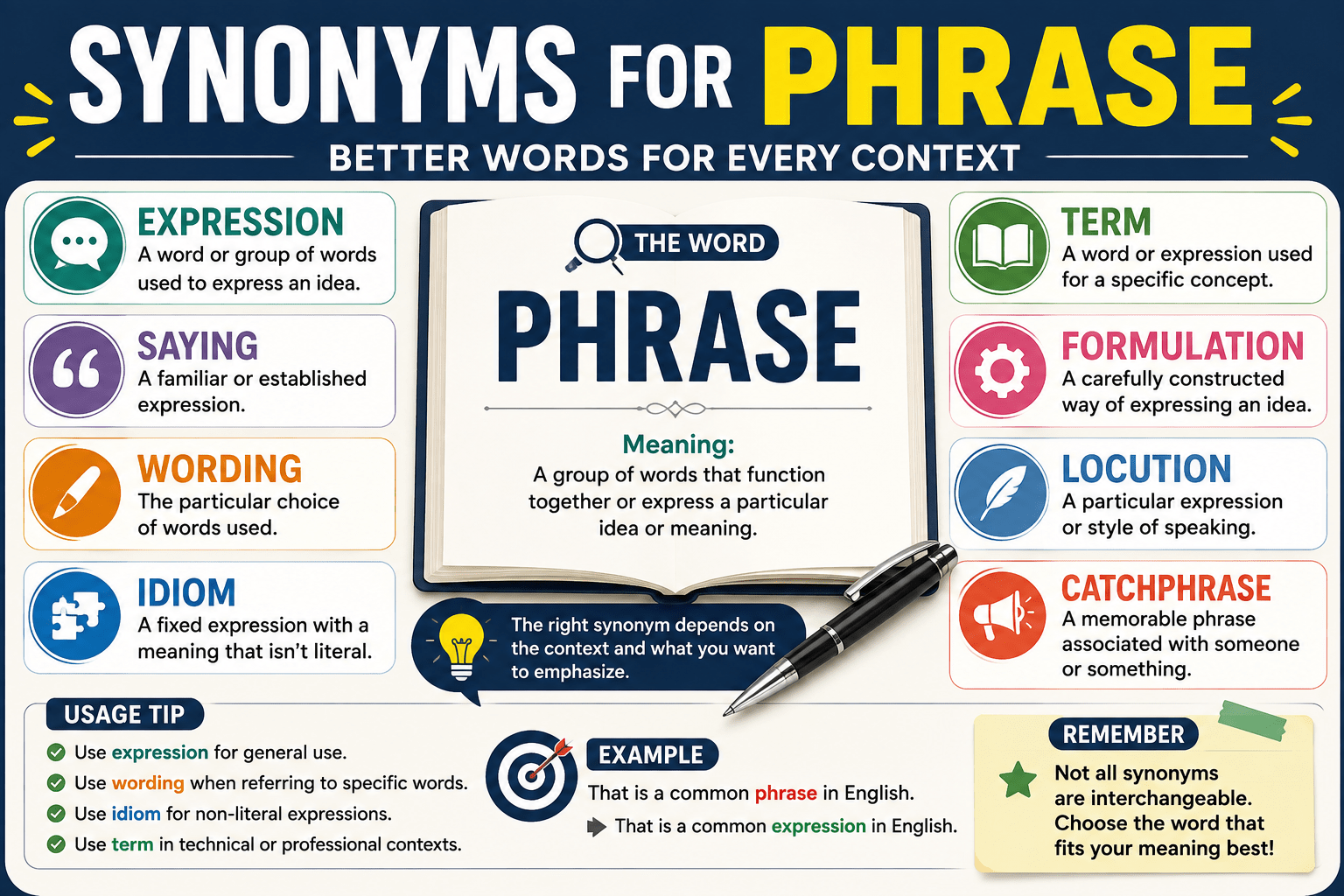
Finding the right synonyms for phrase depends on what you mean by the word. When phrase refers to a group of words or an expression, useful alternatives include expression, idiom, saying, utterance, locution, construction, remark, and turn of phrase. When phrase is used as a verb, alternatives such as express, word, formulate, state, articulate, and couch are more appropriate.
The important point is that these words are not interchangeable in every sentence. An idiom is a particular kind of expression, while wording focuses on the choice of words. Choosing the right alternative therefore requires attention to meaning and context.
Quick Answer: What Are the Best Synonyms for Phrase?
The closest general synonyms for phrase as a noun are expression, word group, utterance, locution, construction, and remark. Depending on the meaning, idiom, saying, motto, slogan, or turn of phrase may also work. As a verb, phrase can often be replaced by express, word, formulate, state, articulate, or couch. Major English thesauruses distinguish these noun and verb senses rather than treating them as one interchangeable list.
Table of Contents
- What Does “Phrase” Mean?
- Best Synonyms for Phrase
- Closest Synonyms
- Context-Specific Alternatives
- Synonyms for Phrase as a Verb
- Phrase vs. Expression vs. Idiom
- Which Synonym Should You Use?
- Common Mistakes
- Examples in Real-World Contexts
- Antonyms
- Frequently Asked Questions
- Conclusion
What Does “Phrase” Mean?
Phrase can be a noun or a verb.
Phrase as a noun
As a noun, phrase generally refers to a group or sequence of words used together, often conveying a particular idea or expression. It can also refer to a distinctive way of expressing something.
For example:
“Break the ice” is a common English phrase.
In another context:
That is an unusual phrase.
Depending on its meaning, phrase can overlap with words such as expression, saying, idiom, utterance, construction, and locution. However, each carries its own nuance.
Phrase as a verb
As a verb, phrase means to express or formulate something in particular words.
She phrased the question carefully.
Here, appropriate alternatives include word, express, formulate, state, articulate, couch, and put into words.
Best Synonyms for Phrase
The following table separates genuine alternatives from words that only work in particular contexts.
| Word | Relationship | Strength | Formality | Best Context |
|---|---|---|---|---|
| Expression | Direct/near synonym | Neutral | Neutral | A way of expressing an idea |
| Word group | Direct descriptive alternative | Neutral | Neutral | Grammar and language study |
| Utterance | Near synonym | Neutral | Formal | Spoken words |
| Locution | Near synonym | Neutral | Formal/literary | A particular expression or way of speaking |
| Construction | Contextual alternative | Neutral | Academic | Grammar and sentence structure |
| Idiom | Contextual alternative | Specific | Neutral | Fixed expression with established meaning |
| Saying | Contextual alternative | Specific | Neutral | A familiar or memorable expression |
| Remark | Contextual alternative | Neutral | Neutral | A spoken or written comment |
| Turn of phrase | Contextual alternative | Specific | Neutral/literary | A distinctive way of expressing something |
| Wording | Related/contextual alternative | Specific | Neutral | Choice of words |
| Motto | Contextual alternative | Specific | Neutral/formal | Guiding or memorable statement |
| Slogan | Contextual alternative | Specific | Neutral | Advertising or promotional language |
| Quotation | Contextual alternative | Specific | Neutral/formal | Words repeated from another source |
| Maxim | Contextual alternative | Specific | Formal | A concise statement of general principle |
| Aphorism | Contextual alternative | Specific | Formal/literary | Brief statement expressing an observation or principle |
These distinctions matter. For example, expression is a broad alternative, while idiom describes a more specific type of expression. Wording concerns the way something is expressed rather than necessarily referring to a phrase itself. Current thesaurus entries from Cambridge, Merriam-Webster, and Collins reflect these distinctions.
Closest Synonyms for Phrase
1. Expression
Meaning: A word, group of words, or form of language used to communicate an idea, feeling, or concept.
How it differs: Expression is probably the most versatile general replacement for phrase, but it is broader. An expression does not necessarily have to be a short phrase.
Best used for: General writing and speech.
Example:
“Thank you very much” is a common expression of gratitude.
2. Word Group
Meaning: A group of words functioning together.
How it differs: Unlike expression, word group is descriptive and particularly useful when discussing grammar rather than style or idiomatic language.
Best used for: Linguistics, grammar, and ESL/EFL instruction.
Example:
The teacher asked students to identify the word group in the sentence.
3. Utterance
Meaning: Something spoken or expressed aloud.
How it differs: Utterance emphasizes an act of speaking rather than a conventional expression.
Best used for: Formal, academic, and linguistic contexts.
Example:
His final utterance was difficult to understand.
4. Locution
Meaning: A particular word, expression, or way of speaking.
How it differs: Locution is more formal and less common in everyday English than phrase or expression.
Best used for: Linguistic, literary, or formal writing.
Example:
The unusual locution caught the editor’s attention.
5. Construction
Meaning: A particular arrangement of words or grammatical elements.
How it differs: Construction is not a universal synonym for phrase. It is most appropriate when discussing grammar or sentence structure.
Example:
The construction is common in formal English.
Context-Specific Alternatives to Phrase
Some words should not be presented as universal synonyms because they describe particular types of phrases.
Idiom
An idiom is a fixed expression whose meaning may not be predictable from the literal meanings of its individual words.
“Spill the beans” is an English idiom meaning to reveal a secret.
Therefore, idiom is a good alternative only when phrase refers to an idiomatic expression. Merriam-Webster and Cambridge both include idiom among related synonyms for phrase.
Saying
A saying is a familiar expression, often conveying advice, wisdom, or a commonly repeated observation.
“Actions speak louder than words” is a well-known saying.
Calling every phrase a saying would be too broad.
Turn of Phrase
Turn of phrase refers to a particular or distinctive way of expressing something.
I liked the author’s clever turn of phrase.
This is especially useful when discussing writing style.
Wording
means the particular choice and arrangement of words used to express something.
The wording of the email sounded too harsh.
Wording is therefore often related to phrase, but it is not a direct substitute in every sentence.
Remark
A remark is a spoken or written comment.
She made a thoughtful remark during the meeting.
It can replace phrase only when the original word refers to a comment or statement.
Motto
A motto is a short statement expressing a guiding principle, belief, or purpose.
“Quality before quantity” became the company’s motto.
Slogan
A slogan is a memorable phrase associated particularly with advertising, campaigns, organizations, or causes.
The campaign introduced a memorable slogan.
A slogan is therefore a specific type of phrase, not a general synonym.
Synonyms for Phrase as a Verb
When phrase is used as a verb, the synonym list changes substantially.
Consider:
She phrased the question carefully.
Here are the most useful alternatives:
| Verb | Main Nuance | Example |
| Express | Communicate an idea | She expressed her concerns clearly. |
| Word | Choose particular words | He worded the request politely. |
| Formulate | Carefully construct an idea or statement | The researchers formulated the question carefully. |
| State | Present something directly | She stated her position clearly. |
| Articulate | Express an idea clearly and effectively | He articulated his concerns well. |
| Couch | Express something in a particular style or form | The proposal was couched in cautious language. |
| Put into words | Express an idea verbally | She struggled to put her feelings into words. |
| Voice | Express an opinion or feeling aloud | He voiced his concerns at the meeting. |
Merriam-Webster and Cambridge list several of these verbs, including express, word, formulate, articulate, couch, state, and put into words, as alternatives related to the verb phrase.
Phrase vs. Expression vs. Idiom
These three words are frequently confused.
| Word | What It Means | Example |
| Phrase | A group or sequence of words | “At the end of the day” |
| Expression | A way of communicating an idea or feeling | “Nice to meet you” |
| Idiom | A fixed expression with an established, often nonliteral meaning | “Break the ice” |
The key distinction is specificity.
A phrase may be an expression, but not every phrase is an idiom. Likewise, an expression can be broader than a simple phrase.
Which Word Should I Use?
Expression is the safest general alternative when you need a broad term for a group of words that conveys an idea.
Idiom fits when the phrase has a conventional meaning that is different from its literal interpretation.
Saying works well for a familiar, memorable, or proverbial expression.
Wording is appropriate when the focus is on the particular words chosen to communicate an idea.
Utterance is suitable when phrase refers specifically to something spoken aloud.
Locution provides a formal or linguistic term for a particular way of expressing something.
Turn of phrase describes someone’s distinctive, skillful, or effective way of expressing an idea.
Construction is more appropriate in grammar and linguistics when discussing how words are arranged.
Remark fits when phrase refers to a comment, statement, or observation.
Motto or slogan is appropriate only when the phrase functions as a guiding principle, memorable statement, or promotional message.
Phrase Synonyms by Context
For Everyday Conversation
The most natural alternatives are:
- expression
- saying
- remark
- idiom
Example:
That’s an interesting expression.
For Academic Writing
Consider:
- construction
- expression
- utterance
- locution
- wording
Example:
This grammatical construction occurs frequently in academic English.
For Creative Writing
Useful choices include:
- expression
- turn of phrase
- wording
- locution
Example:
The author’s unusual turn of phrase gives the passage its distinctive character.
For Professional Communication
The best choice depends on meaning:
- wording — when discussing how something is written
- statement — when referring to a clear declaration
- expression — for a general form of communication
- formulation — when emphasizing careful construction
Example:
We should revise the wording of the announcement before publishing it.
Common Mistakes When Choosing a Synonym for Phrase
Mistake 1: Treating “idiom” as a universal synonym
Not every phrase is an idiom.
Better: Use idiom only for an established expression whose meaning has a special conventional character.
Mistake 2: Using “wording” when you mean “phrase”
Wording refers to the choice of words.
The wording of the sentence was unclear.
It does not necessarily mean a short group of words.
Mistake 3: Using “slogan” for any memorable phrase
A slogan normally serves a recognizable promotional, political, organizational, or campaign-related purpose.
Mistake 4: Confusing the noun and verb forms
She used a different phrase.
Here phrase is a noun.
She phrased the question differently.
Here phrase is a verb.
The appropriate alternatives are different.
Mistake 5: Choosing an unnecessarily obscure synonym
Words such as locution can be accurate but may sound overly formal in ordinary conversation.
A good synonym is not simply one that is technically possible. It should also be appropriate for the audience and context.
Real-World Examples
Workplace
Original:
We should reconsider the phrase used in the report.
Natural alternatives:
We should reconsider the wording used in the report.
We should reconsider the expression used in the report.
The first emphasizes the choice of words; the second is broader.
Academic Writing
This construction is common in formal English.
Here construction is better than idiom because the discussion concerns grammatical structure.
Everyday Conversation
That’s a strange expression.
This is more natural than the formal locution in ordinary conversation.
Creative Writing
The novelist has a distinctive turn of phrase.
This highlights the writer’s particular style.
Professional Communication
The email’s wording could be interpreted as too direct.
Here wording is more precise than phrase.
Antonyms of Phrase
There is no single straightforward antonym for phrase because the word refers to a linguistic unit rather than a simple quality.
Depending on the intended meaning, contrasting concepts might include:
- silence
- nonverbal communication
- unexpressed thought
These are not strict dictionary antonyms of phrase. They simply represent concepts that contrast with spoken or written expression.
Frequently Asked Questions
What is another word for phrase?
The best general alternative is expression. Depending on context, saying, idiom, utterance, locution, construction, or remark may also work.
What is the closest synonym for phrase?
Expression is usually the closest broad synonym when phrase means a way of expressing an idea. However, the exact choice depends on the intended sense.
What is a formal synonym for phrase?
Locution and utterance can work in formal or linguistic contexts, while construction is useful when discussing grammar.
What is a synonym for phrase in writing?
Expression, wording, turn of phrase, and construction can be appropriate, depending on whether you mean the expression itself, the choice of words, style, or grammatical structure.
What is the synonym for phrase as a verb?
Useful alternatives include express, word, formulate, state, articulate, couch, voice, and put into words.
Is “expression” the same as “phrase”?
Not exactly. Expression is broader and can refer to a way of communicating an idea or feeling. A phrase is typically a group or sequence of words.
Is “idiom” a synonym for phrase?
Only in certain contexts. An idiom is a particular type of established expression, so it is more specific than the general word phrase.
What is the difference between phrase and wording?
A phrase is a group or sequence of words, while wording refers to the particular words chosen to express something.
Conclusion
The best synonyms for phrase is usually expression, but there is no single replacement that works in every context. Use idiom for a fixed idiomatic expression, saying for a familiar or memorable expression, wording for the choice of words, utterance for spoken language, construction for grammatical structure, and turn of phrase for distinctive expression.
Use up and down arrow keys to resize the meta box pane.
When phrase is a verb, choose words such as express, word, formulate, state, articulate, or couch instead. The strongest vocabulary choice is not necessarily the most unusual one—it is the word that preserves the intended meaning and sounds natural in context.

Daniel Carter is a professional content strategist and language enthusiast. He focuses on semantic SEO, keyword research, and creating structured vocabulary content that ranks well on search engines while remaining user-friendly.