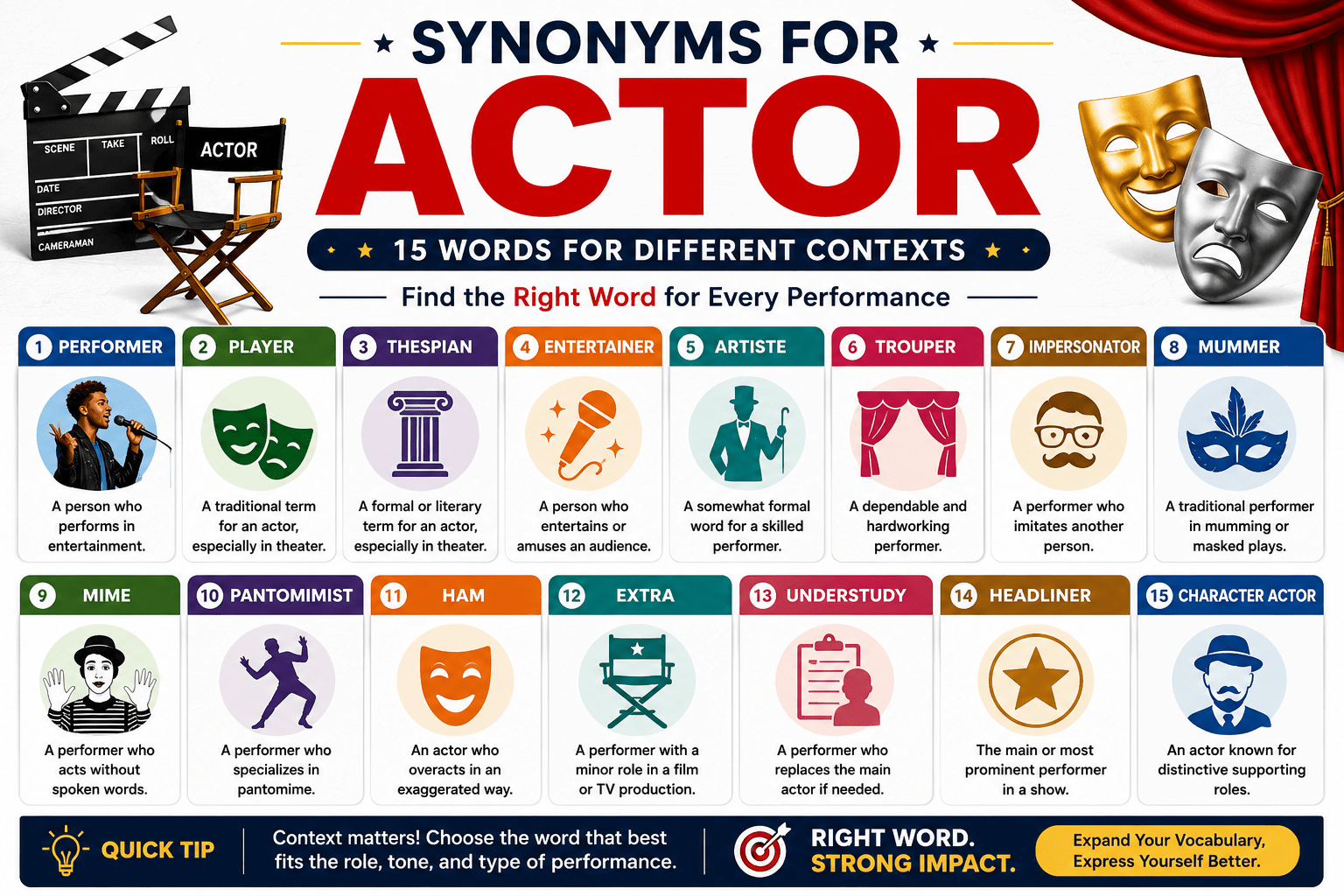
Finding the right alternative to actor depends on what you want to emphasize. Performer is the most versatile choice, while thespian has a formal or literary tone. Player has theatrical and historical associations, whereas entertainer emphasizes the ability to amuse or engage an audience. Some terms, such as impersonator, describe a specific type of performance rather than an actor in general.
This guide explains the closest synonyms for actor, their differences, levels of formality, and the situations in which each sounds most natural.
Quick Answer
The closest synonyms for actor include performer, player, thespian, entertainer, artiste, and trouper. Performer is usually the safest general alternative because it can describe someone who performs on stage or screen. Thespian is more formal and literary, while player has a theatrical or older usage. Other words describe more specific types of performers.
What Does “Actor” Mean?
Actor is a noun referring primarily to a person who portrays a character in a play, film, television program, or similar production. Oxford also records broader meanings, including someone who behaves as though playing a role and, in formal contexts, a participant in an action or process.
Pronunciation:
- US: /ˈæk.tɚ/
- UK: /ˈæk.tər/
The word can therefore have more than one meaning:
- Film/theater: She is a talented actor.
- Television: The actor received an award for the role.
- Broader formal sense: Several international actors influenced the negotiations.
Its historical roots also reflect this broader sense. Actor comes through Middle English from Anglo-French and Latin, ultimately connected with Latin agere, meaning “to do” or “act.” The theatrical sense developed later.
The Best Synonyms for Actor
Not every word associated with actor is interchangeable in every sentence. The table below separates close alternatives from words with more specialized meanings.
| Word | Relationship | Tone/Formality | Best Context |
|---|---|---|---|
| Performer | Near synonym | Neutral | Stage, film, live entertainment |
| Player | Near synonym | Neutral / traditional | Theater and acting |
| Thespian | Near synonym | Formal / literary | Theater and formal writing |
| Entertainer | Contextual alternative | Neutral | Amusing or engaging an audience |
| Artiste | Contextual alternative | Formal / old-fashioned | Performing arts |
| Trouper | Contextual alternative | Informal / appreciative | Dedicated performer |
| Impersonator | Contextual alternative | Neutral | Mimicking another person |
| Mummer | Contextual alternative | Literary / traditional | Historical or theatrical contexts |
| Mime | Contextual alternative | Neutral | Silent physical performance |
| Pantomimist | Contextual alternative | Neutral / specialized | Pantomime performance |
| Ham | Contextual alternative | Informal | An overly theatrical performer |
| Extra | Related term | Neutral | Minor film or television role |
| Understudy | Related term | Neutral | Performer prepared to replace another |
| Headliner | Related term | Neutral | Main attraction in a show |
| Character actor | Specialized term | Neutral | Actor known for distinctive supporting roles |
Current dictionary and thesaurus references support several of these relationships, including performer, player, thespian, entertainer, and trouper.
1. Performer
Performer is probably the most useful general alternative to actor when you want to emphasize the act of performing rather than the specific profession of acting.
How it differs:
An actor specifically portrays characters, while a performer can include actors, singers, dancers, musicians, comedians, and other entertainers.
Example:
The young performer delivered a memorable performance on stage.
Best choice: Use performer when the person’s exact type of performance is broader than acting.
2. Player
Player is a traditional theatrical term for an actor, particularly in references to theater companies or dramatic performances. Cambridge identifies this sense as an older use of player.
Example:
The local players presented Shakespeare’s comedy.
Important:
Player has many modern meanings, especially in sports, games, and music. Context is therefore essential.
3. Thespian
Thespian is a formal or literary term for an actor, especially someone involved in theater.
How it differs:
It strongly evokes the stage and dramatic arts, so it is less neutral than actor.
Example:
The renowned thespian gave a powerful performance in the classic play.
Best choice: Use thespian in formal, literary, or theatrical writing when you want a more distinctive alternative to actor.
4. Entertainer
Entertainer describes someone whose performance is intended to amuse, engage, or captivate an audience.
How it differs:
An entertainer may be an actor, singer, comedian, dancer, or another type of performer. The word therefore has a broader meaning.
Example:
The versatile entertainer delighted the audience throughout the evening.
Best choice: Choose entertainer when the person’s ability to engage an audience matters more than acting specifically.
5. Artiste
Artiste is a somewhat formal or old-fashioned term for a skilled performer, particularly in the performing arts.
How it differs:
It can refer to various performers rather than actors alone and often carries an artistic or theatrical flavor.
Example:
The celebrated artiste appeared in several productions across Europe.
Best choice: It works best in literary, historical, or deliberately sophisticated writing.
6. Trouper
Trouper describes a performer who is dependable, hardworking, and committed, particularly under difficult circumstances.
How it differs:
It does not simply mean “actor.” It highlights reliability and dedication.
Example:
Despite the technical problems, the veteran performer remained a trouper and finished the show.
Best choice: Use trouper when you want to praise someone’s resilience or professionalism.
7. Impersonator
An impersonator is a performer who deliberately imitates another person’s appearance, voice, mannerisms, or behavior.
How it differs:
This is a specific type of performer rather than a general synonym for actor.
Example:
The impersonator recreated the singer’s voice and mannerisms remarkably well.
Best choice: Use it when imitation is the central feature of the performance.
8. Mummer
Mummer is a traditional or literary term associated with performers who participate in mumming or masked theatrical performances.
How it differs:
It is much narrower and more historical than actor.
Example:
The village festival featured traditional mummers in colorful costumes.
Best choice: Reserve mummer for historical, cultural, theatrical, or literary contexts.
9. Mime
A mime is a performer who communicates through gesture, movement, and facial expression, traditionally without spoken dialogue.
How it differs:
A mime is a specialized type of performer, so it should not normally replace actor in a general sentence.
Example:
The mime entertained the crowd using exaggerated gestures.
Best choice: Use mime when silent physical performance is specifically meant.
10. Pantomimist
Pantomimist refers to a performer who specializes in pantomime.
How it differs:
It identifies a particular performing style rather than acting as a broad profession.
Example:
The experienced pantomimist communicated the entire story through movement.
Best choice: Use it when discussing pantomime specifically.
11. Ham
Ham is an informal term for an actor who performs in an exaggerated, overly dramatic, or showy manner.
How it differs:
Unlike performer or thespian, ham usually carries a negative or teasing connotation.
Example:
He’s a bit of a ham, but his exaggerated performance keeps the audience laughing.
Best choice: Use ham in informal contexts when describing excessive theatricality.
12. Extra
An extra is a performer who appears in a film, television program, or production without having a major speaking role.
How it differs:
An extra is a type of performer, but not a direct synonym for actor in every context.
Example:
She worked as an extra before landing her first major speaking role.
Best choice: Use extra when referring specifically to background performers.
13. Understudy
An understudy is a performer who learns a role so they can replace the main performer if necessary.
How it differs:
The term describes a role or professional function, not simply someone who acts.
Example:
The understudy stepped in when the lead actor became unavailable.
Best choice: Use understudy when substitution for another performer is the important idea.
14. Headliner
A headliner is the principal or most prominent performer in a show or event.
How it differs:
It emphasizes status and prominence, not simply the ability to act.
Example:
The award-winning actor was the headliner of the evening’s production.
Best choice: Use headliner when referring to the main attraction.
15. Character Actor
A character actor is an actor known especially for distinctive supporting roles rather than consistently playing conventional leading characters.
How it differs:
It is a specialized industry term rather than a general replacement for actor.
Example:
The respected character actor brought depth and humor to the supporting role.
Best choice: Use this term when discussing an actor’s particular career type or screen presence.
Closest Alternatives to “Actor”
If you need a word that can replace actor with the least change in meaning, the strongest choices are:
| Alternative | How Close Is It? | Main Nuance |
|---|---|---|
| Performer | Very close | Broader than acting |
| Player | Close | Traditional theatrical sense |
| Thespian | Close | Formal and theatrical |
| Entertainer | Moderately close | Focuses on entertaining an audience |
| Artiste | Moderately close | Artistic or theatrical flavor |
For most modern writing, performer is the safest broad alternative.
Formal Synonyms for Actor
When the writing needs a more sophisticated or literary tone, consider:
- Thespian
- Artiste
- Player
Example
Instead of:
The actor delivered an impressive performance.
You could write:
The thespian delivered an impressive performance.
However, actor itself is completely appropriate in formal writing. There is no need to replace it simply to make a sentence sound more sophisticated.
Informal Words Related to Actor
Some alternatives work particularly well in casual or conversational contexts:
- Performer
- Player
- Ham
The meaning changes significantly with ham, so it should not be treated as a neutral replacement.
He’s a talented performer.
This is neutral and positive.
He’s such a ham.
This suggests that he is deliberately or excessively theatrical.
Words for Different Types of Actors and Performers
The best alternative often depends on the specific role.
| Situation | Natural Term |
|---|---|
| General acting | Actor |
| Broad performing role | Performer |
| Theater | Thespian / player |
| Background film role | Extra |
| Replacement performer | Understudy |
| Main attraction | Headliner |
| Silent physical performance | Mime |
| Pantomime | Pantomimist |
| Imitating another person | Impersonator |
| Distinctive supporting roles | Character actor |
| Overly theatrical performer | Ham |
Actor vs. Performer
These two words are often confused because they overlap considerably.
| Actor | Performer |
|---|---|
| Specifically associated with acting | Broader category |
| Usually portrays characters | May act, sing, dance, perform comedy, etc. |
| Common and neutral | Common and neutral |
| Best for film, television, and theater | Best when the exact type of performance is broader |
Compare:
She is a talented actor.
This specifically identifies her as someone who acts.
She is a talented performer.
This tells us she performs effectively but does not specify whether she acts, sings, dances, or does something else.
Bottom line: Performer is broader; actor is more precise.
Actor vs. Thespian
Actor is the ordinary modern term.
Thespian is more formal, literary, theatrical, or sometimes humorous.
The actor appeared in three films this year.
The celebrated thespian returned to the stage.
For everyday English, actor is usually more natural.
Actor vs. Player
Player can refer to an actor, especially in theatrical contexts, but it has many other meanings in modern English.
The theater company employed several talented players.
Because player commonly refers to someone participating in a sport or game, actor or performer is usually clearer in general writing.
Actor vs. Entertainer
An actor performs by portraying characters.
An entertainer has the broader purpose of engaging or amusing an audience.
A comedian can be an entertainer without being an actor. A singer can be an entertainer without being an actor. An actor can also be an entertainer.
Bottom line: entertainer is broader than actor.
Which Word Should You Choose?
Choose actor when:
You are referring specifically to someone who portrays characters in film, television, theater, or another dramatic production.
Choose performer when:
You want a broader term covering different kinds of performance.
Choose thespian when:
You want a formal, literary, or distinctly theatrical expression.
Choose player when:
You are writing about theater, especially in a traditional or literary context.
Choose entertainer when:
The emphasis is on amusing or engaging an audience.
Choose impersonator when:
The performer imitates a particular person.
Choose extra when:
The performer has a minor or background role.
Choose understudy when:
The person is prepared to replace another performer.
Choose headliner when:
The person is the principal attraction in a show or event.
Choose ham when:
You want to describe someone who performs in an exaggerated or overly theatrical way.
Common Mistakes When Choosing an Actor Synonym
1. Treating “performer” as an exact equivalent
Performer is broader than actor.
A performer could be a singer, dancer, comedian, musician, or actor.
2. Using “thespian” in everyday conversation
Although grammatically appropriate, thespian can sound unusually formal or literary.
In ordinary conversation, actor is more natural.
3. Calling every actor an “extra”
An extra is specifically a background performer, generally without a significant speaking role.
Not every actor is an extra.
4. Using “ham” as a positive synonym
Ham usually suggests exaggerated or excessive acting. It can be playful, but it is not a neutral professional term.
5. Assuming “player” always means actor
Modern player has numerous meanings. Use context carefully when employing it in the theatrical sense.
Natural Examples
Film
The actor gave a compelling performance in the psychological drama.
Theater
The theater company brought together several experienced players.
Formal writing
The acclaimed thespian returned to the stage after several years away.
General performance
The versatile performer has worked in theater, television, and live entertainment.
Background role
She began her career as an extra in television productions.
Imitation
The impersonator was remarkably convincing.
Supporting role
The character actor received praise for his understated performance.
Replacement role
The understudy took over when the lead performer was unable to appear.
Antonyms of Actor
There is no single direct antonym for actor, because actor primarily identifies a role or profession rather than a quality.
Depending on the intended contrast, you might use terms such as:
- audience member
- spectator
- viewer
- observer
These describe someone watching a performance rather than participating in it.
Frequently Asked Questions
What is another word for actor?
The most useful general alternative is performer. Other options include player, thespian, and entertainer, although each has a slightly different meaning or tone.
What is the closest synonym for actor?
Performer is one of the closest broadly applicable alternatives. However, it is slightly broader because performers can include singers, dancers, comedians, and other entertainers.
What is a formal word for actor?
Thespian is the best-known formal or literary alternative. Artiste can also work in certain performing-arts contexts.
What is a professional synonym for actor?
Performer is a natural professional alternative, although actor itself remains the standard professional term for someone who acts in film, television, or theater.
What is another word for a movie actor?
Film actor or performer can work, but actor is already the most natural and precise term. A screen actor can also be used when the distinction from stage acting matters.
What is another word for a stage actor?
Thespian and player can work in theatrical contexts, although stage actor remains the clearest modern expression.
Is “performer” the same as “actor”?
Not exactly. Performer is a broader term that includes actors but can also refer to singers, dancers, comedians, and other people who entertain an audience.
Is “thespian” a synonym for actor?
Yes. Thespian can mean an actor, especially one associated with theater, but it is more formal, literary, or theatrical than the everyday word actor.
Conclusion
The best synonyms for actor depend on the meaning you want to emphasize. Performer is the most versatile alternative, while thespian adds a formal or theatrical tone. Player suits traditional theater, entertainer has a broader meaning, and specialized terms such as extra, understudy, impersonator, and character actor describe particular roles or types of performers.
For everyday English, actor remains the clearest choice. Use an alternative when it adds a meaningful distinction in context rather than simply replacing the original word.

Sarah Williams is an ESL teacher and content writer with a passion for simplifying English vocabulary. She creates easy-to-understand synonym guides and learning resources that help beginners and intermediate learners build strong language skills.