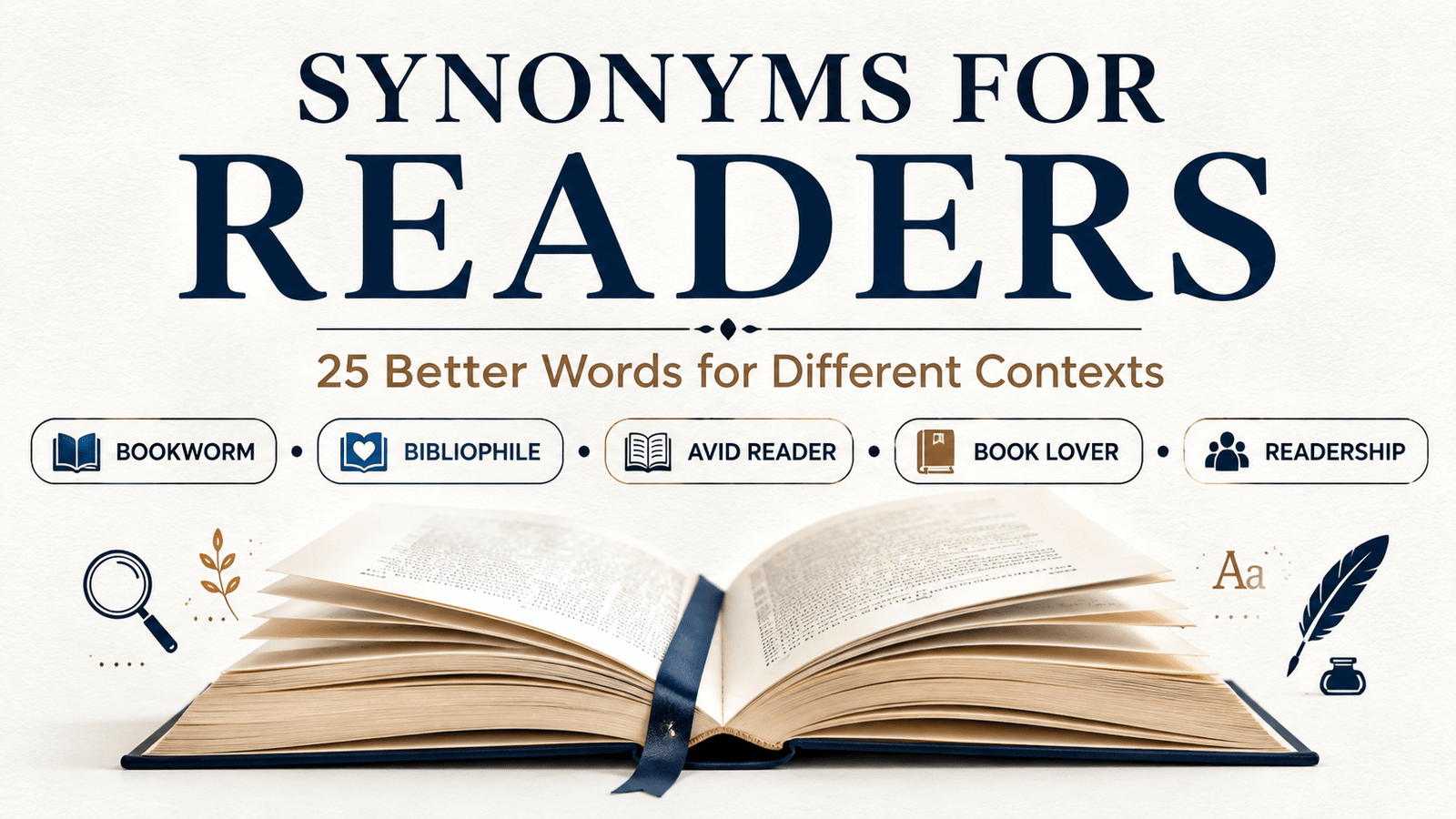
If you’re looking for synonyms for readers, the best choice depends on what you mean by readers. A person who reads books for pleasure might be a book lover, bookworm, or bibliophile, while people who regularly read a newspaper or website are often described as its audience, readership, or subscribers. Other words, such as peruser or reader, are useful in more specific contexts. The key is not to treat every related word as an exact synonym.
Quick Answer: What Are the Best Synonyms for Readers?
The closest alternatives to readers include book lovers, bookworms, bibliophiles, book readers, perusers, and reading enthusiasts when referring to people who read. For a publication or website, audience, readership, subscribers, followers, and patrons may work better depending on the context. Bookworm and bibliophile emphasize a strong interest in books, while audience describes the people consuming or following content more broadly.
Synonyms for Readers at a Glance
| Word or phrase | Relationship | Best context | Tone/formality |
|---|---|---|---|
| Book readers | Direct/contextual | People who read books | Neutral |
| Book lovers | Near synonym | People who enjoy books | Neutral |
| Bookworms | Near synonym | Enthusiastic readers | Informal |
| Bibliophiles | Near synonym | People with a strong love of books | Formal/literary |
| Reading enthusiasts | Near synonym | People enthusiastic about reading | Neutral |
| Avid readers | Near synonym | People who read frequently | Neutral |
| Voracious readers | Near synonym | People who read a great deal | Descriptive |
| Perusers | Contextual alternative | People examining or reading something carefully | Formal |
| Audience | Contextual alternative | People consuming a publication or content | Neutral |
| Readership | Related collective term | The people who read a publication | Formal |
| Subscribers | Contextual alternative | People paying for or receiving a publication/service | Neutral |
| Followers | Contextual alternative | People following online content | Neutral |
| Patrons | Contextual alternative | Library or institutional users | Formal |
| Scholars | Contextual alternative | Academic readers/researchers | Formal |
| Researchers | Contextual alternative | People reading for research | Neutral/formal |
| Reviewers | Related role | People evaluating books or publications | Neutral |
| Book reviewers | Related role | People professionally reviewing books | Neutral |
| Proofreaders | Related role, not a general synonym | People checking written material | Professional |
| Editors | Related role, not a general synonym | People preparing or revising publications | Professional |
| Literary critics | Related role | People analyzing literature | Formal/academic |
The most important distinction is that these words are not all interchangeable. Dictionaries themselves recognize multiple senses of reader, including an ordinary person who reads, a person who evaluates manuscripts, a proofreader, a university position, a teaching assistant, and other specialized meanings.
What Does “Reader” Mean?
A reader is most commonly a person who reads something. This may mean someone who reads books for pleasure, someone who reads a particular newspaper or magazine, or someone who reads written content generally. Cambridge also identifies specialized meanings in publishing and education.
For example:
The novel attracted thousands of readers.
Here, readers simply means people who read the novel.
But:
The newspaper has millions of readers.
In this sentence, readership or audience may be useful alternatives depending on what you want to emphasize.
The word reader can also refer to a person employed to evaluate manuscripts for a publisher, a proofreader, a person who reads aloud, or—in some varieties of English—an academic position.
1. Book Reader
Book reader is one of the clearest alternatives when you specifically mean someone who reads books.
Example:
The library offers special programs for young book readers.
Unlike bookworm or bibliophile, book reader does not necessarily imply enthusiasm. It is straightforward and neutral.
Best for: books, libraries, reading habits, education.
2. Book Lover
A book lover is someone who particularly enjoys books.
Example:
The bookstore is a perfect destination for book lovers.
This is a natural alternative when you want to emphasize affection for books rather than simply the act of reading.
Best for: marketing, lifestyle writing, book communities, informal descriptions.
3. Bookworm
Bookworm is an informal word for someone who reads a lot, especially someone who enjoys books.
Example:
She’s been a bookworm since childhood.
It is warmer and more expressive than reader. It should not normally be used in highly formal writing unless the tone permits it.
Best for: casual conversation, blogs, social media, personal writing.
4. Bibliophile
A bibliophile is a person who loves books, particularly as objects or as part of a strong literary interest.
Example:
The rare-book exhibition attracted bibliophiles from around the country.
This word has a more sophisticated, literary, or formal feel than book lover.
Best for: literary writing, publishing, rare books, sophisticated descriptions.
5. Reading Enthusiast
Reading enthusiast emphasizes someone’s enthusiasm for reading.
Example:
The club welcomes reading enthusiasts of all ages.
It is clear and neutral, although less concise than reader or bookworm.
Best for: educational websites, clubs, events, and general descriptions.
6. Avid Reader
Avid reader is one of the most natural phrases when you mean someone who reads frequently and enthusiastically.
Example:
She is an avid reader of historical fiction.
The word avid adds intensity. Therefore, it is not a perfect replacement for every occurrence of reader.
Reader:
Many readers enjoyed the novel.
Avid reader:
Many avid readers finished the novel in one weekend.
The second expression specifically suggests strong reading interest.
7. Voracious Reader
A voracious reader is someone who reads a very large amount.
Example:
He is a voracious reader who finishes several books each month.
This is stronger than simply saying reader.
Use it when quantity or intensity matters.
8. Peruser
Peruser refers to someone who peruses something—that is, someone who reads, examines, or looks through written material.
Example:
The report is designed to help the peruser locate key information quickly.
This word is more formal and considerably less common in everyday conversation.
It can be useful in formal writing, but reader will usually sound more natural.
9. Audience
Audience can replace readers when referring to people who consume content, especially a publication, website, newsletter, or other media.
Example:
The article was written for a general audience.
However, audience is broader than readers. An audience can include people who watch, listen to, or otherwise consume content.
So:
The magazine has a large readership.
is more specifically about people who read the magazine, whereas:
The brand has a large audience.
can include readers, viewers, listeners, and followers.
10. Readership
Readership refers collectively to the people who read a particular publication or type of content.
Example:
The magazine has a young and highly engaged readership.
This is particularly useful in professional, publishing, journalism, and marketing contexts.
Unlike readers, it normally describes the group collectively rather than individual people.
11. Subscribers
Subscribers can describe readers of a newspaper, magazine, newsletter, or paid online publication when those people have specifically subscribed.
Example:
Our subscribers receive a new issue every Friday.
But not every reader is a subscriber.
Someone can read a newspaper without subscribing to it, so subscriber is a contextual alternative rather than a universal synonym.
12. Followers
Followers works particularly well for websites, blogs, newsletters, social media accounts, and online creators.
Example:
The author has thousands of followers online.
A follower may read the author’s work, but the word does not necessarily mean they read every piece of content.
Therefore, followers is related to readers, not a direct replacement in every context.
13. Patrons
Patrons can describe people who use or support an institution such as a library.
Example:
The library provides digital resources for its patrons.
It is more institutional and formal than readers.
For ordinary book readers, readers is usually clearer.
14. Scholars
Scholars may refer to people who read academic or scholarly material, but it is not a general synonym for readers.
Example:
The paper will be useful to scholars studying medieval history.
A scholar is more than simply someone who reads. The word suggests academic study or expertise.
15. Researchers
Researchers is appropriate when people are reading information as part of investigation or research.
Example:
Researchers examined thousands of historical documents.
Again, this is a contextual alternative rather than a direct synonym.
A researcher may read extensively, but not every reader is a researcher.
Which Synonym Should You Use?
The easiest way to choose is to identify why the person is reading.
Choose “book lover” when:
You want to emphasize enjoyment or affection for books.
The event is ideal for book lovers.
Choose “bookworm” when:
You want an informal, friendly expression for someone who reads a lot.
My sister is a complete bookworm.
Choose “bibliophile” when:
You want a more literary or sophisticated term for someone with a strong love of books.
The collection attracted serious bibliophiles.
Choose “avid reader” when:
You want to emphasize frequent or enthusiastic reading.
She is an avid reader of mystery novels.
Choose “voracious reader” when:
You want to emphasize an unusually high amount of reading.
He is a voracious reader who can finish a novel in a day.
Choose “readership” when:
You mean the collective group of people who read a publication.
The newspaper has expanded its readership.
Choose “audience” when:
You mean the broader group consuming your content.
The article was written for a general audience.
Choose “subscriber” when:
The people specifically subscribe to your publication or service.
Our subscribers receive exclusive articles.
Synonyms for Readers by Context
For People Who Read Books
The most natural choices are:
- book readers
- book lovers
- bookworms
- bibliophiles
- avid readers
- reading enthusiasts
- voracious readers
The best choice depends on intensity and tone.
For Newspaper or Magazine Readers
Use:
- readers
- readership
- audience
- subscribers
For example:
The magazine’s readership increased significantly.
If you specifically mean paying members:
The magazine gained 10,000 new subscribers.
For Blog or Website Readers
Useful choices include:
- readers
- audience
- followers
- visitors
- users
These words are not interchangeable. Visitors emphasizes people who visit a website; users emphasizes people using a website or service; followers emphasizes an ongoing connection with a creator or account.
For Academic Readers
Depending on context, you might use:
- scholars
- researchers
- students
- academics
- readers
These terms describe particular groups rather than being exact synonyms for readers.
For Publishing Contexts
A reader can have a specialized professional meaning. Publishing sources use reader for someone who evaluates manuscripts and advises a publishing company.
Depending on the exact job, related terms may include:
- manuscript reviewer
- book reviewer
- editorial reader
- proofreader
- editor
These should not be casually substituted for reader when you simply mean someone who reads.
Reader vs. Readership vs. Audience
These three words are easy to confuse.
| Term | Meaning | Example |
|---|---|---|
| Reader | An individual person who reads | The reader enjoyed the story. |
| Readers | Multiple people who read | The readers loved the ending. |
| Readership | The collective population of readers | The newspaper has a large readership. |
| Audience | People consuming content more broadly | The website has a global audience. |
The key difference
Reader is usually individual.
Readership is collective.
Audience is broader and does not necessarily imply reading.
Reader vs. Bookworm
Both words can describe someone who reads frequently, but their tone differs.
Reader is neutral:
Maria is an enthusiastic reader.
Bookworm is informal and expressive:
Maria is a real bookworm.
Use reader in professional or neutral writing. Use bookworm when you want a friendlier, more colorful description.
Reader vs. Bibliophile
A reader is simply someone who reads.
A bibliophile has a strong love of books.
Someone can be a reader without being a bibliophile.
He is a regular reader of science magazines.
She is a bibliophile who collects rare first editions.
The second sentence suggests a deeper relationship with books.
Common Mistakes With “Reader” Synonyms
Mistake 1: Calling every related word a synonym
Words such as editor, proofreader, scholar, reviewer, and lecturer may be associated with reading, but they do not generally mean “a person who reads.”
Mistake 2: Using “subscriber” for every reader
A subscriber has a specific relationship with a publication or service. A publication can have readers who are not subscribers.
Mistake 3: Using “audience” when you mean only readers
An audience can include people who watch videos, listen to podcasts, attend events, or consume other forms of media.
Mistake 4: Using “bibliophile” as a neutral replacement
Bibliophile implies a strong love of books. It is more specific than reader.
Mistake 5: Using “bookworm” in formal contexts
Bookworm is understandable and natural, but its informal tone may not fit academic or professional writing.
Frequently Asked Questions
What is another word for readers?
Depending on context, alternatives include book readers, book lovers, bookworms, bibliophiles, avid readers, reading enthusiasts, perusers, audience members, and readership. The best option depends on whether you mean people who read books, a publication’s audience, or enthusiastic readers.
What is a synonym for a person who reads?
The simplest alternative is reader itself. More specific choices include book lover, bookworm, bibliophile, avid reader, reading enthusiast, and peruser. These words add different shades of meaning rather than functioning as perfect replacements in every sentence.
What is a formal word for reader?
Peruser can work in formal contexts, particularly when referring to someone examining written material. Reader itself is already neutral and professional, so replacing it with a more unusual word is not always an improvement.
What is a synonym for an avid reader?
Natural alternatives include voracious reader, enthusiastic reader, reading enthusiast, bookworm, book lover, and bibliophile. However, each has a slightly different emphasis. Voracious reader emphasizes quantity, while bibliophile emphasizes a strong love of books.
What is another word for book reader?
Book lover, bookworm, bibliophile, avid reader, reading enthusiast, and book enthusiast can work depending on the intended meaning. Book reader itself is often the clearest choice when you simply need to distinguish people who read books from other types of readers.
What is the difference between readers and readership?
Readers refers to individual people or multiple individuals who read. Readership refers collectively to the population of people who read a particular publication or type of content.
The newspaper has millions of readers.
The newspaper has a large readership.
Is “audience” a synonym for “readers”?
Sometimes, but not always. Audience is broader. It can include readers, viewers, listeners, or followers. If you specifically mean people who read a publication, readers or readership is usually more precise.
What is a synonym for people who read books?
The most natural options are book readers, book lovers, bookworms, bibliophiles, avid readers, and reading enthusiasts. Choose based on tone: bookworm is informal, bibliophile is more literary, and avid reader emphasizes frequent reading.
Conclusion
The best synonyms for readers depend on the exact meaning you want to communicate.For ordinary reading, “book reader” or simply “reader” is usually the clearest choice. If you want to show enthusiasm, terms such as “avid reader,” “book lover,” “bookworm,” and “bibliophile” work well. When referring to the collective audience of a publication, “readership” is more precise. However, “audience” is a better choice when the content reaches people beyond rea
The important lesson is that a good synonym should not merely be related to reader. It should fit the meaning, context, tone, and grammatical role of the original word. That distinction helps you choose vocabulary that sounds natural rather than simply replacing one word with another

Michael Thompson is an English language specialist and experienced editor who focuses on vocabulary development and clear communication. He creates high-quality synonym guides, word comparisons, and writing tips to help students and professionals express their ideas more effectively. His work combines linguistic knowledge with practical SEO strategies to make learning both useful and engaging.