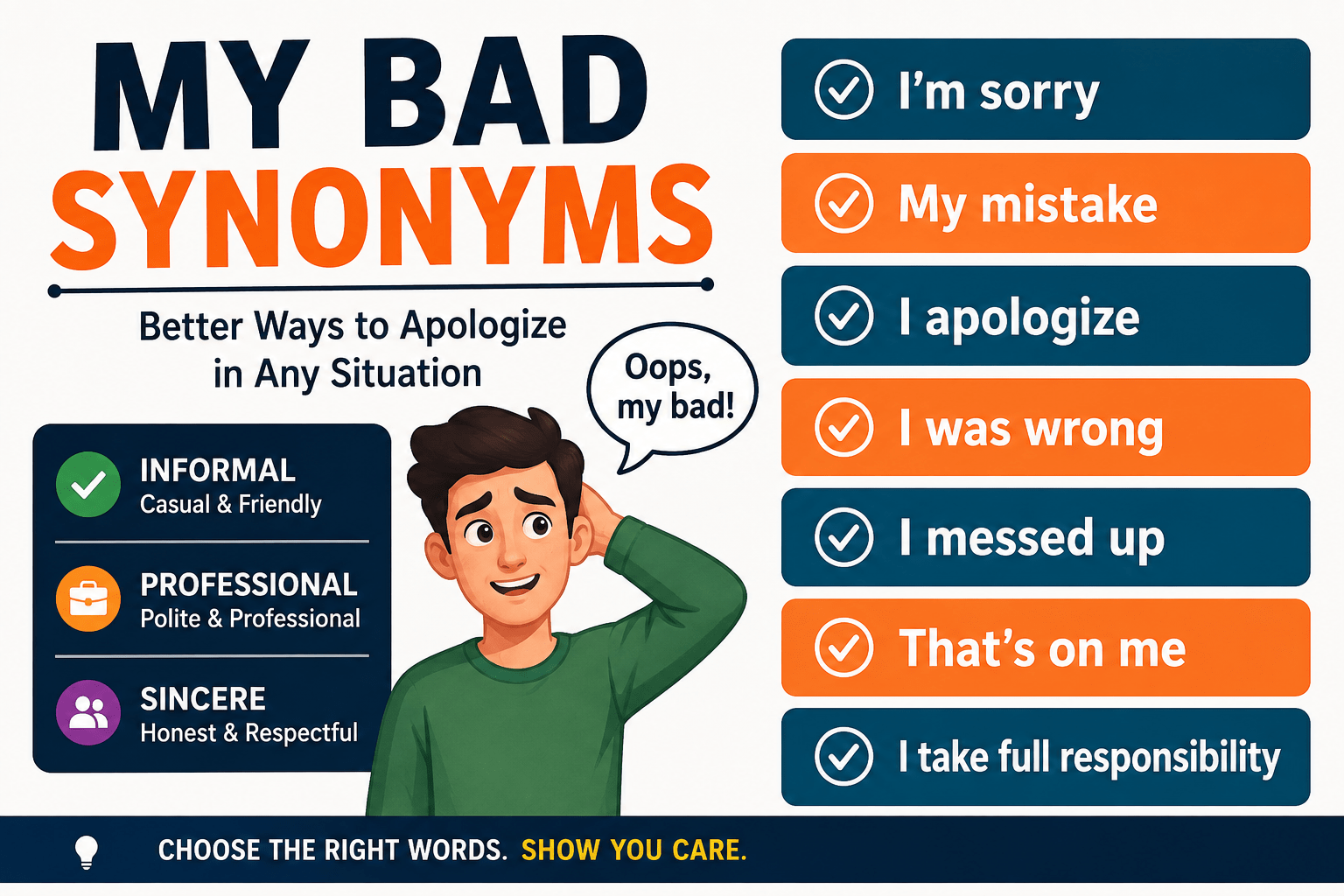
Looking for my bad synonyms usually means you want another way to admit a mistake, accept responsibility, or apologize. The phrase “my bad” is natural English, but it is distinctly informal. Dictionaries describe it as an expression used to acknowledge that something is your fault or that you made a mistake. Oxford specifically labels it informal, while Cambridge describes it as an informal expression for accepting that you are wrong or responsible.
The best alternative depends on the situation. “My mistake” is a straightforward neutral choice, “my fault” puts stronger emphasis on responsibility, and “I apologize” is much more appropriate for professional or formal situations. Other expressions, such as “that’s on me,” work well in casual speech but should not automatically be treated as exact synonyms.
Quick Answer
The closest alternatives to “my bad” are my mistake, my fault, I was wrong, I apologize, sorry about that, that’s on me, I take responsibility, and please accept my apologies. However, they are not interchangeable in every situation. “My bad” is casual, “my mistake” is neutral, and “I apologize” is more formal and deliberate.
Best Synonyms and Alternatives for “My Bad”
| Word or phrase | Relationship | Tone | Formality | Best context |
|---|---|---|---|---|
| My mistake | Close synonym | Neutral | Neutral | Everyday mistakes |
| My fault | Close synonym | Direct | Neutral | Accepting responsibility |
| I was wrong | Close alternative | Direct | Neutral | Admitting an incorrect belief |
| Sorry about that | Contextual alternative | Friendly | Informal/neutral | Minor mistakes |
| I apologize | Formal alternative | Polite | Formal | Work and serious situations |
| That’s on me | Close casual alternative | Casual | Informal | Conversation and messaging |
| I take responsibility | Responsibility-focused alternative | Serious | Formal | Professional situations |
| Please accept my apologies | Formal apology | Respectful | Formal | Written or serious apologies |
| I made an error | Error-focused alternative | Professional | Formal | Business and technical contexts |
| I messed up | Casual admission | Self-critical | Informal | Significant personal mistakes |
| I slipped up | Near synonym | Casual | Informal | Small or accidental mistakes |
| I got that wrong | Contextual alternative | Neutral | Neutral | Incorrect information or judgment |
Not every phrase above is a dictionary-level synonym. Some are contextual alternatives because they perform a similar communicative function without having exactly the same meaning.
What Does “My Bad” Mean?
“My bad” is an informal idiomatic expression used when someone admits that they made a mistake or that something is their fault. Cambridge gives it the sense of accepting that you are wrong or responsible, while Collins defines it as an informal expression meaning “my fault or mistake.”
For example:
“You sent me the wrong address.”
“Oh, my bad. I read the message incorrectly.”
It is especially natural for small, everyday mistakes where a quick acknowledgment is enough.
The phrase is not grammatically equivalent to the verb apologize. Saying “my bad” acknowledges fault, but it does not necessarily express the same degree of apology or regret as “I sincerely apologize.”
The Closest Synonyms for “My Bad”
1. My Mistake
“My mistake” is probably the most useful neutral alternative.
It clearly identifies the error as yours without sounding as casual as “my bad.”
Example:
“I gave you the wrong meeting time. My mistake.”
Use it when you want to acknowledge an error directly without making the situation sound overly serious.
Best for: everyday conversation, workplace conversations, messages, and minor errors.
2. My Fault
“My fault” is another very close alternative. It emphasizes responsibility more strongly than “my mistake.”
Example:
“I forgot to send the attachment. My fault.”
It can sound more serious because fault focuses on responsibility rather than simply identifying an error.
Best for: accepting responsibility, personal conversations, and situations where you clearly caused the problem.
3. I Was Wrong
Use “I was wrong” when the problem involves an incorrect belief, opinion, assumption, or judgment.
Example:
“I thought the store closed at eight, but I was wrong.”
This is not always a direct replacement for “my bad,” but it is often a more precise choice.
Best for: admitting that your information, judgment, or assumption was incorrect.
4. Sorry About That
“Sorry about that” is a natural conversational alternative when the mistake is minor.
Example:
“Sorry about that. I accidentally deleted your message.”
It sounds warmer and more apologetic than simply saying “my bad.”
Best for: casual conversation, customer interactions, and everyday mistakes.
5. That’s on Me
“That’s on me” is an informal expression meaning that you accept responsibility for something.
Example:
“I didn’t check the schedule. That’s on me.”
It is close in tone to “my bad,” but it can sound more deliberate about taking responsibility.
Best for: casual conversation, workplace conversations with familiar colleagues, and informal online communication.
Formal and Professional Alternatives to “My Bad”
“My bad” is generally too casual for formal correspondence, especially when communicating with clients, managers, officials, or customers.
6. I Apologize
“I apologize” is one of the safest professional alternatives.
Example:
“I apologize for sending the incorrect document.”
It communicates an actual apology rather than merely acknowledging responsibility.
Best for: professional emails, customer communication, formal conversations, and serious mistakes.
7. I Take Responsibility
“I take responsibility” focuses strongly on accountability.
Example:
“I take responsibility for the error and will make sure it is corrected.”
This is more serious than “my bad” and is particularly useful when responsibility needs to be made explicit.
Best for: professional communication, leadership contexts, and significant mistakes.
8. I Made an Error
“I made an error” is objective and professional.
Example:
“I made an error in the report and have corrected the figures.”
Unlike “my bad,” this wording emphasizes the error rather than the conversational apology.
Best for: reports, workplace communication, technical contexts, and formal writing.
9. Please Accept My Apologies
This is a more formal expression of regret.
Example:
“Please accept my apologies for the delay.”
It is appropriate when the situation deserves a more deliberate apology.
Best for: formal emails, business correspondence, customer service, and serious situations.
Casual Alternatives to “My Bad”
If you’re talking to friends or communicating informally, these expressions can sound natural:
- My mistake.
- My fault.
- Sorry about that.
- That’s on me.
- I messed up.
- I slipped up.
- Oops, sorry.
- I got that wrong.
For example:
“Oops, sorry. I thought you said Tuesday.”
or:
“I messed up and sent the old version.”
These expressions vary in intensity. “I messed up” usually sounds more self-critical than “my bad.”
Which “My Bad” Alternative Should You Use?
Choose “my mistake” when:
You want a simple, neutral admission of an error.
“My mistake. I entered the wrong date.”
Choose “my fault” when:
You want to emphasize that you were responsible.
“The delay was my fault.”
Choose “sorry about that” when:
You want a friendly, natural apology for a minor problem.
“Sorry about that. I didn’t see your message.”
Choose “that’s on me” when:
You want a casual but clear acknowledgment of responsibility.
“I should have checked first. That’s on me.”
Choose “I apologize” when:
You are communicating professionally or the situation deserves a more formal apology.
“I apologize for the inconvenience.”
Choose “I take responsibility” when:
The mistake is significant and accountability matters.
“I take responsibility for the error.”
Choose “I was wrong” when:
You need to admit that your belief, judgment, or information was incorrect.
“I was wrong about the deadline.”
“My Bad” vs. “My Mistake”
These phrases are closely related, but their tone differs.
| Phrase | Tone | Typical use |
| My bad | Very informal | Casual conversation |
| My mistake | Neutral | Everyday and workplace communication |
Compare:
“Oh, my bad. I grabbed your charger.”
with:
“My mistake. I attached the wrong document.”
The second sounds more appropriate in professional communication.
“My Bad” vs. “My Fault”
Both acknowledge responsibility, but “my fault” places more emphasis on blame or responsibility.
“My bad—I forgot the tickets.”
This sounds casual and light.
“It was my fault that the order was delayed.”
This sounds more serious and explicitly assigns responsibility.
Therefore, “my bad” is often better for a minor conversational mistake, while “my fault” can be better when responsibility itself matters.
“My Bad” vs. “I Apologize”
These are not exact equivalents.
“My bad” primarily acknowledges fault.
“I apologize” explicitly expresses an apology.
Compare:
“My bad. I sent the wrong file.”
“I apologize for sending the wrong file.”
The second sentence sounds more professional and more deliberate.
For a formal email, “I apologize” is generally a safer choice than “my bad.”
Common Mistakes When Using “My Bad” Synonyms
Treating every alternative as an exact synonym
Words such as “I apologize,” “I was wrong,” and “I take responsibility” overlap with “my bad,” but each emphasizes something different.
Using “my bad” in formal writing
Because dictionaries label the expression informal, it is usually better to choose a more professional phrase in formal communication.
Instead of:
“My bad for the delay.”
Use:
“I apologize for the delay.”
Using “I take responsibility” for every minor mistake
This phrase can sound unnecessarily serious.
For a small conversational error:
“My mistake.”
is usually more natural than:
“I take full responsibility.”
Confusing an admission with an apology
“I was wrong” admits an error.
“I apologize” expresses an apology.
Sometimes you need both:
“I was wrong about the deadline, and I apologize for the confusion.”
Natural Examples
Casual conversation
“My bad. I thought you were already home.”
Text message
“Oops, my bad. I sent that to the wrong person.”
Neutral workplace conversation
“My mistake. I entered the wrong number.”
Professional email
“I apologize for the error in the previous report.”
Serious mistake
“I take responsibility for the oversight and will correct it immediately.”
Admitting incorrect information
“I got that wrong. The meeting is actually at 3 p.m.”
These examples show why choosing an alternative based on context and tone is more useful than memorizing a long synonym list.
Are “My Bad” and “Sorry” the Same?
Not exactly.
“My bad” acknowledges that you caused or made a mistake and often carries an informal, quick-apology tone.
“Sorry” is a broader apology that can express regret, sympathy, or politeness in situations where you may not be at fault.
For example:
“My bad. I took your seat.”
But:
“I’m sorry you’re having a difficult day.”
The second use has nothing to do with accepting responsibility for a mistake.
Is “My Bad” Formal or Informal?
“My bad” is informal. Oxford labels it informal, and Cambridge likewise identifies it as informal. Collins describes the expression as US/Canadian informal and also identifies its American use as slang.
It is appropriate for:
- friends
- casual conversations
- texting
- informal online communication
- minor everyday mistakes
For formal or professional communication, prefer:
- I apologize
- I apologize for the error
- I regret the mistake
- Please accept my apologies
- I take responsibility for the error
FAQ
What is the best synonym for “my bad”?
“My mistake” is one of the closest neutral alternatives. “My fault” is also very close, while “I apologize” is better when you need a formal or professional apology.
What is a professional way to say “my bad”?
Use “I apologize,” “I apologize for the error,” “I made an error,” or “I take responsibility for the mistake.” The best choice depends on how serious the situation is.
What is a polite way to say “my bad”?
“Sorry about that” is a natural polite alternative in everyday conversation. In more formal situations, “I apologize” is better.
Can I use “my bad” in an email?
You can use it in a casual email to someone you know well, but it is generally not the best choice for formal or professional correspondence. A phrase such as “I apologize for the mistake” is safer.
Is “my mistake” better than “my bad”?
It depends on the context. “My mistake” is more neutral and versatile, while “my bad” is more casual. For professional situations, “my mistake” is usually the better choice.
What is another way to say “my bad” to a friend?
Natural choices include “my mistake,” “my fault,” “sorry about that,” “that’s on me,” and “I messed up.” The first four are generally less self-critical than “I messed up.”
What is the difference between “my bad” and “my fault”?
Both acknowledge responsibility. “My bad” is more casual and often lighter, while “my fault” places greater emphasis on responsibility for the problem.
Conclusion
The best “my bad” synonym depends on what you want to communicate. Use “my mistake” for a neutral admission, “my fault” when responsibility is the focus, “sorry about that” for a friendly apology, and “that’s on me” for casual accountability. In professional or formal situations, choose “I apologize,” “I made an error,” or “I take responsibility.”
The key is not to find the longest list of alternatives. It is to choose the expression that matches the context, tone, level of responsibility, and seriousness of the mistake.

Michael Thompson is an English language specialist and experienced editor who focuses on vocabulary development and clear communication. He creates high-quality synonym guides, word comparisons, and writing tips to help students and professionals express their ideas more effectively. His work combines linguistic knowledge with practical SEO strategies to make learning both useful and engaging.