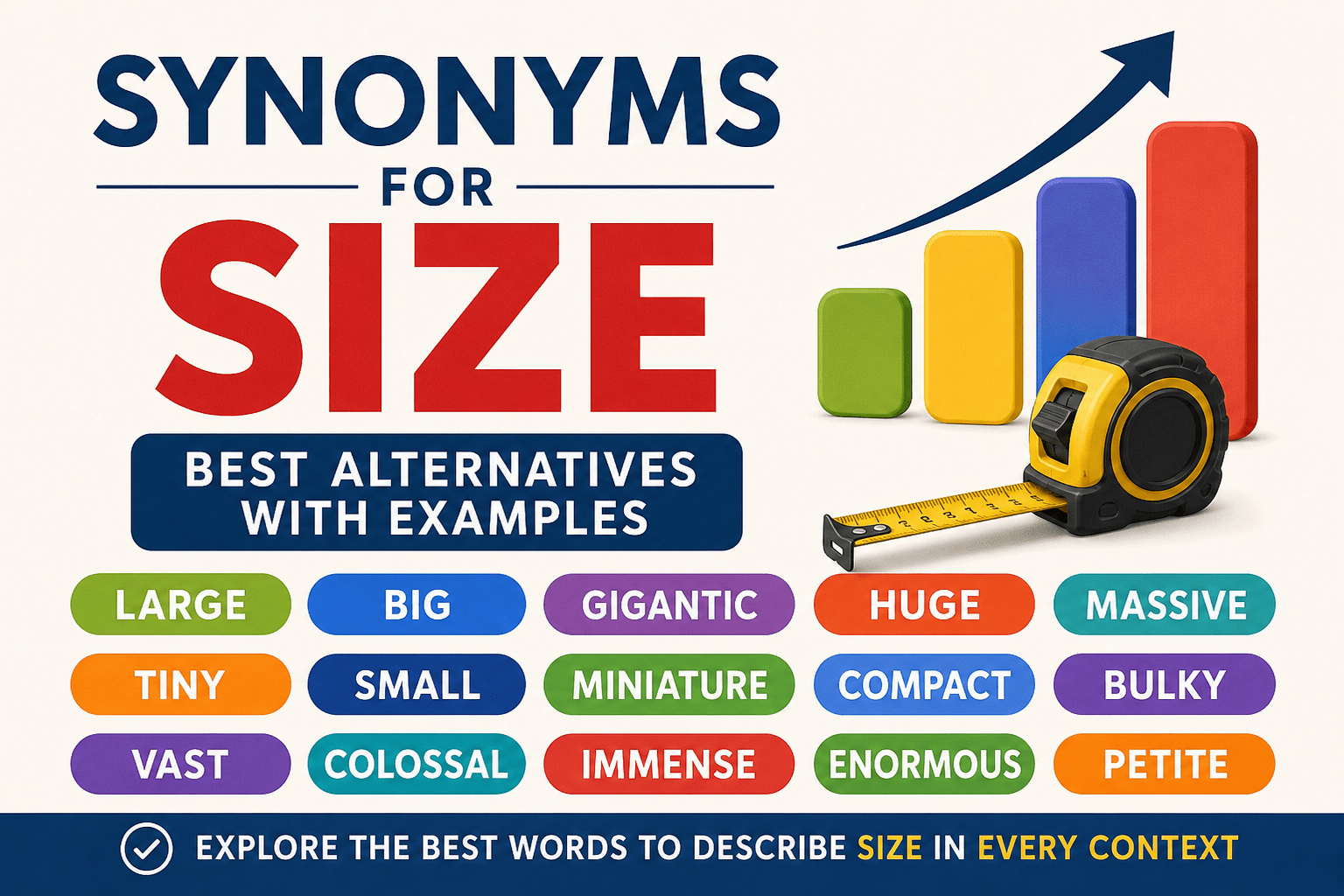
Finding the right synonym for size depends on what you mean by the word. If you are talking about the physical dimensions of an object, dimensions, measurement, or extent may work. If you mean overall magnitude, scale or magnitude can be better. For physical mass or heaviness, bulk may be more precise, while volume describes the amount of three-dimensional space something occupies. In contexts involving money, people, or quantities, amount, quantity, or capacity may be more natural.
The key is not to replace size automatically. Choose a word that preserves the exact meaning and sounds natural in the sentence.
Quick Answer: What Are the Best Synonyms for Size?
Some of the most useful synonyms and contextual alternatives for size are:
- Dimensions — the measurable length, width, and height of something
- Measurement — a numerical determination of size
- Extent — the degree or amount to which something reaches
- Magnitude — the great or relative size of something
- Scale — size considered in relation to a standard or other things
- Bulk — the physical mass or large size of something
- Volume — the amount of three-dimensional space occupied
- Area — the amount of two-dimensional surface covered
- Capacity — how much something can contain
- Amount — the quantity of something, especially something uncountable
- Quantity — a particular amount or number of something
- Proportion — the relative size of one part compared with another
These words overlap with size, but they are not interchangeable in every sentence. Cambridge and Merriam-Webster both list several of these terms among the words associated with the noun size.
What Does “Size” Mean?
Size is a noun referring generally to how large or small something is. It can describe physical dimensions, extent, amount, or a standardized measurement such as a clothing or shoe size.
The size of the room makes it suitable for a large meeting.
It can also refer to a particular measurement category:
These shoes are available in three different sizes.
The word can have other meanings as well. As a verb, size can mean to sort things according to size or make something a particular size.
For this article, the main focus is on size as a noun.
Core Synonyms for Size
| Word | Relationship | Meaning | Best Context |
|---|---|---|---|
| Dimensions | Direct/contextual | Measurable length, width, and height | Objects, rooms, buildings |
| Measurement | Direct/contextual | A measured amount or dimension | Technical and general contexts |
| Extent | Near synonym | How far something reaches or spreads | Land, damage, influence |
| Magnitude | Near synonym | Relative or considerable size | Problems, forces, changes |
| Scale | Near synonym | Size in relation to a reference | Projects, maps, operations |
| Bulk | Contextual | Physical mass or large volume | Objects, bodies, materials |
| Volume | Contextual | Three-dimensional space occupied | Containers, liquids, objects |
| Area | Contextual | Surface covered | Rooms, land, regions |
| Capacity | Contextual | Maximum amount that can be contained | Containers, systems, venues |
| Amount | Contextual | Quantity of something | Money, work, information |
| Quantity | Contextual | A particular amount or number | Products, materials, items |
| Proportion | Near synonym | Relative size of one part to another | Design, composition, comparison |
These classifications are more useful than treating every thesaurus entry as a direct substitute. Cambridge, for example, separates words such as dimensions, measurement, extent, proportions, area, volume, magnitude, bulk, scope, and capacity, while Merriam-Webster similarly lists dimension, measurement, extent, proportion, magnitude, bulk, area, volume, and mass.
1. Dimensions
Dimensions is one of the best alternatives when size refers to measurable physical characteristics such as length, width, height, or depth.
What are the dimensions of the table?
This is more precise than:
What is the size of the table?
Use dimensions when you want specific measurements rather than simply describing something as large or small.
Best for: objects, rooms, buildings, furniture, packages, screens, and other measurable things.
2. Measurement
Measurement refers to the process or result of determining the size, length, amount, or extent of something.
The measurement of the wall was recorded before construction began.
It is especially useful in technical, scientific, engineering, and practical contexts.
Size is broader, while measurement emphasizes the numerical or measured value.
3. Extent
Extent describes how far something reaches or how large an area, effect, or situation is.
The report examined the extent of the environmental damage.
You would not normally use extent for a clothing size or the exact dimensions of a box.
Best for: damage, influence, land, problems, effects, and coverage.
4. Magnitude
Magnitude refers to the size, importance, intensity, or scale of something, especially when it is substantial or significant.
We underestimated the magnitude of the problem.
It sounds more formal than size and is common in academic, scientific, technical, and professional writing.
Best for: problems, changes, forces, risks, effects, and significant events.
5. Scale
Scale is useful when size is considered in relation to another object, standard, map, model, or level of operation.
The company expanded the scale of its operations.
Compare:
The size of the building is impressive.
The scale of the building is impressive.
The first focuses on how large the building is. The second can suggest how large it is relative to its surroundings or intended purpose.
Best for: projects, businesses, maps, models, operations, and large developments.
6. Bulk
Bulk emphasizes the physical mass, volume, or imposing size of something.
The bulk of the machine made it difficult to move.
It often suggests that something is large and physically substantial.
Collins notes that bulk can suggest both weight and a recognizable, sometimes unwieldy shape, which makes it different from the more general word size.
Best for: machinery, furniture, bodies, animals, buildings, and heavy objects.
7. Volume
Volume refers specifically to the amount of three-dimensional space occupied by an object or substance.
The volume of the container is 20 liters.
It is also used for the amount of something produced or handled:
The company experienced a high volume of orders.
Therefore, volume is not a universal synonym for size. It is more precise when space or quantity is the focus.
8. Area
Area refers to the amount of two-dimensional surface covered by something.
The office has a floor area of 200 square feet.
It is particularly useful for rooms, land, floors, surfaces, and geographical regions.
The size of the garden is 500 square feet.
can become:
The area of the garden is 500 square feet.
Here, area is more precise.
9. Capacity
Capacity means the maximum amount that something can hold, contain, accommodate, or process.
The stadium has a seating capacity of 50,000.
It is related to size but does not simply mean physical dimensions.
A large container may have a large capacity, but capacity focuses on what it can hold rather than how physically large it is.
10. Amount
Amount can replace size when size means the quantity of something, particularly an uncountable noun.
We need to reduce the size of the budget.
A more natural alternative can be:
We need to reduce the amount of the budget.
However, the two words are not always interchangeable. Amount focuses on quantity rather than physical dimensions.
Best for: money, time, work, information, energy, and other quantities.
11. Quantity
Quantity refers to an amount or number of something.
The company ordered a large quantity of materials.
It is especially natural when discussing products, goods, materials, or measurable amounts.
Use quantity instead of size when the intended meaning is how much or how many, rather than how physically large something is.
12. Proportion
Proportion concerns the relative size of one part compared with another or with the whole.
The windows are too large in proportion to the walls.
This is especially useful in design, art, architecture, mathematics, and visual description.
It is therefore a near synonym, not a general replacement for size.
Which Word Should I Use Instead of “Size”?
The best alternative depends on your sentence.
Choose “dimensions” when:
You need exact physical measurements.
Please provide the dimensions of the package.
Choose “measurement” when:
You are referring to a measured value.
The measurement was taken twice for accuracy.
Choose “magnitude” when:
You want to emphasize the considerable size or importance of something.
The magnitude of the change surprised researchers.
Choose “scale” when:
You are comparing size, scope, or level with a reference point.
The project was completed on a much larger scale.
Choose “bulk” when:
You mean physical mass or an imposing physical presence.
The bulk of the equipment occupied most of the room.
Choose “volume” when:
You mean three-dimensional space or the quantity handled.
The volume of the tank is 500 gallons.
Choose “capacity” when:
You mean how much something can contain or accommodate.
The hall has a capacity of 800 people.
Choose “amount” or “quantity” when:
You mean how much or how many of something there is.
We reduced the amount of waste.
The factory increased the quantity of products produced.
Size vs. Dimensions
Size is the broader word. Dimensions refers specifically to measurable physical characteristics.
The size of the box is convenient.
The dimensions of the box are 40 × 30 × 20 cm.
Use size when you want a general description. Use dimensions when exact measurements matter.
Size vs. Scale
Size describes how large or small something is. Scale often describes size in relation to another object, standard, or level.
The size of the building is impressive.
The project was completed on a national scale.
A map can also have a scale, which tells you the relationship between distances on the map and actual distances.
Size vs. Magnitude
Size is a broad everyday term. Magnitude is more formal and often emphasizes the extent, importance, or intensity of something.
We were surprised by the size of the crowd.
Researchers were surprised by the magnitude of the effect.
The second sentence sounds more analytical or formal.
Size vs. Volume
Size can refer generally to how large something is. Volume specifically concerns the amount of three-dimensional space occupied.
The size of the box is convenient.
The volume of the box is 0.5 cubic meters.
In technical writing, volume is usually the more precise choice when cubic space is being discussed.
Common Mistakes When Choosing a Synonym for Size
Mistake 1: Treating “capacity” as a direct synonym
Capacity describes how much something can hold, not simply its physical dimensions.
Incorrect:
The physical dimensions of the bottle are its capacity.
Better:
The bottle’s dimensions determine its physical size, while its capacity tells us how much liquid it can hold.
Mistake 2: Using “magnitude” in casual situations
Magnitude is correct in many contexts, but it can sound unnecessarily formal.
The magnitude of my suitcase is large.
This is unnatural.
Better:
The size of my suitcase is large.
Or more naturally:
My suitcase is quite large.
Mistake 3: Using “area” for three-dimensional size
Area measures a two-dimensional surface. Volume measures three-dimensional space.
The floor has an area of 50 square meters.
The container has a volume of 50 liters.
Mistake 4: Using “quantity” for physical dimensions
Quantity means an amount or number, not necessarily physical dimensions.
The quantity of the table is large.
This is incorrect.
Better:
The size of the table is large.
Or, if discussing measurements:
The dimensions of the table are large.
Related Words for Size
Some words are strongly associated with size but should not automatically be treated as direct synonyms.
- Height — vertical measurement
- Width — measurement from side to side
- Length — measurement from end to end
- Depth — measurement from front to back or surface inward
- Diameter — distance across a circle through its center
- Girth — measurement around something
- Stature — height or physical presence, especially of a person
- Mass — amount of matter in an object
- Scope — range or extent of something
- Spread — area or range over which something extends
These words are useful when you need a more specific meaning than the general word size.
Antonyms of Size
Because size itself is not simply “large,” it does not have one perfect opposite. Depending on context, useful opposites include:
- smallness
- tininess
- compactness
- narrowness
- insignificance — when size means importance or magnitude
For physical dimensions, smallness or tininess may be appropriate. For significance, insignificance may be the better opposite.
FAQ About Synonyms for Size
What is the closest synonym for size?
Dimension is one of the closest synonyms when size means the physical extent of an object. Measurement is also closely related. However, the best replacement depends on context because size can also refer to amount, magnitude, capacity, or standardized measurements.
What is a formal synonym for size?
Magnitude, extent, dimensions, and scale can provide more formal alternatives in appropriate contexts. Magnitude is particularly useful in academic and technical writing when discussing the degree or significance of something.
What is another word for the size of an object?
Dimensions is often the best choice when referring to the object’s length, width, height, or depth. Measurement can also work when the emphasis is on the numerical measurement.
What is a synonym for size meaning amount?
When size means quantity, amount, quantity, total, or volume may work depending on the noun and context. Cambridge lists amount, quantity, sum, aggregate, and total among alternatives in this sense.
Is “scale” a synonym for size?
Sometimes. Scale can refer to the relative size or extent of something, especially when size is considered in relation to a standard or another object. It is not a universal replacement for size.
Is “magnitude” the same as size?
Not exactly. Magnitude refers to the size, extent, degree, or importance of something and is often more formal. It is especially common when discussing effects, changes, forces, problems, or significant events.
What is the best synonym for size in professional writing?
There is no single best choice. Dimensions works well for physical measurements, scale for projects and operations, magnitude for effects or problems, and capacity for how much something can hold. Choosing the precise word is better than using a more sophisticated synonym simply to sound formal.
Conclusion
The best synonym for size depends on the meaning you want to express. Use dimensions for exact physical measurements, measurement for measured values, scale for relative size or scope, magnitude for significant extent or degree, bulk for physical mass, volume for three-dimensional space, and capacity for how much something can contain. When size means quantity, amount or quantity may be more natural.
Rather than replacing size with any word from a thesaurus, identify the specific idea you want to communicate first. That small distinction leads to more precise, natural English.

Daniel Carter is a professional content strategist and language enthusiast. He focuses on semantic SEO, keyword research, and creating structured vocabulary content that ranks well on search engines while remaining user-friendly.