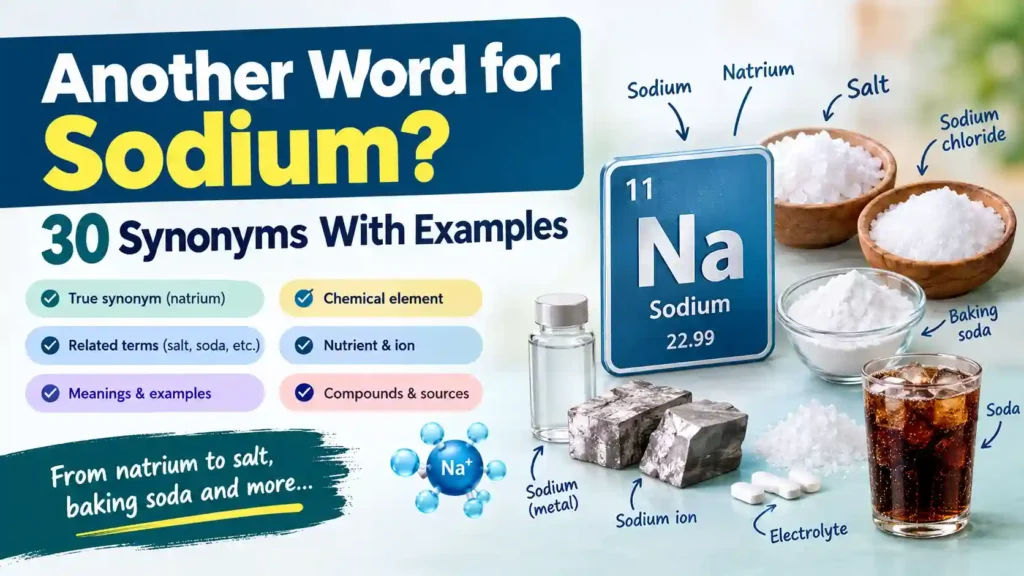
Sodium has only one true synonym: natrium, the element’s Latin-based name, which gives us its symbol, Na. In everyday English, people often use salt, sodium chloride, or soda in its place. These are related terms, not exact synonyms. Salt and soda are compounds that contain sodium, not the element itself.
The best alternative depends on what you mean. Are you writing about the chemical element, the nutrient on a food label, or an ion in the body? Or do you mean a common compound such as table salt or baking soda? This article covers each of these areas.
Quick list: natrium, Na, salt, sodium chloride, table salt, soda, baking soda, alkali metal, electrolyte, mineral
Below, you will find 30 alternatives with meanings, IPA pronunciation, usage notes, and examples. Each entry says clearly whether it is a true synonym or only a related term.
At a Glance: Sodium Synonyms and Related Alternatives
| Alternative | Part of Speech | Meaning | Register / Tone | Ideal Context |
|---|---|---|---|---|
| Natrium | noun | The Latin-based name for sodium | Technical | Chemistry, European languages, history of the symbol |
| Na | symbol | The chemical symbol for sodium | Technical | Periodic table, formulas |
| Salt | noun | Table salt (mainly sodium chloride) | Everyday | Food, cooking, health advice |
| Sodium chloride | noun | The chemical compound NaCl | Formal / technical | Science, medicine, labels |
| Sodium ion | noun | A sodium atom with a positive charge (Na⁺) | Technical | Biology, chemistry |
| Alkali metal | noun | The group of metals sodium belongs to | Technical | Chemistry classes |
| Electrolyte | noun | A substance that carries electric charge in water | Technical / health | Hydration, medicine |
| Mineral | noun | A nutrient the body needs from food | Neutral | Nutrition |
| Soda | noun | Older name for sodium compounds | Mixed | Chemistry, industry, product names |
| Baking soda | noun | Sodium bicarbonate used in baking | Everyday | Cooking, cleaning |
Which Word Should You Use?
| If you want to… | Use | Why |
|---|---|---|
| Name the element in science writing | sodium | It is the standard English name. |
| Write the chemical symbol | Na | It is the international symbol used in formulas. |
| Talk about the origin of the symbol Na | natrium | The symbol comes from this name. |
| Talk about seasoning food | salt | It is the everyday word for what we add to food. |
| Be precise about the compound in salt | sodium chloride | It names the exact substance. |
| Describe sodium’s role in the body | electrolyte or sodium ion | These describe how sodium works in fluids and cells. |
| Describe the nutrient on a label | sodium | Food labels list sodium, not salt, in grams or milligrams. |
| Talk about baking or cleaning powder | baking soda | It is the common name for sodium bicarbonate. |
Exploring the Multiple Meanings of “Sodium”
1. The Chemical Element
- Meaning: A soft, silvery-white metallic element with the symbol Na and atomic number 11.
- Explanation: This is the core scientific meaning. Sodium is very reactive, so it is not found alone in nature. It is found in compounds such as salt.
- Example: Sodium reacts strongly with water, so scientists store it under oil.
2. A Dietary Nutrient
- Meaning: The sodium in food and drink, measured on nutrition labels.
- Explanation: In health writing, “sodium” usually means the sodium part of salt, not salt itself. Salt is about 40% sodium by weight, so the two numbers are different.
- Example: This soup has too much sodium for a low-sodium diet.
3. An Ion in the Body
- Meaning: The positively charged form of sodium (Na⁺) that helps control fluids, nerves, and muscles.
- Explanation: In biology and medicine, sodium works as an electrolyte. Doctors may check “blood sodium” levels.
- Example: The nurse checked the patient’s sodium level after the long race.
4. A Part of Compound Names
- Meaning: A word used to name substances that contain sodium.
- Explanation: Many everyday chemicals include the word, such as sodium bicarbonate and sodium hydroxide. Here, “sodium” tells you which element the compound is built around.
- Example: Sodium bicarbonate is another name for baking soda.
5. Industrial and Technical Uses
- Meaning: Sodium as a material or part of a technology.
- Explanation: Examples include sodium-vapor lamps, which give a yellow-orange glow, and liquid sodium used as a coolant in some nuclear reactors.
- Example: The old street lights were sodium lamps with a warm orange color.
Sources: Merriam-Webster; Collins Dictionary; Britannica; World Health Organization (dietary salt and sodium guidance).
Analyzing 30 Sodium Alternatives in Detail
Only natrium is a direct synonym of sodium. The other 29 words are related terms that name sodium’s symbol, class, compounds, sources, or properties, so each entry says how close it really is.
Group 1: Direct Names and Symbols
1. Natrium
IPA: /ˈneɪtriəm/ (US and UK)
Definition: The New Latin name for sodium.
- Usage: This is the only true synonym. It is rare in English but common in languages such as German, Dutch, and Swedish. It explains why sodium’s symbol is Na.
- Example: The symbol Na comes from natrium, the Latin-based name for sodium.
2. Na
IPA: /ˌɛn ˈeɪ/ (US and UK)
Definition: The chemical symbol for sodium.
- Usage: This is a symbol, not a word you would use in normal sentences. It is used in formulas and tables and is always written with a capital N and lowercase a.
- Example: Na sits in the first column of the periodic table.
3. Sodium ion
IPA: US /ˌsoʊdiəm ˈaɪɑːn/ · UK /ˌsəʊdiəm ˈaɪən/
Definition: A sodium atom that has lost one electron and carries a positive charge, written Na⁺.
- Usage: This is a related term, not an exact synonym. It names the form of sodium found in salt, in water, and in the body.
- Example: Cells move sodium ions in and out to send nerve signals.
Group 2: Chemical and Nutritional Classes
4. Alkali metal
IPA: /ˈælkəlaɪ ˈmɛtəl/ (US and UK)
Definition: A metal from Group 1 of the periodic table, such as lithium, sodium, or potassium.
- Usage: This is a category word, not a synonym. Sodium is one example of an alkali metal. Use it when you explain what kind of element sodium is.
- Example: Sodium is an alkali metal, like potassium and lithium.
5. Alkali
IPA: /ˈælkəlaɪ/ (US and UK)
Definition: A substance that is a strong base and dissolves in water, such as sodium hydroxide.
- Usage: This is a related term and not a synonym. An alkali is a type of compound, not the element sodium. Sodium compounds are often alkalis.
- Example: Caustic soda is a strong alkali.
6. Electrolyte
IPA: /ɪˈlɛktrəlaɪt/ (US and UK)
Definition: A substance that carries an electric charge when dissolved in water.
- Usage: This is a related term, not a synonym. In health writing, sodium is one of the main electrolytes, along with potassium and calcium.
- Example: Sports drinks replace sodium and other electrolytes lost in sweat.
7. Mineral
IPA: /ˈmɪnərəl/ (US and UK)
Definition: A natural substance, or in nutrition, an element the body needs from food.
- Usage: This is a related, general term. In nutrition, sodium is listed as a mineral. Do not use “mineral” to mean sodium alone, because it covers many nutrients.
- Example: Sodium is an essential mineral, but most people get too much of it.
Group 3: Salt and Diet Terms
8. Salt
IPA: /sɔːlt/ (US and UK)
Definition: A white crystal substance, mainly sodium chloride, used to flavor food.
- Usage: The most common everyday alternative, but not an exact synonym. Salt contains sodium and chlorine. Health advice often says “salt” when it means sodium.
- Example: Try not to add too much salt to your meal.
9. Table salt
IPA: US /ˈteɪbəl sɔːlt/ · UK /ˈteɪbəl sɔːlt/
Definition: Refined salt used for cooking and eating, often with added iodine.
- Usage: Related term. It names one kind of salt, not sodium itself.
- Example: A pinch of table salt brings out the flavor of the eggs.
10. Common salt
IPA: US /ˈkɑːmən sɔːlt/ · UK /ˈkɒmən sɔːlt/
Definition: Ordinary salt, or sodium chloride.
- Usage: Related term, mostly used in older or scientific writing to separate it from other chemical salts.
- Example: Common salt is made of sodium and chlorine.
11. Sea salt
IPA: /ˈsiː sɔːlt/ (US and UK)
Definition: Salt made by drying seawater.
- Usage: Related term. It is still mostly sodium chloride, so it is not a low-sodium choice.
- Example: She sprinkled sea salt on the fresh bread.
12. Sodium chloride
IPA: US /ˌsoʊdiəm ˈklɔːraɪd/ · UK /ˌsəʊdiəm ˈklɔːraɪd/
Definition: The chemical compound NaCl, made of sodium and chlorine.
- Usage: The formal name for table salt. Not a synonym for sodium, because it names a compound.
- Example: Sodium chloride dissolves easily in water.
13. NaCl
IPA: /ˌɛn eɪ ˌsiː ˈɛl/ (US and UK)
Definition: The chemical formula for sodium chloride.
- Usage: A formula, not a word for the element. Use it in science writing.
- Example: The teacher wrote NaCl on the board to show the formula for salt.
Group 4: Natural Salt Sources
14. Rock salt
IPA: US /ˈrɑːk sɔːlt/ · UK /ˈrɒk sɔːlt/
Definition: Salt mined from the ground.
- Usage: Related term, mostly sodium chloride.
- Example: The city spread rock salt on icy roads.
15. Halite
IPA: /ˈhælaɪt/ (US and UK)
Definition: The natural mineral form of sodium chloride.
- Usage: Technical term. It names a mineral, not the element.
- Example: Halite forms when salty water dries up.
16. Brine
IPA: /braɪn/ (US and UK)
Definition: Water with a lot of salt in it.
- Usage: Related term. It describes a solution, not sodium itself.
- Example: The olives were stored in brine.
17. Natron
IPA: US /ˈneɪtrɑːn/ · UK /ˈneɪtrɒn/
Definition: A natural salt of sodium carbonate and bicarbonate.
- Usage: Related historical term. It shares an origin with natrium.
- Example: Ancient Egyptians used natron to preserve bodies.
Group 5: Soda Compounds
18. Soda
IPA: US /ˈsoʊdə/ · UK /ˈsəʊdə/
Definition: An old word for some sodium compounds.
- Usage: Related, not a synonym. It can also mean a soft drink.
- Example: The name sodium comes from soda.
19. Soda ash
IPA: US /ˈsoʊdə æʃ/ · UK /ˈsəʊdə æʃ/
Definition: Powdered sodium carbonate.
- Usage: Related industrial term for a compound.
- Example: Factories use soda ash to make glass.
20. Sodium carbonate
IPA: US /ˌsoʊdiəm ˈkɑːrbənət/ · UK /ˌsəʊdiəm ˈkɑːbənət/
Definition: A white compound used in glass and cleaning.
- Usage: Formal name for soda ash. Related term.
- Example: Sodium carbonate softens hard water.
21. Washing soda
IPA: US /ˈwɑːʃɪŋ ˌsoʊdə/ · UK /ˈwɒʃɪŋ ˌsəʊdə/
Definition: Sodium carbonate sold for laundry.
- Usage: Household term. Not the same as baking soda.
- Example: She added washing soda to remove stains.
22. Baking soda
IPA: US /ˈbeɪkɪŋ ˌsoʊdə/ · UK /ˈbeɪkɪŋ ˌsəʊdə/
Definition: Sodium bicarbonate, used in baking and cleaning.
- Usage: Related everyday term. It contains sodium but is not sodium.
- Example: Add one teaspoon of baking soda.
23. Sodium bicarbonate
IPA: US /ˌsoʊdiəm baɪˈkɑːrbənət/ · UK /ˌsəʊdiəm baɪˈkɑːbənət/
Definition: The chemical name for baking soda.
- Usage: Formal related term.
- Example: Sodium bicarbonate can ease an upset stomach.
24. Caustic soda
IPA: US /ˌkɔːstɪk ˈsoʊdə/ · UK /ˌkɔːstɪk ˈsəʊdə/
Definition: Sodium hydroxide, a strong chemical that burns skin.
- Usage: Related industrial term. Not edible.
- Example: Caustic soda is used to make soap.
25. Sodium hydroxide
IPA: US /ˌsoʊdiəm haɪˈdrɑːksaɪd/ · UK /ˌsəʊdiəm haɪˈdrɒksaɪd/
Definition: A strong alkali, NaOH.
- Usage: Formal name for caustic soda. It names a compound.
- Example: Wear gloves when handling sodium hydroxide.
26. Lye
IPA: /laɪ/ (US and UK)
Definition: A strong alkali, usually sodium hydroxide.
- Usage: Related term. Old lye from wood ashes was potassium-based.
- Example: Soap makers mix lye with oil.
Group 6: Salt-Related Descriptors
27. Sodium salt
IPA: US /ˌsoʊdiəm ˈsɔːlt/ · UK /ˌsəʊdiəm ˈsɔːlt/
Definition: Any chemical salt that contains sodium.
- Usage: This is a related, technical term. It names a whole group of compounds, not the element.
- Example: Table salt is the best-known sodium salt.
28. Saline
IPA: US /ˈseɪliːn/ · UK /ˈseɪlaɪn/
Definition: Containing salt, or a salt-and-water solution used in medicine.
- Usage: This is a related adjective and noun. It is not a synonym for sodium, but it points to sodium chloride in water.
- Example: The nurse cleaned the wound with saline.
29. Saltiness
IPA: /ˈsɔːltinəs/ (US and UK)
Definition: The quality of tasting like salt.
- Usage: This is a related term and describes taste, not the element. Food with a lot of sodium often has strong saltiness.
- Example: The saltiness of the soup was too strong.
30. Salinity
IPA: /səˈlɪnəti/ (US and UK)
Definition: The amount of salt in water or soil.
- Usage: This is a related, technical term used in science and environmental writing. It is the weakest alternative in this list, because it measures salt content, not sodium.
- Example: The salinity of the Dead Sea is far higher than that of the ocean.
Sources: Merriam-Webster; Collins Dictionary; Dictionary.com; Britannica; Etymonline.
Sodium vs. Salt vs. Sodium Chloride vs. Soda
These four words are often mixed up. They are not the same thing.
| Term | What it is | Example of use |
|---|---|---|
| Sodium | A chemical element (Na) and a nutrient | “Check the sodium on the label.” |
| Salt | A common food seasoning, mostly sodium chloride | “Add a little salt.” |
| Sodium chloride | The exact chemical compound in table salt (NaCl) | “Sodium chloride is made of sodium and chlorine.” |
| Soda | An older word for some sodium compounds, or a soft drink | “Baking soda is sodium bicarbonate.” |
Salt is about 40% sodium by weight. This means that 1 gram of sodium comes from roughly 2.5 grams of salt. Health guidelines, such as those from the World Health Organization, often give advice in both forms, so check whether a number refers to salt or to sodium.
Sources: World Health Organization; Merriam-Webster; Britannica.
Sodium and Opposite/Paired Word Pairs
| Word | Paired Word | Note |
|---|---|---|
| Sodium | Potassium | A common pair of nutrients and electrolytes. They work together in the body, so this is a pair, not an opposite. |
| Sodium | Chlorine / Chloride | Together they make table salt. |
| High-sodium | Low-sodium | A common contrast on food labels. |
| Sodium | Sodium-free | Describes foods with little or no sodium. |
| Hypernatremia | Hyponatremia | Medical terms for too much and too little sodium in the blood. |
| Sodium | Water | Sodium reacts strongly with water, which is why they are often discussed together in science lessons. |
Sodium has no true opposite, because it is an element and not a quality. The useful contrasts come from amount (high or low) and from partners, such as chloride and potassium.
Sources: Merriam-Webster; Britannica; National Institutes of Health.
Common Word Partners of “Sodium”
| Pattern | Common Partners | Example |
|---|---|---|
| sodium + noun | sodium intake, sodium content, sodium level, sodium ion | Check the sodium content on the label. |
| adjective + sodium | low-sodium, high-sodium, reduced-sodium | She follows a low-sodium diet. |
| sodium + compound | sodium chloride, sodium bicarbonate, sodium hydroxide, sodium carbonate | Sodium bicarbonate is used in baking. |
| verb + sodium | reduce, cut, limit, add | Try to cut sodium in your meals. |
| sodium + equipment | sodium-vapor lamp, sodium coolant | Sodium-vapor lamps light some roads. |
| sodium + body term | blood sodium, sodium balance, sodium-potassium pump | Doctors check blood sodium after severe sweating. |
Sources: Collins Dictionary; Merriam-Webster; Britannica.
Idiomatic Phrases Featuring “Sodium”
“Sodium” is a technical word, so it has no genuine idioms. The classic idioms in this area use “salt,” not “sodium.” Below are four established expressions that contain “sodium.” They are fixed terms of science and health, not idioms.
1. Sodium chloride
- Meaning: The scientific name for table salt.
- Example: The label lists sodium chloride as the main ingredient.
2. Low-sodium diet
- Meaning: An eating plan that limits foods high in sodium.
- Example: His doctor put him on a low-sodium diet.
3. Sodium-potassium pump
- Meaning: A protein in cell walls that moves sodium out of cells and potassium in.
- Example: The sodium-potassium pump helps nerve cells work.
4. Sodium-vapor lamp
- Meaning: A lamp that makes light by passing electricity through sodium vapor, giving a yellow-orange glow.
- Example: Sodium-vapor lamps were once common on city streets.
Sources: Merriam-Webster; Collins Dictionary; Britannica.
Word Formation of “Sodium”
Etymology & Structure
“Sodium” was formed from soda plus the suffix -ium, which is used for names of metallic elements. The name was created by the English chemist Humphry Davy. “Soda” comes from Medieval Latin, and its earlier origin is less certain.
The symbol Na comes from natrium, a New Latin name connected to natron, the natural salt mixture used since ancient times.
Date and History
Etymonline dates “sodium” to 1807. That is the year Davy isolated the metal by passing electricity through caustic soda.
Word Class Variations
- Noun: sodium (usually uncountable)
- Adjective: sodic (relating to or containing sodium, mainly in science, such as “sodic soil”)
- Combining forms: sodium-free, low-sodium, high-sodium, monosodium
- Verb / adverb: none
Sources: Etymonline; Merriam-Webster; Britannica.
Common Word-Choice Mistakes
- “Salt and sodium are the same”: salt contains sodium, but it is not the same thing. Salt is about 40% sodium.
- “Add 2 grams of sodium to the soup”: say “salt” when you mean the seasoning.
- “Baking soda is sodium”: baking soda is sodium bicarbonate, a compound.
- “Natrium” in everyday English: use “sodium.” Keep “natrium” for talk about the symbol or other languages.
- “Sodium is found as a pure metal in nature”: it reacts too easily, so it is found only in compounds.
- “Caustic soda and baking soda are the same”: caustic soda is sodium hydroxide, which is dangerous, while baking soda is safe to eat.
- “NA” or “na” for the symbol: write it as “Na.”
Frequently Asked Questions
1. What is another word for sodium?
The only true synonym is natrium. Related words include salt, sodium chloride, soda, and the symbol Na.
2. Is salt a synonym for sodium?
No. Salt is a compound that contains sodium. People often use the words loosely in health advice.
3. Why is the symbol for sodium Na?
It comes from natrium, the element’s New Latin name.
4. What is the difference between sodium and sodium chloride?
Sodium is an element. Sodium chloride is a compound of sodium and chlorine, better known as table salt.
5. Is baking soda the same as sodium?
No. Baking soda is sodium bicarbonate, a compound that contains sodium.
6. What is a formal alternative to “salt”?
“Sodium chloride” is the formal, scientific name.
7. Is sodium a metal?
Yes. It is a soft, silvery alkali metal that reacts strongly with water.
8. What is the opposite of sodium?
There is no true opposite. In food and health writing, “low-sodium” or “sodium-free” is the closest contrast.
9. How much sodium is in salt?
About 40% of salt by weight is sodium.
10. Can you say “sodiums”?
It is very rare. Sodium is normally uncountable, so you say “sodium” or “sodium compounds.”
Conclusion
The closest synonym for sodium is natrium, though it is rare in English. Common related words are Na, salt, sodium chloride, and soda. The remaining alternatives name compounds, sources, and descriptions that connect to sodium.
Context matters because most of these words name something that contains sodium, not sodium itself. Salt, baking soda, and caustic soda are very different substances, and the last one is dangerous. Reading labels and science writing correctly depends on these differences.
To choose the right word, ask what you mean: the element, the nutrient, the ion, or a compound. Use “sodium” for the element and nutrient, “salt” for the seasoning, and the full chemical name when you need to be precise.

Hi, I’m Anam, a dedicated writer and curious researcher who believes learning should be simple, useful, and enjoyable. At VistoraDaily, I explore general knowledge, everyday questions, fascinating facts, and helpful information, creating clear content that inspires readers to discover something new.