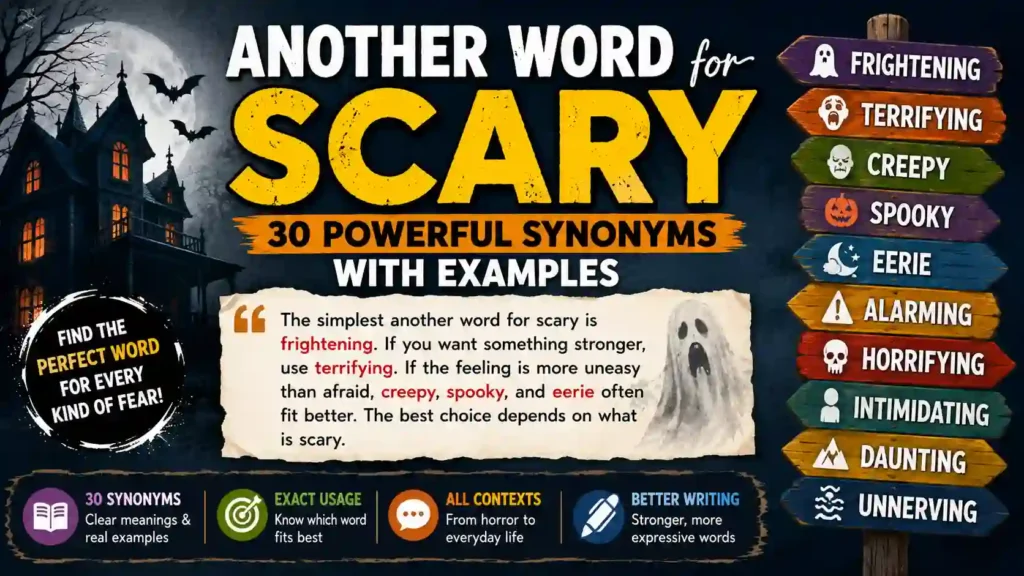
The simplest another word for scary is frightening. If you want something stronger, use terrifying. If the feeling is more uneasy than afraid, creepy, spooky, and eerie often fit better. The best choice depends on what is scary: a dangerous event, a ghost story, a strange place, a threatening person, or a difficult task.
“Scary” covers many kinds of fear, from real danger to playful Halloween fun. That is why one replacement rarely works everywhere. Some words suggest ghosts and mystery, some suggest threat or danger, and some describe worry or pressure instead of fear.
Quick list: frightening, terrifying, creepy, spooky, eerie, alarming, horrifying, intimidating, daunting, unnerving
This article looks at 30 alternatives to “scary.” Each one has a meaning, IPA pronunciation, usage note, and example sentence, so you can see which words are direct synonyms and which only fit certain contexts.
At a Glance: Scary Synonyms and Related Alternatives
| Alternative | Part of Speech | Meaning | Register / Tone | Ideal Context |
|---|---|---|---|---|
| Frightening | Adjective | Causing fear | Neutral | General use in speech and writing |
| Terrifying | Adjective | Causing extreme fear | Neutral, strong | Real danger, intense fear |
| Creepy | Adjective | Causing an uneasy, skin-crawling feeling | Informal | Strange people, places, behavior |
| Spooky | Adjective | Strange and ghostly in a frightening way | Informal, light | Halloween, ghost stories |
| Eerie | Adjective | Strange and unsettling, often quiet | Neutral to literary | Silence, fog, empty places |
| Alarming | Adjective | Causing worry or fear that something is wrong | Neutral to formal | News, reports, warning signs |
| Horrifying | Adjective | Causing shock and strong fear or disgust | Neutral, strong | Violent or shocking events |
| Intimidating | Adjective | Making someone feel afraid or less confident | Neutral | People, places, challenges |
| Daunting | Adjective | Making a task seem hard and worrying | Neutral | Big tasks, new situations |
| Unnerving | Adjective | Making someone feel uneasy or lose confidence | Neutral | Odd sounds, quiet tension |
Which Word Should You Use?
| If you want to… | Use | Why |
|---|---|---|
| Describe ordinary fear in neutral language | frightening | It is the closest everyday synonym and works almost everywhere. |
| Show extreme fear | terrifying | It is stronger than scary and suggests real panic. |
| Describe a quiet, strange place | eerie | It focuses on mood and mystery, not danger. |
| Describe a person or behavior that makes you uneasy | creepy | It suggests discomfort more than real danger. |
| Describe a ghost story or Halloween scene | spooky | It sounds playful and fits ghosts and haunted settings. |
| Describe a warning sign | ominous | It says something bad may happen soon. |
| Describe a hard task that makes you nervous | daunting | It is about difficulty, not horror. |
| Describe a shocking or bloody scene | horrifying or gruesome | Both suggest shock, and gruesome adds disgust. |
| Sound casual and spoken | freaky or hairy | They are informal and fit chatty speech. |
Exploring the Multiple Meanings of “Scary”
1. Causing Fear
- Meaning: Frightening or likely to cause fear.
- Explanation: This is the main sense. It can describe real danger or something that only feels frightening.
- Example: The thunderstorm was so loud that it was scary.
2. Frightening on Purpose (Entertainment)
- Meaning: Made to give people a safe thrill of fear.
- Explanation: In this sense, scary describes stories, films, games, and costumes. People often choose these experiences because they enjoy being frightened.
- Example: We watched a scary movie on Friday night.
3. Worrying or Alarming
- Meaning: Causing serious concern, even if nothing is physically dangerous.
- Explanation: This sense is common in informal speech, often with phrases like “it’s scary how…” The alternatives here are alarming and worrying.
- Example: It’s scary how quickly prices have gone up.
4. Intimidating or Overwhelming
- Meaning: Difficult or nerve-racking to face.
- Explanation: Here, “scary” describes tasks and choices, not monsters. Daunting and intimidating are better in formal writing.
- Example: Speaking in front of a large crowd is scary for many people.
5. Easily Frightened
- Meaning: Timid or quick to become afraid.
- Explanation: This older sense is now uncommon. Etymonline says the Oxford English Dictionary marks it as originally and mainly North American. Today, “scared” or “timid” is clearer.
- Example: The scary little horse jumped at every sound. (uncommon; “easily frightened” is clearer today)
Sources: Etymonline; Merriam-Webster; Collins English Dictionary
Analyzing 30 Scary Alternatives in Detail
Some of these words are direct synonyms of “scary,” while others only fit certain situations, and the usage notes say which is which.
Core Everyday Synonyms
1. Frightening
IPA: /ˈfraɪtnɪŋ/ (US and UK)
Definition: Causing fear or alarm.
- Usage: This is the closest everyday synonym. It is neutral, so it works in speech and writing, and it sounds a little less casual than “scary.”
- Example: The thunder was loud and frightening.
2. Terrifying
IPA: /ˈtɛrɪfaɪɪŋ/ (US and UK)
Definition: Causing extreme fear.
- Usage: A direct synonym, but stronger than “scary.” Use it for real danger or very intense fear.
- Example: The car skidded toward the cliff edge, and the ride became terrifying.
3. Alarming
IPA: US /əˈlɑːrmɪŋ/ · UK /əˈlɑːmɪŋ/
Definition: Causing worry or fear because something may be wrong or dangerous.
- Usage: This is a related alternative that matches the “worrying” sense of “scary.” It is rarely used for ghost stories or horror.
- Example: The report showed an alarming rise in water pollution.
4. Horrifying
IPA: US /ˈhɔːrɪfaɪɪŋ/ · UK /ˈhɒrɪfaɪɪŋ/
Definition: Causing shock and strong fear or disgust.
- Usage: Stronger and darker than “scary.” It adds shock, so it suits violent or upsetting events more than mild fear.
- Example: Witnesses described the horrifying scene after the crash.
5. Fearsome
IPA: US /ˈfɪrsəm/ · UK /ˈfɪəsəm/
Definition: Causing fear because of great size, power, or strength.
- Usage: A related alternative for powerful animals, enemies, or reputations. It is slightly formal and sounds odd for mild situations.
- Example: The wolf had a fearsome reputation among local farmers.
6. Chilling
IPA: /ˈtʃɪlɪŋ/ (US and UK)
Definition: Causing fear in a cold, serious way, often by showing something disturbing.
- Usage: Used figuratively, often for facts, warnings, voices, or stories. It is serious in tone, not playful.
- Example: Her calm voice made the threat even more chilling.
Spooky, Eerie, and Unsettling Alternatives
7. Creepy
IPA: /ˈkriːpi/ (US and UK)
Definition: Causing an uneasy feeling, as if something is strange or slightly threatening.
- Usage: Informal and milder than “terrifying.” It is a related alternative for people, places, or behavior that make you uncomfortable.
- Example: The empty hallway felt creepy at night.
8. Spooky
IPA: /ˈspuːki/ (US and UK)
Definition: Strange and frightening in a way that suggests ghosts.
- Usage: Informal and often light in tone. It is a related alternative, best for haunted places and Halloween.
- Example: We told spooky stories around the campfire.
9. Eerie
IPA: US /ˈɪri/ · UK /ˈɪəri/
Definition: Strange in a way that causes fear or unease, often quiet or mysterious.
- Usage: Focuses on mood, not danger. It suits silence, fog, lights, and sounds, and is a little more formal than “creepy.”
- Example: An eerie silence settled over the empty village.
10. Uncanny
IPA: /ʌnˈkæni/ (US and UK)
Definition: Strange in a way that is hard to explain, sometimes unsettling.
- Usage: Only a related alternative. It does not always mean scary and can simply mean surprisingly accurate, as in “an uncanny resemblance.”
- Example: The robot’s face had an uncanny likeness to a real person.
11. Ghostly
IPA: US /ˈɡoʊstli/ · UK /ˈɡəʊstli/
Definition: Like a ghost, or suggesting a ghost; pale and faint.
- Usage: A descriptive related word, not a general synonym. It describes appearance or atmosphere, not every kind of fear.
- Example: A ghostly figure appeared in the fog.
12. Sinister
IPA: US /ˈsɪnɪstər/ · UK /ˈsɪnɪstə/
Definition: Seeming evil or harmful, as if something bad will happen.
- Usage: A related alternative that stresses evil intent more than raw fear. It is formal or literary.
- Example: There was something sinister about the stranger’s smile.
Strong and Dramatic Alternatives
13. Petrifying
IPA: /ˈpɛtrɪfaɪɪŋ/ (US and UK)
Definition: So frightening that a person cannot move or think clearly.
- Usage: A very strong synonym, often used in a dramatic or exaggerated way in everyday speech.
- Example: The thought of speaking on stage was petrifying.
14. Bloodcurdling
IPA: US /ˈblʌdˌkɜːrdlɪŋ/ · UK /ˈblʌdˌkɜːdlɪŋ/
Definition: Causing great horror or fear.
- Usage: Vivid and dramatic. It is most often used with screams, cries, or sounds.
- Example: A bloodcurdling scream came from the basement.
15. Hair-raising
IPA: US /ˈher ˌreɪzɪŋ/ · UK /ˈheə ˌreɪzɪŋ/
Definition: Causing great fear or excitement.
- Usage: Informal. It fits dangerous adventures, rides, and stories, and can also mean thrilling.
- Example: He told a hair-raising story about crossing the mountain pass.
16. Harrowing
IPA: US /ˈhæroʊɪŋ/ · UK /ˈhærəʊɪŋ/
Definition: Very upsetting and distressing to experience or watch.
- Usage: A related alternative. It stresses suffering and distress, not ghost-style fear, so use it for real ordeals.
- Example: Survivors gave a harrowing account of the flood.
17. Spine-tingling
IPA: /ˈspaɪn ˌtɪŋɡlɪŋ/ (US and UK)
Definition: Causing a thrill of fear or excitement.
- Usage: A related alternative that is often positive. It suits entertainment and exciting moments more than real danger.
- Example: The film ends with a spine-tingling chase through the woods.
Threatening and Intimidating Alternatives
18. Menacing
IPA: /ˈmɛnəsɪŋ/ (US and UK)
Definition: Seeming likely to cause harm; threatening.
- Usage: A related alternative for people, looks, tones, and objects that seem dangerous. It suggests threat more than fear.
- Example: The dog gave a low, menacing growl.
19. Ominous
IPA: US /ˈɑːmɪnəs/ · UK /ˈɒmɪnəs/
Definition: Suggesting that something bad is about to happen.
- Usage: A related alternative about warning signs, not fear itself. It is common in news writing and stories.
- Example: Ominous clouds gathered over the hills.
20. Intimidating
IPA: /ɪnˈtɪmɪdeɪtɪŋ/ (US and UK)
Definition: Making someone feel afraid, nervous, or less confident, often because of size, power, or manner.
- Usage: A related alternative that works for people, places, and challenges. It is softer than “terrifying.”
- Example: The tall, silent guard looked intimidating.
21. Forbidding
IPA: US /fərˈbɪdɪŋ/ · UK /fəˈbɪdɪŋ/
Definition: Looking unfriendly or threatening, and hard to approach.
- Usage: A related alternative for places, buildings, and expressions. It is formal or literary.
- Example: The old castle looked dark and forbidding.
22. Daunting
IPA: /ˈdɔːntɪŋ/ (US and UK)
Definition: Making you feel worried or less confident because something seems difficult.
- Usage: A related alternative for the “scary because it is hard” sense. It does not suit ghost stories or horror.
- Example: Moving to a new country can be a daunting step.
Informal and Tension-Related Alternatives
23. Freaky
IPA: /ˈfriːki/ (US and UK)
Definition: Strange or frightening in an odd way.
- Usage: Very informal. It is only a loose alternative, because it can mean “strange” without any fear.
- Example: That freaky noise woke me up.
24. Hairy
IPA: US /ˈheri/ · UK /ˈheəri/
Definition: Dangerous or frightening, especially in a risky situation.
- Usage: An informal related alternative for tense, risky moments. It does not suit ghost stories.
- Example: The drive over the icy pass got a bit hairy.
25. Nerve-racking
IPA: US /ˈnɜːrv ˌrækɪŋ/ · UK /ˈnɜːv ˌrækɪŋ/
Definition: Causing great nervousness or tension.
- Usage: A related alternative. It describes anxiety about an event, not horror.
- Example: Waiting for the test results was nerve-racking.
26. Unnerving
IPA: US /ʌnˈnɜːrvɪŋ/ · UK /ʌnˈnɜːvɪŋ/
Definition: Making someone lose confidence or feel uneasy or afraid.
- Usage: A related alternative that is milder than “terrifying.” It fits quiet tension and strange situations.
- Example: It was unnerving to hear footsteps above us in an empty house.
Dark, Gory, and Literary Alternatives
27. Macabre
IPA: /məˈkɑːbrə/ (US and UK)
Definition: Strange and frightening because it involves death or violence.
- Usage: A related alternative that is formal or literary. It is for dark subject matter, not everyday fear.
- Example: The museum had a macabre collection of old medical tools.
28. Gruesome
IPA: /ˈɡruːsəm/ (US and UK)
Definition: Causing horror or disgust because of violence or blood.
- Usage: A related alternative. It points to gore and shock, so it does not suit a merely spooky scene.
- Example: The detective described a gruesome discovery in the woods.
29. Nightmarish
IPA: US /ˈnaɪtmerɪʃ/ · UK /ˈnaɪtmeərɪʃ/
Definition: Like a nightmare; very frightening or unpleasant.
- Usage: A figurative, dramatic word. It often describes long, stressful experiences, not a single moment.
- Example: The journey home turned into a nightmarish ordeal.
30. Frightful
IPA: /ˈfraɪtfəl/ (US and UK)
Definition: Very frightening or shocking.
- Usage: Formal or old-fashioned. In British English it can also mean “very bad” or “extreme” (as in “a frightful mess”), so check the context.
- Example: The storm made a frightful noise.
Sources: Merriam-Webster; Collins English Dictionary; Dictionary.com
Scary vs. Frightening vs. Terrifying vs. Horrifying: How Strong Is Each Word?
These four words are close, but they differ in strength and in what they suggest.
| Word | Strength | Usually Describes | Example |
|---|---|---|---|
| Scary | Light to medium | Everyday fear, films, stories, worries | The dark road was scary. |
| Frightening | Medium | Real fear in neutral, clear language | The sudden crash was frightening. |
| Terrifying | Strong | Extreme fear, real danger | The earthquake was terrifying. |
| Horrifying | Very strong | Shock, violence, disgust | The accident scene was horrifying. |
“Scary” is the most flexible and the most casual. In formal writing, “frightening” is usually the safer choice. Choose “terrifying” or “horrifying” only when the situation truly matches that level of fear or shock.
Sources: Merriam-Webster; Collins English Dictionary
Scary and Opposite/Paired Word Pairs
| Word | Paired Word | Note |
|---|---|---|
| Scary | Comforting | A common contrast for things that bring ease instead of fear. |
| Scary | Reassuring | Fits news, voices, and facts that calm worry. |
| Scary | Harmless | Used when something looks frightening but is not dangerous. |
| Scary | Safe | Contrasts danger with security. |
| Frightening | Soothing | Fits sounds, music, and touch that calm someone. |
| Alarming | Encouraging | Contrasts bad warning signs with good news. |
| Scary | Scared | Not opposites. “Scary” describes the cause, and “scared” describes the person who feels fear. |
True opposites of “scary” depend on the sense. If something causes fear, the opposite is calming or safe. If a task is scary, the opposite may be easy or manageable. “Brave” is the opposite of “scared,” not of “scary.”
Sources: Merriam-Webster; Collins Thesaurus
Common Word Partners of “Scary”
| Pattern | Common Partners | Example |
|---|---|---|
| scary + noun | movie, story, monster, noise, thought, experience, moment | That was a scary moment for everyone. |
| adverb + scary | really, pretty, so, a bit, kind of, downright | The old house was downright scary. |
| scary + for / to | for kids, to think about, to watch | It is scary to think about what could have happened. |
| it’s scary how… | it’s scary how fast, how much, how easily | It’s scary how fast time passes. |
| linking verb + scary | be, sound, look, seem, feel | The story sounds scary. |
Sources: Collins English Dictionary; Merriam-Webster
Idiomatic Phrases Featuring “Scary”
“Scary” has few traditional idioms. The items below are better described as established informal expressions.
1. Scary good
- Meaning: Informal. Extremely or surprisingly good, so good it is almost unnerving. It matches the positive use of “scarily” recorded in the 1960s.
- Example: Her drawing skills are scary good.
2. A scary thought
- Meaning: An idea that is worrying or uncomfortable to imagine.
- Example: Losing all my photos is a scary thought.
3. Scary stuff
- Meaning: Informal. Frightening things in general, such as films, events, or topics.
- Example: I can’t watch scary stuff before bed.
4. Scary movie
- Meaning: A common phrase for a horror film, especially in everyday speech.
- Example: We picked a scary movie for Halloween night.
Sources: Etymonline; Merriam-Webster
Word Formation of “Scary”
Etymology & Structure
“Scary” is formed from the noun scare plus the adjective ending -y, which means “full of” or “characterized by.” It comes from scare (noun) and the suffix -y. The noun scare developed from the verb. The verb scare is an unusual change from Middle English skerren, “to frighten,” which came from Old Norse skirra.
Date and History
The sense “terrifying, causing fright” dates from the 1580s. The sense “easily frightened” appeared around 1800, and the Oxford English Dictionary marks it as originally and chiefly North American. The noun scare is recorded from the 1520s, first meaning “something that frightens, a scarecrow.”
Word Class Variations
- Adjective: scary (comparative: scarier; superlative: scariest). “Scarey” is recorded as a variant spelling, but “scary” is the standard form.
- Adverb: scarily. It is recorded from 1845 with the meaning “timidly,” and by 1967 it was also used in a positive sense, “unnervingly,” as in “scarily good.”
- Noun (related): scare, as in “a health scare.”
- Verb (related): scare, as in “Don’t scare the cat.”
- Adjective (related): scared, as in “I’m scared.” It dates from the mid-1400s.
- Noun (derived): scariness, meaning the quality of being scary.
Sources: Etymonline (entries for scary, scarily, scare, scared)
Common Word-Choice Mistakes
- She is scary of spiders: she is scared of spiders.
- I felt scary during the storm: I felt scared (people feel scared; things are scary).
- The movie was very scared: the movie was very scary.
- The exam was spooky: the exam was daunting or nerve-racking (“spooky” needs a ghostly or strange mood).
- It was a daunting ghost story: it was a spooky or scary ghost story (“daunting” means hard to face).
- The monster attack was creepy: the monster attack was terrifying (“creepy” is milder and suggests unease).
- The ghost story had a gruesome atmosphere: the ghost story had an eerie atmosphere (“gruesome” means bloody or disgusting).
Frequently Asked Questions
What is the closest synonym for scary?
“Frightening” is the closest everyday synonym. “Terrifying” is the stronger choice.
What is a formal alternative to scary?
“Frightening,” “alarming,” “ominous,” and “menacing” all work in formal writing. “Frightful” is also formal but sounds old-fashioned.
What is the difference between scary and scared?
“Scary” describes what causes fear, and “scared” describes how a person feels. A film is scary, and the viewer is scared.
What is the difference between scary and creepy?
“Scary” covers many kinds of fear. “Creepy” describes an uneasy, skin-crawling feeling, often about strange people or places.
What is a good word for scary in a children’s story?
“Spooky,” “eerie,” and “creepy” are usually better than “terrifying” or “horrifying,” which are too strong.
What is a literary alternative for scary?
“Macabre,” “sinister,” “nightmarish,” “ghostly,” and “ominous” suit stories and descriptive writing.
What is the opposite of scary?
It depends on the sense, but “comforting,” “reassuring,” “harmless,” and “calming” are common opposites.
Can scary mean worrying?
Yes. In phrases like “it’s scary how fast prices rise,” it means worrying or alarming, and “alarming” is the formal alternative.
Can scary describe people?
Yes. A scary person is one who causes fear. “Intimidating” and “menacing” are more precise.
Is “scarey” a correct spelling?
“Scary” is the standard spelling. Etymonline records “scarey” as a variant, but it is uncommon and best avoided.
Conclusion
The closest everyday alternatives to “scary” are “frightening” and “terrifying.” For milder, stranger feelings, “creepy,” “spooky,” and “eerie” often fit better. For danger and shock, “horrifying,” “menacing,” and “ominous” are stronger options.
Context matters because “scary” covers different kinds of fear. Ghosts, threats, shocking events, and hard tasks each call for different words. Using “daunting” for a ghost story or “spooky” for an exam creates a mismatch.
To choose well, first decide what is causing the fear and how strong it is. Then pick the word that matches the situation, the tone, and the audience.

Hi, I’m Anam, a dedicated writer and curious researcher who believes learning should be simple, useful, and enjoyable. At VistoraDaily, I explore general knowledge, everyday questions, fascinating facts, and helpful information, creating clear content that inspires readers to discover something new.