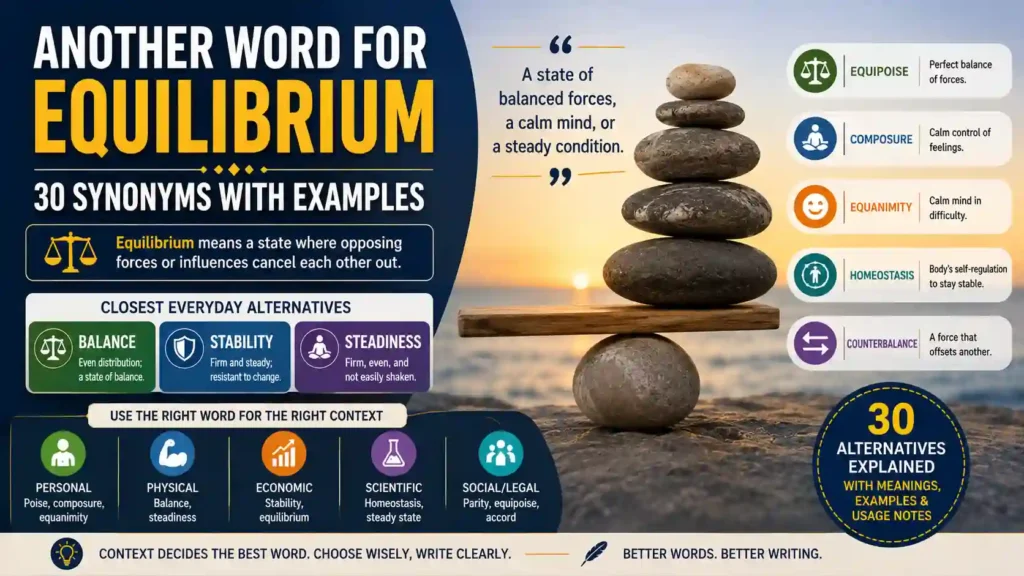
The closest everyday alternatives to equilibrium are balance, stability, and steadiness. For a calm mind, use poise, composure, or equanimity. For science, use homeostasis or steady state. The best choice depends on whether you mean physical balance, emotional calm, fair equality, or a state where opposing forces cancel out.
Equilibrium is a noun. It can describe a balanced object, a calm person, a stable market, or a chemical reaction that has stopped changing overall. Some alternatives fit all of these senses, while others fit only one.
Quick list: balance, stability, steadiness, poise, equipoise, composure, equanimity, symmetry, parity, homeostasis
This article covers 30 alternatives, with meanings, IPA, usage notes, examples, and context, so you can pick the word that fits your sentence.
At a Glance: Equilibrium Synonyms and Related Alternatives
| Alternative | Part of Speech | Meaning | Register / Tone | Ideal Context |
|---|---|---|---|---|
| Balance | noun | Even distribution of weight or forces | Neutral, everyday | General use, physical or abstract |
| Stability | noun | Resistance to change or collapse | Neutral to formal | Economy, structures, relationships |
| Equipoise | noun | Perfect balance of forces or interests | Formal, literary | Writing, philosophy, law |
| Poise | noun | Steady, balanced manner | Neutral, positive | Describing people |
| Steadiness | noun | Firm, unshaken condition | Neutral | Body, hands, mood, progress |
| Parity | noun | Equal standing or value | Formal | Pay, scores, comparisons |
| Composure | noun | Calm control of feelings | Neutral to formal | Stress, pressure |
| Equanimity | noun | Calm mind during difficulty | Formal, literary | Reflective or serious writing |
| Homeostasis | noun | Body’s self-regulation to stay stable | Technical | Biology, medicine |
| Counterbalance | noun | A force that offsets another | Neutral to formal | Opposing forces or influences |
Which Word Should You Use?
| If you want to… | Use | Why |
|---|---|---|
| Describe a general, everyday state of evenness | balance | It is the most common and flexible word. |
| Describe a calm mind under pressure | composure or equanimity | Both focus on emotional control, not physical forces. |
| Describe a body or object staying upright | balance or steadiness | These are plain words for physical steadiness. |
| Describe a system that resists change | stability | It stresses lasting, unshaken conditions. |
| Describe how a living body keeps its internal conditions steady | homeostasis | It is the exact scientific term. |
| Describe two sides with equal strength or value | parity or equipoise | Both focus on equality between two things. |
| Describe one force offsetting another | counterbalance | It names the offsetting force, not the whole state. |
| Describe a deadlock where neither side moves | stalemate | It is related to equilibrium but suggests being stuck. |
Exploring the Multiple Meanings of “Equilibrium”
1. Physical Balance of Forces
- Meaning: A state in which opposing forces cancel each other, causing no net change in motion.
- Explanation: In physics and mechanics, equilibrium occurs when forces are balanced. A book on a table is in equilibrium because gravity and the table’s upward force are equal.
- Example: The bridge remains in equilibrium because the forces acting on it are balanced.
2. Chemical or Scientific Equilibrium
- Meaning: A state in which a reversible process occurs in both directions at equal rates.
- Explanation: The process does not stop. Instead, the forward and reverse reactions continue at the same rate, creating a stable condition called dynamic equilibrium.
- Example: The reaction reached equilibrium, and the colour stopped changing.
3. Economic Balance
- Meaning: A state where supply and demand are balanced, so prices tend to remain stable.
- Explanation: Economists use equilibrium when discussing markets, prices, and economies. Common terms include market equilibrium and general equilibrium.
- Example: The market moved toward equilibrium as supply and demand became balanced.
4. Mental or Emotional Balance
- Meaning: A calm and steady state of mind, especially after stress or difficulty.
- Explanation: This figurative meaning describes emotional stability and composure.
- Example: She regained her equilibrium after the stressful experience.
5. Bodily Sense of Balance
- Meaning: The ability to remain upright and steady.
- Explanation: This sense relates to the body’s balance system, including the inner ear. Losing equilibrium can cause someone to stumble or fall.
- Example: The rough boat ride caused him to lose his equilibrium.
6. Balance Between Competing Interests
Example: The agreement maintained an uneasy equilibrium between the two countries.When different sides remain balanced.
Meaning: A stable relationship between opposing groups, forces, or influences.
Explanation: This meaning appears in politics, society, and ecology when different sides remain balanced.
Analyzing 30 Equilibrium Alternatives in Detail
Some alternatives below are close synonyms, while others are context-specific words that overlap with only one sense of equilibrium, and each Usage note says which is which.
Core Synonyms
1. Balance
IPA: /ˈbæl.əns/ (US and UK)
Definition: A steady position or condition in which weight or forces are evenly spread.
- Usage: The closest everyday synonym. It works for physical, emotional, and abstract senses. It is less technical than equilibrium.
- Example: She lost her balance on the icy path.
2. Stability
IPA: US /stəˈbɪl.ə.t̬i/ · UK /stəˈbɪl.ə.ti/
Definition: The quality of being firm, steady, and not likely to change or fall.
- Usage: A close synonym when the focus is on lasting steadiness, not on opposing forces. Common in economics, politics, and engineering.
- Example: The country needs economic stability.
3. Equipoise
IPA: US /ˈiː.kwə.pɔɪz/ · UK /ˈek.wɪ.pɔɪz/
Definition: A state of perfect balance between opposing forces or interests.
- Usage: A formal, literary synonym. It is rare in daily speech but fits writing about law, philosophy, and ideas.
- Example: The judge weighed both arguments in careful equipoise.
4. Poise
IPA: /pɔɪz/ (US and UK)
Definition: A calm, balanced, and self-controlled manner.
- Usage: A synonym for the personal or emotional sense. It describes people, not objects or markets.
- Example: She answered the hard question with great poise.
5. Steadiness
IPA: /ˈsted.i.nəs/ (US and UK)
Definition: The quality of being firm, even, and not shaking or changing.
- Usage: A plain, close synonym for physical or emotional balance. It suggests an absence of wobbling or sudden change.
- Example: The surgeon’s steadiness calmed the whole team.
Equality and Evenness Terms
5. Parity
Numbering note: the list continues below from 6.
6. Parity
IPA: US /ˈper.ə.t̬i/ · UK /ˈpær.ə.ti/
Definition: The state of being equal, especially in amount, value, or status.
- Usage: A related alternative, not an exact synonym. It fits equality between two sides, such as pay or scores, but not emotional or physical balance.
- Example: The two teams played at parity for most of the match.
7. Equality
IPA: US /iˈkwɑː.lə.t̬i/ · UK /iˈkwɒl.ə.ti/
Definition: The state of being equal in amount, rank, or value.
- Usage: A related alternative that overlaps with equilibrium only when two sides are evenly matched. It does not describe calm or stability.
- Example: The two armies fought with near equality of strength.
8. Evenness
IPA: /ˈiː.vən.nəs/ (US and UK)
Definition: The quality of being level, regular, or equally spread.
- Usage: A related alternative. It suits balance in distribution or temper, but it is weaker and less technical than equilibrium.
- Example: The evenness of the colour made the wall look new.
9. Symmetry
IPA: /ˈsɪm.ə.tri/ (US and UK)
Definition: Balanced proportions, with parts matching on either side of a dividing line.
- Usage: A related alternative for visual or structural balance. It is not a synonym for forces cancelling each other out.
- Example: The building’s symmetry gives it a calm look.
10. Equivalence
IPA: /ɪˈkwɪv.əl.əns/ (US and UK)
Definition: The state of being equal in value, meaning, or effect.
- Usage: A formal, related alternative. It suits comparisons and logic, not physical or emotional balance.
- Example: The test showed the equivalence of the two methods.
Calm and Emotional Balance
11. Composure
IPA: US /kəmˈpoʊ.ʒɚ/ · UK /kəmˈpəʊ.ʒə/
Definition: A calm, controlled state of mind, especially under stress.
- Usage: A synonym for the emotional sense only. It works well in the phrase “regain your composure.”
- Example: He kept his composure during the long interview.
12. Equanimity
IPA: US /ˌiː.kwəˈnɪm.ə.t̬i/ · UK /ˌek.wəˈnɪm.ə.ti/
Definition: Mental calmness and evenness of temper, especially in difficulty.
- Usage: A formal, close synonym for the emotional sense. It shares its Latin root with equilibrium and suggests lasting calm, not a brief recovery.
- Example: She accepted the loss with equanimity.
13. Calmness
IPA: /ˈkɑːm.nəs/ (US and UK)
Definition: A quiet, peaceful state without worry or strong emotion.
- Usage: A simple, related alternative for the emotional sense. It describes mood but does not suggest balance between forces.
- Example: The calmness of the lake relaxed everyone.
14. Serenity
IPA: US /səˈren.ə.t̬i/ · UK /səˈren.ə.ti/
Definition: A state of being calm, peaceful, and untroubled.
- Usage: A softer, more poetic related alternative. It fits calm places or minds, not scientific balance.
- Example: She found serenity in her morning walks.
15. Self-possession
IPA: /ˌself.pəˈzeʃ.ən/ (US and UK)
Definition: Calm control over one’s feelings and actions, especially in difficult situations.
- Usage: A formal, related alternative close to composure. It applies only to people.
- Example: The young speaker showed remarkable self-possession.
Scientific and Technical Alternatives
16. Homeostasis
IPA: US /ˌhoʊ.mi.oʊˈsteɪ.sɪs/ · UK /ˌhəʊ.mi.əʊˈsteɪ.sɪs/
Definition: The tendency of a living system to keep its internal conditions steady.
- Usage: A technical, context-specific alternative. It is used for living bodies and systems, not for general balance.
- Example: Sweating helps the body maintain homeostasis.
17. Steady state
IPA: /ˌsted.i ˈsteɪt/ (US and UK)
Definition: A condition in which key features of a system stay constant over time.
- Usage: A technical, related alternative. It is close to dynamic equilibrium, but a steady state can involve ongoing input and output without balanced forward and reverse reactions.
- Example: After an hour, the engine reached a steady state.
18. Counterbalance
IPA: US /ˈkaʊn.t̬ɚˌbæl.əns/ · UK /ˈkaʊn.tə.bæl.əns/
Definition: A force or influence that cancels or offsets another.
- Usage: A related alternative. It names the offsetting force, not the entire balanced state.
- Example: The heavy weight acts as a counterbalance to the crane’s arm.
19. Counterpoise
IPA: US /ˈkaʊn.t̬ɚ.pɔɪz/ · UK /ˈkaʊn.tə.pɔɪz/
Definition: A force or weight that balances another; also, a state of balance.
- Usage: A formal, rarer related alternative. It is nearly interchangeable with counterbalance in many contexts.
- Example: The new party acted as a counterpoise to the ruling group.
20. Equipollence
IPA: US /ˌiː.kwəˈpɑː.ləns/ · UK /ˌiː.kwɪˈpɒl.əns/
Definition: Equality of force, power, or effect.
- Usage: A rare, formal related alternative. It is included only for readers of older or technical texts and is seldom used in everyday English.
- Example: The scholar wrote about the equipollence of the two claims.
Settled and Unchanging States
21. Constancy
IPA: US /ˈkɑːn.stən.si/ · UK /ˈkɒn.stən.si/
Definition: The quality of staying the same over time.
- Usage: A related alternative. It matches the “no net change” idea in equilibrium, not the balance of forces.
- Example: The constancy of the temperature helped the experiment.
22. Stasis
IPA: /ˈsteɪ.sɪs/ (US and UK)
Definition: A state in which nothing changes or moves.
- Usage: A related alternative, not an exact synonym. Stasis suggests stillness or stagnation, while equilibrium can be healthy and active.
- Example: The company fell into stasis and stopped growing.
23. Stillness
IPA: /ˈstɪl.nəs/ (US and UK)
Definition: The state of being quiet and without movement.
- Usage: A related alternative that fits only the “no motion” idea. It is poetic and not technical.
- Example: A deep stillness settled over the room.
24. Rest
IPA: /rest/ (US and UK)
Definition: A state of not moving or being in motion.
- Usage: A related alternative used mainly in physics. An object “at rest” is in static equilibrium if forces on it are balanced.
- Example: The ball stayed at rest until someone pushed it.
25. Standstill
IPA: /ˈstænd.stɪl/ (US and UK)
Definition: A complete stop, with no movement or progress.
- Usage: A related alternative for stopped activity. It suggests blocked progress, unlike calm, balanced equilibrium.
- Example: Traffic came to a standstill.
Harmony and Standoff Terms
26. Harmony
IPA: US /ˈhɑːr.mə.ni/ · UK /ˈhɑː.mə.ni/
Definition: A pleasing state of agreement or balanced fit among parts.
- Usage: A related alternative for balance between people, groups, or elements. It carries a warm tone that equilibrium lacks.
- Example: The family lived in harmony.
27. Accord
IPA: US /əˈkɔːrd/ · UK /əˈkɔːd/
Definition: Agreement or a state of being in harmony.
- Usage: A formal, related alternative. It fits social or political balance but not physical or scientific equilibrium.
- Example: The two sides worked in accord after the long dispute.
28. Stalemate
IPA: /ˈsteɪl.meɪt/ (US and UK)
Definition: A situation in which neither side can win or make progress.
- Usage: A related alternative, not a true synonym. It describes forces in balance, but in a stuck, negative way.
- Example: The talks ended in stalemate.
29. Deadlock
IPA: US /ˈded.lɑːk/ · UK /ˈded.lɒk/
Definition: A situation in which no progress can be made because opposing sides will not give way.
- Usage: A related alternative with a negative tone. It stresses blocked progress, while equilibrium is neutral.
- Example: The vote ended in deadlock.
30. Standoff
IPA: US /ˈstænd.ɔːf/ · UK /ˈstænd.ɒf/
Definition: A situation in which two opposing sides are evenly matched and neither will give way.
- Usage: A related alternative that matches the “opposing forces cancel out” idea in a tense context. It is not used for calm balance.
- Example: The standoff between the two companies lasted months.
Sources: Merriam-Webster; Collins English Dictionary and Collins Thesaurus; Dictionary.com; Cambridge Dictionary; Oxford Learner’s Dictionaries.
Equilibrium vs. Balance vs. Stability vs. Homeostasis
These four words overlap, but each has its own focus.
| Word | Main idea | Typical context | Example |
|---|---|---|---|
| Equilibrium | Opposing forces or processes cancel each other out | Physics, chemistry, economics, emotions | The market reached equilibrium. |
| Balance | Even distribution of weight, amount, or influence | Everyday and general use | Keep a balance between work and rest. |
| Stability | Resistance to change or collapse | Structures, economies, relationships | The bridge has great stability. |
| Homeostasis | A living system keeps its internal conditions steady | Biology, medicine | The body uses homeostasis to control temperature. |
A simple rule: use balance in everyday writing, stability when you stress lasting steadiness, homeostasis for living bodies, and equilibrium when opposing forces or processes cancel out.
Sources: Merriam-Webster; Collins English Dictionary; Encyclopaedia Britannica.
Equilibrium and Opposite/Paired Word Pairs
| Word | Paired Word | Note |
|---|---|---|
| equilibrium | disequilibrium | The standard opposite: a loss of balance. |
| equilibrium | imbalance | A plain, everyday opposite. |
| balance | imbalance | The most common opposite pair in daily English. |
| stability | instability | Used for economies, governments, and structures. |
| stable equilibrium | unstable equilibrium | Physics terms: a system returns or does not return after a push. |
| static equilibrium | dynamic equilibrium | Static means no motion; dynamic means opposing processes continue. |
| calm | turmoil | A contrast for the emotional sense. |
| equilibrium | upheaval | A contrast when order is suddenly disturbed. |
Some pairs are true opposites, such as equilibrium and disequilibrium. Others are contrasts or paired types, such as static and dynamic equilibrium. Choose the pair that matches the sense you mean.
Sources: Merriam-Webster; Collins English Dictionary; Encyclopaedia Britannica.
Common Word Partners of “Equilibrium”
| Pattern | Common Partners | Example |
|---|---|---|
| verb + equilibrium | reach, achieve, maintain, restore, disturb, upset, regain, lose | The system slowly reached equilibrium. |
| adjective + equilibrium | stable, unstable, dynamic, static, thermal, chemical, economic, market | The mixture is in chemical equilibrium. |
| equilibrium + noun | price, point, position, state, constant, condition | The equilibrium price is where supply meets demand. |
| preposition phrases | in equilibrium, out of equilibrium, equilibrium between X and Y | The two forces are in equilibrium. |
| noun + of equilibrium | state of, sense of, point of | The body has a natural sense of equilibrium. |
Sources: Collins English Dictionary; Cambridge Dictionary; Merriam-Webster.
Idiomatic Phrases Featuring “Equilibrium”
Equilibrium has no widely used everyday idioms. The items below are established technical and scholarly expressions, not idioms.
1. Punctuated equilibrium
- Meaning: A theory in evolutionary biology that species stay mostly unchanged for long periods, with short bursts of rapid change. It was proposed by Niles Eldredge and Stephen Jay Gould in 1972.
- Example: The fossil record fits the idea of punctuated equilibrium.
2. Nash equilibrium
- Meaning: A situation in game theory in which no player can gain by changing their own strategy alone, if the others stay the same. It is named after mathematician John Nash.
- Example: The two stores reached a Nash equilibrium in their pricing.
3. Reflective equilibrium
- Meaning: In philosophy, a state of balance reached by adjusting principles and judgments until they fit together. The term was made famous by John Rawls.
- Example: She tested each belief until her views reached reflective equilibrium.
4. General equilibrium
- Meaning: In economics, a state in which supply and demand balance across all markets at once.
- Example: The model studies general equilibrium across the whole economy.
Sources: Merriam-Webster; Encyclopaedia Britannica; Stanford Encyclopedia of Philosophy; Collins English Dictionary.
Word Formation of “Equilibrium”
Etymology & Structure
Equilibrium comes from Latin aequilibrium, from aequilibris (“in equal balance”). That word combines aequus (“equal”) and libra (“balance, scale”). The word is built from equi- (equal) and libr- (balance), with the Latin noun ending -ium.
Date and History
Equilibrium entered English in the early 1600s, first in the sense of equal weight or physical balance. Its figurative meaning of mental or emotional balance developed later.
Word Class Variations
- Noun: equilibrium (plural: equilibria or equilibriums)
- Verb: equilibrate (“to bring into or keep in equilibrium”)
- Noun: equilibration (the act of equilibrating)
- Noun: equilibrist (a person who performs balancing acts)
- Noun: disequilibrium (a loss of balance)
- Adjective use: equilibrium works as a noun adjunct, as in “equilibrium price”
Sources: Etymonline; Merriam-Webster; Collins English Dictionary; Dictionary.com.
Common Word-Choice Mistakes
- Wrong: “The teams ended in equilibrium.” Correction: “The teams ended level” or “the match ended in a tie.”
- Wrong: “The company’s equilibrium sheet.” Correction: “The company’s balance sheet.”
- Wrong: “She is a very equilibrium person.” Correction: “She is a very balanced person” or “an even-tempered person.”
- Wrong: “The equanimity of the scale.” Correction: “The equilibrium of the scale.” Equanimity applies to minds, not objects.
- Wrong: “The body is in stasis and healthy.” Correction: “The body is in homeostasis.” Stasis suggests stagnation.
- Wrong: “We must equilibrium the budget.” Correction: “We must balance the budget.” Equilibrium is not a verb.
- Wrong: “Equillibrium.” Correction: “Equilibrium,” with one l, then two l’s only in -libr- spelling: e-q-u-i-l-i-b-r-i-u-m.
Frequently Asked Questions
What is the closest synonym for equilibrium?
Balance is the closest everyday synonym. It fits physical, emotional, and general uses.
What is a formal alternative?
Equipoise and stability are formal options. Equanimity is formal for the emotional sense.
What is a calm, personal alternative?
Poise, composure, and equanimity describe calm balance in a person.
What is the science term for a living body staying steady?
That term is homeostasis. It describes how living systems keep internal conditions stable.
What is the opposite of equilibrium?
Disequilibrium and imbalance are the main opposites. Upheaval is a contrast in social or emotional contexts.
Can equilibrium be used for people?
Yes. It can mean a person’s emotional balance, as in “regain your equilibrium,” or their physical sense of balance.
What is the difference between equilibrium and balance?
Equilibrium usually involves opposing forces or processes cancelling out and is more technical. Balance is simpler and used more widely.
Is equilibrium the same as stability?
Not exactly. Equilibrium describes forces cancelling out, while stability describes resisting change. A system can be in equilibrium but unstable, like a pencil balanced on its tip.
What is dynamic equilibrium?
It is a state in which opposing processes continue at equal rates, so the overall result does not change. It differs from static equilibrium, where nothing moves.
What is the plural of equilibrium?
Equilibria is the standard plural in science. Equilibriums is also accepted, especially in general writing.
Conclusion
The closest everyday alternatives to equilibrium are balance, stability, and steadiness. For calm minds, poise, composure, and equanimity fit better. For science and technical writing, homeostasis, steady state, and counterbalance are more precise.
Context matters because equilibrium has several senses. It can mean forces cancelling out, a balanced market, a calm mind, or the body’s sense of balance. Words like stalemate and standstill overlap with equilibrium only in part and can add a negative tone.
To choose the right word, first decide which sense you mean. Then match the tone: plain, formal, technical, or poetic. When in doubt, balance is the safest everyday choice.

Hi, I’m Anam, a dedicated writer and curious researcher who believes learning should be simple, useful, and enjoyable. At VistoraDaily, I explore general knowledge, everyday questions, fascinating facts, and helpful information, creating clear content that inspires readers to discover something new.