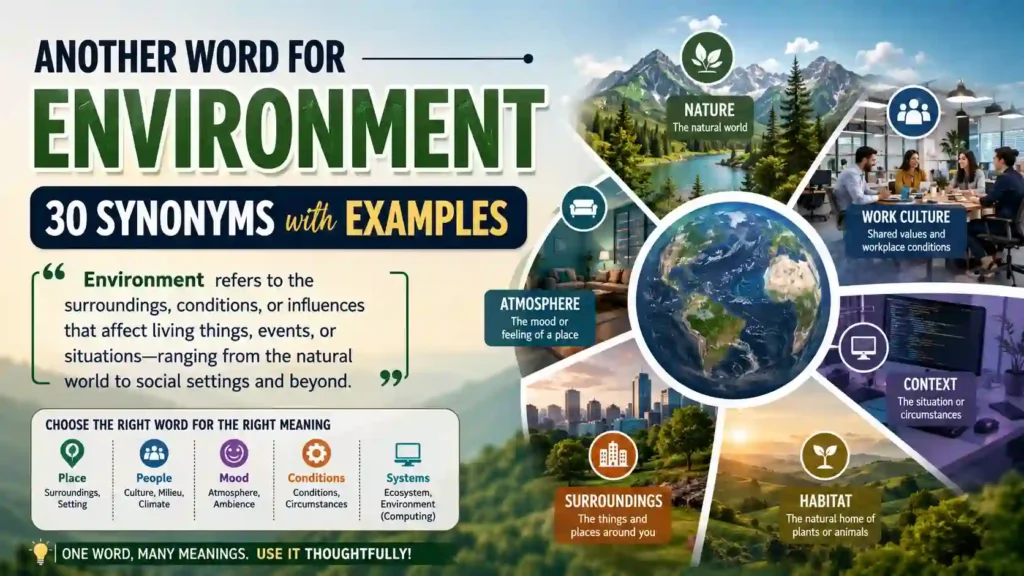
Another word for environment is surroundings, which is the closest everyday alternative. Depending on what you mean, you can also use setting, atmosphere, habitat, nature, conditions, or context. The right choice depends on the sense. “Environment” can mean the place around you, the natural world, the mood of a place, or the conditions that shape how people live and work.
The word covers several areas of meaning. It can describe physical places, wild nature, social and workplace conditions, and even computer settings. Some alternatives fit only one of these areas, so it helps to know which one you mean.
Quick list: surroundings, setting, atmosphere, habitat, ecosystem, nature, milieu, context, conditions, climate
This article looks at 30 alternatives to “environment.” Each comes with a meaning, IPA pronunciation, a usage note, and an example. It also explains when each word fits and when it does not.
At a Glance: Environment Synonyms and Related Alternatives
| Alternative | Part of Speech | Meaning | Register / Tone | Ideal Context |
|---|---|---|---|---|
| Surroundings | Noun (plural) | The things and places around you | Neutral | Everyday description of a place |
| Setting | Noun | The place and conditions where something happens | Neutral | Stories, events, scenes |
| Atmosphere | Noun | The mood or feeling of a place | Neutral | Restaurants, rooms, workplaces |
| Habitat | Noun | The natural home of a plant or animal | Neutral, scientific | Biology, wildlife |
| Nature | Noun | The natural world as a whole | Neutral | Outdoors, conservation |
| Ecosystem | Noun | Living things and their surroundings as one system | Technical, now also figurative | Science, business writing |
| Milieu | Noun | The social or cultural surroundings of a person | Formal, literary | Sociology, biography |
| Context | Noun | The situation in which something happens or is understood | Neutral to formal | Explaining events or meaning |
| Conditions | Noun (plural) | The state of the surroundings that affect people or things | Neutral | Work, weather, living standards |
| Climate | Noun | The general mood or attitude in a group or place | Neutral, figurative | Politics, business, schools |
Which Word Should You Use?
| If you want to… | Use | Why |
|---|---|---|
| Describe the place around you | surroundings | It is the plainest, most direct match. |
| Say where a story or event takes place | setting | It points to place and time together. |
| Describe the mood of a room or venue | atmosphere or ambience | Both focus on feeling, not physical things. |
| Talk about where an animal or plant lives | habitat | It names a natural home. |
| Talk about the whole natural world | nature | “Environment” here means the planet’s living world. |
| Describe how living things and their surroundings work together | ecosystem | It shows that the parts depend on each other. |
| Describe the social world a person grew up in | milieu | It is formal and suggests class, culture, and circle of people. |
| Describe shared attitudes at work or school | culture or climate | Both describe how people behave, not the physical place. |
| Explain the facts around an event | context | It points to the situation that gives something meaning. |
Exploring the Multiple Meanings of “Environment”
1. The Surroundings of a Person or Thing
- Meaning: The conditions, objects, and places around someone or something.
- Explanation: This is the most general sense. It can be physical (a room, a street) or broader (a home life). Here, “surroundings” and “setting” work well.
- Example: The child learned quickly in a calm, bright environment.
2. The Natural World
- Meaning: The air, water, land, plants, and animals, especially as affected by human activity.
- Explanation: Used with “the,” as in “protect the environment.” In this sense, “nature” or “the natural world” often works, but “environment” usually suggests concern for human impact.
- Example: The new law aims to reduce pollution and protect the environment.
3. Social, Cultural, or Workplace Conditions
- Meaning: The social setting and shared conditions in which people live, work, or study.
- Explanation: Here the word is about people and rules, not trees or rivers. “Culture,” “climate,” or “atmosphere” can replace it, depending on the focus.
- Example: She left because the work environment had become stressful.
4. Outside Influences on Development
- Meaning: The non-genetic factors that shape a person or organism, such as upbringing and nutrition.
- Explanation: In science and psychology, “environment” is often contrasted with heredity. “Surroundings” would not fit well here, because the sense is about influence, not place.
- Example: Height depends on both genes and environment.
5. A Computing Setup
- Meaning: The hardware and software conditions in which a program runs or is built.
- Explanation: This sense appears in phrases like “development environment” or “test environment.” Here “setting” or “setup” is sometimes used, but “environment” is the standard technical term.
- Example: The code worked in the test environment but failed on the live site.
Sources: Merriam-Webster; Collins English Dictionary; Dictionary.com.
Analyzing 30 Environment Alternatives in Detail
Some of these words are direct synonyms, while others are related alternatives that match only one sense of “environment.” The usage notes make the difference clear.
Core Synonyms
- surroundings
IPA: /səˈraʊndɪŋz/ (US and UK)
Definition: The things, places, and conditions around a person or thing.- Usage: The closest everyday synonym for the general sense. It is almost always plural. It does not work for the natural world as a global concept.
- Example: She felt calm in her peaceful surroundings.
- setting
IPA: /ˈsɛtɪŋ/ (US and UK)
Definition: The place, time, and conditions in which something happens.- Usage: A direct synonym in the sense of place and conditions, especially for events, stories, and scenes. It is less common for the natural world.
- Example: The old library was the perfect setting for a quiet meeting.
- environs
IPA: /ɪnˈvaɪrənz/ (US and UK)
Definition: The area around a place, especially a town or city.- Usage: Formal and literary. It shares a root with “environment” but means the surrounding area, not conditions or mood. It takes a plural verb.
- Example: The hotel and its environs are popular with hikers.
- milieu
IPA: US /mɪlˈjuː/ · UK /ˈmiːljɜː/
Definition: The social or cultural surroundings in which a person lives or acts.- Usage: A formal near-synonym for the social sense of “environment.” It rarely refers to nature.
- Example: He grew up in a working-class milieu.
- conditions
IPA: /kənˈdɪʃənz/ (US and UK)
Definition: The state of the surroundings that affect how people live, work, or operate.- Usage: A related alternative for the workplace or living sense. It stresses quality, such as safe or poor conditions, not the place itself.
- Example: The workers asked for better conditions.
Natural World Alternatives
- nature
IPA: US /ˈneɪtʃər/ · UK /ˈneɪtʃə/
Definition: The physical world of plants, animals, landscapes, and weather, not made by people.- Usage: Replaces “environment” in the natural-world sense. It is less common in policy writing, where “environment” suggests human impact.
- Example: They spent the weekend close to nature.
- habitat
IPA: /ˈhæbɪtæt/ (US and UK)
Definition: The natural home or environment of an animal or plant.- Usage: A related alternative, narrower than “environment.” It names where a living thing normally lives.
- Example: Wetlands are the habitat of many rare birds.
- ecosystem
IPA: US /ˈiːkoʊˌsɪstəm/ · UK /ˈiːkəʊˌsɪstəm/
Definition: A community of living things and the non-living parts of their surroundings, working as a system.- Usage: A related alternative. It stresses connections between parts, not just the surroundings. It is also used figuratively, as in “the startup ecosystem.”
- Example: Pollution can damage the whole river ecosystem.
- biosphere
IPA: US /ˈbaɪoʊˌsfɪr/ · UK /ˈbaɪəʊˌsfɪə/
Definition: The parts of Earth where life exists, including land, water, and air.- Usage: A scientific, related term. It is much broader than most uses of “environment.”
- Example: Human activity affects the entire biosphere.
- biome
IPA: US /ˈbaɪoʊm/ · UK /ˈbaɪəʊm/
Definition: A large natural region defined by its climate and the plants and animals that live there.- Usage: A technical, related alternative. It names a type of environment, such as desert or rainforest, not environment in general.
- Example: Tundra is a cold, treeless biome.
- landscape
IPA: /ˈlændskeɪp/ (US and UK)
Definition: The visible features of an area of land, including hills, fields, and buildings.- Usage: A related alternative that stresses what you can see. It is also used figuratively, as in “the political landscape.”
- Example: The wind farm changed the landscape of the valley.
Atmosphere and Mood Alternatives
- atmosphere
IPA: US /ˈætməsˌfɪr/ · UK /ˈætməsfɪə/
Definition: The mood or feeling of a place or situation.- Usage: A good alternative when “environment” means the feeling of a place, not its physical features. It does not mean the natural world.
- Example: The café has a warm, friendly atmosphere.
- ambience
IPA: /ˈæmbiəns/ (US and UK)
Definition: The character and mood of a place, especially as created by its design, lighting, or sound.- Usage: A slightly more polished word than “atmosphere,” common in reviews of restaurants and hotels. “Ambiance” is a common variant spelling.
- Example: Soft lighting gave the restaurant a relaxed ambience.
- climate
IPA: /ˈklaɪmət/ (US and UK)
Definition: The general mood, attitude, or conditions in a group, organization, or period.- Usage: A figurative alternative for the social sense of “environment.” It also has a separate weather meaning that does not apply here.
- Example: The company worked to improve the climate for new ideas.
- vibe
IPA: /vaɪb/ (US and UK)
Definition: The mood or feeling that a person or place gives off.- Usage: Informal and conversational. It is a casual alternative to “atmosphere” and does not suit formal writing.
- Example: I like the relaxed vibe of this neighborhood.
- feel
IPA: /fiːl/ (US and UK)
Definition: The general quality or impression of a place or thing.- Usage: A casual, related alternative. It is vague, so it works best when the mood is clear from the sentence.
- Example: The old bookshop has a cozy feel.
Place and Area Alternatives
- locale
IPA: US /loʊˈkæl/ · UK /ləʊˈkɑːl/
Definition: A place where something happens, especially with its particular features.- Usage: A related alternative that stresses location. It is somewhat formal and common in travel and event writing.
- Example: The film’s non-native locale attracted many tourists.
- vicinity
IPA: /vəˈsɪnəti/ (US and UK)
Definition: The area near or around a particular place.- Usage: A related alternative that means “nearby area.” It does not suggest conditions or mood.
- Example: There are several good schools in the vicinity.
- neighborhood
IPA: US /ˈneɪbərˌhʊd/ · UK /ˈneɪbəhʊd/ (British spelling: neighbourhood)
Definition: A part of a town or city, and the people who live there.- Usage: A related alternative for the local, community sense. It is narrower than “environment.”
- Example: They wanted to raise their children in a safe neighborhood.
- area
IPA: US /ˈɛriə/ · UK /ˈeəriə/
Definition: A region or part of a place.- Usage: A plain, general word. It is a weak synonym, useful only when the exact kind of environment does not matter.
- Example: The area around the lake is protected.
- terrain
IPA: /təˈreɪn/ (US and UK)
Definition: The physical features of a stretch of land.- Usage: A related alternative for physical ground only. It does not cover mood or social conditions.
- Example: The rough terrain made the hike difficult.
Social and Situational Alternatives
- context
IPA: US /ˈkɑːntekst/ · UK /ˈkɒntekst/
Definition: The situation or set of facts that surround an event and help explain it.- Usage: A related alternative for situations, not places. It is useful when “environment” means the circumstances that give something meaning.
- Example: You need to understand the historical context of the law.
- backdrop
IPA: US /ˈbækdrɑːp/ · UK /ˈbækdrɒp/
Definition: The background against which events take place.- Usage: A figurative related alternative, common in news and fiction. It suggests a scene behind the action.
- Example: The talks took place against a backdrop of economic worry.
- background
IPA: /ˈbækɡraʊnd/ (US and UK)
Definition: The conditions and past events behind a person or situation.- Usage: A related alternative for the social sense. It points to upbringing or history, not present surroundings.
- Example: Students come from many different backgrounds.
- culture
IPA: US /ˈkʌltʃər/ · UK /ˈkʌltʃə/
Definition: The shared beliefs, habits, and behavior of a group or organization.- Usage: A close alternative in “work culture” and “company culture.” It describes how people behave, not the physical place.
- Example: The firm has a culture of open discussion.
- circumstances
IPA: US /ˈsɜːrkəmˌstænsɪz/ · UK /ˈsɜːkəmstənsɪz/
Definition: The facts and conditions that affect a situation or a person’s life.- Usage: A related alternative for the situational sense. It focuses on events and facts, not on place.
- Example: Children are shaped by the circumstances of their lives.
Formal, Technical, and Wider Alternatives
- medium
IPA: /ˈmiːdiəm/ (US and UK)
Definition: The substance or surroundings in which something lives, moves, or is carried.- Usage: A technical, related alternative. Water is the medium in which fish live. It is not a general synonym.
- Example: Sound travels faster through water than through air, which is a different medium.
- sphere
IPA: US /sfɪr/ · UK /sfɪə/
Definition: An area of activity, interest, or influence.- Usage: A related alternative for a field of life, such as the “public sphere.” It does not mean physical surroundings.
- Example: She is well known in the political sphere.
- element
IPA: /ˈɛlɪmənt/ (US and UK)
Definition: The natural or most suitable surroundings for a person or thing.- Usage: A limited alternative that appears mainly in the phrase “in one’s element.” It is not a general synonym.
- Example: On stage, he is truly in his element.
- realm
IPA: /rɛlm/ (US and UK)
Definition: An area of knowledge, activity, or interest.- Usage: A literary or formal related alternative. It suggests a field or world, not physical surroundings.
- Example: These questions belong to the realm of science.
Sources: Merriam-Webster; Collins English Dictionary; Collins Thesaurus; Dictionary.com.
Environment vs. Surroundings vs. Setting vs. Atmosphere
These four words are the most often confused. They overlap, but each has a main focus.
| Word | Main Focus | Typical Use |
|---|---|---|
| Environment | Conditions and influences, including nature | “A safe learning environment”; “protect the environment” |
| Surroundings | The physical things around you | “Beautiful surroundings” |
| Setting | Place and time of an event | “The setting of the story” |
| Atmosphere | Mood and feeling | “A tense atmosphere” |
“Environment” is the broadest of the four. It can include physical surroundings, mood, and rules or habits. The other three are narrower, so choose them when you want to be more exact.
Sources: Merriam-Webster; Collins English Dictionary; Dictionary.com.
Environment and Opposite/Paired Word Pairs
| Word | Paired Word | Note |
|---|---|---|
| Environment | Heredity / genes | A standard contrast in biology and psychology. |
| Environment | Organism | The surroundings versus the living thing within them. |
| Natural environment | Built environment | Nature compared with roads, buildings, and cities. |
| Indoor environment | Outdoor environment | Common in health and design writing. |
| Environment | Economy | Often paired in policy debates. This is a contrast, not a true opposite. |
“Environment” has no single true antonym. Its natural pairs depend on the sense. In science, the usual contrast is with heredity, as in the nature-versus-nurture debate. In planning and architecture, the useful contrast is between natural and built environments.
Sources: Merriam-Webster; Collins English Dictionary.
Common Word Partners of “Environment”
| Pattern | Common Partners | Example |
|---|---|---|
| Adjective + environment | natural, working, learning, safe, supportive, hostile, healthy | Teachers try to create a safe learning environment. |
| Environment + noun | environment agency, environment minister | The environment minister announced a new plan. |
| Verb + environment | protect, damage, harm, pollute, create, improve | Factories must not pollute the environment. |
| Noun + environment | work, home, business, school | A friendly work environment helps everyone. |
| Type + environment | built, controlled, operating, development | The software runs in a controlled environment. |
Sources: Collins English Dictionary; Merriam-Webster; Oxford Learner’s Dictionaries.
Idiomatic Phrases Featuring “Environment”
“Environment” has few true idioms. The following are established expressions, not idioms in the strict sense.
- Hostile work environment
- Meaning: A workplace where harassment or abuse makes it hard to do a job. It is also a legal term in some countries.
- Example: The employee filed a complaint about a hostile work environment.
- The built environment
- Meaning: The human-made surroundings, such as buildings, roads, and parks.
- Example: The city plans to make the built environment safer for walking.
- Controlled environment
- Meaning: A space where conditions such as temperature or light are carefully managed.
- Example: The plants were grown in a controlled environment.
- Environment-friendly
- Meaning: Not harmful to the natural world. “Environmentally friendly” is the more common form.
- Example: The company switched to environment-friendly packaging.
Sources: Merriam-Webster; Collins English Dictionary; Cambridge Dictionary.
Word Formation of “Environment”
Etymology & Structure
“Environment” comes from the verb environ, meaning “to surround.” Environ came into English from Old French environner, which comes from environ, “around.” That word is built from en- (“in”) and viron (“circle” or “turn”). The suffix -ment turns the verb into a noun that names the state or result of surrounding.
Date and History
Merriam-Webster lists the first known use of “environment” in 1603, in the sense of the state of being surrounded. According to Etymonline, the broader meaning of “surroundings” developed in the 19th century. The sense of the natural world affected by humans became common in the 20th century.
Word Class Variations
- Noun: environment, environments
- Adjective: environmental
- Adverb: environmentally
- Related nouns: environmentalism, environmentalist
- Verb: environ (rare and formal; “to surround”)
- Related noun: environs (plural; “surrounding area”)
Sources: Merriam-Webster; Etymonline; Collins English Dictionary.
Common Word-Choice Mistakes
- The café has a warm environment: the café has a warm atmosphere.
- Please protect the surroundings: please protect the environment (when you mean the natural world as a whole).
- An environmental-friendly product: an environmentally friendly product, or an environment-friendly product.
- The environs of the town is quiet: the environs of the town are quiet (“environs” takes a plural verb).
- A toxic nature at work: a toxic work environment, or a toxic work culture.
- The ecosystem of the room is calm: the atmosphere of the room is calm.
- Enviroment: environment (do not forget the n before -ment).
Frequently Asked Questions
What is the closest synonym for environment?
“Surroundings” is the closest everyday synonym. “Setting” is also close when you mean place and conditions.
What is a formal alternative to environment?
“Milieu” is a formal alternative for social surroundings. “Conditions” and “circumstances” also work in formal writing.
What can I say instead of “work environment”?
You can say “workplace,” “work culture,” “work atmosphere,” or “working conditions.” Each one stresses something slightly different.
What is the difference between environment and ecosystem?
“Environment” is the general word for surroundings and conditions. An “ecosystem” is a system in which living things and their surroundings depend on each other.
What is the difference between environment and habitat?
A habitat is the natural home of a particular plant or animal. An environment is broader and can include human, social, and natural conditions.
What is a casual alternative to environment?
“Vibe” works for mood in informal speech. “Surroundings” is a plain, neutral choice.
Can environment refer to people’s behavior?
Yes. In phrases such as “learning environment” or “work environment,” it describes the social conditions and habits of a group.
Is “environment” the same as “nature”?
Not always. “Nature” refers only to the natural world, while “environment” can also mean social, workplace, or computing conditions.
What is the opposite of environment?
There is no single opposite. In science, the usual contrast is heredity, or genes. In planning, the contrast is the built environment versus the natural environment.
What is a literary alternative to environment?
“Milieu,” “realm,” and “backdrop” suit more literary writing. “Environs” works when you mean the surrounding area.
Conclusion
The closest everyday alternatives to “environment” are “surroundings” and “setting.” For the natural world, “nature,” “habitat,” and “ecosystem” are better. For mood, “atmosphere” and “ambience” fit best.
“Environment” has several senses, so no single synonym works every time. Ask what you mean: the place, the natural world, the mood, or the conditions people live and work in. Words like “culture,” “climate,” and “context” suit social and situational meanings, while “milieu” and “realm” give a more formal tone.
When you choose an alternative, match its main focus to your meaning. Use “surroundings” for physical places, “atmosphere” for feeling, “habitat” for animals and plants, and “conditions” for quality. If none of these fits exactly, “environment” is often still the best word.

Hi, I’m Anam, a dedicated writer and curious researcher who believes learning should be simple, useful, and enjoyable. At VistoraDaily, I explore general knowledge, everyday questions, fascinating facts, and helpful information, creating clear content that inspires readers to discover something new.