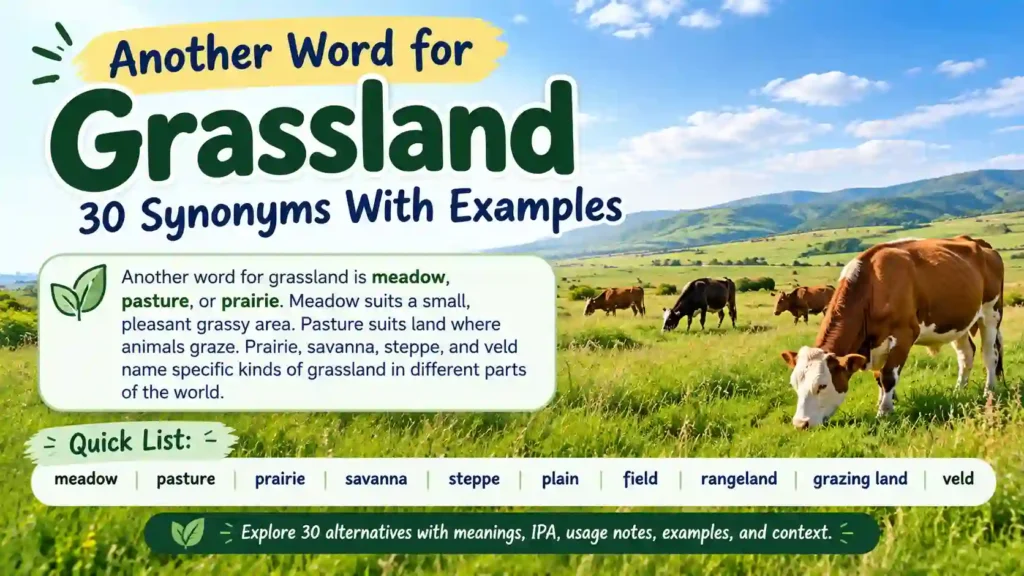
Another word for grassland is meadow, pasture, or prairie. Meadow suits a small, pleasant grassy area. Pasture suits land where animals graze. Prairie, savanna, steppe, and veld name specific kinds of grassland in different parts of the world.
The best alternative depends on meaning and context. Some words describe natural landscapes, some describe farmland, and some are literary. A few describe a surface of short grass, such as a lawn.
Quick list: meadow, pasture, prairie, savanna, steppe, plain, field, rangeland, grazing land, veld
This article covers 30 alternatives with meanings, IPA, usage notes, examples, and context. It marks which words are close synonyms and which only fit certain situations.
At a Glance: Grassland Synonyms and Related Alternatives
| Alternative | Part of Speech | Meaning | Register / Tone | Ideal Context |
|---|---|---|---|---|
| Meadow | noun | Grassy land, often small and moist | Neutral, pleasant | Wildflowers, hay, scenery |
| Pasture | noun | Grassy land used for grazing | Neutral | Farming, livestock |
| Prairie | noun | Large, level or rolling grassland | Neutral | North America |
| Savanna | noun | Tropical grassland with scattered trees | Neutral, scientific | Africa, geography, ecology |
| Steppe | noun | Dry, treeless grassland | Neutral, scientific | Eastern Europe, Asia |
| Veld | noun | Open grassland country | Regional | Southern Africa |
| Pampas | noun | Wide grassy plains | Regional | South America |
| Rangeland | noun | Open land for grazing | Technical | Land management, ranching |
| Plain | noun | Large flat area of land | Neutral | Geography |
| Field | noun | Open area of land | Everyday | General use, farming |
Which Word Should You Use?
| If you want to… | Use | Why |
|---|---|---|
| Describe a small, pretty grassy area | meadow | It suggests grass and wildflowers, often on a small scale |
| Talk about land for cattle or sheep | pasture | It means land used for grazing |
| Name a North American grassland | prairie | It is the standard term for the grasslands of central North America |
| Describe grass with scattered trees in a warm region | savanna | Trees are part of its meaning |
| Describe dry, treeless grassland in Eurasia | steppe | It is the usual term for these temperate grasslands |
| Write a formal land-management report | rangeland | It is technical and means grazing land with natural vegetation |
| Write a poem or fantasy story | lea, sward, or greensward | They sound old and literary |
| Describe a lawn or sports surface | turf or lawn | Grassland usually means a larger, natural area |
Exploring the Multiple Meanings of “Grassland”
1. Natural Land Dominated by Grass
- Meaning: Land where grasses and similar plants are the main vegetation.
- Explanation: This is the main scientific sense. Merriam-Webster defines it as land on which the natural dominant plant forms are grasses and forbs. Forbs are flowering plants that are not grasses.
- Example: Zebras and giraffes roam the grasslands of Africa.
2. Farmland Used for Grazing or Feed
- Meaning: Farmland used mainly for grass or other plants that animals eat.
- Explanation: In this sense, the land is managed by people, not wild. Pasture and hayfield come closest here.
- Example: Most of the farm is grassland, with a small area for crops.
3. An Ecological Community
- Meaning: A community of living things in which grasses are the typical plants.
- Explanation: Scientists use grassland for the whole community, including plants, insects, birds, and animals. The word is then often used before another noun, as in “grassland habitat.”
- Example: The grassland community supports many ground-nesting birds.
4. A Large Named Region
- Meaning: A wide area known for its grass cover, often written in the plural.
- Explanation: The plural, grasslands, usually points to a large region and is common in geography writing.
- Example: The Eurasian grasslands stretch across thousands of kilometers.
Sources: Merriam-Webster (grassland entry).
Analyzing 30 Grassland Alternatives in Detail
Some alternatives below are close synonyms, while others only fit certain contexts, and each Usage note says which.
Everyday Alternatives
1. Meadow
IPA: US /ˈmɛdoʊ/ · UK /ˈmɛdəʊ/
Definition: Land covered mostly with grass, especially low-lying, moist grassland.
- Usage: This is the closest everyday alternative for a small or pleasant grassy area. It often suggests wildflowers or hay. It is less natural for a huge wild region.
- Example: Bees buzzed over the meadow behind the house.
2. Pasture
IPA: US /ˈpæstʃɚ/ · UK /ˈpɑːstʃə/
Definition: Land covered with grass or other plants that animals eat.
- Usage: This is a related word, not an exact synonym. It replaces grassland only when livestock graze there.
- Example: The cows spend the summer in the upper pasture.
3. Field
IPA: /fiːld/ (US and UK)
Definition: An open area of land, often used for crops or animals.
- Usage: This is a broad, everyday word. It does not always mean grass, so “grassy field” is clearer. It usually describes a smaller area than grassland.
- Example: The children played football in the grassy field.
4. Plain
IPA: /pleɪn/ (US and UK)
Definition: A large area of flat land with few trees.
- Usage: This is a related alternative. Plains are often grassy, but plain describes the shape of the land, not the plants.
- Example: Herds of bison once crossed the open plain.
5. Grazing land
IPA: /ˈɡreɪzɪŋ lænd/ (US and UK)
Definition: Land where animals feed on grass.
- Usage: This is a plain, clear phrase for the farming sense of grassland. It is useful in simple explanations.
- Example: Farmers need more grazing land during dry years.
Farming and Grazing Alternatives
6. Pastureland
IPA: US /ˈpæstʃɚˌlænd/ · UK /ˈpɑːstʃəlænd/
Definition: Land used as pasture.
- Usage: This is a slightly more formal form of pasture. It fits farming and land-use writing.
- Example: Much of the valley is pastureland.
7. Rangeland
IPA: /ˈreɪndʒlænd/ (US and UK)
Definition: Open land where livestock graze on natural plants.
- Usage: This is a technical term in land management and ranching. It covers natural grassland, and shrubland that is grazed can count too.
- Example: The agency studies how cattle affect rangeland.
8. Range
IPA: /reɪndʒ/ (US and UK)
Definition: Open land over which livestock can roam and feed.
- Usage: This is a related alternative, common in writing about the American West. Range has many other meanings, so context matters.
- Example: Cowboys drove the herd across the open range.
9. Paddock
IPA: /ˈpædək/ (US and UK)
Definition: A small fenced field for horses or other animals.
- Usage: This is a narrow, related word. It suggests a small, enclosed area. In Australia and New Zealand it is also used for a fenced farm field.
- Example: The foal stayed in the paddock beside the barn.
10. Hayfield
IPA: /ˈheɪfiːld/ (US and UK)
Definition: A field where grass is grown and cut for hay.
- Usage: This is a related alternative for managed grassland. It only fits land cut for animal feed.
- Example: The hayfield was cut twice in July.
11. Pasturage
IPA: US /ˈpæstʃərɪdʒ/ · UK /ˈpɑːstʃərɪdʒ/
Definition: Grass or other plants for grazing, or land used for grazing.
- Usage: This is a formal, older word. It is related to grassland but rare in everyday speech.
- Example: The villagers shared the pasturage on the hills.
Here is the shortened version, about 215 words:
Regional and Ecological Types
12. Prairie
IPA: US /ˈprɛri/ · UK /ˈpreəri/
Definition: A large area of level or rolling grassland, especially in central North America.
- Usage: A specific type of grassland, not a general synonym. Use it mainly for North America.
- Example: Tall grasses covered the prairie.
13. Savanna
IPA: /səˈvænə/ (US and UK)
Definition: Grassland with scattered trees or shrubs, found in warm regions.
- Usage: A related type, not an exact synonym. It does not fit treeless grassland.
- Example: Elephants crossed the savanna at dusk.
14. Steppe
IPA: /stɛp/ (US and UK)
Definition: A large, dry, treeless grassland, especially in southeastern Europe and Asia.
- Usage: A specific type linked to Eurasia. It suggests dry land and open sky.
- Example: Nomads herded horses across the steppe.
15. Veld
IPA: /vɛlt/ (US and UK)
Definition: Open grassland country in southern Africa, usually with few or no trees.
- Usage: A regional term, also spelled veldt.
- Example: The antelope grazed on the open veld.
16. Pampas
IPA: US /ˈpɑːmpəz/ · UK /ˈpæmpəz/
Definition: The wide, treeless grassy plains of South America, especially Argentina.
- Usage: A regional term, usually used with “the.”
- Example: Gauchos once herded cattle across the pampas.
17. Llano
IPA: US /ˈlɑːnoʊ/ · UK /ˈlɑːnəʊ/
Definition: A flat, treeless plain, especially in Spanish-speaking regions of the Americas.
- Usage: A rare regional loanword, related to grassland but not an everyday synonym.
- Example: The road ran straight across the llano.
18. Downland
IPA: /ˈdaʊnlænd/ (US and UK)
Definition: Rolling, grass-covered upland, especially chalk hills in southern England.
- Usage: A British, region-specific word for hill grassland, not flat plains.
- Example: Sheep grazed on the open downland.
Literary and Old-Fashioned Alternatives
19. Lea
IPA: /liː/ (US and UK)
Definition: An area of grassland or meadow.
- Usage: This is a poetic, old-fashioned word. Use it in verse or in deliberately literary writing.
- Example: Cattle wandered slowly across the lea.
20. Mead
IPA: /miːd/ (US and UK)
Definition: A poetic word for meadow.
- Usage: This is archaic or poetic. It looks the same as the honey drink mead, so avoid it where readers might be confused.
- Example: The poem describes a green mead beside a stream.
21. Sward
IPA: US /swɔːrd/ · UK /swɔːd/
Definition: An expanse of short grass, or the grassy surface of land.
- Usage: This is a formal, technical, or literary word. It names the grass layer itself more than a whole landscape.
- Example: The sheep kept the sward short.
22. Greensward
IPA: US /ˈɡriːnswɔːrd/ · UK /ˈɡriːnswɔːd/
Definition: Ground covered with fresh, short grass.
- Usage: This is a literary, related word. It suggests a smooth, green grassy surface, not a wild region.
- Example: They rested on the greensward by the river.
Open Country and Landscape Alternatives
23. Wold
IPA: US /woʊld/ · UK /wəʊld/
Definition: An upland area of open, rolling country.
- Usage: This is a related, literary word, found in names like the Cotswolds. It does not always mean grass.
- Example: The road crossed the windy wold.
24. Parkland
IPA: US /ˈpɑːrklænd/ · UK /ˈpɑːklænd/
Definition: Open land with grass and scattered trees, or land used as a park.
- Usage: This is related to grassland, with trees. It often describes a managed or landscaped area.
- Example: The estate has acres of parkland.
25. Common
IPA: US /ˈkɑːmən/ · UK /ˈkɒmən/
Definition: In Britain, open land that the public or a community may use.
- Usage: This is a British word that describes how land is used, not what grows there. Many commons are grassy, but not all.
- Example: We walked our dog across the common.
26. Open country
IPA: US /ˈoʊpən ˈkʌntri/ · UK /ˈəʊpən ˈkʌntri/
Definition: Land with few trees or buildings.
- Usage: This is a general phrase. It does not say the land is grassy.
- Example: Beyond the town lay miles of open country.
27. Flatland
IPA: /ˈflætlænd/ (US and UK)
Definition: Level land.
- Usage: This is a related word about shape, not plants. It can describe grassland, but also farmland.
- Example: The flatland stretched to the horizon.
Short Grass and Managed Surfaces
28. Lawn
IPA: /lɔːn/ (US and UK)
Definition: An area of closely cut grass, usually near a house or in a park.
- Usage: This is not a synonym for natural grassland. Use it only for a small, tended area.
- Example: She mowed the lawn on Saturday.
29. Turf
IPA: US /tɝːf/ · UK /tɜːf/
Definition: The surface layer of grass and its roots, or grass-covered ground.
- Usage: This is related to grassland. It is common in sports and gardening and rarely describes a wild landscape.
- Example: The ground staff replaced the worn turf.
30. Green
IPA: /ɡriːn/ (US and UK)
Definition: A grassy open area, especially a public one in a village.
- Usage: This is a British-leaning, related word. It suits small shared grass areas, as in “village green.”
- Example: Children played cricket on the village green.
Sources: Merriam-Webster (grassland, meadow, grass entries).
Types of Grassland: Prairie vs. Savanna vs. Steppe vs. Pampas vs. Veld
These five words name grasslands in different parts of the world. They are not interchangeable.
| Word | Typical Region | Key Feature |
|---|---|---|
| Prairie | Central North America | Large, level or rolling grassland |
| Savanna | Warm regions such as Africa | Grass with scattered trees |
| Steppe | Southeastern Europe and Asia | Dry, treeless grassland |
| Pampas | South America, especially Argentina | Wide, treeless grassy plains |
| Veld | Southern Africa | Open grassland, few or no trees |
Use grassland when you mean the general idea, and use a regional word when you are naming a specific place.
Sources: Merriam-Webster (grassland entry).
Grassland and Opposite/Paired Word Pairs
| Word | Paired Word | Note |
|---|---|---|
| Grassland | Forest | The most common contrast: open grass versus trees |
| Grassland | Woodland | Woodland has fewer trees than forest, but still more than grassland |
| Grassland | Desert | Both are open, but a desert has little plant life |
| Grassland | Cropland | Cropland is farmed for crops, not grass |
| Grassland | Wetland | Wetland is wet land such as marsh or swamp |
| Grassland | Shrubland | Shrubland is dominated by shrubs, not grasses |
Grassland has no single true opposite. These words are contrasts, and which one fits depends on what you are comparing, such as trees, water, or farming use.
Sources: Merriam-Webster (grassland entry).
Common Word Partners of “Grassland”
| Pattern | Common Partners | Example |
|---|---|---|
| Adjective + grassland | tropical, temperate, native, open, vast | Native grassland is disappearing in many places. |
| Grassland + noun | habitat, ecosystem, birds, fire | Grassland birds need large, unbroken areas. |
| Verb + grassland | protect, restore, convert, burn | Farmers converted the grassland to cropland. |
| Grassland + preposition | of, across, in | Giraffes roam the grasslands of Africa. |
| Grassland + and + noun | forest, wetland, cropland | The reserve includes grassland and wetland. |
Sources: Merriam-Webster (grassland entry, including its example sentences).
Idiomatic Phrases Featuring “Grassland”
Grassland has no genuine idioms of its own. The expressions below are established ones built on its root word, grass.
1. Put out to grass
- Meaning: To make someone retire or leave a job, often because they are old.
- Example: After forty years with the club, the coach was put out to grass.
2. The grass is always greener on the other side
- Meaning: Other people’s situations seem better than your own.
- Example: She regretted changing jobs and learned that the grass is not always greener.
3. Grassroots
- Meaning: Ordinary people at the local level, especially in politics.
- Example: The campaign grew from grassroots support.
4. Don’t let the grass grow under your feet
- Meaning: Don’t waste time. Act quickly.
- Example: If you want the job, don’t let the grass grow under your feet.
Sources: Merriam-Webster (grass entry, for “put out to grass”).
Word Formation of “Grassland”
Etymology & Structure
Grassland is a compound noun made from two English words: grass and land. Its meaning follows from its parts, which is “land covered with grass.” Most speakers say it as US /ˈɡræsˌlænd/ and UK /ˈɡrɑːslænd/.
Date and History
Merriam-Webster dates the first known use of grassland to the 14th century. The word grass itself goes back to before the 12th century.
Word Class Variations
- Noun: grassland, grasslands (plural)
- Used before another noun: grassland habitat, grassland birds
- Related words from the same root: grass (noun and verb), grassy (adjective)
Grassland has no verb or adverb form.
Sources: Merriam-Webster (grassland and grass entries).
Common Word-Choice Mistakes
- Calling a garden lawn “grassland”: use lawn or turf for a small, mown area.
- Using prairie for every grassland in the world: prairie mainly means central North America.
- Calling a treeless plain a savanna: a savanna has scattered trees.
- Using pasture for wild land: pasture is grazing land used by livestock.
- Calling a huge region a meadow: meadow usually suggests a small, pleasant area.
- “The grassland are wide”: use “The grasslands are wide” or “The grassland is wide.”
- Using steppe for a tropical grassland: steppe is a dry, temperate grassland.
Frequently Asked Questions
What is the closest synonym for grassland?
Meadow is the closest everyday synonym, though it suggests a smaller, gentler area. For a large natural region, use a term like prairie, savanna, or steppe.
What is another word for grassland used for animals?
Pasture, pastureland, and grazing land all describe grassland used for livestock. Rangeland is the technical term for open land grazed on natural plants.
What is the difference between grassland and pasture?
Grassland can be wild or managed. Pasture is grassland used for grazing animals.
What is the difference between a prairie and a savanna?
A prairie is mainly grassland in central North America. A savanna is grassland with scattered trees in warmer regions.
What is a formal alternative to grassland?
Rangeland and pastureland are formal, technical choices for farming and land-management writing.
What is a poetic word for grassland?
Lea, mead, and greensward all sound literary.
What is the opposite of grassland?
There is no single opposite. Forest is the most common contrast, and desert and cropland are also used.
Can grassland mean farmland?
Yes, when the land is used for grazing or feed plants. It does not mean land planted with crops.
Is a lawn a grassland?
Not usually. A lawn is a small, tended area of cut grass, while grassland usually means a larger, natural area.
Is “grasslands” correct?
Yes. The plural usually refers to large regions or several areas, as in “the grasslands of Africa.”
Conclusion
The closest everyday alternatives to grassland are meadow and pasture. For specific regions, prairie, savanna, steppe, veld, and pampas are the precise choices.
Context matters because these words are not equal. Some describe wild landscapes and some describe farmland. Some are poetic, and others describe only a surface of short grass.
To choose the right word, ask three questions: is the land wild or farmed, is it large or small, and does it have trees? Your answers will point to the best alternative.

Hi, I’m Anam, a dedicated writer and curious researcher who believes learning should be simple, useful, and enjoyable. At VistoraDaily, I explore general knowledge, everyday questions, fascinating facts, and helpful information, creating clear content that inspires readers to discover something new.