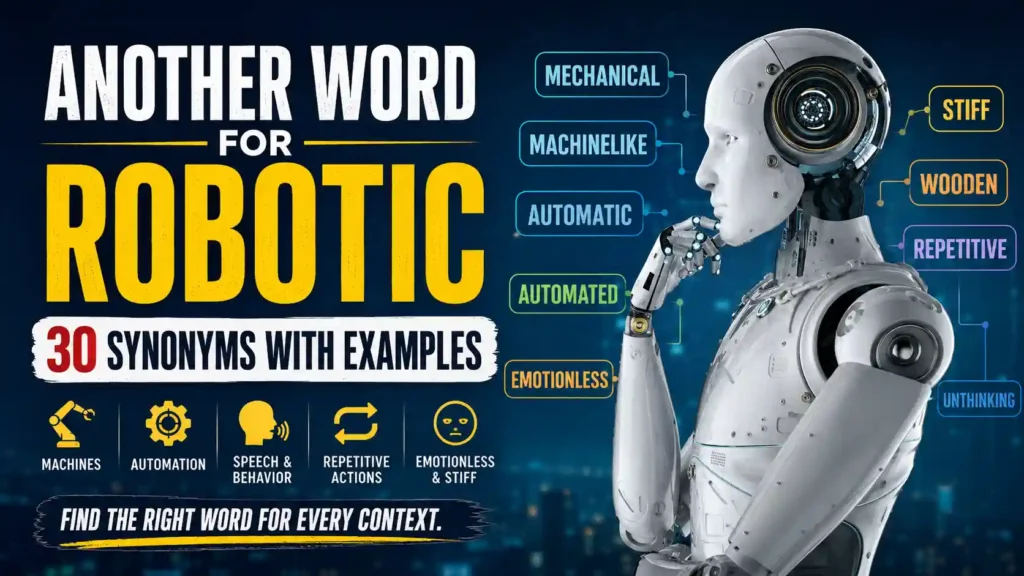
The closest everyday alternatives to “robotic” are mechanical, machinelike, and automatic. If you mean a person who sounds or acts without feeling, try emotionless, wooden, or stilted. If you mean a task done by machines, use automated or mechanized.
The best choice depends on what you are describing. “Robotic” can mean “related to robots,” “done by machine,” “lacking emotion,” “stiff in movement,” or “repeated without thought.” Each meaning has its own best alternatives.
Quick list: mechanical, machinelike, automatic, automated, emotionless, stiff, wooden, repetitive, unthinking
This article looks at 30 alternatives to “robotic.” For each one it gives the meaning, IPA pronunciation, a usage note, and an example sentence. Some are direct synonyms. Others are related words that only fit certain contexts, and the usage notes say which is which.
At a Glance: Robotic Synonyms and Related Alternatives
| Alternative | Part of Speech | Meaning | Register / Tone | Ideal Context |
| Mechanical | Adjective | Done by machine, or done without thought or feeling | Neutral | Machines, routines, manner of speaking |
| Machinelike | Adjective | Like a machine in action or look | Neutral | Movement, precision, behavior |
| Automatic | Adjective | Working by itself with little human control | Neutral | Devices, systems, habits |
| Automated | Adjective | Run by machines or computers instead of people | Neutral, technical | Factories, software, services |
| Emotionless | Adjective | Showing no feeling | Neutral, slightly critical | Voice, face, reaction |
| Impassive | Adjective | Showing no emotion, often on purpose | Formal | Calm face, steady manner |
| Stiff | Adjective | Not relaxed or natural | Neutral, informal | Body language, speech |
| Wooden | Adjective | Stiff and awkward, without natural ease | Neutral, critical | Acting, speeches, movement |
| Repetitive | Adjective | Repeating the same thing again and again | Neutral | Tasks, wording, motions |
| Unthinking | Adjective | Done without thought | Neutral to formal | Habits, obedience, reactions |
Which Word Should You Use?
| If you want to… | Use | Why |
| Describe something related to actual robots | Robotic (or automated) | “Robotic” is the standard word for robot technology, such as a robotic arm. |
| Describe a machine that works by itself | Automatic | It stresses that no one needs to control it each time. |
| Describe a factory or service run by machines | Automated | It suggests machines or computers replaced human steps. |
| Criticize a flat, feelingless voice | Emotionless or monotonous | They focus on missing feeling or a flat tone. |
| Criticize awkward, unnatural acting or speech | Wooden or stilted | They describe a lack of natural ease. |
| Describe a face that shows no reaction | Impassive or expressionless | They suit a calm or blank face. |
| Describe a task that is the same every time | Repetitive or routine | They focus on repetition, not machines. |
| Describe a response given without thinking | Unthinking or reflexive | They stress the lack of thought. |
Exploring the Multiple Meanings of “Robotic”
1. Related to robots
- Meaning: Of or relating to robots or robotics.
- Explanation: This is the most literal sense. It describes machines and technology, not people or behavior.
- Example: The hospital bought a robotic arm for use in surgery.
2. Done by a machine automatically
- Meaning: Carried out by machines that follow set instructions.
- Explanation: This is close to “automated.” It often describes factory work or household devices, such as a robotic vacuum.
- Example: A robotic vacuum cleans the floor while we are at work.
3. Unthinking and machinelike
- Meaning: Resembling the unthinking way a machine works.
- Explanation: Here “robotic” describes a person or action that seems automatic and repeated without thought. It is usually mildly negative.
- Example: He gave the same robotic answer to every question.
4. Lacking emotion
- Meaning: Flat, cold, or without feeling.
- Explanation: This sense is common with voices, speech, and writing. It suggests that someone is not showing normal human warmth or variation.
- Example: Her robotic voice made the apology sound insincere.
5. Stiff and jerky in movement
- Meaning: Moving in a rigid, mechanical way.
- Explanation: This sense applies to the body, such as a walk or dance. It is related to the “robot” dance style, where movements are sharp and separate.
- Example: The actor’s robotic movements fit the part of a toy soldier.
Sources: Merriam-Webster; Britannica Dictionary (Learner’s); Dictionary.com (Collins English Dictionary); American Heritage Dictionary via YourDictionary; WordWeb
Analyzing 30 Robotic Alternatives in Detail
Some of the words below are direct synonyms of “robotic,” while others are related alternatives that fit only one meaning or context. The usage notes make that difference clear.
Group 1: Core Machine-Like Synonyms
1. Mechanical
IPA: /mɪˈkænɪkəl/ (US and UK)
Definition: Done by a machine, or done in a routine way without thought or feeling.
- Usage: A close synonym for “robotic,” especially for the “unthinking” and “feelingless” senses. It is neutral and common in both speech and writing.
- Example: She gave a mechanical smile and walked away.
2. Machinelike
IPA: /məˈʃiːnlaɪk/ (US and UK)
Definition: Like a machine in the way it works or looks.
- Usage: A direct synonym that works for people, movements, and precision. It sounds a little more descriptive than “mechanical.”
- Example: The workers moved with machinelike speed.
3. Robotlike
IPA: US /ˈroʊbɑːtlaɪk/ · UK /ˈrəʊbɒtlaɪk/
Definition: Acting or looking like a robot.
- Usage: A direct synonym, but it is more informal and more literal than “robotic.” It works best for stiff or repetitive behavior.
- Example: The guard stood in a robotlike pose for an hour.
4. Automatic
IPA: /ˌɔːtəˈmætɪk/ (US and UK)
Definition: Working by itself with little or no human control; also done without thinking.
- Usage: A synonym for the “machine does it by itself” sense and the “unthinking” sense. It does not suggest coldness the way “robotic” can.
- Example: The doors are automatic, so they open when you walk up.
5. Automated
IPA: /ˈɔːtəmeɪtɪd/ (US and UK)
Definition: Operated by machines or computers instead of people.
- Usage: A related alternative for the technical sense of “robotic.” It does not describe a person’s manner or emotion.
- Example: The company uses an automated system to sort packages.
6. Programmed
IPA: US /ˈproʊɡræmd/ · UK /ˈprəʊɡræmd/
Definition: Set to act in a fixed way by instructions.
- Usage: A related alternative. It fits machines directly, and it suggests fixed behavior when used for people. It is not an exact synonym.
- Example: The toy is programmed to repeat three phrases.
Group 2: Technical and Industrial Alternatives
7. Mechanized
IPA: /ˈmɛkənaɪzd/ (US and UK)
Definition: Using machines to do work.
- Usage: A related alternative for the “done by machine” sense. It often describes farming, factories, or armies and sounds more formal than “automated.”
- Example: Mechanized farming has reduced the need for hand labor.
8. Computerized
IPA: /kəmˈpjuːtəraɪzd/ (US and UK)
Definition: Controlled, done, or stored by a computer.
- Usage: A related alternative. It points to computers rather than robots, so it is not a full synonym.
- Example: The clinic keeps computerized records.
9. Cybernetic
IPA: US /ˌsaɪbərˈnɛtɪk/ · UK /ˌsaɪbəˈnɛtɪk/
Definition: Relating to cybernetics, the study of control and communication in machines and living things; in fiction, part machine, part human.
- Usage: A context-specific related alternative, mostly used in science, technology, and science fiction. It is not an everyday synonym.
- Example: The film shows a hero with a cybernetic arm.
10. Self-operating
IPA: US /ˌsɛlf ˈɑːpəˌreɪtɪŋ/ · UK /ˌsɛlf ˈɒpəreɪtɪŋ/
Definition: Able to run without someone controlling it.
- Usage: A related alternative that is similar to “automatic.” It describes machines only.
- Example: The garden has a self-operating watering system.
Group 3: Emotionless and Cold Alternatives
11. Emotionless
IPA: US /ɪˈmoʊʃənləs/ · UK /ɪˈməʊʃənləs/
Definition: Showing no emotion.
- Usage: A close synonym for the “lacking emotion” sense. It is neutral to mildly critical.
- Example: He read the news in an emotionless voice.
12. Impassive
IPA: /ɪmˈpæsɪv/ (US and UK)
Definition: Not showing feeling, especially on the face.
- Usage: A formal related alternative. Unlike “robotic,” it can sound calm or controlled, not necessarily cold.
- Example: The judge listened with an impassive face.
13. Unfeeling
IPA: /ʌnˈfiːlɪŋ/ (US and UK)
Definition: Having or showing no kindness or sympathy.
- Usage: A related alternative. It is stronger than “robotic” and judges a person’s character, not just their manner.
- Example: Some customers called the manager unfeeling.
14. Expressionless
IPA: /ɪkˈsprɛʃənləs/ (US and UK)
Definition: Showing no feeling or meaning on the face or in the voice.
- Usage: A close alternative for blank faces and flat delivery. It is more about appearance than behavior.
- Example: The guide gave an expressionless stare.
15. Lifeless
IPA: /ˈlaɪfləs/ (US and UK)
Definition: Lacking energy, liveliness, or interest.
- Usage: A related alternative for flat writing, music, or performance. It is not a direct synonym, because a lifeless thing may not seem machine-made.
- Example: The song sounded lifeless after so many edits.
Group 4: Stiff and Awkward Alternatives
16. Stiff
IPA: /stɪf/ (US and UK)
Definition: Not relaxed or natural in manner or movement.
- Usage: A related alternative for the “stiff movement” sense. It is plain and everyday, and it is less specific than “robotic.”
- Example: His speech was stiff, as if he had memorized every word.
17. Wooden
IPA: /ˈwʊdən/ (US and UK)
Definition: Stiff and awkward, without natural ease.
- Usage: A close alternative when “robotic” means stiff and unnatural. It is often used for acting and public speaking.
- Example: The lead actor was wooden in the first scenes.
18. Stilted
IPA: /ˈstɪltɪd/ (US and UK)
Definition: Stiff and unnatural in speech or writing.
- Usage: A related alternative for language only. It fits formal, overly careful wording.
- Example: Their stilted conversation made the dinner awkward.
19. Jerky
IPA: US /ˈdʒɜːrki/ · UK /ˈdʒɜːki/
Definition: Moving in sudden, uneven starts and stops.
- Usage: A context-specific alternative for the “stiff, sharp movement” sense of “robotic.” It does not suggest lack of feeling.
- Example: The old toy walked with jerky steps.
20. Rigid
IPA: /ˈrɪdʒɪd/ (US and UK)
Definition: Not bending or changing; also strict.
- Usage: A related alternative for stiff bodies or inflexible behavior. It is not a direct synonym for “robotic.”
- Example: He stood rigid when the teacher called his name.
Group 5: Repetitive and Routine Alternatives
21. Routine
IPA: /ruːˈtiːn/ (US and UK)
Definition: Done regularly in the same way, often without much thought.
- Usage: A related alternative for tasks and habits. It is neutral, and it does not mean the same as “emotionless.”
- Example: The work became routine after a few weeks.
22. Repetitive
IPA: /rɪˈpɛtətɪv/ (US and UK)
Definition: Repeating the same thing many times.
- Usage: A close alternative when “robotic” describes a repeated task, motion, or wording.
- Example: The job is repetitive, but the pay is steady.
23. Monotonous
IPA: US /məˈnɑːtənəs/ · UK /məˈnɒtənəs/
Definition: Boring because it never changes, especially in sound or pattern.
- Usage: A close alternative for flat voices and dull routines. It focuses on the lack of variety.
- Example: The speaker’s monotonous tone put the room to sleep.
24. Rote
IPA: US /roʊt/ · UK /rəʊt/
Definition: Done by repeating something from memory without real understanding.
- Usage: A context-specific alternative. It most often describes learning or answers (rote learning).
- Example: The student gave a rote answer instead of explaining it.
25. Perfunctory
IPA: US /pərˈfʌŋktəri/ · UK /pəˈfʌŋktəri/
Definition: Done as a duty, with little care or interest.
- Usage: A formal related alternative. It suggests low effort, which “robotic” does not always imply.
- Example: She gave a perfunctory nod and kept typing.
Group 6: Unthinking and Impersonal Alternatives
26. Unthinking
IPA: /ʌnˈθɪŋkɪŋ/ (US and UK)
Definition: Done or acting without thought.
- Usage: A close alternative for the “robotic” sense of acting without thinking. It can also describe careless behavior.
- Example: The crowd followed the leader with unthinking loyalty.
27. Mindless
IPA: /ˈmaɪndləs/ (US and UK)
Definition: Done without attention or thought.
- Usage: A related alternative that is stronger and more negative than “robotic.”
- Example: The game was mindless fun after a long day.
28. Reflexive
IPA: /rɪˈflɛksɪv/ (US and UK)
Definition: Done automatically, like a reflex, without deciding.
- Usage: A related alternative for quick, automatic reactions. It does not suggest coldness.
- Example: His reflexive answer was “no” before he heard the question.
29. Formulaic
IPA: US /ˌfɔːrmjəˈleɪɪk/ · UK /ˌfɔːmjʊˈleɪɪk/
Definition: Following a fixed pattern, with little that is new.
- Usage: A related alternative for writing, speech, or stories that feel produced from a template. It is not a direct synonym.
- Example: The email was polite but formulaic.
30. Impersonal
IPA: US /ɪmˈpɜːrsənəl/ · UK /ɪmˈpɜːsənəl/
Definition: Without warmth or personal feeling.
- Usage: A related alternative for services, letters, or places that feel cold. It describes a lack of personal touch more than machine-like behavior.
- Example: The phone menu felt impersonal.
Sources: Merriam-Webster; Collins English Dictionary and Dictionary.com; Oxford Learner’s Dictionaries; Britannica Dictionary (Learner’s); WordReference Thesaurus
Robotic vs. Mechanical vs. Automatic
These three words overlap, but they are not the same.
| Word | Main Idea | Often Used For | Example |
| Robotic | Like a robot, or related to robots | Machines, voices, movements | A robotic arm; a robotic reply |
| Mechanical | Done by a machine, or done without thought or feeling | Devices, routines, manners | A mechanical habit |
| Automatic | Works by itself, or happens without thinking | Doors, systems, reactions | An automatic response |
Sources: Merriam-Webster; Dictionary.com (Collins English Dictionary); WordReference Thesaurus
Robotic and Opposite/Paired Word Pairs
| Word | Paired Word | Note |
| Robotic | Human | A common contrast between machine-like and person-like behavior |
| Robotic | Natural | Natural speech or movement sounds relaxed, not stiff |
| Robotic | Expressive | Expressive people show feeling clearly |
| Robotic | Spontaneous | Spontaneous actions are not planned or repeated |
| Robotic | Warm | Warm tone contrasts with a flat, cold manner |
| Robotic (machine sense) | Manual | Manual means done by hand; WordReference lists it as an antonym of “automatic” |
“Robotic” has no single perfect opposite, because it has several meanings. For a flat voice, the opposite is “expressive” or “natural.” For a machine doing a job, the opposite is “manual.” Pick the contrast that fits the meaning you are using.
Sources: WordReference Thesaurus; Merriam-Webster
Common Word Partners of “Robotic”
| Pattern | Common Partners | Example |
| robotic + machine noun | arm, vacuum, device, pet | The robotic arm lifted the box. |
| robotic + manner noun | voice, tone, delivery, movement, answer | His delivery was too robotic. |
| sound / seem / feel + robotic | sounds robotic, seems robotic | The message sounded robotic. |
| adverb + robotic | almost, a little, too | The dance was almost robotic. |
| robotically + verb | nod, repeat, answer | She robotically repeated the rule. |
Sources: Oxford Learner’s Dictionaries; Britannica Dictionary (Learner’s); Merriam-Webster
Idiomatic Phrases Featuring “Robotic”
“Robotic” has no well-known idioms. The phrases below are established expressions, not idioms, because their meaning is clear from their words.
1. Robotic process automation
- Meaning: A technical term for software that performs routine computer tasks.
- Example: The bank uses robotic process automation to check forms.
2. Robotic surgery
- Meaning: Surgery in which a surgeon uses robotic instruments.
- Example: The hospital offers robotic surgery for some operations.
3. Robotic voice
- Meaning: A flat, mechanical-sounding voice, either from a machine or from a person.
- Example: The phone system answered in a robotic voice.
4. Robotic dance
- Meaning: A dance style with sharp, separate, machine-like movements.
- Example: The students performed a robotic dance at the talent show.
Sources: Merriam-Webster; American Heritage Dictionary via YourDictionary; Britannica Dictionary (Learner’s)
Word Formation of “Robotic”
Etymology & Structure
“Robotic” is made from robot plus the suffix -ic. “Robot” comes from the Czech word robota, meaning forced labor or drudgery. Etymonline links it to the Czech robotnik (“forced worker”) and notes that the word was popularized by Karel Čapek’s play R.U.R. (Rossum’s Universal Robots). It also reports, citing Rawson, that Čapek’s brother Josef coined it.
Date and History
Etymonline dates “robot” in English to 1923, from the English translation of the 1920 play. It dates “robotic” to 1941, in Isaac Asimov’s writing, meaning “of or pertaining to robots.” Merriam-Webster also gives 1941 for “robotics.”
Word Class Variations
- Noun: robot, robotics, roboticist (a specialist in robotics), robotism
- Adjective: robotic, robotlike
- Adverb: robotically
- Verb: robotize (first recorded in 1925–30, per Dictionary.com)
- Related noun: robotization
Sources: Etymonline; Merriam-Webster; Dictionary.com (Collins English Dictionary); Oxford Learner’s Dictionaries; Britannica Dictionary (Learner’s)
Common Word-Choice Mistakes
- A robotics voice: a robotic voice.
- Robotical movements: robotic movements.
- A mechanic voice: a mechanical voice.
- He spoke robotic: he spoke robotically (or “like a robot”).
- The robotic is broken: the robot is broken.
- A robotic door that opens by itself: an automatic door.
- Calling a calm, kind person “robotic”: use composed or calm, because “robotic” suggests lack of feeling.
Frequently Asked Questions
What is the closest synonym for “robotic”?
“Mechanical” is the closest everyday synonym. “Machinelike” and “robotlike” are also close.
What is a formal alternative to “robotic”?
“Impassive” and “perfunctory” are more formal, depending on if you mean lack of feeling or lack of care.
What is the difference between “robotic” and “automated”?
“Robotic” can describe machines or a flat, stiff manner. “Automated” describes processes run by machines or computers and is not used for people’s emotions.
Can “robotic” describe a person?
Yes. It usually means the person seems stiff, flat, or unthinking, and it is often mildly negative.
Is “robotic” the same as “mechanical”?
Not exactly. They overlap in meaning, but “robotic” more strongly suggests robots or a robot-like manner, while “mechanical” is broader.
What is a good word for a robotic voice?
“Monotonous,” “emotionless,” and “mechanical” all fit. “Flat” also works in everyday speech.
What word fits a robotic movement?
“Stiff,” “jerky,” and “rigid” all work. “Wooden” suits awkward acting.
What is the opposite of “robotic”?
It depends on the meaning. For manner, use “natural,” “expressive,” or “warm.” For machine work, use “manual.”
Is “robotic” always negative?
No. For machines and technology it is neutral, as in “robotic surgery” or “robotic arm.” It is negative mainly when used for people’s behavior.
What is the adverb of “robotic”?
It is “robotically,” as in “She robotically repeated the instructions.”
Conclusion
The closest everyday alternatives to “robotic” are “mechanical,” “machinelike,” and “automatic.” For technology, “automated” and “mechanized” are often better. For flat or stiff behavior, words such as “emotionless,” “wooden,” and “monotonous” are more precise.
The key is to decide which meaning you need. “Robotic” can describe a real machine, a task done automatically, a lack of emotion, stiff movement, or repeated unthinking behavior. Each meaning points to a different set of words.
To choose well, ask what you want the reader to picture.
When describing a machine at work, use “automated” or “mechanical.” For a flat voice, choose “monotonous” or “emotionless.” If you mean awkward acting or movement, use “wooden,” “stilted,” or “jerky.”

Hi, I’m Anam, a dedicated writer and curious researcher who believes learning should be simple, useful, and enjoyable. At VistoraDaily, I explore general knowledge, everyday questions, fascinating facts, and helpful information, creating clear content that inspires readers to discover something new.