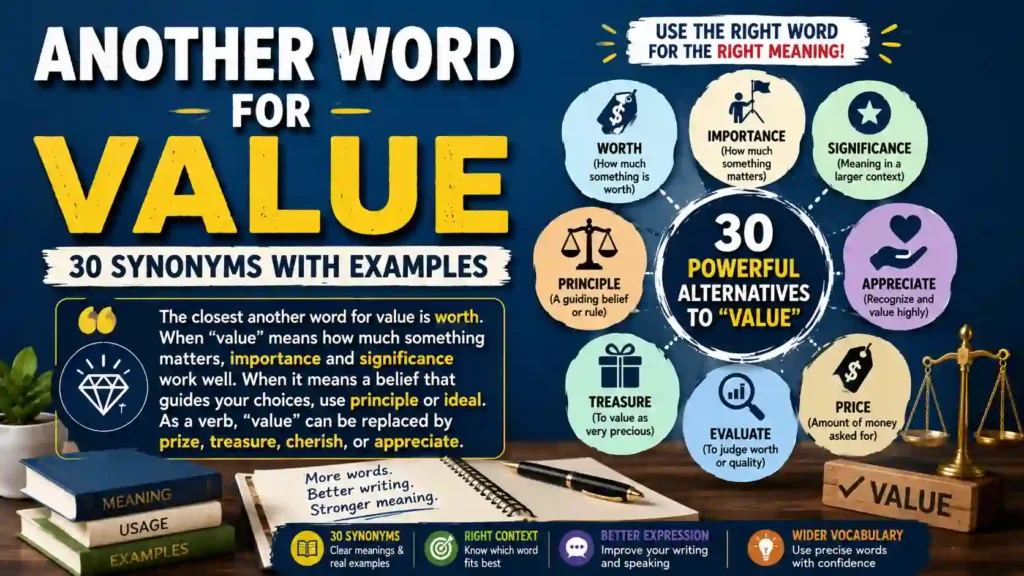
The closest another word for value is worth. When “value” means how much something matters, importance and significance work well. When it means a belief that guides your choices, use principle or ideal. As a verb, “value” can be replaced by prize, treasure, cherish, or appreciate.
“Value” is both a noun and a verb, and it covers money, importance, beliefs, and numbers. That is why no single synonym works in every sentence. “Worth” fits a price tag, “principle” fits character, and “amount” fits a measurement. The right word depends on which meaning you need.
Quick list: worth, importance, significance, merit, price, principle, appreciate, prize, treasure, evaluate
This article looks at 30 alternatives to “value.” Each one has a definition, IPA pronunciation, usage note, and example sentence. The notes make clear which words are direct synonyms and which only fit certain contexts.
At a Glance: Value Synonyms and Related Alternatives
| Alternative | Part of Speech | Meaning | Register / Tone | Ideal Context |
|---|---|---|---|---|
| Worth | Noun | How much something is valued, in money or use | Neutral | General use, prices, usefulness |
| Importance | Noun | How much something matters | Neutral | Ideas, tasks, people |
| Significance | Noun | Importance or meaning in a larger context | Formal | Events, discoveries, research |
| Merit | Noun | Good quality that deserves praise | Formal | Plans, arguments, awards |
| Price | Noun | Amount of money asked for something | Neutral | Shopping, business |
| Principle | Noun | A basic rule or belief that guides behavior | Neutral to formal | Ethics, character, decisions |
| Prize | Verb | To value highly | Slightly formal | Rare or special things |
| Treasure | Verb | To keep and value as very precious | Warm, emotional | Gifts, memories, relationships |
| Appreciate | Verb | To recognize the worth of something | Neutral | Thanks, understanding quality |
| Evaluate | Verb | To judge the worth or quality of something | Formal | Work, projects, results |
Which Word Should You Use?
| If you want to… | Use | Why |
|---|---|---|
| Talk about general worth | worth | It is the closest direct synonym and works in many sentences. |
| Say how much something matters | importance | It focuses on how much something matters, not on money. |
| Name the money someone asks for | price | It means what you pay, not what the thing is worth. |
| Give a formal estimate of money value | valuation | It suits property, companies, and official work. |
| Describe personal beliefs | principles or ideals | They fit what guides someone’s behavior. |
| Say you hold something very dear | treasure or cherish | They add emotion and care. |
| Say you recognize someone’s help | appreciate | It shows thanks and understanding. |
| Judge how good or useful something is | evaluate or assess | They suit careful, formal judgment. |
| Describe a number in math or data | amount or figure | They suit numbers and measurements. |
Exploring the Multiple Meanings of “Value”
1. Money Worth
- Meaning: The amount of money something is worth.
- Explanation: This sense is about market worth, which can differ from the price someone asks. A house may be sold for one price but have a different value.
- Example: The value of the house rose last year.
2. Importance or Usefulness
- Meaning: How important, useful, or helpful something is.
- Explanation: Here, value is not about money. It describes how much good something does or how much it matters.
- Example: Daily exercise has great value for your health.
3. Principles and Beliefs
- Meaning: Ideas about what is right, good, or important in life. This sense is usually plural: values.
- Explanation: These are the beliefs that guide a person’s or group’s choices. The singular form can also be used for one such belief.
- Example: Kindness and honesty are values that guide her life.
4. Good Return for the Price
- Meaning: Quality or usefulness that matches or beats the price paid.
- Explanation: This sense is common in shopping. It describes if you got a fair or good deal.
- Example: The hotel is simple, but it is very good value.
5. A Number or Amount
- Meaning: A number, size, or quantity, especially in math, science, or computing.
- Explanation: This is a technical sense. It also has special uses in music (the length of a note) and painting (how light or dark a color is).
- Example: What is the value of x in this equation?
6. To Regard Highly or Estimate Worth (Verb)
- Meaning: To think something is important, or to decide how much it is worth.
- Explanation: As a verb, “value” can mean feeling that something matters or putting a figure on it.
- Example: I value your advice. / An expert valued the necklace at $5,000.
Sources: Merriam-Webster; Collins English Dictionary; Etymonline
Analyzing 30 Value Alternatives in Detail
Some of these words are direct synonyms of “value,” while others are related alternatives that fit only one of its meanings, and the usage notes say which is which.
Core Synonyms (Worth and Importance)
1. Worth
IPA: US /wɜːrθ/ · UK /wɜːθ/
Definition: The value of something, if in money, use, or importance.
- Usage: The closest direct synonym for the noun “value.” It also works as an adjective with amounts (“worth $50”), which “value” cannot do.
- Example: The painting’s worth is hard to measure.
2. Importance
IPA: US /ɪmˈpɔːrtns/ · UK /ɪmˈpɔːtns/
Definition: The quality of mattering a lot or having a strong effect.
- Usage: A direct synonym for the “how much it matters” sense. It does not describe money.
- Example: Teachers stress the importance of reading every day.
3. Significance
IPA: /sɪɡˈnɪfɪkəns/ (US and UK)
Definition: Importance or meaning, especially in a larger context.
- Usage: More formal than “importance.” It is a related alternative that fits events, discoveries, and research.
- Example: The discovery had great significance for local history.
4. Merit
IPA: /ˈmɛrɪt/ (US and UK)
Definition: Good quality that deserves praise or reward.
- Usage: A related, formal alternative. It focuses on what deserves praise, not on price.
- Example: The plan has merit, but it costs too much.
5. Usefulness
IPA: /ˈjuːsfəlnəs/ (US and UK)
Definition: The quality of being helpful or practical.
- Usage: A related alternative that matches the “useful” side of value. It does not cover money or beliefs.
- Example: The app’s usefulness grows when you add friends.
6. Benefit
IPA: /ˈbɛnɪfɪt/ (US and UK)
Definition: An advantage or help gained from something.
- Usage: A related alternative. It names the good result you get, not the worth of the thing itself.
- Example: The main benefit of the course is the practice it gives you.
Money and Price Alternatives
7. Price
IPA: /praɪs/ (US and UK)
Definition: The amount of money needed to buy something.
- Usage: A related alternative, not an exact synonym. Price is what a seller asks, while value is what the thing is worth.
- Example: The price of the jacket dropped by half.
8. Cost
IPA: US /kɔːst/ · UK /kɒst/
Definition: The amount paid or spent to get or make something.
- Usage: A related alternative. It can include time and effort, and it stresses what you give, not what you get.
- Example: The cost of repairs was higher than we expected.
9. Valuation
IPA: /ˌvæljuˈeɪʃn/ (US and UK)
Definition: An estimate of how much something is worth in money.
- Usage: Formal. It is a close alternative for the money sense and suggests a careful, official estimate.
- Example: The bank asked for a valuation of the house.
10. Appraisal
IPA: /əˈpreɪzl/ (US and UK)
Definition: An expert judgment of the value or quality of something.
- Usage: Formal. Common for property and art, and it can also mean a review of someone’s work.
- Example: An appraisal showed the ring was worth more than expected.
11. Bargain
IPA: US /ˈbɑːrɡən/ · UK /ˈbɑːɡɪn/
Definition: Something bought for less than its usual price.
- Usage: A related alternative for the “good value” sense. It talks about a good deal, not value in general.
- Example: At ten dollars, the book was a bargain.
Principles and Beliefs Alternatives
12. Principle
IPA: US /ˈprɪnsəpl/ · UK /ˈprɪnsɪpl/
Definition: A basic rule or belief that guides behavior.
- Usage: A close alternative for the plural “values.” It is neutral to formal and common in discussions of ethics.
- Example: She refused the offer on principle.
13. Ideal
IPA: US /aɪˈdiːəl/ · UK /aɪˈdɪəl/
Definition: A standard or idea of perfection that people aim for.
- Usage: A related alternative, usually plural in this sense. It stresses goals more than everyday rules.
- Example: He worked for the ideals of fairness and equality.
14. Belief
IPA: /bɪˈliːf/ (US and UK)
Definition: Something a person accepts as true or holds strongly.
- Usage: A related alternative but broader. Beliefs are about what is true, while values are about what matters.
- Example: Their beliefs about hard work shaped how they raised their children.
15. Standard
IPA: US /ˈstændərd/ · UK /ˈstændəd/
Definition: A level of quality or behavior that people are expected to meet.
- Usage: A related alternative, often plural (“moral standards”). It stresses the level expected, not personal belief.
- Example: The school keeps high standards of honesty.
16. Virtue
IPA: US /ˈvɜːrtʃuː/ · UK /ˈvɜːtʃuː/
Definition: A good quality in a person’s character.
- Usage: A related, formal alternative. It names a specific moral quality, such as patience or honesty.
- Example: Patience is a virtue.
Verbs for Holding Something in High Regard
17. Appreciate
IPA: /əˈpriːʃieɪt/ (US and UK)
Definition: To recognize the worth of something, or to be thankful for it.
- Usage: A close alternative to the verb “value.” In finance it also means to rise in value, so check the context.
- Example: I really appreciate your honest advice.
18. Prize
IPA: /praɪz/ (US and UK)
Definition: To value something highly.
- Usage: A direct near-synonym for the verb. It is slightly formal and often appears in the passive, as in “prized possessions.”
- Example: Collectors prize rare stamps.
19. Treasure
IPA: US /ˈtrɛʒər/ · UK /ˈtrɛʒə/
Definition: To keep and value as very precious.
- Usage: Stronger and more emotional than “value.” Common for gifts, memories, and relationships.
- Example: She treasures the letters her grandfather wrote.
20. Cherish
IPA: /ˈtʃɛrɪʃ/ (US and UK)
Definition: To hold dear and care for.
- Usage: Warm and emotional. It is a related alternative that suits people, memories, and moments.
- Example: He cherished every moment with his children.
21. Esteem
IPA: /ɪˈstiːm/ (US and UK)
Definition: To respect and admire highly.
- Usage: Formal, often passive. It is a related alternative that mostly applies to people.
- Example: She is highly esteemed by her colleagues.
22. Respect
IPA: /rɪˈspɛkt/ (US and UK)
Definition: To admire someone, or to take their feelings or rights seriously.
- Usage: A related alternative. It is about regard for a person or idea, not the importance of objects.
- Example: I respect your honesty.
Verbs for Estimating Worth
23. Evaluate
IPA: /ɪˈvæljueɪt/ (US and UK)
Definition: To judge the value, quality, or importance of something carefully.
- Usage: A related alternative for the “estimate worth” sense of the verb. It is formal and does not mean “to cherish.”
- Example: Teachers evaluate each student’s work every term.
24. Assess
IPA: /əˈsɛs/ (US and UK)
Definition: To judge the value, amount, or quality of something.
- Usage: Formal. Often used for official or measured judgments and not for emotional regard.
- Example: The engineer assessed the damage to the bridge.
25. Estimate
IPA: /ˈɛstɪmeɪt/ (US and UK)
Definition: To judge or calculate roughly the value, size, or cost of something.
- Usage: A related alternative. It stresses a rough figure instead of an exact one.
- Example: Experts estimate the vase is worth about $2,000.
26. Rate
IPA: /reɪt/ (US and UK)
Definition: To judge the quality or value of something, or give it a rank.
- Usage: A related alternative. In “rate highly,” it matches the verb “value.” It can also mean to give a score.
- Example: Critics rate the film highly.
Number, Amount, and Measurement Alternatives
27. Amount
IPA: /əˈmaʊnt/ (US and UK)
Definition: The total quantity of something.
- Usage: A related alternative for the “number” sense of value. It does not cover worth or importance.
- Example: The amount on the bill was higher than expected.
28. Quantity
IPA: US /ˈkwɑːntəti/ · UK /ˈkwɒntɪti/
Definition: How much or how many of something there is.
- Usage: A related, slightly formal alternative for measuring.
- Example: The recipe needs only a small quantity of salt.
29. Figure
IPA: US /ˈfɪɡjər/ · UK /ˈfɪɡə/
Definition: A number, especially one that shows an amount.
- Usage: A related alternative common in statistics and finance. “Figure” can also mean a shape or a person, so context matters.
- Example: The sales figure rose every month.
30. Magnitude
IPA: US /ˈmæɡnɪtuːd/ · UK /ˈmæɡnɪtjuːd/
Definition: Great size or importance; in science, the size of a quantity.
- Usage: A related, formal alternative for the measurement sense. Not used for money or personal beliefs.
- Example: Scientists measured the magnitude of the earthquake.
Sources: Merriam-Webster; Collins English Dictionary; Dictionary.com
Value vs. Worth vs. Price vs. Cost
These four words are often mixed up because they all connect to money, but each has a different focus.
| Word | Focus | Typical Use | Example |
|---|---|---|---|
| Value | How much something is worth or matters | Money, importance, beliefs | The value of the land is rising. |
| Worth | How much something is valued | Often used with amounts | The ring is worth $500. |
| Price | What a seller asks | Shopping, sales | The price of the ring is $450. |
| Cost | What is paid or given up | Money, time, effort | The cost of the trip surprised us. |
A simple rule: price and cost look at what you pay, while value and worth look at what you get. A thing can have a high price and a low value, or a low price and a high value.
Sources: Merriam-Webster; Collins English Dictionary
Value and Opposite/Paired Word Pairs
| Word | Paired Word | Note |
|---|---|---|
| Value (noun) | Worthlessness | The closest opposite for the noun. |
| Value (verb) | Disregard | To ignore something instead of valuing it. |
| Value (verb) | Devalue | To reduce the worth of something. |
| Value (verb) | Undervalue | To rate something too low. |
| Value (verb) | Overvalue | To rate something too high. |
| Valuable | Worthless | Describes things with no worth. |
| Value | Price | A contrast, not an opposite. Price is what you pay, value is what you get. |
“Value” does not have one clear opposite, because it has several meanings. For the noun, “worthlessness” fits best. For the verb, the opposite depends on what went wrong: ignoring something, rating it too low, or rating it too high.
Sources: Etymonline; Merriam-Webster; Collins Thesaurus
Common Word Partners of “Value”
| Pattern | Common Partners | Example |
|---|---|---|
| adjective + value | high, low, great, real, true, market, face, nutritional, sentimental | The necklace has sentimental value. |
| verb + value | add, increase, lose, hold, retain, estimate, place a value on | The house has held its value. |
| value + noun | system, chain, judgment | The company explained its value system. |
| values (plural) | core, family, moral, shared, company | Shared values keep the team together. |
| adverb + value (verb) | highly, greatly, deeply, truly | We highly value your feedback. |
| of value | of great value, of little value | Nothing of value was stolen. |
Sources: Collins English Dictionary; Merriam-Webster
Idiomatic Phrases Featuring “Value”
These are established expressions and fixed phrases. Only the first is a true idiom.
1. Take something at face value
- Meaning: To accept something as it appears, without checking more closely. The noun “face value” has been recorded since 1842.
- Example: Don’t take his promise at face value.
2. Value for money
- Meaning: Good quality or usefulness for the price paid.
- Example: The restaurant offers great value for money.
3. Value judgment
- Meaning: An opinion about if something is good or bad, based on personal beliefs more than facts. The phrase dates from 1889 and came into English from German.
- Example: Calling the film boring is a value judgment, not a fact.
4. Value-added tax
- Meaning: A tax added to the price of goods and services in many countries, often shortened to VAT.
- Example: The final price includes value-added tax.
Sources: Etymonline; Merriam-Webster; Collins English Dictionary
Word Formation of “Value”
Etymology & Structure
“Value” came into English from Old French value, meaning “worth” or “price.” This was the noun use of the feminine past participle of valoir (“to be worth”), which came from Latin valere, meaning “to be strong, to be well, to be worth.” Latin valere comes from a Proto-Indo-European root meaning “to be strong.” The idea of worth is connected to the idea of strength.
Date and History
The noun is recorded around 1300, first meaning the price equal to a thing’s real worth. The verb appears in the mid-1400s, meaning to estimate the money worth of something, or to think highly of it. A later sense, “useful properties” or “non-material worth,” is recorded by the late 1300s. “Value judgment” is recorded in 1889.
Word Class Variations
- Noun: value (plural: values).
- Verb: value (valued, valuing). Recorded from the mid-1400s.
- Adjective: valuable (recorded from the 1580s as “of great value or price”), valued, valueless, invaluable (extremely valuable).
- Noun (derived): valuation (1520s), valuables (the plural noun, by 1775).
- Related verbs: devalue, undervalue, overvalue, revalue.
- Related noun: devaluation (1898).
Sources: Etymonline (entries for value, valuation, valuable)
Common Word-Choice Mistakes
- Honesty is an important values: honesty is an important value (or “honesty and kindness are important values“).
- It is worth of fifty dollars: it is worth fifty dollars.
- This ring is invaluable, so it costs nothing: “invaluable” means extremely valuable. Use worthless or valueless for no worth.
- The shop lowered the value of the coat: the shop lowered the price of the coat.
- She evaluates her friends deeply: she values (or cherishes) her friends deeply.
- The hotel has good values for money: the hotel has good value for money (singular).
- The inspector cherished the house before the sale: the inspector assessed the house before the sale.
Frequently Asked Questions
What is the closest synonym for value?
“Worth” is the closest synonym for the noun. For the “how much it matters” sense, “importance” is closest.
What is another word for value as a verb?
“Prize,” “treasure,” “cherish,” and “appreciate” all work, depending on how strong the feeling is. “Evaluate” and “assess” fit when you mean estimating worth.
What is the difference between value and price?
Price is the amount asked or paid. Value is how much something is worth to you or on the market.
What is the difference between value and worth?
They are often interchangeable, but “worth” is used with amounts, as in “worth $50.” “Values” is the usual word for beliefs.
What is a formal alternative to value?
“Significance,” “merit,” “valuation,” and “esteem” are common formal choices.
What is another word for values meaning beliefs?
“Principles,” “ideals,” “beliefs,” and “standards” all fit. “Ethics” and “morals” are also used, but they are stronger and more specific.
What is the opposite of value?
For the noun, “worthlessness.” For the verb, “disregard,” “devalue,” or “undervalue,” depending on the meaning.
Can value mean a number?
Yes. In math and computing, “value” means a number or amount, as in “the value of x.” “Amount,” “figure,” and “quantity” are close alternatives.
Can value be used for people?
Yes, in the verb sense: “We value our employees.” “Valued” and “esteemed” also describe people.
Is value a noun or a verb?
Both. As a noun it means worth, importance, or a belief. As a verb it means to think highly of something or to estimate its worth.
Conclusion
The closest alternatives to “value” are “worth” and “importance.” “Price,” “principle,” “prize,” and “evaluate” cover its other main meanings: money, beliefs, high regard, and judging worth.
Context matters because “value” can be about money, importance, beliefs, or numbers. “Price” tells you what a seller asks, “principle” tells you what guides a person, and “treasure” shows feeling. Picking the wrong one can change the meaning of a sentence.
To choose well, first decide which meaning you need. Then choose the word that fits it, the tone of your writing, and your audience.

Hi, I’m Sophia a passionate writer and curious learner who enjoys exploring fascinating facts, everyday questions, and interesting discoveries. At VistoraDaily, I share clear, reliable, and engaging general knowledge content to help readers learn something new and understand the world better.