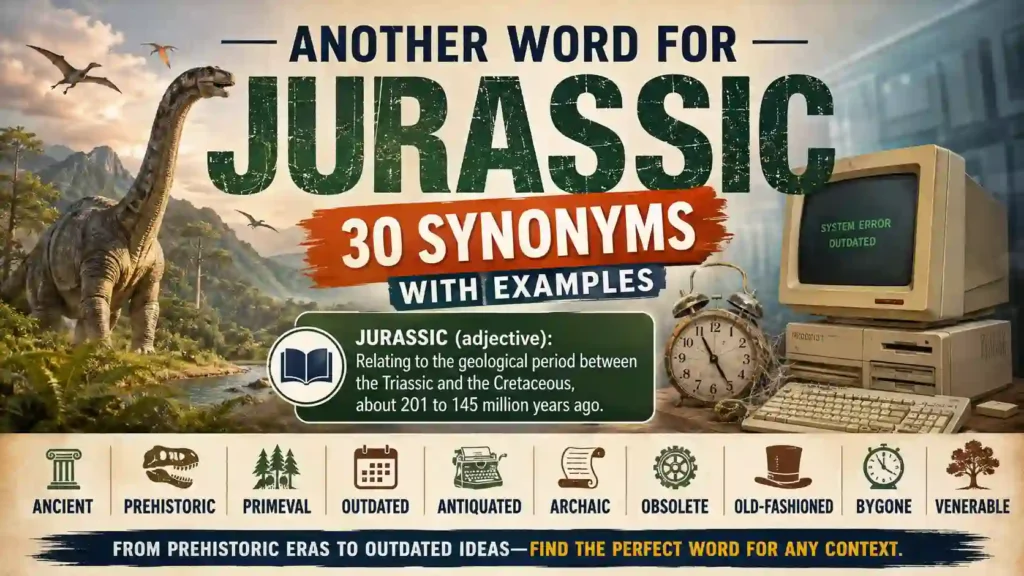
The closest everyday alternatives for “Jurassic” depend on how you use it. In science, “Jurassic” names one specific period of Earth’s history, so it has no exact synonym. The nearest related terms are “Mesozoic” (the larger era that contains it) and “prehistoric.” In casual speech, “Jurassic” is often a joke meaning “extremely old” or “hopelessly outdated.” There, good alternatives include “ancient,” “antiquated,” “outdated,” and “old-fashioned.”
The best choice depends on meaning and context. A geology student, a writer poking fun at an old computer, and a poet describing an old forest each need a different word. This article covers three areas: the geological period, the figurative “very old” sense, and the formal or literary words for age.
Quick list: ancient, prehistoric, primeval, Mesozoic, outdated, old-fashioned, outmoded, antiquated, archaic, obsolete
Below you will find 30 alternatives with meanings, IPA, usage notes, examples, and context. The article also covers word pairs, word partners, expressions, word formation, common mistakes, and a short FAQ.
At a Glance: Jurassic Synonyms and Related Alternatives
| Alternative | Part of Speech | Meaning | Register / Tone | Ideal Context |
|---|---|---|---|---|
| Mesozoic | adjective / noun | Of the era that includes the Jurassic (related, not exact) | Scientific | Geology, paleontology |
| Prehistoric | adjective | From before written records | Neutral; also humorous | Science, jokes about old things |
| Primeval | adjective | From the earliest ages of the world | Literary | Nature, landscapes, writing |
| Ancient | adjective | Very old; from long ago | Neutral | Everyday and historical use |
| Outdated | adjective | No longer current or useful | Neutral | Technology, ideas, methods |
| Old-fashioned | adjective | Belonging to an earlier style or habit | Neutral to informal | Clothes, manners, products |
| Outmoded | adjective | Out of fashion or no longer in use | Slightly formal | Methods, designs, systems |
| Antiquated | adjective | So old that it seems ridiculous or useless | Formal; critical | Laws, equipment, systems |
| Archaic | adjective | From an earlier time; no longer used | Formal | Language, customs, institutions |
| Obsolete | adjective | No longer used because something better exists | Neutral to formal | Technology, tools, rules |
Which Word Should You Use?
| If you want to… | Use | Why |
|---|---|---|
| Name the actual geological period | Jurassic | It is the precise term. “Mesozoic” is wider and covers three periods. |
| Talk about the whole age of the dinosaurs | Mesozoic | It covers the Triassic, Jurassic, and Cretaceous together. |
| Describe life before written history | prehistoric | It is the standard word and works in science and everyday speech. |
| Say something is very old, without judgment | ancient | It is neutral and works for buildings, trees, and customs. |
| Joke that a computer or method is hopelessly old | antiquated | It adds a mocking tone that “outdated” lacks. |
| Politely say something is no longer current | outdated | It is mild and works in business and school writing. |
| Describe words or customs that are no longer used | archaic | It is the precise word for language and traditions. |
| Describe an old thing with respect | venerable | It suggests age that earns honor. |
| Describe something unchanged for a very long time | age-old | It fits traditions, problems, and customs. |
Exploring the Multiple Meanings of “Jurassic”
“Jurassic” has one clear scientific meaning and one informal figurative meaning. Here are the four main uses.
1. The Geological Period (Adjective)
- Meaning: Relating to the period between the Triassic and the Cretaceous.
- Explanation: This is the main dictionary sense. It describes anything linked to that time, such as Jurassic plants or Jurassic seas. The Jurassic lasted from about 201 to 145 million years ago and sits in the middle of the Mesozoic Era.
- Example: Scientists found a Jurassic fossil in the cliff.
2. The Period Itself (Noun)
- Meaning: The span of geological time, usually written “the Jurassic.”
- Explanation: As a noun, it names the period as a whole. It is often divided into Early, Middle, and Late Jurassic.
- Example: Many famous long-necked dinosaurs lived in the Jurassic.
3. Rocks and Fossils From That Time
- Meaning: Describing rock layers, fossils, or coasts formed in that period.
- Explanation: Geologists use “Jurassic” to date rock and fossils. The name comes from limestone in the Jura Mountains.
- Example: The Jurassic limestone in this area is full of ammonite fossils.
4. Extremely Old or Outdated (Informal, Figurative)
- Meaning: Very old, out of date, or belonging to a distant past.
- Explanation: People use this sense jokingly, because the Jurassic is so far back in time. It is humorous and informal, and it usually exaggerates. It does not mean the thing is actually millions of years old.
- Example: My phone is so slow that it feels Jurassic.
Sources: Etymonline (Jurassic); Merriam-Webster; Collins Dictionary; Carnegie Museum of Natural History; International Commission on Stratigraphy.
Analyzing 30 Jurassic Alternatives in Detail
Some alternatives below are close synonyms for the figurative “very old” sense. Others are related terms for the geological sense, and each Usage note says which kind it is.
Group 1: Prehistoric and Early-Earth Terms (Geological Sense)
1. Mesozoic
IPA: US /ˌmɛzəˈzoʊɪk/ · UK /ˌmɛzəˈzəʊɪk/
Definition: Relating to the geological era that lasted from about 252 to 66 million years ago.
- Usage: This is a related term, not an exact synonym. The Mesozoic is the larger era that contains the Jurassic, so it is broader. It is scientific and cannot replace “Jurassic” when you mean that exact period.
- Example: Mesozoic fossils include dinosaurs, early birds, and marine reptiles.
2. Prehistoric
IPA: US /ˌpriːhɪˈstɔːrɪk/ · UK /ˌpriːhɪˈstɒrɪk/
Definition: Belonging to the time before written records.
- Usage: This is the closest general alternative for the geological sense. It is wider than “Jurassic,” since it covers all time before records, and it also works in the joking sense.
- Example: The museum has a room full of prehistoric animals.
3. Primeval
IPA: (US and UK) /praɪˈmiːvəl/
Definition: Belonging to the earliest period of the world’s history.
- Usage: This is a literary alternative and a related term, not an exact synonym. It suggests an untouched, ancient world, so it fits forests or landscapes better than technology.
- Example: Mist hung over the primeval forest.
4. Primordial
IPA: US /praɪˈmɔːrdiəl/ · UK /praɪˈmɔːdiəl/
Definition: Existing at or from the very beginning of time.
- Usage: This is a related term that is more scientific and formal than “primeval.” It often refers to the beginning of life or the universe, which is earlier than the Jurassic.
- Example: Scientists study how life began in the primordial oceans.
Group 2: Everyday Words for “Very Old” or “Out of Date”
5. Ancient
IPA: (US and UK) /ˈeɪnʃənt/
Definition: Very old; belonging to a time long past.
- Usage: This is the closest neutral synonym for the figurative sense. Unlike “Jurassic,” it is not a joke. It works for people, objects, and ideas.
- Example: The ancient castle stands on a hill above the town.
6. Old
IPA: US /oʊld/ · UK /əʊld/
Definition: Having existed for a long time.
- Usage: This is the simplest synonym, but it is much weaker than “Jurassic.” Use it when you do not want an exaggeration.
- Example: This old laptop takes five minutes to start.
7. Old-fashioned
IPA: US /ˌoʊld ˈfæʃənd/ · UK /ˌəʊld ˈfæʃnd/
Definition: Belonging to a style or way of doing things that is no longer common.
- Usage: This is a mild synonym for the figurative sense. It can be neutral or gently critical, and it can even sound charming.
- Example: She has old-fashioned manners.
8. Outdated
IPA: (US and UK) /ˌaʊtˈdeɪtɪd/
Definition: No longer current or useful because newer things exist.
- Usage: This is a direct alternative for the figurative sense. It is neutral and common in business and school writing.
- Example: The company still uses an outdated website.
9. Dated
IPA: (US and UK) /ˈdeɪtɪd/
Definition: Looking or sounding old-fashioned.
- Usage: This is a mild alternative. It usually describes style, such as fashion, language, or design, rather than function.
- Example: The film’s special effects look dated now.
10. Outmoded
IPA: US /ˌaʊtˈmoʊdɪd/ · UK /ˌaʊtˈməʊdɪd/
Definition: No longer in fashion or no longer accepted.
- Usage: This is a slightly formal alternative. It often describes methods, designs, or beliefs.
- Example: The school replaced its outmoded teaching methods.
Group 3: Formal and Stronger Alternatives
11. Archaic
IPA: US /ɑːrˈkeɪɪk/ · UK /ɑːˈkeɪɪk/
Definition: Belonging to an earlier time and no longer in common use.
- Usage: This is a formal alternative. It is most accurate for language, customs, laws, and institutions, and less natural for gadgets.
- Example: The word “thou” is archaic in modern English.
12. Antiquated
IPA: (US and UK) /ˈæntɪkweɪtɪd/
Definition: So old or old-fashioned that it seems useless or silly.
- Usage: This is one of the best formal matches for the humorous “Jurassic” sense. It sounds critical.
- Example: The office still runs on antiquated computers.
13. Obsolete
IPA: US /ˌɑːbsəˈliːt/ · UK /ˈɒbsəliːt/
Definition: No longer used because something newer or better has replaced it.
- Usage: This is a stronger and more definite alternative than “outdated.” It means the thing is no longer used at all, which “Jurassic” does not always mean.
- Example: Flash drives made floppy disks obsolete.
14. Anachronistic
IPA: (US and UK) /əˌnækrəˈnɪstɪk/
Definition: Belonging to a different time from the one in which it appears.
- Usage: This is a related alternative, not an exact synonym. It means something looks out of place in time, not simply old.
- Example: A mobile phone in a film about ancient Rome would be anachronistic.
15. Antediluvian
IPA: (US and UK) /ˌæntidɪˈluːviən/
Definition: Extremely old-fashioned; literally “before the Flood.”
- Usage: This is a rare, formal, often humorous alternative. It is the closest match in tone to the joking “Jurassic” sense.
- Example: His antediluvian opinions surprised everyone at the meeting.
Group 4: Informal and Humorous Alternatives
16. Creaky
IPA: (US and UK) /ˈkriːki/
Definition: Old, weak, and slow to work.
- Usage: This is an informal figurative alternative. It suggests something old that barely works, like a machine or a system.
- Example: The creaky old elevator stops between floors.
17. Fusty
IPA: (US and UK) /ˈfʌsti/
Definition: Old-fashioned and stuffy; smelling of damp or old air.
- Usage: This is a related informal alternative. It suggests dull, closed-minded old ideas or a musty place, not just age.
- Example: The club has a fusty reputation.
18. Passé
IPA: US /pæˈseɪ/ · UK /ˈpæseɪ/
Definition: No longer fashionable.
- Usage: This is a direct alternative for style and trends. It is more about fashion than about being very old.
- Example: Skinny jeans were suddenly passé.
19. Fossilized
IPA: US /ˈfɑːsəlaɪzd/ · UK /ˈfɒsəlaɪzd/
Definition: Turned into a fossil; or, figuratively, fixed and unable to change.
- Usage: This is a related figurative alternative. It stresses that something has stopped changing and fits ideas or habits better than devices.
- Example: Their fossilized rules never change.
20. Old-school
IPA: US /ˌoʊld ˈskuːl/ · UK /ˌəʊld ˈskuːl/
Definition: Traditional, in a way that people respect.
- Usage: This is a related, informal alternative. Unlike “Jurassic,” it is often a compliment.
- Example: He’s an old-school teacher who still writes on the blackboard.
Group 5: Historical and Era Comparisons
21. rudimentary
IPA: (US and UK) /ˈprɪmətɪv/
Definition: Belonging to an early stage of development; very simple or basic.
- Usage: This is a related alternative. It describes something basic or crude, not something old-fashioned. Be careful when describing people or cultures, as it can sound disrespectful.
- Example: The cabin had only rudimentary cooking equipment.
22. Medieval
IPA: US /ˌmiːdiˈiːvəl/ · UK /ˌmɛdiˈiːvəl/
Definition: Relating to the Middle Ages; informally, very old-fashioned or harsh.
- Usage: This is a related figurative alternative. It is informal and often exaggerated, and it suggests backward or rough conditions.
- Example: The hospital’s medieval facilities need major repairs.
23. Stone Age
IPA: US /ˈstoʊn eɪdʒ/ · UK /ˈstəʊn eɪdʒ/
Definition: Relating to the earliest period of human history; informally, extremely old-fashioned.
- Usage: This is an informal, humorous alternative, close in tone to the joking “Jurassic.” It exaggerates in the same way.
- Example: Their Stone Age phone system drives customers unbelievable.
24. Antique
IPA: (US and UK) /ænˈtiːk/
Definition: Old and often valuable, as an object.
- Usage: This is a related alternative. It describes valued old objects, not outdated ideas. It does not mean useless.
- Example: She collects antique clocks.
Group 6: Descriptive and Literary Alternatives
25. Age-old
IPA: US /ˌeɪdʒ ˈoʊld/ · UK /ˌeɪdʒ ˈəʊld/
Definition: Having existed for a very long time.
- Usage: This is a neutral descriptive alternative. It usually describes traditions, problems, or customs.
- Example: Farmers still use age-old methods here.
26. Olden
IPA: US /ˈoʊldən/ · UK /ˈəʊldən/
Definition: Of a time long ago.
- Usage: This is a literary or old-style alternative. It appears mostly in the phrase “olden days” or “olden times.”
- Example: In olden times, people traveled by horse.
27. Hoary
IPA: (US and UK) /ˈhɔːri/
Definition: Very old; also, overused (as in a “hoary joke”).
- Usage: This is a literary alternative and a related term. It often suggests age with a hint of tiredness or overuse.
- Example: The comedian told the same hoary joke again.
28. Venerable
IPA: (US and UK) /ˈvɛnərəbəl/
Definition: Respected because of great age or wisdom.
- Usage: This is a related, formal alternative. It is respectful, which makes it the opposite in tone of the joking “Jurassic.”
- Example: The venerable oak has stood here for centuries.
29. Immemorial
IPA: (US and UK) /ˌɪməˈmɔːriəl/
Definition: Going back further than anyone can remember.
- Usage: This is a formal, literary, related alternative. It appears in set phrases like “from time immemorial.”
- Example: The fishing village has existed since time immemorial.
30. Bygone
IPA: US /ˈbaɪɡɔːn/ · UK /ˈbaɪɡɒn/
Definition: Belonging to the past.
- Usage: This is a literary, related alternative. It often has a nostalgic feel.
- Example: The film recalls a bygone era.
Sources: Merriam-Webster; Collins Dictionary; Dictionary.com; Etymonline.
Jurassic vs. Triassic vs. Cretaceous
The Jurassic is the middle of three periods in the Mesozoic Era. Readers often mix them up, so here is a quick comparison.
| Period | Position | Approximate Dates | Useful Note |
|---|---|---|---|
| Triassic | First | about 252–201 million years ago | The first dinosaurs appeared late in this period. |
| Jurassic | Middle | about 201–145 million years ago | Long-necked dinosaurs and early birds lived in this period. |
| Cretaceous | Last | about 145–66 million years ago | It ended with the extinction of non-bird dinosaurs. |
Many famous dinosaurs, including Tyrannosaurus rex and Velociraptor, lived in the Cretaceous, not the Jurassic. Stegosaurus and Brachiosaurus are Jurassic examples.
Sources: International Commission on Stratigraphy; Carnegie Museum of Natural History; Merriam-Webster.
Jurassic and Opposite/Paired Word Pairs
| Word | Paired Word | Note |
|---|---|---|
| Jurassic (outdated) | modern | The most natural opposite for the figurative sense. |
| Jurassic (outdated) | up-to-date | Neutral and practical, especially for technology. |
| Jurassic (outdated) | cutting-edge | Suggests the newest and most advanced. |
| Jurassic (outdated) | futuristic | Means looking like the future; strongly contrasts the “ancient” image. |
| Jurassic | Triassic | The period before the Jurassic. |
| Jurassic | Cretaceous | The period after the Jurassic. |
| Mesozoic | Cenozoic | The Cenozoic is the era that follows the Mesozoic. |
In science, the useful pairs are neighboring periods and eras. In the figurative sense, the pairs are words for new and modern things.
Sources: Merriam-Webster; Collins Dictionary; International Commission on Stratigraphy.
Common Word Partners of “Jurassic”
| Pattern | Common Partners | Example |
|---|---|---|
| Early / Middle / Late + Jurassic | Early Jurassic, Middle Jurassic, Late Jurassic | The fossil dates from the Late Jurassic. |
| Jurassic + noun | period, era, rocks, limestone, fossils, dinosaurs, sea | They studied Jurassic rocks along the coast. |
| in / during / from + the Jurassic | in the Jurassic, during the Jurassic | Many reptiles lived in the Jurassic. |
| Jurassic + place name | Jurassic Coast | We walked along the Jurassic Coast in southern England. |
| Jurassic + technology (informal) | Jurassic computer, Jurassic software | The office still runs Jurassic software. |
Sources: Collins Dictionary; Merriam-Webster; Carnegie Museum of Natural History.
Idiomatic Phrases Featuring “Jurassic”
“Jurassic” has no true idioms. These are established expressions and names, not idioms.
1. Jurassic Coast
- Meaning: A stretch of coast in southern England known for rocks and fossils from the Triassic, Jurassic, and Cretaceous periods.
- Example: Visitors hunt for fossils on the Jurassic Coast.
2. Jurassic Park
- Meaning: The title of Michael Crichton’s 1990 novel and the 1993 film. People sometimes use it as a pop-culture reference to dinosaurs and ancient animals.
- Example: The scientist joked that the museum looked like Jurassic Park.
3. Early / Middle / Late Jurassic
- Meaning: The standard three-part division of the period in geology.
- Example: The animal lived in the Early Jurassic.
4. Straight out of the Jurassic
- Meaning: An informal, joking phrase for something extremely old or outdated. It is not a fixed idiom, just a common style of joke.
- Example: That printer looks straight out of the Jurassic.
Sources: UNESCO World Heritage Centre; Merriam-Webster; Collins Dictionary.
Word Formation of “Jurassic”
Etymology & Structure
“Jurassic” comes from French jurassique, which means “of the Jura Mountains.” These mountains lie between France and Switzerland, and their limestone dates from this period. Etymonline notes that the name “Jura” is said to come from a Gaulish word meaning “wooded mountain.” The ending -assic is said to come from Triassic, which was named earlier.
Date and History
Etymonline records “Jurassic” as an adjective from 1823 and as a noun from 1831. Other sources credit the French geologist Alexandre Brongniart with first publishing the term terrains jurassiques in 1829. The German scientist Alexander von Humboldt had earlier named the Jura limestone, using the name Jura-Kalkstein. Because early use is hard to date, different sources give slightly different dates.
Word Class Variations
- Adjective: Jurassic (Jurassic rocks)
- Noun: the Jurassic (the period itself)
There is no verb or adverb form in standard English.
Sources: Etymonline (Jurassic); Carnegie Museum of Natural History.
Common Word-Choice Mistakes
- Jurassic man: prehistoric humans, because humans did not exist in the Jurassic.
- T. rex lived in the Jurassic: T. rex lived in the Cretaceous.
- The Mesozoic period: the Mesozoic era, since “Mesozoic” is a larger unit than a period.
- jurassic: Jurassic, with a capital J.
- An antique idea: an outdated idea, because “antique” describes valued old objects.
- An archaic smartphone: an outdated smartphone, because “archaic” fits language and customs better.
- A rudimentary person: an early human, because “rudimentary” can sound disrespectful.
Frequently Asked Questions
1. What is the closest synonym for Jurassic?
For the figurative sense, “ancient” is the closest neutral word, and “antiquated” is closest in tone. For the geological sense, no exact synonym exists.
2. What is a scientific alternative to Jurassic?
“Mesozoic” is the closest scientific term, but it is wider because it covers the Triassic, Jurassic, and Cretaceous.
3. What is a formal alternative?
“Antiquated,” “archaic,” and “obsolete” are the most common formal choices.
4. What is a literary alternative?
“Primeval,” “immemorial,” and “bygone” suit poetic or descriptive writing.
5. What is the opposite of Jurassic?
In the figurative sense, “modern,” “up-to-date,” and “cutting-edge” are natural opposites.
6. Is “Jurassic” the same as “prehistoric”?
No. “Prehistoric” means before written records and covers a much longer time, while “Jurassic” names one specific period.
7. Can “Jurassic” describe people?
Only jokingly and informally. It can sound insulting, so use it with care.
8. Is “Jurassic” a noun or an adjective?
Both. It is an adjective in “Jurassic rocks” and a noun in “the Jurassic.”
9. When was the Jurassic period?
It lasted from about 201 to 145 million years ago, in the middle of the Mesozoic Era.
10. What is the difference between “ancient” and “antique”?
“Ancient” means very old and has no value judgment. “Antique” usually describes an old object that is collected or valued.
Conclusion
The closest everyday alternatives for “Jurassic” in the figurative sense are “ancient,” “outdated,” “old-fashioned,” and “antiquated.” For the geological sense, “Mesozoic” and “prehistoric” are related terms, but neither matches “Jurassic” exactly.
Context makes the difference. “Archaic” suits language, “obsolete” suits things no longer used, and “venerable” shows respect for age. “Jurassic” itself is a joke in everyday speech, so it works best in casual writing.
To choose the right word, first decide whether you mean the real period or something merely old. Then decide whether you want a neutral, formal, funny, or respectful tone.

Hi, I’m Sophia a passionate writer and curious learner who enjoys exploring fascinating facts, everyday questions, and interesting discoveries. At VistoraDaily, I share clear, reliable, and engaging general knowledge content to help readers learn something new and understand the world better.