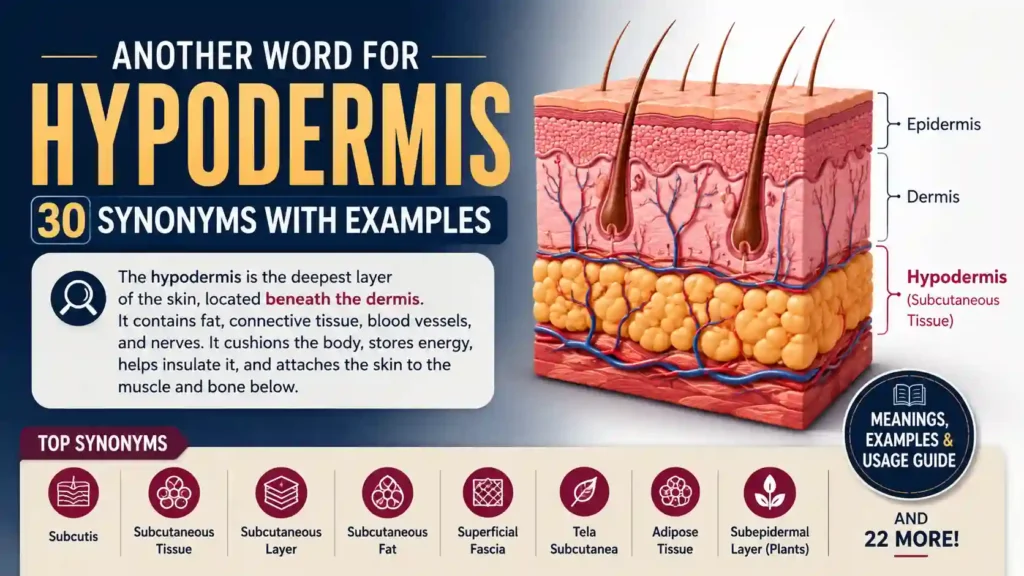
The closest everyday alternatives to hypodermis are subcutis, subcutaneous tissue, and subcutaneous layer. All three name the deepest layer of the skin, under the dermis. In plants and in animals such as insects, hypodermis has other meanings, so the best alternative depends on which one you need.
Related words fall into a few areas: fat and insulation (adipose tissue, blubber), neighboring skin layers (dermis, epidermis), adjectives (subcutaneous, hypodermic), plant tissues, and arthropod body coverings.
Quick list: subcutis, subcutaneous tissue, subcutaneous layer, subcutaneous fat, superficial fascia, tela subcutanea, adipose tissue, subepidermal layer
This article looks at 30 alternatives, with meanings, IPA, usage notes, examples, and context. Some are direct synonyms. Others are related terms that name a neighboring structure or a single part of the hypodermis.
At a Glance: Hypodermis Synonyms and Related Alternatives
| Alternative | Part of Speech | Meaning | Register / Tone | Ideal Context |
|---|---|---|---|---|
| Subcutis | noun | Tissue layer beneath the dermis | Technical, medical | Anatomy and dermatology |
| Subcutaneous tissue | noun phrase | Tissue beneath the skin | Medical, standard | Health writing, patient information |
| Subcutaneous layer | noun phrase | The deepest layer of the skin | Neutral, clear | General explanations |
| Subcutaneous fat | noun phrase | Fat stored in the hypodermis | Medical, everyday | Body composition, health |
| Superficial fascia | noun phrase | Connective tissue layer under the skin, often treated as the same layer | Technical | Anatomy and surgery |
| Tela subcutanea | noun phrase (Latin) | Official anatomical name for subcutaneous tissue | Very technical | Anatomical nomenclature |
| Adipose tissue | noun phrase | Body tissue made mostly of fat cells | Scientific | Biology, nutrition |
| Subepidermal layer | noun phrase | Layer just under the epidermis | Technical | Plant anatomy |
| Epidermis | noun | Surface cell layer; in arthropods, the layer that makes the cuticle | Technical | Zoology, modern usage |
| Blubber | noun | Thick fat layer of marine mammals | Neutral, specific | Marine biology |
Which Word Should You Use?
| If you want to… | Use | Why |
|---|---|---|
| Name the deepest skin layer in plain terms | subcutaneous layer | It is clear and easy to understand |
| Write for doctors or students | subcutis or subcutaneous tissue | Both are standard in medical texts |
| Talk about the fat part only | subcutaneous fat | It names the fat, not the whole layer |
| Use the official Latin term | tela subcutanea | It appears in anatomical nomenclature |
| Describe a layer under a plant’s surface | hypodermis or subepidermal layer | It matches botanical usage |
| Describe an insect’s cell layer under the cuticle | epidermis | Many modern texts prefer it for arthropods |
| Describe an animal’s thick insulating fat | blubber | It fits whales and seals |
| Describe something under the skin as an adjective | subcutaneous | It is the most common medical adjective |
Exploring the Multiple Meanings of “Hypodermis”
1. The Deepest Layer of Skin
- Meaning: The layer of tissue beneath the dermis in humans and other vertebrates.
- Explanation: It holds fat, connective tissue, blood vessels, and nerves. It cushions the body, stores energy, helps insulate it, and attaches the skin to the muscle and bone below. This is the most common meaning.
- Example: The nurse explained that insulin is injected into the hypodermis, not into the muscle.
2. The Fatty, Insulating Layer
- Meaning: The fat-storing part of the layer under the skin.
- Explanation: Many people use the word to mean the fat layer itself. Fat is its main part, but the layer also contains other tissue.
- Example: A thick hypodermis helps some animals stay warm in cold weather.
3. A Layer Beneath a Plant’s Epidermis
- Meaning: A layer of cells just below the outer surface of a plant organ such as a leaf or stem.
- Explanation: In some plants this layer has thick walls and gives support or protection. In others it helps store water.
- Example: The leaf’s hypodermis adds strength under its thin outer skin.
4. The Cell Layer of an Arthropod’s Body Wall
- Meaning: The layer of cells that produces the cuticle in insects, crabs, and related animals.
- Explanation: Older texts call this layer the hypodermis. Many modern texts simply call it the epidermis.
- Example: In the molting insect, the hypodermis releases the material that forms a new outer shell.
Sources: Merriam-Webster; Collins Dictionary; Dictionary.com; Encyclopaedia Britannica; NCBI StatPearls (anatomy of the skin)
Analyzing 30 Hypodermis Alternatives in Detail
Some of these words are direct synonyms for the skin layer, while others are related terms for a neighboring structure, a part of the layer, or a similar tissue in plants and animals.
Core Synonyms and Medical Terms
1. Subcutis
IPA: /sʌbˈkjuːtɪs/
Definition: The layer of tissue beneath the dermis.
- Usage: A direct synonym for hypodermis in medical and dermatology contexts.
- Example: The infection had spread into the subcutis.
2. Subcutaneous tissue
IPA: /ˌsʌbkjuːˈteɪniəs ˈtɪʃuː/
Definition: Tissue found just under the skin.
- Usage: A common medical term that is clear to general readers.
- Example: The doctor checked the subcutaneous tissue for swelling.
3. Subcutaneous layer
IPA: /ˌsʌbkjuːˈteɪniəs ˈleɪər/
Definition: The layer of skin below the dermis.
- Usage: A direct, neutral synonym that works well in teaching.
- Example: The subcutaneous layer connects the skin to the muscle.
4. Tela subcutanea
IPA: /ˈteɪlə ˌsʌbkjuːˈteɪniə/
Definition: The Latin anatomical name for subcutaneous tissue.
- Usage: A formal term mainly used in anatomical textbooks.
- Example: The atlas lists tela subcutanea as another name for hypodermis.
5. Superficial fascia
IPA: /ˌsuːpəˈfɪʃəl ˈfeɪʃiə/
Definition: Connective tissue beneath the skin.
- Usage: A close, overlapping term rather than a perfect synonym.
- Example: Surgeons cut through the superficial fascia to reach the muscle.
6. Lower skin layer
IPA: /ˈloʊər ˈskɪn ˈleɪər/
Definition: A plain description of the deepest skin layer.
- Usage: A casual phrase useful for simple explanations.
- Example: Fat is stored in the lower skin layer.
7. Subcutaneous space
IPA: /ˌsʌbkjuːˈteɪniəs ˈspeɪs/
Definition: The area just under the skin.
- Usage: A related term that describes a location rather than the tissue itself.
- Example: The medicine is delivered into the subcutaneous space.
Fat and Insulation Terms
8. Subcutaneous fat
IPA: /ˌsʌbkjuːˈteɪniəs ˈfæt/
Definition: Fat stored just under the skin.
- Usage: Related term naming the main fatty part of the hypodermis, not the whole layer.
- Example: Subcutaneous fat is the fat you can pinch.
9. Adipose tissue
IPA: /ˈædəˌpoʊs ˈtɪʃu/
Definition: Body tissue made mostly of fat cells.
- Usage: Related term found in the hypodermis and elsewhere in the body.
- Example: Adipose tissue stores energy for later use.
10. Fatty tissue
IPA: /ˈfæti ˈtɪʃu/
Definition: Body tissue containing a lot of fat.
- Usage: Plain-English form of adipose tissue. It is related, not exact.
- Example: Swimmers with more fatty tissue felt less cold.
11. Panniculus adiposus
IPA: /pəˈnɪkjələs ˌædɪˈpoʊsəs/
Definition: A layer of fat under the skin.
- Usage: Rare technical term focusing on fat rather than the whole hypodermis.
- Example: Older anatomy books describe the panniculus adiposus.
12. Blubber
IPA: /ˈblʌbɚ/
Definition: Thick fat under the skin of whales, seals, and similar animals.
- Usage: Related term for marine mammals that provides insulation and energy storage.
- Example: A seal’s blubber keeps it warm in icy water.
13. Fat pad
IPA: /ˈfæt ˌpæd/
Definition: A cushion of fat in a specific body area.
- Usage: Related term for a local fat deposit, not the whole layer.
- Example: The fat pad under the heel absorbs shock.
14. Visceral fat
IPA: /ˈvɪsərəl ˈfæt/
Definition: Fat stored around organs deep inside the abdomen.
- Usage: A contrast term, not a synonym. It is separate from the hypodermis.
- Example: Doctors often check visceral fat, not just subcutaneous fat.
Neighboring Skin Layers and Structures
15. Dermis
IPA: US /ˈdɝːmɪs/ · UK /ˈdɜːmɪs/
Definition: The layer of skin under the epidermis and above the hypodermis.
- Usage: A related term, not a synonym. It sits directly above the hypodermis.
- Example: Hair roots and sweat glands sit mainly in the dermis.
16. Cutis
IPA: /ˈkjuːtɪs/ (US and UK)
Definition: The skin proper, made of the epidermis and the dermis.
- Usage: A related term, not a synonym. The hypodermis lies below the cutis.
- Example: Subcutis literally means “below the cutis.”
17. Skin
IPA: /ˈskɪn/ (US and UK)
Definition: The outer covering of the body.
- Usage: A broad related word. Some sources count the hypodermis as part of the skin and others count it as the layer under it, so context matters.
- Example: The skin has three main layers.
18. Connective tissue
IPA: /kəˈnɛktɪv ˈtɪʃuː/ US /kəˈnɛktɪv ˈtɪʃu/ · UK /kəˈnɛktɪv ˈtɪʃuː/
Definition: Tissue that supports and links other tissues.
- Usage: A related term. The hypodermis contains connective tissue, but the term is much broader.
- Example: Connective tissue holds the skin loosely to the muscle below.
19. Fascia
IPA: US /ˈfæʃ(i)ə/ · UK /ˈfeɪʃ(i)ə/
Definition: A sheet of connective tissue that wraps muscles, organs, and other structures.
- Usage: A related term. Alone, it is broader than the hypodermis. See superficial fascia for the closer match.
- Example: A thin fascia covers each muscle.
Adjectives and Descriptive Forms
20. Subcutaneous
IPA: /ˌsʌbkjuːˈteɪniəs/ (US and UK)
Definition: Situated or applied under the skin.
- Usage: The standard adjective linked to hypodermis. It describes things in or under the layer.
- Example: The patient had a subcutaneous injection.
21. Subdermal
IPA: US /ˌsʌbˈdɝːməl/ · UK /ˌsʌbˈdɜːməl/
Definition: Located beneath the skin.
- Usage: A near-synonym of subcutaneous, often used for implants and procedures. Subcutaneous is more standard in medicine.
- Example: The device is a small subdermal implant.
22. Hypodermal
IPA: US /ˌhaɪpəˈdɝːməl/ · UK /ˌhaɪpəˈdɜːməl/
Definition: Relating to the hypodermis.
- Usage: The direct adjective form of hypodermis. It is technical and used in biology.
- Example: The hypodermal layer is thicker in some body areas.
23. Hypodermic
IPA: US /ˌhaɪpəˈdɝːmɪk/ · UK /ˌhaɪpəˈdɜːmɪk/
Definition: Relating to the area under the skin, especially an injection given there.
- Usage: A related word, not a synonym. It is mostly used for needles and syringes.
- Example: The nurse prepared a hypodermic syringe.
Plant Anatomy Terms
24. Subepidermal layer
IPA: US /ˌsʌbˌɛpɪˈdɝːməl ˈleɪɚ/ · UK /ˌsʌbˌɛpɪˈdɜːməl ˈleɪə/
Definition: A layer just beneath the epidermis.
- Usage: A descriptive alternative for the plant sense of hypodermis. It names the position, not a special tissue type.
- Example: The subepidermal layer of the stem gives extra support.
25. Sclerenchyma
IPA: /sklɪˈrɛŋkɪmə/ (US and UK)
Definition: Plant tissue made of cells with thick, hard walls that give support.
- Usage: A related term. A plant hypodermis may be made of sclerenchyma, but the two are not the same thing.
- Example: Sclerenchyma makes some seed coats hard.
26. Collenchyma
IPA: /kəˈlɛŋkɪmə/ (US and UK)
Definition: Flexible plant tissue with unevenly thickened walls that supports growing parts.
- Usage: A related term. A hypodermis in some stems is made of collenchyma, but the words do not mean the same thing.
- Example: Collenchyma helps young stems stay upright without being stiff.
Arthropod and Invertebrate Terms
27. Epidermis
IPA: US /ˌɛpɪˈdɝːmɪs/ · UK /ˌɛpɪˈdɜːmɪs/
Definition: The outer layer of skin in animals; in arthropods, the cell layer that secretes the cuticle.
- Usage: In arthropods, a synonym for the older hypodermis. In humans, it is a different layer on the opposite side of the skin.
- Example: The insect’s epidermis builds the new cuticle after each molt.
28. Cuticle
IPA: /ˈkjuːtɪkəl/ (US and UK)
Definition: A protective outer covering, such as the non-living outer layer of an arthropod.
- Usage: A related term. The cuticle is made by the hypodermis in arthropods, so it is a product, not a synonym.
- Example: The cuticle hardens after the insect molts.
29. Integument
IPA: US /ɪnˈtɛɡjəmənt/ · UK /ɪnˈtɛɡjʊmənt/
Definition: A natural outer covering, such as skin, shell, or husk.
- Usage: A broad related term. It covers the whole outer wall, including the hypodermis and cuticle in arthropods.
- Example: The crab’s integument includes a hard outer shell.
30. Exoskeleton
IPA: US /ˌɛksoʊˈskɛlətən/ · UK /ˌɛksəʊˈskɛlɪtən/
Definition: A hard outer supporting structure on the outside of an animal’s body.
- Usage: A related term. The hypodermis lies beneath an arthropod’s exoskeleton and builds it.
- Example: The beetle’s exoskeleton protects it from predators.
Sources: Merriam-Webster; Collins Dictionary; Dictionary.com; Encyclopaedia Britannica; NCBI StatPearls; Terminologia Anatomica
Hypodermis vs. Dermis vs. Epidermis
These three words are often confused. They name three layers of human skin from top to bottom.
| Layer | Position | Main Contents | Main Role |
|---|---|---|---|
| Epidermis | Outermost | Tightly packed skin cells | Protects the body and limits water loss |
| Dermis | Middle | Collagen, blood vessels, nerves, glands, hair roots | Gives strength and feeling |
| Hypodermis | Deepest | Fat, loose connective tissue, vessels, nerves | Cushions, insulates, stores energy, and attaches skin to what lies below |
Some sources count only the epidermis and dermis as the “skin” and treat the hypodermis as the tissue below it. Others include it as the third layer.
Sources: Merriam-Webster; Cleveland Clinic; NCBI StatPearls
Hypodermis and Opposite/Paired Word Pairs
| Word | Paired Word | Note |
|---|---|---|
| Hypodermis | Epidermis | Deepest and outermost layers of the skin |
| Hypodermis | Dermis | Neighboring layers; the dermis lies just above |
| Subcutaneous | Intradermal | Under the skin versus inside the dermis, often used for injections |
| Subcutaneous | Intramuscular | Injection into the fat layer versus into a muscle |
| Subcutaneous fat | Visceral fat | Fat under the skin versus fat around organs |
| Hypo- | Epi- | Prefixes meaning “under” and “upon” in hypodermis and epidermis |
True opposites are rare for anatomical terms like this one. The pairs are best understood by position: epidermis is the outer layer, dermis the middle, and hypodermis the inner one.
Sources: Merriam-Webster; Collins Dictionary; Etymonline; Cleveland Clinic
Common Word Partners of “Hypodermis”
| Pattern | Common Partners | Example |
|---|---|---|
| adjective + hypodermis | thick, thin, deep | The hypodermis is thin on the eyelids. |
| hypodermis + of + noun | the skin, the leaf, the body | The hypodermis of the leaf adds strength. |
| preposition + hypodermis | in, into, beneath, below | Fat is stored in the hypodermis. |
| verb + hypodermis | insulate, cushion, anchor, store (fat in) | The hypodermis anchors the skin to muscle. |
| noun + hypodermis | skin, leaf, plant | A pine needle has a hypodermis beneath its surface. |
| hypodermis + verb | stores, protects, connects | The hypodermis protects deeper tissue. |
Sources: Collins Dictionary; Merriam-Webster; NCBI StatPearls
Idiomatic Phrases Featuring “Hypodermis”
Hypodermis has no real idioms. The expressions below are established terms built on its adjective form, hypodermic, so treat them as fixed expressions rather than idioms.
1. Hypodermic needle
- Meaning: A thin, hollow needle used to inject drugs under the skin or draw fluid out.
- Example: The nurse wiped the arm and picked up the hypodermic needle.
2. Hypodermic syringe
- Meaning: A device with a plunger and a hollow needle for injecting or withdrawing liquid.
- Example: He kept a hypodermic syringe in the first-aid kit.
3. Hypodermic injection
- Meaning: An injection given under the skin.
- Example: The drug was given by hypodermic injection.
4. Hypodermic needle model
- Meaning: A theory in communication studies that says media messages go directly into audiences’ minds. It is also called the “magic bullet” theory.
- Example: Modern researchers often criticize the hypodermic needle model as too simple.
Sources: Merriam-Webster; Collins Dictionary; Encyclopaedia Britannica
Word Formation of “Hypodermis”
Etymology & Structure
Hypodermis is built from hypo-, meaning “under,” and derma, the Greek word for “skin.” The ending -is matches epidermis and other anatomical nouns. The word literally means “under the skin.”
Date and History
I could not confirm a reliably documented earliest date for hypodermis itself. Its adjective hypodermic is recorded by Etymonline in the 1850s, which matches the history of the hypodermic syringe. For an exact first-use date of the noun, check the OED or Merriam-Webster.
Word Class Variations
- Noun: hypodermis; hypodermic can also act as a noun for a syringe or an injection
- Adjective: hypodermal, hypodermic
- Adverb: hypodermically
- Verb: none in standard use
- Related prefix forms: epidermis, dermis, subdermal
Sources: Etymonline; Merriam-Webster; Collins Dictionary
Common Word-Choice Mistakes
- The top layer of skin is the hypodermis: the hypodermis is the deepest layer, and the top layer is the epidermis.
- Hypodermis and hypodermic are the same word: hypodermis is the layer, while hypodermic describes injections and needles.
- The hypodermis is only fat: it is mostly fat, but it also contains connective tissue, blood vessels, and nerves.
- The cutis includes the hypodermis: the cutis is only the epidermis and the dermis.
- Visceral fat is part of the hypodermis: visceral fat surrounds the organs, while subcutaneous fat is in the hypodermis.
- A plant’s hypodermis is its outer skin: the outer skin is the epidermis, and the hypodermis lies beneath it.
- Subdermal and subcutaneous always mean the same: they are close, but subcutaneous is the more standard medical term.
Frequently Asked Questions
What is the closest synonym for hypodermis?
Subcutis and subcutaneous tissue are the closest. Subcutaneous layer is the clearest everyday choice.
Is hypodermis the same as subcutaneous fat?
Not exactly. Subcutaneous fat is the main part of the hypodermis, but the layer also has connective tissue, vessels, and nerves.
What is the difference between the hypodermis and the dermis?
The dermis is the middle skin layer and contains collagen, glands, and hair roots. The hypodermis lies below it and mostly stores fat.
Is the hypodermis part of the skin?
It depends on the source. Some count it as the third skin layer, and others describe it as the tissue just below the skin.
What is a formal alternative to hypodermis?
Tela subcutanea is the formal Latin name, and subcutis is a common technical term.
What is the opposite of hypodermis?
There is no true opposite. The epidermis is the outermost layer, so it is often paired with the hypodermis as the other end of the skin.
Can hypodermis be used for plants?
Yes. In botany it names a layer of cells just under the epidermis, which may add support or protection.
Can hypodermis be used for insects?
Yes, in older and some current texts. It names the cell layer that makes the cuticle, though many modern texts say epidermis.
Is hypodermic the adjective for hypodermis?
Partly. Hypodermal relates directly to the layer, while hypodermic is mostly used for needles and injections.
What does the hypodermis do?
It cushions the body, stores energy as fat, helps insulate against cold, and connects the skin to muscle and bone.
Conclusion
The closest alternatives to hypodermis are subcutis, subcutaneous tissue, and subcutaneous layer. Words like subcutaneous fat, adipose tissue, and blubber focus on the fat. Words like dermis and epidermis name neighboring layers, not synonyms.
Context matters most. Hypodermis can mean the deepest skin layer, a layer below a plant’s epidermis, or an arthropod’s cuticle-making layer, and each sense has different alternatives.
To choose the right word, first decide if you mean skin, a plant, or an arthropod. Then decide if you want the whole layer or only its fat. For general readers, subcutaneous layer is clear. For medical writing, subcutis or subcutaneous tissue is the safer choice.

Hi, I’m Anam, a dedicated writer and curious researcher who believes learning should be simple, useful, and enjoyable. At VistoraDaily, I explore general knowledge, everyday questions, fascinating facts, and helpful information, creating clear content that inspires readers to discover something new.