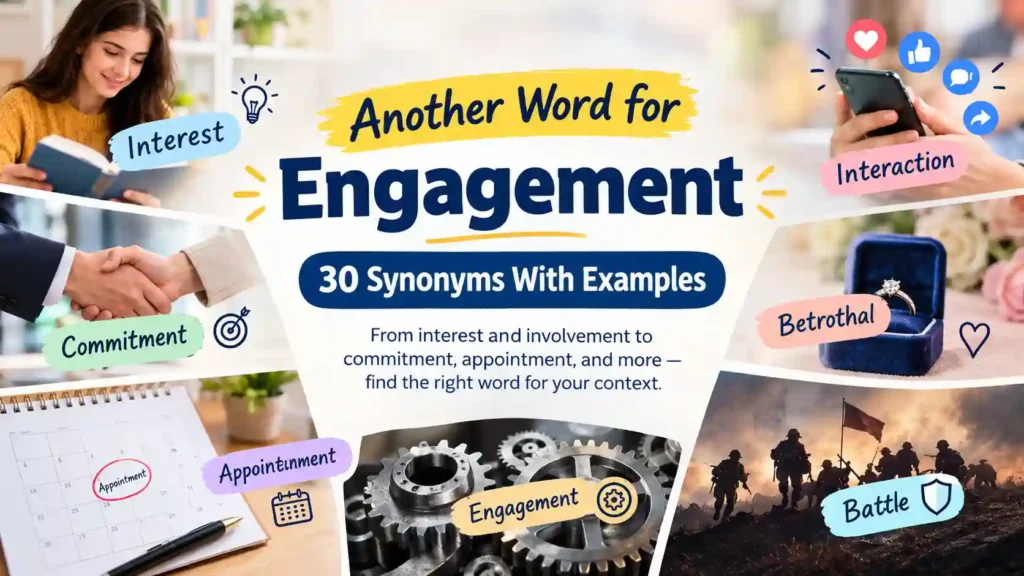
The best another word for engagement depends on what you mean.The best another word for engagement depends on what you mean. When you mean interest and attention, use involvement, interest, or participation. Online likes, comments, and shares are best called interaction. A promise to marry is a betrothal, while a planned event or booked job is an appointment or booking.
“Engagement” has several unrelated meanings. It can describe how much someone cares about a task, a promise to marry, a scheduled commitment, a hiring arrangement, a fight, or the meeting of two gears. A word that fits one meaning often sounds wrong in another.
Quick list: involvement, participation, interest, interaction, commitment, appointment, betrothal, booking, hiring, battle
This article looks at 30 alternatives. For each one it gives the meaning, IPA pronunciation, usage notes, and an example sentence, so you can choose the right word for your context.
At a Glance: Engagement Synonyms and Related Alternatives
| Alternative | Part of Speech | Meaning | Register / Tone | Ideal Context |
|---|---|---|---|---|
| involvement | noun | being part of something | neutral | work, school, projects |
| participation | noun | taking an active part | neutral to formal | classes, events, research |
| interaction | noun | two-way action or response | neutral | social media, customer service |
| interest | noun | attention and curiosity | neutral | readers, students, audiences |
| commitment | noun | strong loyalty to a task or cause | neutral to formal | workplace, relationships |
| betrothal | noun | a formal promise to marry | formal, old-fashioned | weddings, historical writing |
| appointment | noun | a planned meeting or time slot | neutral | schedules, medical visits |
| booking | noun | an arranged job or reservation | neutral | performers, speakers, travel |
| hiring | noun | the act of employing someone | neutral | business, consulting |
| battle | noun | a fight between armed forces | neutral to formal | military history |
Which Word Should You Use?
| If you want to… | Use | Why |
|---|---|---|
| Describe how much an audience cares about content | interest | It focuses on attention and curiosity. |
| Talk about likes, comments, and shares | interaction | It describes actions people take in response. |
| Say people are actively taking part | participation | It stresses doing, not just watching. |
| Describe staff who care about their work | commitment | It suggests loyalty and effort. |
| Say you are already booked | appointment or prior commitment | Both sound natural when declining an invitation. |
| Describe a paid appearance by a speaker or performer | booking | It is the common word for arranged appearances. |
| Describe a marriage promise in formal writing | betrothal | It sounds formal and traditional. |
| Describe a short fight in military writing | skirmish | It suggests a small, brief clash. |
Exploring the Multiple Meanings of “Engagement”
1. Interest and Involvement
- Meaning: The state of being interested in something and giving it your attention.
- Explanation: This is the sense behind “student engagement” and “employee engagement.” It describes mental and emotional involvement, not just being present.
- Example: The teacher used games to improve engagement in the class.
2. Interaction With Content or People
- Meaning: The ways people respond to or interact with a message, page, or brand.
- Explanation: In marketing, engagement usually means measurable actions such as likes, comments, shares, and clicks. It is narrower than general interest.
- Example: The post got more engagement than any other video this month.
3. A Promise to Marry
- Meaning: An agreement between two people to marry each other, or the period between that agreement and the wedding.
- Explanation: This sense is why we say “engagement ring” and “engagement party.” Here, “engaged” describes people, not their level of attention.
- Example: They announced their engagement in June.
4. An Appointment or Booked Commitment
- Meaning: An arrangement to be somewhere or do something at a set time, including a paid appearance.
- Explanation: People use this sense in polite excuses (“a previous engagement”) and for speakers and performers (“a speaking engagement”).
- Example: She had a speaking engagement in Lahore on Friday.
5. A Fight Between Forces
- Meaning: A battle or clash between opposing military forces.
- Explanation: This sense appears in military history and news reports. It often describes a specific fight, not a whole war.
- Example: The engagement lasted less than an hour.
6. The Meshing of Parts
- Meaning: The state of being connected or in gear, as with parts of a machine.
- Explanation: This is a technical sense used in engineering and mechanics.
- Example: The clutch controls the engagement of the gears.
Sources: Merriam-Webster (engagement, engage), Collins English Dictionary, Dictionary.com, Etymonline.
Analyzing 30 Engagement Alternatives in Detail
Some of these words are close synonyms for one meaning of “engagement,” while others are related alternatives that fit only a particular context, and each entry says which is which.
Involvement and Interest
1. Involvement
IPA: US /ɪnˈvɑːlvmənt/ · UK /ɪnˈvɒlvmənt/
Definition: Being connected with or taking part in something.
- Usage: A close synonym for engagement. It is neutral and describes participation or connection without necessarily showing excitement.
- Example: Parents’ involvement in school activities has grown this year.
2. Participation
IPA: US /pɑːrˌtɪsɪˈpeɪʃn/ · UK /pɑːˌtɪsɪˈpeɪʃn/
Definition: Taking part in an activity or event.
- Usage: A close alternative that emphasizes active participation. It is slightly more formal than involvement.
- Example: Class participation counts for ten percent of the grade.
3. Interest
IPA: /ˈɪntrəst/ (US and UK)
Definition: Curiosity or concern about something.
- Usage: A common alternative for audience or reader engagement. It describes attention and curiosity rather than measurable actions.
- Example: The article kept the readers’ interest from start to finish.
4. Absorption
IPA: US /əbˈsɔːrpʃn/ · UK /əbˈsɔːpʃn/
Definition: The state of being completely interested in something.
- Usage: A related alternative that suggests deeper focus than ordinary engagement.
- Example: Her absorption in the book made her miss her stop.
5. Immersion
IPA: US /ɪˈmɜːrʒn/ · UK /ɪˈmɜːʃn/
Definition: Deep involvement in an activity or experience.
- Usage: This word suits activities such as gaming, language learning, and training, where someone becomes deeply involved.
- Example: Language immersion helped him speak with more confidence.
6. Commitment
IPA: /kəˈmɪtmənt/ (US and UK)
Definition: A strong promise or dedication to a task, cause, or person.
- Usage: A close alternative in workplace contexts because it suggests loyalty and effort. It can also refer to a scheduled obligation.
- Example: The team showed real commitment to the project.
Interaction and Connection
7. interaction
IPA: (US and UK) /ˌɪntərˈækʃn/
Definition: Communication or action between people or things.
- Usage: The best everyday alternative for social media engagement, where it refers to likes, comments, and replies.
- Example: The brand tracks customer interaction on every platform.
8. connection
IPA: (US and UK) /kəˈnekʃn/
Definition: A relationship in which people or things are linked.
- Usage: A related alternative for emotional engagement with an audience or brand. It does not suggest measurable actions.
- Example: Good teachers build a real connection with their students.
9. rapport
IPA: US /ræˈpɔːr/ · UK /ræˈpɔː/
Definition: A friendly, trusting relationship in which people understand each other.
- Usage: A related alternative that describes people, not content. It fits teachers, speakers, and customer service.
- Example: The coach built a strong rapport with the players.
10. attachment
IPA: (US and UK) /əˈtætʃmənt/
Definition: A feeling of affection or loyalty toward someone or something.
- Usage: A related alternative for emotional engagement with a brand, place, or group. It sounds warmer and more personal than “interest.”
- Example: Many customers feel a strong attachment to the brand.
11. buy-in
IPA: (US and UK) /ˈbaɪ ɪn/
Definition: Agreement with and support for a plan or idea.
- Usage: An informal business term and a related alternative. It describes whether people accept a plan, not whether they are interested in it.
- Example: The manager needed staff buy-in before changing the schedule.
Dedication and Motivation
12. dedication
IPA: (US and UK) /ˌdedɪˈkeɪʃn/
Definition: Strong loyalty and effort given to a task or goal.
- Usage: A close alternative for committed engagement at work or in training. It stresses long-term effort.
- Example: Her dedication to the job impressed everyone.
13. devotion
IPA: US /dɪˈvoʊʃn/ · UK /dɪˈvəʊʃn/
Definition: Great love, loyalty, or enthusiasm for a person, cause, or activity.
- Usage: A related alternative. It is stronger and more emotional than “engagement,” so it can sound too intense for ordinary work or marketing.
- Example: His devotion to teaching was clear to every student.
14. enthusiasm
IPA: US /ɪnˈθuːziæzəm/ · UK /ɪnˈθjuːziæzəm/
Definition: Strong excitement and interest in something.
- Usage: A related alternative that describes energy and mood. It fits employees and audiences, but it can describe a short burst, while engagement suggests lasting involvement.
- Example: The new students showed great enthusiasm for the project.
15. motivation
IPA: US /ˌmoʊtɪˈveɪʃn/ · UK /ˌməʊtɪˈveɪʃn/
Definition: The reason or drive that makes someone want to act.
- Usage: A related alternative, not an exact synonym. Motivation is what leads to engagement, but it is not the same thing.
- Example: Clear goals raise motivation and keep people involved.
16. attention
IPA: (US and UK) /əˈtenʃn/
Definition: The act of focusing your mind on something.
- Usage: A related alternative that covers only the focus part of engagement. It is common in media and teaching contexts.
- Example: The story held the children’s attention for an hour.
Marriage and Promises
17. betrothal
IPA: US /bɪˈtroʊðl/ · UK /bɪˈtrəʊðl/
Definition: A formal promise or agreement to marry.
- Usage: A direct synonym for the marriage sense. It is formal and somewhat old-fashioned, so it suits historical or ceremonial writing. In daily speech, people say “engagement.”
- Example: The king announced the betrothal of his daughter.
18. proposal
IPA: US /prəˈpoʊzl/ · UK /prəˈpəʊzl/
Definition: An offer or suggestion, including a request to marry someone.
- Usage: A related alternative, not a synonym. The proposal is the moment of asking. The engagement is the agreement and the time that follows.
- Example: He made his proposal on the beach at sunset.
19. pledge
IPA: (US and UK) /pledʒ/
Definition: A serious promise.
- Usage: A related alternative that connects to the word’s origin. It can describe the promise at the heart of a betrothal, but it is not used for the marriage agreement itself in modern speech.
- Example: They made a pledge to marry within the year.
Appointments, Bookings, and Hiring
20. appointment
IPA: (US and UK) /əˈpɔɪntmənt/
Definition: An arrangement to meet someone or do something at a set time.
- Usage: A direct synonym for the “scheduled commitment” sense. It is the most common everyday choice, especially for doctors, meetings, and services.
- Example: I can’t come tonight because I have an appointment.
21. obligation
IPA: US /ˌɑːblɪˈɡeɪʃn/ · UK /ˌɒblɪˈɡeɪʃn/
Definition: Something you must do because of a promise, duty, or rule.
- Usage: A related alternative for “a previous engagement” when you mean a duty, not a social plan. It can sound heavier than “engagement.”
- Example: She had a family obligation and could not attend.
22. booking
IPA: (US and UK) /ˈbʊkɪŋ/
Definition: An arrangement to reserve a place, service, or performer for a set time.
- Usage: A close synonym when engagement means a paid appearance, such as a speaker’s event or a concert date.
- Example: The band has a booking at the festival in August.
23. gig
IPA: (US and UK) /ɡɪɡ/
Definition: A job, especially a short-term one, or a live performance.
- Usage: An informal synonym for a performer’s engagement. It also means a short-term job. Avoid it in formal writing.
- Example: The singer has three gigs this weekend.
24. hiring
IPA: (US and UK) /ˈhaɪərɪŋ/
Definition: The act of employing someone to do a job.
- Usage: A related alternative for the “engagement of a consultant” meaning. It names the act of employing, not the job itself.
- Example: The firm’s hiring of an outside expert saved time.
25. employment
IPA: (US and UK) /ɪmˈplɔɪmənt/
Definition: The state of having paid work, or the use of someone’s services.
- Usage: A related alternative for the arrangement itself. It is more formal than “booking” and does not suit performers.
- Example: The agency arranged short-term employment for the designer.
Combat and Mechanical Terms
26. battle
IPA: (US and UK) /ˈbætl/
Definition: A fight between armed forces.
- Usage: A close synonym for the military sense. It is the plain, common word, and it usually describes a larger fight than “engagement” does.
- Example: The battle ended before sunset.
27. skirmish
IPA: US /ˈskɜːrmɪʃ/ · UK /ˈskɜːmɪʃ/
Definition: A small, short fight between groups.
- Usage: A close synonym when the fight is small and brief, which matches how “engagement” is often used in military reports.
- Example: A skirmish broke out near the border.
28. encounter
IPA: US /ɪnˈkaʊntər/ · UK /ɪnˈkaʊntə/
Definition: A meeting, especially an unexpected one, or a short fight.
- Usage: A related alternative for the military sense. It is less specific and can also mean a simple meeting, so check the context.
- Example: The patrol had an encounter with enemy troops.
29. combat
IPA: US /ˈkɑːmbæt/ · UK /ˈkɒmbæt/
Definition: Fighting between armed forces.
- Usage: A related alternative. It names the activity in general, while an engagement is one specific fight.
- Example: Many of the soldiers had never seen combat.
30. meshing
IPA: (US and UK) /ˈmeʃɪŋ/
Definition: The fitting together of parts, such as gear teeth.
- Usage: A technical alternative for the mechanical sense. It describes the physical fit of parts and does not work for people or interest.
- Example: Poor meshing of the gears made a loud noise.
Sources: Merriam-Webster, Collins English Dictionary and Collins Thesaurus, Dictionary.com, Oxford Learner’s Dictionaries.
Engagement vs. Involvement vs. Participation
These three words are often treated as the same, but they are not. A person can be involved or can participate without being truly engaged.
| Word | Core Idea | Example |
|---|---|---|
| involvement | being connected to something | Her involvement in the club is small. |
| participation | taking an active part | Participation in the survey was voluntary. |
| engagement | caring about and focusing on something | The lesson led to high student engagement. |
Think of a student in a meeting. Participation means she speaks when called on. Involvement means she is on the team. Engagement means she is listening, thinking, and interested. This is why teachers and managers often prefer “engagement” when they want to describe how much people care, not just whether they show up.
Sources: Merriam-Webster, Collins English Dictionary, Dictionary.com.
Engagement and Opposite/Paired Word Pairs
| Word | Paired Word | Note |
|---|---|---|
| engagement | disengagement | Disengagement means withdrawing interest or involvement. Common in work and school writing. |
| engagement | apathy | Apathy means a lack of interest or concern. |
| engagement | indifference | Indifference means not caring either way. |
| engagement | boredom | Boredom is the feeling that often goes with low engagement. |
| engagement | withdrawal | Used for pulling out of a fight or an activity. |
| engagement | marriage | A natural pair. The engagement comes before the wedding. |
| engagement | retention | Common business pair. Engaged customers and staff are more likely to stay. |
“Engagement” has no single opposite because each meaning has its own contrast.The opposite of engagement depends on the context. Apathy and disengagement suggest a lack of interest or involvement. In a military context, withdrawal means pulling back from a fight. For a marriage promise, the next step is usually marriage.
Sources: Merriam-Webster, Collins English Dictionary, Dictionary.com.
Common Word Partners of “Engagement”
| Pattern | Common Partners | Example |
|---|---|---|
| adjective + engagement | high, low, active, strong, public | Teachers want high engagement in every lesson. |
| noun + engagement | customer, user, employee, student, community | Employee engagement affects how long people stay. |
| verb + engagement | boost, increase, measure, improve, encourage | The company hopes to boost engagement this year. |
| engagement + noun | ring, party, rate, strategy | The post had a high engagement rate. |
| announce / break off + engagement | announce, call off, end, break | They decided to call off their engagement. |
| speaking / previous + engagement | speaking, previous, prior, social | She had a prior engagement and left early. |
Sources: Merriam-Webster, Collins English Dictionary, Oxford Learner’s Dictionaries.
Idiomatic Phrases Featuring “Engagement”
“Engagement” has very few true idioms. The items below are established expressions and fixed phrases, not idioms in the strict sense.
1. Rules of engagement
- Meaning: Official rules about when and how military forces may fight. It is also used in business and politics for the accepted rules of how to deal with an opponent.
- Example: The company set clear rules of engagement for handling customer complaints.
2. A previous (or prior) engagement
- Meaning: A polite way to decline an invitation because you have already made other plans.
- Example: “I’d love to come, but I have a previous engagement.”
3. Engagement ring
- Meaning: A ring given as a sign of a promise to marry.
- Example: He chose the engagement ring himself.
Sources: Merriam-Webster, Collins English Dictionary, Dictionary.com.
Word Formation of “Engagement”
Etymology & Structure
“Engagement” is built from the verb engage plus the suffix -ment, which forms nouns that name an action or its result. Engage came into English from French engager, which comes from en- (“in, make”) and gage (“pledge”). That origin explains why the earliest meanings connect to promises and obligations.
Date and History
According to Etymonline and Merriam-Webster, the noun was in use in English by the early 1600s. The other senses, including the military fight and the promise to marry, developed from the idea of binding yourself to something, though exact dates differ between dictionaries.
Word Class Variations
- Verb: engage, engages, engaged, engaging
- Noun: engagement
- Adjective: engaged, engaging
- Adverb: engagingly
- Related derivatives: disengage, disengagement, reengage, reengagement, unengaged
Sources: Etymonline, Merriam-Webster, Collins English Dictionary.
Common Word-Choice Mistakes
- Social media interaction means likes and comments, not “betrothal.”
- A speaking booking, not a “speaking betrothal,” is the arranged talk.
- Engagement means strong interest, not “obligation,” when you describe an audience.
- Skirmish describes a small fight, not a large “engagement of the whole war.”
- Betrothal sounds formal, so say “We got engaged,” not “We got betrothed,” in daily speech.
- Employee involvement is not always the same as employee engagement, because someone can be involved without caring.
- “Proposal” is the question, not the whole “engagement” period that follows.
Frequently Asked Questions
What is the closest synonym for engagement?
It depends on the meaning. For interest and attention, the closest words are involvement and interest. For online activity, it is interaction.
What is another word for engagement in marketing?
Interaction is the most common. Other options are response, involvement, and audience interest.
What is a formal word for engagement in marriage?
Betrothal is the formal word. It sounds traditional and is rare in everyday speech.
What is the difference between engagement and involvement?
Involvement means being part of something. Engagement means being focused on it and caring about it, so it is a deeper level.
Can engagement mean an appointment?
Yes. In formal or polite speech, an engagement can be a planned meeting, event, or booked appearance, as in “a speaking engagement.”
What is a word for employee engagement?
Commitment, dedication, and involvement are common alternatives. Each describes a slightly different part of how much staff care about their work.
What is the opposite of engagement?
For interest, the opposites are disengagement and apathy. For fighting, a contrast is withdrawal.
Is engagement the same as participation?
No. Participation means taking part. Engagement means caring and paying attention while taking part.
Can engagement be used for fights?
Yes, especially in military writing, where it means a battle or clash between forces. Skirmish suits a small, brief fight.
What is a casual word for a paid performance engagement?
Gig is the common informal word. It often describes a short job or a live show.
Conclusion
The closest everyday alternatives to “engagement” are involvement, interest, participation, and interaction. For other meanings, appointment, booking, betrothal, and battle fit better. No single word covers every sense.
Context decides the best choice. A word that suits a marketing report, such as interaction, will not work for a wedding announcement. A formal word like betrothal sounds out of place in casual speech, and gig sounds out of place in a formal letter.
To choose well, first ask which meaning you need. Then match the word to the situation and tone. If you want to describe how much people care, use interest, involvement, or commitment. If you mean a plan, a promise, or a fight, use the more specific word from this list.

Hi, I’m Sophia a passionate writer and curious learner who enjoys exploring fascinating facts, everyday questions, and interesting discoveries. At VistoraDaily, I share clear, reliable, and engaging general knowledge content to help readers learn something new and understand the world better.