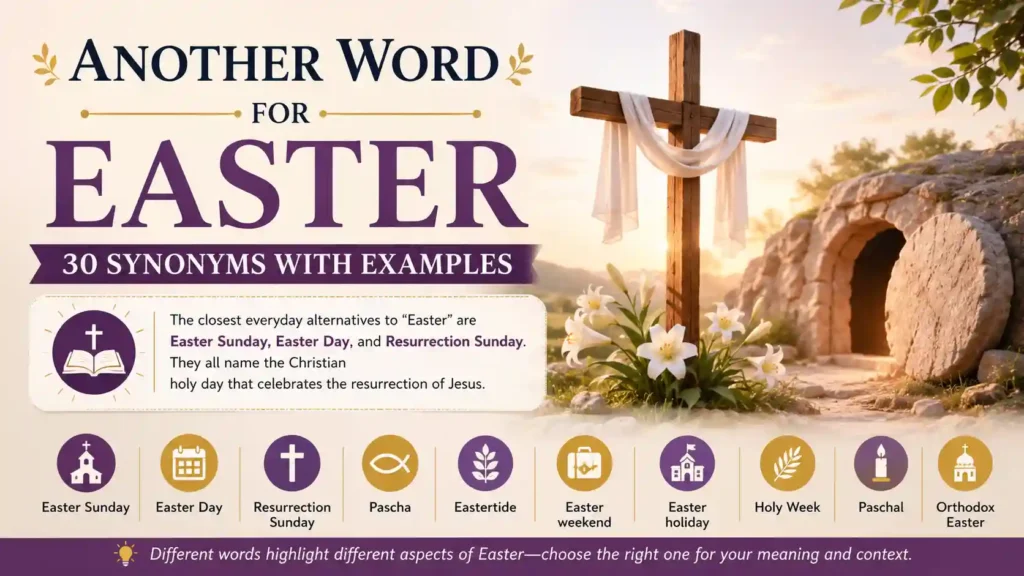
The closest alternatives to Easter are Easter Sunday, Easter Day, and Resurrection Sunday. All three refer to the Christian holiday celebrating the resurrection of Jesus. In traditional church language, you may also see Pascha or Pasch.
Easter can refer to the holy day, the spring holiday weekend, or the school break. Related terms include Eastertide, Holy Week, and Easter weekend, but each has a different meaning.
Some words, such as Passover and Lent, are connected to Easter but are not direct synonyms. The best alternative depends on the context.
Quick list: Easter Sunday, Easter Day, Resurrection Sunday, Pascha, Pasch, Eastertide, Easter weekend, Easter holiday, Holy Week, Paschal
Below, you will find 30 alternatives with meanings, IPA, usage notes, examples, and context.
At a Glance: Easter Synonyms and Related Alternatives
| Alternative | Part of Speech | Meaning | Register / Tone | Ideal Context |
|---|---|---|---|---|
| Easter Sunday | noun | The day Christians celebrate the resurrection of Jesus | Neutral | Everyday and religious use |
| Easter Day | noun | Another name for Easter Sunday | Neutral, slightly formal | Church notices, British English |
| Resurrection Sunday | noun | Easter, with focus on the resurrection | Religious | Church services, Christian writing |
| Pascha | noun | The Christian name for Easter, from Greek | Formal, liturgical | Orthodox and historical writing |
| Eastertide | noun | The Easter season after Easter Sunday | Formal, religious | Church calendar |
| Easter weekend | noun | Good Friday through Easter Monday | Neutral, casual | Travel, work, family plans |
| Easter holiday | noun | The Easter break from work or school | Neutral | Schools, travel, British English |
| Holy Week | noun | The week before Easter Sunday | Religious, neutral | Church events, history |
| Paschal | adjective | Relating to Easter or Passover | Formal | “Paschal candle,” “paschal feast” |
| Orthodox Easter | noun | Easter as calculated by Orthodox churches | Neutral | Dates and traditions |
Which Word Should You Use?
| If you want to… | Use | Why |
|---|---|---|
| Name the holy day in plain English | Easter Sunday | It is the clearest and most common option. |
| Write a church notice or a traditional sentence | Easter Day | It sounds familiar and slightly formal. |
| Stress the religious meaning | Resurrection Sunday | It names what is being celebrated. |
| Write about Orthodox or early Christian tradition | Pascha | It is the traditional name in those settings. |
| Talk about the long season after Easter | Eastertide | “Easter” alone usually means the day or weekend. |
| Plan time off or travel | Easter weekend | It covers the usual days off. |
| Discuss school or work breaks | Easter holiday | It is the usual British term; “Easter break” is common in the US. |
| Refer to the days leading up to Easter | Holy Week | It covers Palm Sunday through Holy Saturday. |
| Describe things linked to Easter or Passover | Paschal | It works as an adjective (“paschal lamb”). |
Exploring the Multiple Meanings of “Easter”
1. The Christian Festival
- Meaning: The Christian holy day that celebrates the resurrection of Jesus.
- Explanation: This is the main sense. It falls on a Sunday, and the date changes each year. Western churches and Orthodox churches often celebrate on different dates, because they use different calendar rules.
- Example: We go to church every Easter.
2. The Easter Season or Weekend
- Meaning: The days or weeks around Easter Sunday.
- Explanation: People often say “Easter” for the whole weekend, from Good Friday to Easter Monday. In church language, the longer season is called Eastertide.
- Example: We’re visiting my parents over Easter.
3. The Easter Holiday or Break
- Meaning: A school or work holiday around Easter.
- Explanation: In the UK, “the Easter holidays” usually means the school break. The phrase is less common in the US, where “spring break” or “Easter break” is more usual.
- Example: The kids are off school for two weeks at Easter.
4. Secular or Cultural Easter
- Meaning: The spring holiday with eggs, the Easter Bunny, and family meals, without a religious focus.
- Explanation: Many people enjoy Easter customs without observing the religious holiday.
- Example: We always do an Easter egg hunt in the garden.
Sources: Merriam-Webster; Collins Dictionary; Britannica; Etymonline.
Analyzing 30 Easter Alternatives in Detail
Some alternatives below are direct names for Easter Sunday, while others are related terms for the season, the days around it, or the same festival in other languages. Each Usage note says which kind it is. For foreign words, the IPA shows the native pronunciation.
Group 1: Names for Easter Sunday
1. Easter Sunday
IPA: US /ˌiːstər ˈsʌndeɪ/ · UK /ˌiːstə ˈsʌndeɪ/
Definition: The Sunday on which Christians celebrate the resurrection of Jesus.
- Usage: The closest everyday alternative. It names the day itself, so it is more precise than “Easter,” which can also mean the weekend or season.
- Example: The church was full on Easter Sunday.
2. Easter Day
IPA: US /ˌiːstər ˈdeɪ/ · UK /ˌiːstə ˈdeɪ/
Definition: Easter Sunday.
- Usage: A direct synonym. It sounds slightly more formal and appears often in church notices and traditional writing, especially in British English.
- Example: The service on Easter Day starts at sunrise.
3. Resurrection Sunday
IPA: US /ˌrɛzəˈrɛkʃən ˈsʌndeɪ/ · UK /ˌrɛzəˈrɛkʃn̩ ˈsʌndeɪ/
Definition: Easter, named for the belief that Jesus rose from the dead.
- Usage: A direct synonym with a religious tone. Many Christians prefer it when they want to stress the meaning of the day rather than the customs.
- Example: Our choir is singing at Resurrection Sunday worship.
4. Pascha
IPA: /ˈpɑːskə/ (US and UK)
Definition: The Christian name for Easter, taken from the Greek word for Passover.
- Usage: A direct synonym in liturgical and Orthodox use. It is rare in everyday speech and may need explaining to general readers.
- Example: In Greek, the greeting at Pascha is “Christ is risen.”
5. Pasch
IPA: /pæsk/ (US and UK)
Definition: An old word for Easter, also used for Passover.
- Usage: A direct but archaic synonym. It appears mostly in historical, church, or literary writing.
- Example: The old hymn praises the Pasch of the Lord.
Group 2: Easter Season and Time Off
6. Eastertide
IPA: US /ˈiːstərtaɪd/ · UK /ˈiːstətaɪd/
Definition: The Easter season, in Western churches the period from Easter Sunday to Pentecost.
- Usage: A related alternative, not an exact synonym. It names the season, not the single day. It is formal and religious.
- Example: The church lights its paschal candle throughout Eastertide.
7. Eastertime
IPA: US /ˈiːstərtaɪm/ · UK /ˈiːstətaɪm/
Definition: The time of year around Easter.
- Usage: A related alternative. It is looser and more general than Eastertide and sounds slightly old-fashioned.
- Example: The bakery is busiest at Eastertime.
8. Paschaltide
IPA: /ˈpæskəltaɪd/ (US and UK)
Definition: The Easter season; another word for Eastertide.
- Usage: A rare, formal alternative to Eastertide. It is mainly found in church writing.
- Example: The prayer book has special readings for Paschaltide.
9. Easter weekend
IPA: US /ˌiːstər ˈwiːkɛnd/ · UK /ˌiːstə wiːkˈɛnd/
Definition: The days from Good Friday to Easter Monday.
- Usage: A related alternative for the holiday period. It is neutral and common in news, travel, and work plans.
- Example: Airports expect heavy traffic over the Easter weekend.
10. Easter holiday
IPA: US /ˌiːstər ˈhɑːlədeɪ/ · UK /ˌiːstə ˈhɒlədeɪ/
Definition: A break from work or school around Easter.
- Usage: A related alternative. It refers to time off, not the religious festival. In British English, the plural “Easter holidays” is common for the school break.
- Example: We booked a trip to Spain for the Easter holiday.
Group 3: Holy Week and the Days Around Easter
11. Holy Week
IPA: US /ˈhoʊli wiːk/ · UK /ˈhəʊli wiːk/
Definition: The week before Easter Sunday, from Palm Sunday to Holy Saturday.
- Usage: A related term for the days leading up to Easter.
- Example: Many churches hold daily services during Holy Week.
12. Palm Sunday
IPA: /ˌpɑːm ˈsʌndeɪ/
Definition: The Sunday before Easter, celebrating Jesus’s entry into Jerusalem.
- Usage: It marks the beginning of Holy Week.
- Example: Children carried palm leaves on Palm Sunday.
13. Maundy Thursday
IPA: /ˌmɔːndi ˈθɜːrzdeɪ/
Definition: The Thursday before Easter, remembering the Last Supper.
- Usage: This day is part of Holy Week, not a synonym for Easter.
- Example: The church held a special service on Maundy Thursday.
14. Good Friday
IPA: /ˌɡʊd ˈfraɪdeɪ/
Definition: The Friday before Easter, commemorating Jesus’s crucifixion.
- Usage: It is a solemn day during the Easter weekend.
- Example: Many Christians attend church on Good Friday.
15. Holy Saturday
IPA: US /ˌhoʊli ˈsætərdeɪ/ · UK /ˌhəʊli ˈsætədeɪ/
Definition: The day between Good Friday and Easter Sunday.
- Usage: It is the final day of Holy Week.
- Example: The Easter vigil took place on Holy Saturday.
16. Easter Monday
IPA: US /ˌiːstər ˈmʌndeɪ/ · UK /ˌiːstə ˈmʌndeɪ/
Definition: The Monday after Easter Sunday.
- Usage: It is a public holiday in the UK and several other countries.
- Example: We visited our relatives on Easter Monday.
17. Triduum
IPA: /ˈtrɪduəm/
Definition: The three-day period from Maundy Thursday evening through Easter Sunday.
- Usage: This formal Christian term describes the central days of Easter observance.
- Example: The Triduum is an important part of the church year.
Group 4: Religious and Theological Terms
18. Resurrection
IPA: /ˌrɛzəˈrɛkʃən/ (US and UK)
Definition: The rising of Jesus from the dead, as Christians believe.
- Usage: A related word, not a synonym. It names the event Easter celebrates, not the day. Easter is the festival and the resurrection is what it commemorates.
- Example: Easter celebrates the Resurrection.
19. Paschal
IPA: /ˈpæskəl/ (US and UK)
Definition: Relating to Easter or to Passover.
- Usage: A formal adjective that works as a modifier in place of “Easter,” as in “paschal candle.” It cannot stand in for the noun.
- Example: The paschal candle is lit during the Easter vigil.
20. Passover
IPA: US /ˈpæsoʊvər/ · UK /ˈpɑːsəʊvə/
Definition: The Jewish festival that remembers the Israelites’ escape from slavery in Egypt.
- Usage: Related, but not a synonym. It is a separate Jewish festival. The two share a root because “Pascha” comes from the word for Passover, and the events are linked in the Gospels.
- Example: Easter and Passover often fall in the same week.
21. Lent
IPA: /lɛnt/ (US and UK)
Definition: The 40 days of fasting and prayer before Easter in many Christian churches.
- Usage: Related, but not a synonym. It comes before Easter and is often contrasted with it.
- Example: She gave up sweets for Lent and enjoyed chocolate again on Easter.
22. Easter Vigil
IPA: US /ˌiːstər ˈvɪdʒəl/ · UK /ˌiːstə ˈvɪdʒəl/
Definition: The church service held on the night before Easter Sunday.
- Usage: Related, but not a synonym. It is a specific service that begins the Easter celebration.
- Example: We attended the Easter Vigil on Saturday night.
Group 5: Variants and Cultural Terms
23. Orthodox Easter
IPA: US /ˌɔːrθədɑːks ˈiːstər/ · UK /ˌɔːθədɒks ˈiːstə/
Definition: Easter as calculated and celebrated by Eastern Orthodox churches.
- Usage: A variant of Easter, not a different holiday. It often falls on a different date from Western Easter because of different calendar rules.
- Example: Orthodox Easter is a week later this year.
24. Ostara
IPA: US /oʊˈstɑːrə/ · UK /ɒˈstɑːrə/
Definition: A modern name for a spring festival, used by some pagan groups.
- Usage: A related name linked to the same Old English root as “Easter,” but not a synonym. It refers to a different, modern celebration and should not be used as another word for the Christian holy day.
- Example: Some modern pagans celebrate Ostara at the spring equinox.
25. Easter break
IPA: US /ˌiːstər ˈbreɪk/ · UK /ˌiːstə ˈbreɪk/
Definition: A short vacation from school or work around Easter.
- Usage: A related alternative to “Easter holiday,” more common in American English. It refers to time off, not the festival.
- Example: The college closes for Easter break on Thursday.
Group 6: Easter in Other Languages
26. Pâques (French)
IPA: /pɑk/ (French)
Definition: The French word for Easter.
- Usage: A translation, not an English synonym. It is useful in French contexts and in multilingual writing.
- Example: In France, many families eat lamb at Pâques.
27. Pascua (Spanish)
IPA: /ˈpaskwa/ (Spanish)
Definition: The Spanish word for Easter; it can also mean other festival periods.
- Usage: A translation. In Spanish, the word can also refer to Passover or Christmas season terms, so context matters.
- Example: Spain is known for its Holy Week processions before Pascua.
28. Pasqua (Italian)
IPA: /ˈpaskwa/ (Italian)
Definition: The Italian word for Easter.
- Usage: A translation. Italian greetings such as “Buona Pasqua” use it.
- Example: She sent her cousins a card saying “Buona Pasqua.”
29. Ostern (German)
IPA: /ˈoːstɐn/ (German)
Definition: The German word for Easter.
- Usage: A translation. It comes from the same Germanic root as the English word.
- Example: In Germany, Ostern is often a time for family walks and egg decorating.
30. Pasen (Dutch)
IPA: /ˈpaːsə/ (Dutch)
Definition: The Dutch word for Easter.
- Usage: A translation. It comes from the same source as Pascha, not the Germanic root of “Easter.”
- Example: In the Netherlands, schools often close on the Monday after Pasen.
Sources: Merriam-Webster; Collins Dictionary; Dictionary.com; Etymonline; Britannica; Oxford English Dictionary.
Easter vs. Easter Sunday vs. Eastertide
These three terms are often mixed up. They overlap but are not the same thing.
| Term | What It Means | When It Happens |
|---|---|---|
| Easter Sunday | The single day of the resurrection festival | One Sunday each spring |
| Easter weekend | The days off around the festival | Good Friday to Easter Monday |
| Eastertide | The church season of Easter | In Western churches, Easter Sunday to Pentecost |
The date of Easter changes every year. In Western churches, it falls on the first Sunday after the first full moon on or after March 21, using church rules for the calendar. Orthodox churches use a different calendar for their calculation, which is why the dates often differ.
Sources: Britannica; Merriam-Webster.
Easter and Opposite/Paired Word Pairs
| Word | Paired Word | Note |
|---|---|---|
| Easter | Christmas | The two major Christian festivals, often discussed together. |
| Easter | Lent | Lent leads up to Easter; one is fasting, the other celebration. |
| Easter Sunday | Good Friday | They mark the end and the turning point of the Easter story: sorrow and celebration. |
| Western Easter | Orthodox Easter | The two traditions often celebrate on different dates. |
| Easter | Passover | Related festivals that sometimes fall close together. |
| Easter | Pentecost | Pentecost closes the Easter season in Western tradition. |
“Easter” has no true antonym. The pairs above show natural contrasts and common neighbors in the Christian calendar. Lent and Good Friday are the most useful contrasts, because they describe the mood before Easter.
Sources: Britannica; Merriam-Webster; Collins Dictionary.
Common Word Partners of “Easter”
| Pattern | Common Partners | Example |
|---|---|---|
| Easter + noun | egg, bunny, basket, bonnet, parade, service, Sunday, Monday, weekend, holiday, break, lily, dinner, brunch | The children decorated Easter eggs. |
| adjective + Easter | early, late, Orthodox, happy | Easter is late this year. |
| verb + Easter | celebrate, spend, mark | We spend Easter with my grandparents. |
| Easter + verb | falls, comes, arrives | Easter falls in April this year. |
| preposition + Easter | at, over, before, after | We’ll see you over Easter. |
Sources: Collins Dictionary; Cambridge Dictionary; Merriam-Webster.
Idiomatic Phrases Featuring “Easter”
“Easter” has few true idioms. The entries below are established expressions, and only the first has a figurative meaning.
1. Easter egg
- Meaning: A hidden surprise or feature in a video game, film, or software, placed there by its creators.
- Example: Fans found an Easter egg in the last scene of the movie.
2. Easter Bunny
- Meaning: The imaginary rabbit that children are told brings eggs and treats at Easter.
- Example: The kids left carrots out for the Easter Bunny.
3. Easter Rising
- Meaning: The 1916 armed rebellion against British rule in Ireland, which began on Easter Monday.
- Example: The museum has an exhibit about the Easter Rising.
4. Easter parade
- Meaning: A traditional procession in which people show off new clothes and decorated hats on Easter Sunday.
- Example: The town still holds an Easter parade every spring.
Sources: Merriam-Webster; Collins Dictionary; Britannica.
Word Formation of “Easter”
Etymology & Structure
“Easter” comes from Old English Ēastre (plural Ēastron), from a Proto-Germanic root linked to “dawn” and the east, where the sun rises. The writer Bede, in the 8th century, linked the word to a goddess named Eostre. Modern dictionaries treat that explanation with care because the evidence is limited. The word is related to “east,” and it is a simple noun with no prefixes or suffixes.
Date and History
The word is recorded in Old English, before the 12th century. English kept the Germanic word, while many other European languages use a form of “Pascha,” such as French Pâques, Spanish Pascua, and Italian Pasqua.
Word Class Variations
- Noun: Easter (the festival), Easter Sunday, Eastertide
- Adjective: “Easter” works as a modifier (“Easter eggs,” “Easter morning”). “Paschal” is the related formal adjective.
- Verb/adverb: There is no standard verb or adverb form.
- Related words: “Easterly” and “eastern” come from “east,” which shares the same root, but they do not mean anything related to the holiday.
Sources: Etymonline; Merriam-Webster; Oxford English Dictionary; Britannica.
Common Word-Choice Mistakes
Easter Sunday week: Easter week or Holy Week. (“Holy Week” is the week before Easter.)
Passover is the same as Easter: Passover and Easter are different festivals. Both are celebrated in spring and are historically linked.
Good Friday celebrates the resurrection: Good Friday remembers the crucifixion. Easter Sunday celebrates the resurrection.
Eastertide is one day: Eastertide is the season. Use Easter Sunday for the day.
Ostara is a synonym for Christian Easter: Ostara is a modern name used for a separate spring festival.
Orthodox Easter is a different holiday: It is the same festival, calculated by a different calendar.
Easter holidays means the religious festival: It usually means the school break.
FAQs
What is the closest synonym for Easter?
Easter Sunday and Easter Day are the closest. Resurrection Sunday is a close religious alternative.
What is another word for Easter in church language?
Pascha, Pasch, and Resurrection Sunday are common in church and traditional writing. “Paschal” is the matching adjective.
What is the difference between Easter and Eastertide?
Easter is the holy day. Eastertide is the season that follows it, which in Western churches lasts until Pentecost.
Is Passover the same as Easter?
No. Passover is a Jewish festival, and Easter is a Christian one. They are linked in history and sometimes fall close together.
What is the difference between Holy Week and Easter week?
Holy Week is the week leading up to Easter Sunday. “Easter week” usually means the week after Easter Sunday, though use varies.
What is the opposite of Easter?
There is no true opposite. Lent and Good Friday are natural contrasts because they come before Easter.
What is the Easter weekend?
It usually means Good Friday through Easter Monday, which are public holidays in many countries.
Why do some people celebrate Easter on a different date?
Western and Orthodox churches use different calendar rules to calculate it.
What does “Easter egg” mean in a movie or game?
It means a hidden surprise or message put there by the creators.
Is “Easter” related to the word “east”?
Yes. Both come from a root connected to dawn, according to etymology sources.
Conclusion
The closest alternatives to “Easter” are Easter Sunday, Easter Day, and Resurrection Sunday. Pascha and Pasch are older or church-specific names for the same festival.
Most other words in this article are related terms, not synonyms. Eastertide names the season, Holy Week names the days before Easter, and Easter weekend and Easter holiday describe time off. Words like Passover, Lent, and Ostara belong to other traditions or parts of the calendar.
To choose the right word, first decide whether you mean the day, the season, the holiday, or the tradition. Then choose the term that fits your audience and tone.

Hi, I’m Sophia a passionate writer and curious learner who enjoys exploring fascinating facts, everyday questions, and interesting discoveries. At VistoraDaily, I share clear, reliable, and engaging general knowledge content to help readers learn something new and understand the world better.