
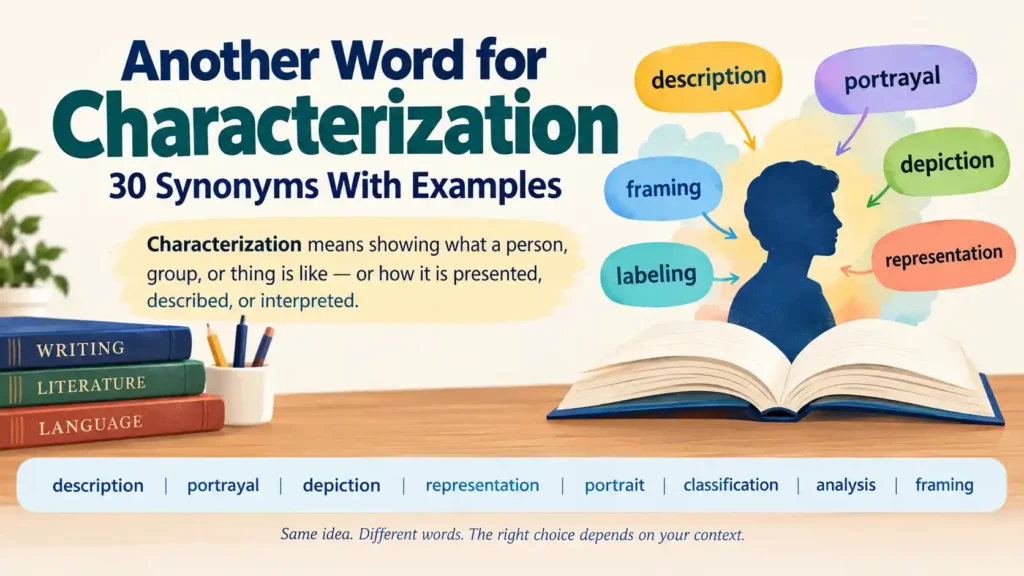
The closest everyday alternatives to “characterization” are description, portrayal, and depiction. All three mean showing what a person, group, or thing is like. The best choice depends on the sense you need.
In writing and conversation, “characterization” often carries an extra idea: the speaker is interpreting, not just listing facts. That is why words like framing, labeling, and interpretation also belong in this article.
Quick list: description, portrayal, depiction, representation, portrait, classification, labeling, analysis, assessment
Below are 30 alternatives with meanings, IPA, usage notes, examples, and context. Some are direct synonyms. Others only fit one sense of “characterization,” and the notes say which.
At a Glance: Characterization Synonyms and Related Alternatives
| Alternative | Part of Speech | Meaning | Register / Tone | Ideal Context |
|---|---|---|---|---|
| Description | noun | A statement of what someone or something is like | Neutral | Everyday and formal writing |
| Portrayal | noun | A way of showing a person or thing in words, film, or art | Neutral to formal | Reviews, news, arts |
| Depiction | noun | A picture or written image of something | Neutral to formal | Art, history, literature |
| Representation | noun | A way of showing or presenting something | Formal | Media studies, academic writing |
| Portrait | noun | A detailed word-picture of a person or place | Literary | Essays, profiles, books |
| Classification | noun | Placing something in a group by shared features | Formal | Science, law, research |
| Labeling | noun | Giving someone or something a name or tag that sums it up | Neutral, often critical | Social and political talk |
| Character development | noun | How a writer builds and changes a character | Neutral, technical | Fiction, film, teaching |
| Analysis | noun | A close study of the parts or features of something | Formal | Science, research, business |
| Framing | noun | Presenting something in a way that shapes how people see it | Neutral to critical | Media, politics, debate |
Which Word Should You Use?
| If you want to… | Use | Why |
|---|---|---|
| Say what someone or something is like, plainly | description | It is the simplest and most flexible choice. |
| Talk about how an actor, writer, or artist shows a person | portrayal | It focuses on how the person is shown. |
| Paint a vivid picture in words or art | depiction or portrait | Both stress detail and imagery. |
| Discuss how an author builds a story person | character development | It names the craft, not just the result. |
| Place something in a group | classification or categorization | Both stress sorting by shared features. |
| Give a short, quick word-picture | sketch | It suggests a brief outline, not full detail. |
| Describe how a speaker shapes the way others see something | framing | It points to the speaker’s angle or purpose. |
| Describe the properties of a sample or material | analysis | It fits technical and scientific work. |
Exploring the Multiple Meanings of “Characterization”
1. A Description of Qualities
- Meaning: The act of describing the special qualities or features of a person, group, or thing.
- Explanation: This is the most common everyday sense. The speaker often adds a judgment, so people often say “a fair characterization” or “an unfair characterization.”
- Example: Calling the city “quiet” is a fair characterization of the neighborhood where I grew up.
2. Labeling Something as a Type
- Meaning: Describing a person or thing as belonging to a certain kind or having a certain quality.
- Explanation: This sense usually appears in the pattern “characterization of X as Y.” It often shows up in news and debate, where people argue over whether the label is accurate.
- Example: The company rejected the characterization of its new policy as a price increase.
3. Creating a Character in Fiction
- Meaning: The way a writer creates and presents a character in a story, play, or film.
- Explanation: Teachers often split this sense into direct characterization, where the narrator tells us, and indirect characterization, where we learn from actions, speech, and thoughts.
- Example: The novel is known for its strong characterization, especially the shy older sister.
4. An Actor’s Portrayal of a Role
- Meaning: The way a performer shows a character in a play or film.
- Explanation: Here the focus is on the performance, not the script. Reviewers often use “portrayal” for this sense, but “characterization” also appears in theater writing.
- Example: Critics praised the actor’s characterization of the tired, kind-hearted doctor.
5. Determining the Properties of Something
- Meaning: The process of finding out and describing the features or properties of a substance, material, or sample.
- Explanation: This is a technical sense in science and engineering. It is about measuring, not telling a story.
- Example: The lab spent a week on the characterization of the new plastic.
Sources: Merriam-Webster, Collins Dictionary, Etymonline
Analyzing 30 Characterization Alternatives in Detail
Some alternatives below are direct synonyms for “characterization.” Others are related words that fit only one sense, and each usage note says which is which.
Core Synonyms: Describing and Showing
1. Description
IPA: /dɪˈskrɪpʃən/
Definition: A statement that tells what someone or something is like.
- Usage: The closest everyday synonym for characterization. It is simple and does not always suggest judgment.
- Example: Her description of the old house made us want to visit.
2. Portrayal
IPA: US /pɔːrˈtreɪəl/ · UK /pɔːˈtreɪəl/
Definition: Showing or describing someone or something through words, art, or performance.
- Usage: Best for literature, acting, films, and media. It focuses on how someone or something is presented.
- Example: The film’s portrayal of small-town life felt honest.
3. Depiction
IPA: /dɪˈpɪkʃən/
Definition: A picture or description showing how something looks or is.
- Usage: A close synonym that emphasizes visual details or vivid descriptions.
- Example: The book’s depiction of the storm was frightening.
4. Representation
IPA: US /ˌrɛprəzənˈteɪʃən/ · UK /ˌreprɪzenˈteɪʃən/
Definition: A way of presenting someone or something in art, media, or symbols.
- Usage: A formal alternative often used in academic writing and media studies.
- Example: The study examined the representation of teachers on television.
5. Delineation
IPA: /dɪˌlɪniˈeɪʃən/
Definition: A careful, detailed description or outline.
- Usage: A formal, less common synonym that emphasizes precision and detail.
- Example: The author’s delineation of each family member was clear and fair.
6. Rendering
IPA: US /ˈrɛndərɪŋ/ · UK /ˈrendərɪŋ/
Definition: A particular way of presenting or performing something.
- Usage: Best for acting and art. It emphasizes the creator’s personal version of a subject.
- Example: Her rendering of the villain was calm and cold.
Descriptive and Literary Alternatives
7. Portrait
IPA: US /ˈpɔːrtrɪt/ · UK /ˈpɔːtrɪt/
Definition: A detailed description in words, or a painting or photograph, of a person or place.
- Usage: A literary synonym for a full and thoughtful characterization. It suggests depth, not just a quick label.
- Example: The essay is a loving portrait of her grandfather.
8. Sketch
IPA: /skɛtʃ/ (US and UK)
Definition: A short, simple description that gives only the main points.
- Usage: A related alternative for a brief characterization. It suggests something light and incomplete.
- Example: The writer gave a quick sketch of each character in the first chapter.
9. Picture
IPA: US /ˈpɪktʃər/ · UK /ˈpɪktʃə/
Definition: A clear description that helps you see or understand something, as in “a picture of life in the city.”
- Usage: A figurative synonym in phrases like “paint a picture of.” It is informal and friendly.
- Example: The report paints a worrying picture of how young workers live.
10. Account
IPA: /əˈkaʊnt/ (US and UK)
Definition: A spoken or written report of something that happened or of what something is like.
- Usage: A related alternative. It fits when the characterization is part of a report or story told by someone, but it focuses on events more than on qualities.
- Example: His account of the town’s early days was warm and funny.
Labeling and Classifying Alternatives
11. Labeling
IPA: /ˈleɪbəlɪŋ/
Definition: Giving someone or something a name or tag that sums it up.
- Usage: Fits when characterization means assigning a label. It can sound critical because labels may oversimplify.
- Example: The labeling of the project as a failure was premature.
12. Categorization
IPA: US /ˌkætəɡərɪˈzeɪʃən/ · UK /ˌkætəɡəraɪˈzeɪʃən/
Definition: Sorting things into groups.
- Usage: A related alternative for grouping items by shared features. It does not describe their qualities in detail.
- Example: The categorization of books by topic took all afternoon.
13. Classification
IPA: US /ˌklæsəfɪˈkeɪʃən/ · UK /ˌklæsɪfɪˈkeɪʃən/
Definition: Arranging things into groups based on shared features.
- Usage: A formal alternative commonly used in science, law, and research.
- Example: The classification of the bird depends on its beak and wings.
14. Designation
IPA: /ˌdɛzɪɡˈneɪʃən/
Definition: A name, title, or label given to someone or something.
- Usage: Fits when characterization involves assigning an official name or status.
- Example: The park received the designation of a protected area.
15. Framing
IPA: /ˈfreɪmɪŋ/
Definition: Presenting an idea or event in a way that shapes understanding.
- Usage: Common in media and politics, framing emphasizes the speaker’s perspective.
- Example: The newspapers used different framing for the same event.
16. Stereotyping
IPA: US /ˈstɛriəˌtaɪpɪŋ/ · UK /ˈsteriəˌtaɪpɪŋ/
Definition: Judging a person or group using a fixed, oversimplified idea.
- Usage: A negative related term, not a true synonym. It describes unfair or inaccurate characterization.
- Example: Stereotyping older workers made it harder for her to find a job.
Fiction and Performance Alternatives
17. Character development
IPA: US /ˈkɛrɪktər dɪˈvɛləpmənt/ · UK /ˈkærəktə dɪˈveləpmənt/
Definition: The way a writer builds a character and shows how that character changes over time.
- Usage: A close match for the fiction sense. It is a little narrower, because it stresses change over the course of a story.
- Example: The show’s character development makes the young detective feel real.
18. Character study
IPA: US /ˈkɛrɪktər ˈstʌdi/ · UK /ˈkærəktə ˈstʌdi/
Definition: A work, or part of one, that closely examines one person’s personality.
- Usage: A related alternative for a whole book, film, or essay centered on one person’s personality.
- Example: The film is a quiet character study of a retired teacher.
19. Interpretation
IPA: US /ɪnˌtɝːprəˈteɪʃən/ · UK /ɪnˌtɜːprɪˈteɪʃən/
Definition: A person’s own way of understanding or performing something.
- Usage: A related alternative for the acting sense. It stresses the performer’s personal view of the role.
- Example: Her interpretation of the queen was softer than usual.
20. Impersonation
IPA: US /ɪmˌpɝːsəˈneɪʃən/ · UK /ɪmˌpɜːsəˈneɪʃən/
Definition: The act of copying a real person’s voice and manner, often for fun.
- Usage: A related alternative, not a true synonym. It suggests imitation, not creation.
- Example: His impersonation of the mayor made the whole room laugh.
21. Personification
IPA: US /pərˌsɑːnɪfɪˈkeɪʃən/ · UK /pəˌsɒnɪfɪˈkeɪʃən/
Definition: Giving human qualities to a thing or idea, or being a perfect example of a quality.
- Usage: A related alternative that shares only part of the meaning. It fits when a writer shows an idea or object as if it were a person.
- Example: In the poem, winter is a personification of loneliness.
Technical and Analytical Alternatives
22. Analysis
IPA: /əˈnælɪsɪs/ (US and UK)
Definition: A careful study of something to understand its parts, features, or causes.
- Usage: A good alternative for the science sense. In everyday speech it is less about describing and more about explaining how something works.
- Example: Analysis of the soil showed it was rich in iron.
23. Assessment
IPA: /əˈsɛsmənt/ (US and UK)
Definition: A judgment about the quality, size, or value of something after thinking it through.
- Usage: A related alternative. It fits when the characterization includes a judgment, as in a report or review.
- Example: The assessment of the team’s work was mostly positive.
24. Evaluation
IPA: /ɪˌvæljuˈeɪʃən/ (US and UK)
Definition: A careful judgment about how good, useful, or strong something is.
- Usage: A formal, related alternative. It is common in schools, workplaces, and research.
- Example: The evaluation of the new program will take six months.
25. Identification
IPA: /aɪˌdɛntɪfɪˈkeɪʃən/ (US and UK)
Definition: The act of recognizing and naming what something is.
- Usage: A related alternative for the science sense, where researchers first identify a substance and then describe its properties. It is not a full synonym.
- Example: The identification of the new species was only the first step.
26. Profiling
IPA: US /ˈproʊfaɪlɪŋ/ · UK /ˈprəʊfaɪlɪŋ/
Definition: Collecting and describing key facts or traits about a person, group, or thing.
- Usage: A related alternative for technical and data contexts. In some settings, such as policing, it also suggests unfair judgment.
- Example: Genetic profiling helped the scientists compare the two plants.
Formal and Figurative Alternatives
27. Attribution
IPA: /ˌætrɪˈbjuːʃən/ (US and UK)
Definition: The act of saying that a quality or cause belongs to someone or something.
- Usage: A formal, related alternative. It fits only when the characterization means assigning a trait to someone.
- Example: The attribution of kindness to the director surprised her old coworkers.
28. Definition
IPA: /ˌdɛfɪˈnɪʃən/ (US and UK)
Definition: A statement of what something is or means.
- Usage: A related alternative that applies only when the characterization sums up what something is. It is stricter and less personal than “characterization.”
- Example: Her definition of success had nothing to do with money.
29. Exposition
IPA: /ˌɛkspəˈzɪʃən/ (US and UK)
Definition: A clear and full explanation of an idea, topic, or situation.
- Usage: A formal, related alternative. It means a careful explanation, so it suits essays and books, not short labels.
- Example: The chapter begins with an exposition of the main characters.
30. Pigeonholing
IPA: US /ˈpɪdʒənˌhoʊlɪŋ/ · UK /ˈpɪdʒɪnˌhəʊlɪŋ/
Definition: Putting someone into a narrow category, often unfairly.
- Usage: An informal, negative related alternative. It describes a narrow kind of characterization, not characterization in general.
- Example: She disliked the pigeonholing of her music as simple pop.
Sources: Merriam-Webster, Collins Dictionary, Etymonline
Characterization in Different Contexts
The same word can mean slightly different things in each field. Pick your alternative based on the context.
| Context | What “characterization” means there | Better alternatives | Example |
|---|---|---|---|
| Everyday speech | A description that includes the speaker’s view | description, picture | That is not a fair description of my brother. |
| Literature | How a writer builds a character | character development, portrayal | The novel’s character development is its biggest strength. |
| Theater and film | How an actor shows a role | portrayal, interpretation | Her interpretation of the lead was bold. |
| News and politics | Calling something a certain kind of thing | labeling, framing | Both sides disagreed with the framing of the new law. |
| Science and engineering | Finding and describing properties | analysis, identification | The analysis of the sample took two days. |
Literature has two main kinds of characterization. With direct characterization, the narrator tells you what a person is like. With indirect characterization, you learn about the person from what they do, say, think, and look like.
Sources: Merriam-Webster, Collins Dictionary
Characterization and Opposite/Paired Word Pairs
| Word | Paired Word | Note |
|---|---|---|
| characterization | mischaracterization | A mischaracterization describes someone or something wrongly. |
| direct characterization | indirect characterization | The narrator tells you, or you learn through actions and speech. |
| fair characterization | unfair characterization | People often use these when they argue about an accurate description. |
| accurate characterization | inaccurate characterization | A close pair for factual or news writing. |
| characterization | caricature | A caricature exaggerates one or two traits. |
| plot and characterization | — | A common pairing in writing about stories: events and people. |
“Characterization” has no single true opposite. The closest contrasts are “mischaracterization,” which is a wrong version, and “caricature,” which is an exaggerated one. Other pairs, such as “direct and indirect,” describe two ways of doing the same thing.
Sources: Merriam-Webster, Collins Dictionary
Common Word Partners of “Characterization”
| Pattern | Common Partners | Example |
|---|---|---|
| adjective + characterization | fair, accurate, unfair, inaccurate, strong | That is a fair characterization of what happened. |
| scientific adjective + characterization | molecular, genetic, material | The team finished the molecular characterization of the protein. |
| verb + characterization | accept, reject, dispute, challenge | The mayor rejected that characterization. |
| characterization + of + noun | of a person, of a group, of an event | Her characterization of the event upset some readers. |
| characterization + of X + as + Y | as unfair, as a mistake | The characterization of the plan as risky was not supported. |
| characterization + in + noun | in a novel, in a film | The characterization in the film is warm and funny. |
Sources: Merriam-Webster, Collins Dictionary
Idiomatic Phrases Featuring “Characterization”
“Characterization” has no well-known idioms. These are established expressions that appear often in writing and speech.
1. Direct and indirect characterization
- Meaning: Two standard ways writers show a character: by telling the reader outright, or by showing actions, speech, and thoughts.
- Example: The teacher asked us to find one example each of direct and indirect characterization.
2. A fair characterization
- Meaning: A description that most people would call honest and balanced.
- Example: “Hardworking” is a fair characterization of everyone on the team.
3. A mischaracterization
- Meaning: A description that gives a wrong or misleading idea of someone or something.
- Example: Saying the study proved the drug works is a mischaracterization of its results.
4. Materials characterization
- Meaning: The technical term for testing and describing the properties of a material.
- Example: He studies materials characterization at a university lab.
Sources: Merriam-Webster, Collins Dictionary
Word Formation of “Characterization”
Etymology & Structure
“Characterization” is built from three parts: character, the verb ending -ize, and the noun ending -ation. Etymonline links the noun to the verb characterize plus the noun ending -ation. The root “character” comes from Greek kharaktēr, which first meant an engraved mark, and from there came the idea of a defining quality. The verb itself traces to Medieval Latin characterizare and Greek kharaktērizein, meaning to mark with a characteristic sign.
Date and History
Etymonline dates the noun to the 1560s with an old sense, now obsolete, of marking out a precise form. The meaning “description of essential features” is recorded from 1814. The verb “characterize” dates to the 1590s in the sense of engraving or writing, and the sense of describing someone’s qualities is recorded from the 1630s.
Word Class Variations
- Verb: characterize (US), characterise (UK)
- Noun: characterization (US), characterisation (UK)
- Related noun: character
- Adjective: characteristic; uncharacteristic
- Adverb: characteristically; uncharacteristically
- Negative forms: mischaracterize (verb), mischaracterization (noun)
IPA of the keyword: US /ˌkɛrɪktərəˈzeɪʃən/ · UK /ˌkærəktəraɪˈzeɪʃən/
Sources: Etymonline (characterization, characterize, characterisation), Merriam-Webster
Common Word-Choice Mistakes
- A characterization about the problem: a characterization of the problem.
- She characterized him with a liar: she characterized him as a liar.
- The film’s characterization were weak: the film’s characterization was weak.
- Character means the same as characterization: “character” is the person in the story, and “characterization” is how the writer builds that person.
- A characterization of the weather (for a plain forecast): a description of the weather. Characterization usually involves qualities and some interpretation.
- Her report was a mischaracterization because the sentences were messy: her report was poorly written. A mischaracterization is wrong about the facts.
- Characterisation in a US paper: characterization. Use “-ise” only for British spelling.
FAQs
What is the closest synonym for characterization?
“Description” is the closest everyday synonym. “Portrayal” is the closest when you mean showing a person in a story, film, or news report.
What is the difference between characterization and portrayal?
“Characterization” is the wider word and can mean describing, labeling, or building a character. “Portrayal” focuses on how someone is shown in words, art, or performance.
What is the difference between character and characterization?
A character is the person in a story. Characterization is the way the writer shows what that person is like.
What is a formal alternative to characterization?
“Delineation,” “representation,” and “attribution” are formal choices. Each fits only certain senses, so check the usage notes above.
What is a literary alternative?
“Portrait,” “sketch,” and “character study” are good literary choices. They work best in essays, reviews, and writing about books.
Can characterization be used for things, not just people?
Yes. People describe groups, events, plans, and even materials. In science, “characterization” is used for the properties of a substance or sample.
What are direct and indirect characterization?
In direct characterization, the narrator tells the reader what a person is like. In indirect characterization, readers learn from what the person does, says, thinks, and looks like.
Is it characterization or characterisation?
Both are correct. American English uses “-ize,” and British English often uses “-ise.”
Conclusion
The closest common alternatives to “characterization” are description, portrayal, and depiction. Words like portrait and sketch add a literary touch. Words like classification, labeling, and framing fit when someone is placing a person or thing into a category.
Context matters because “characterization” has several senses. It can mean describing qualities, labeling something as a type, building a character, performing a role, or testing properties. A word that fits one sense can sound strange in another.
To choose well, first decide which sense you mean. Then match the tone: plain words like “description” for everyday use, formal words like “delineation” for serious writing, and technical words like “analysis” for science.

Hi, I’m Anam, a dedicated writer and curious researcher who believes learning should be simple, useful, and enjoyable. At VistoraDaily, I explore general knowledge, everyday questions, fascinating facts, and helpful information, creating clear content that inspires readers to discover something new.