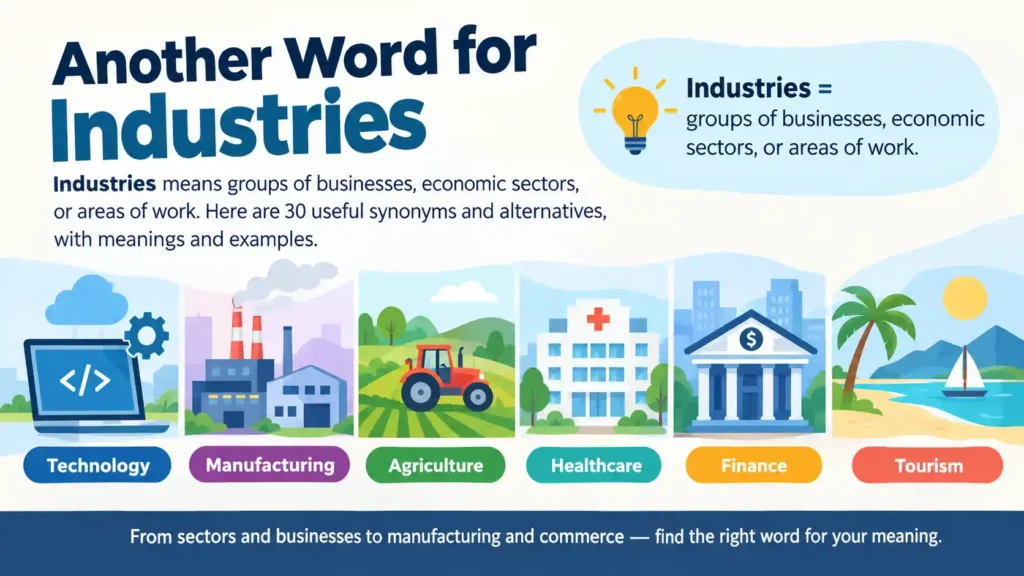
Another word for industries is sectors, businesses, trades, or fields. In everyday writing, “sectors” is the closest match when you mean large parts of an economy, such as banking, farming, or technology. “Manufacturing” works when you mean making goods in factories. “Commerce” and “enterprises” fit talk about buying, selling, and running companies.
The best choice depends on what you mean. “Industries” can describe whole branches of the economy, factory production, organized business activity, or the work people do. It can also relate to the older sense of hard work. Each meaning has different alternatives.
Quick list: sectors, businesses, trades, fields, markets, manufacturing, commerce, enterprises, segments, branches.
This article looks at 30 alternatives. Each one has a meaning, IPA pronunciation, usage note, and example sentence, so you can see how the word works in context.
At a Glance: Industries Synonyms and Related Alternatives
| Alternative | Part of Speech | Meaning | Register / Tone | Ideal Context |
|---|---|---|---|---|
| Sectors | noun | Major parts of an economy | Neutral to formal | Economics, news, reports |
| Businesses | noun | Companies or commercial activities | Neutral | Everyday and general writing |
| Trades | noun | Types of commercial activity or skilled work | Neutral | Skilled work, commerce, history |
| Fields | noun | Areas of work or study | Neutral | Careers, expertise, research |
| Markets | noun | Areas of buying and selling | Neutral to business | Sales, economics, competition |
| Manufacturing | noun | Making goods, usually in factories | Neutral to technical | Production, factories, exports |
| Commerce | noun | The buying and selling of goods and services | Formal | Trade, law, economics |
| Enterprises | noun | Businesses or business projects | Formal | Business writing, policy |
| Segments | noun | Distinct parts of a larger market or economy | Business, technical | Marketing, analysis |
| Professions | noun | Jobs that need special training | Formal | Law, medicine, teaching |
Which Word Should You Use?
| If you want to… | Use | Why |
|---|---|---|
| Talk about large parts of a national economy | sectors | It is the standard word in economics and news. |
| Use a plain, everyday word | businesses | Everyone knows it, though it can mean single companies rather than whole fields. |
| Talk about making goods in factories | manufacturing | It names the activity of production directly. |
| Talk about buying, selling, and trade | commerce | It focuses on exchange, not production. |
| Talk about areas where people work or have skills | fields | It fits careers and expertise. |
| Describe a smaller slice of a larger market | segments | It suggests a defined part of something bigger. |
| Describe jobs that require training and standards | professions | It fits law, medicine, and teaching better than “industries” does. |
| Write in a formal business or policy style | enterprises | It sounds official and broad. |
Exploring the Multiple Meanings of “Industries”
1. A branch of business or trade
- Meaning: A group of companies that make or sell the same kind of product or service.
- Explanation: This is the most common sense. The group is defined by what it sells or does, such as the music, car, or tourism industry. The plural describes several such groups together.
- Example: Tourism and farming are two of the biggest industries in the region.
2. Manufacturing and heavy production
- Meaning: The making of goods, especially in factories and large plants.
- Explanation: Here “industry” means production, not business in general. Phrases like “heavy industry” and “light industry” use this sense. It is the older, narrower meaning of the modern word.
- Example: Steel and chemicals are two of the country’s heavy industries.
3. Organized economic activity as a whole
- Meaning: The total of businesses and production that make up an economy.
- Explanation: This sense looks at the whole picture rather than one branch. It often appears in the phrase “trade and industry.”
- Example: The new law was meant to support industries across the country.
4. Hard work and steady effort
- Meaning: The quality of working hard and being diligent.
- Explanation: This is a formal, older sense of the singular word, as in “praised for her industry.” The plural “industries” does not normally carry it. The related adjective is “industrious.”
- Example: The teacher praised the students for their industry.
Sources: Merriam-Webster; Collins English Dictionary; Dictionary.com; Cambridge Dictionary.
Analyzing 30 Industries Alternatives in Detail
Some of these alternatives are direct synonyms for “industries,” while others are related words that fit only certain contexts or one sense of the word. The Usage note for each one says which it is.
Group 1: Core Synonyms
1. Sectors
IPA: US /ˈsɛktɚz/ · UK /ˈsɛktəz/
Definition: Major parts of an economy or society.
- Usage: A direct synonym for industries, especially in formal writing, economics, and news. Common examples include the public and private sectors.
- Example: Growth was strongest in the technology and health sectors.
2. Businesses
IPA: US /ˈbɪznəsɪz/ · UK /ˈbɪznɪsɪz/
Definition: Organizations that sell goods or services for profit.
- Usage: A simple, everyday alternative. It usually refers to companies or commercial activities rather than entire economic fields.
- Example: Small businesses in many industries struggled during the winter.
3. Trades
IPA: US and UK /treɪdz/
Definition: Types of commercial activity or skilled work.
- Usage: A related alternative often used for skilled jobs, such as carpentry and plumbing. It can also refer to traditional commercial activities.
- Example: Carpentry and plumbing are trades that remain in demand.
4. Fields
IPA: US and UK /fiːldz/
Definition: Areas of work, knowledge, or study.
- Usage: A flexible alternative that focuses on careers, skills, and expertise rather than companies or production.
- Example: She has worked in several fields, including law and education.
5. Markets
IPA: US /ˈmɑːrkɪts/ · UK /ˈmɑːkɪts/
Definition: Areas where goods or services are bought and sold.
- Usage: A related term that emphasizes customers, demand, and competition rather than businesses themselves.
- Example: The company sells its software in several markets, including banking and healthcare.
6. Branches
IPA: US /ˈbræntʃɪz/ · UK /ˈbrɑːntʃɪz/
Definition: Divisions of a larger subject or area of activity.
- Usage: A related alternative used in phrases such as “branches of industry.” It highlights different parts of a larger economic system.
- Example: Textiles and mining are important branches of industry in the region.
Group 2: Manufacturing and Production Terms
7. Manufacturing
IPA: US /ˌmænjəˈfæktʃɚɪŋ/ · UK /ˌmænjʊˈfæktʃərɪŋ/
Definition: The making of goods, usually on a large scale with machines.
- Usage: A direct synonym for the production sense of “industry.” It does not cover service industries such as banking or tourism.
- Example: Manufacturing has moved to countries with lower costs.
8. Production
IPA: (US and UK) /prəˈdʌkʃn/
Definition: The act or process of making goods or growing crops.
- Usage: A related alternative. It is broader than “manufacturing” and also covers farming and energy.
- Example: Food production increased after the new methods were introduced.
9. Factories
IPA: (US and UK) /ˈfæktəriz/
Definition: Buildings where goods are made, usually with machines.
- Usage: A related alternative. It names the places of production, not the whole branch of business.
- Example: Several factories closed when demand dropped.
10. Mills
IPA: (US and UK) /mɪlz/
Definition: Buildings or factories where materials such as grain, cloth, or paper are made or processed.
- Usage: A narrow, historical-sounding alternative. It fits textiles, paper, and steel, and is not a general synonym.
- Example: The town grew around its cotton mills.
11. Plants
IPA: US /plænts/ · UK /plɑːnts/
Definition: Factories or large sites where goods or power are produced.
- Usage: A related, technical alternative for sites like power plants and chemical plants. It names locations, not whole industries.
- Example: The chemical plants along the river employ thousands of workers.
Group 3: Commerce and Organizations
12. Commerce
IPA: US /ˈkɑːmɝːs/ · UK /ˈkɒmɜːs/
Definition: The buying and selling of goods and services, especially on a large scale.
- Usage: A related formal alternative. It stresses exchange more than production. It often appears in “trade and commerce” or “chamber of commerce.”
- Example: The river made the city a center of commerce.
13. Enterprises
IPA: US /ˈɛntɚpraɪzɪz/ · UK /ˈɛntəpraɪzɪz/
Definition: Businesses or organized projects, often with some risk or effort involved.
- Usage: A formal alternative often used in policy and business writing. It can mean single firms or business activity in general.
- Example: The government offered loans to small enterprises.
14. Companies
IPA: (US and UK) /ˈkʌmpəniz/
Definition: Organizations that sell goods or services, or that carry on business.
- Usage: A related alternative that names individual organizations, not the group they belong to. Do not use it when you mean a whole branch of the economy.
- Example: Companies in the energy field are hiring more engineers.
15. Corporations
IPA: US /ˌkɔːrpəˈreɪʃnz/ · UK /ˌkɔːpəˈreɪʃnz/
Definition: Large companies legally treated as single bodies.
- Usage: A related alternative for big businesses only. It does not fit small trades or whole sectors.
- Example: Several large corporations announced plans to cut emissions.
16. Firms
IPA: US /fɝːmz/ · UK /fɜːmz/
Definition: Businesses or companies, especially small or medium-sized ones.
- Usage: A related alternative common in law, accounting, and consulting (“law firms”). It names organizations, not fields.
- Example: Many firms in the design field now allow remote work.
Group 4: Formal and Analytical Alternatives
17. Segments
IPA: (US and UK) /ˈsɛɡmənts/
Definition: Parts into which something is divided.
- Usage: A business and marketing term for slices of a market or economy. It suggests a smaller part than “sectors.”
- Example: Electric cars are one of the fastest-growing segments of the auto market.
18. Verticals
IPA: US /ˈvɝːtɪkəlz/ · UK /ˈvɜːtɪkəlz/
Definition: Specific industries or market areas, especially as targeted by a business.
- Usage: A business-jargon alternative used in technology and marketing. It is informal and is not suited to general writing.
- Example: The software company sells to several verticals, including banking and retail.
19. Domains
IPA: US /doʊˈmeɪnz/ · UK /dəʊˈmeɪnz/
Definition: Areas of knowledge, activity, or influence.
- Usage: A related alternative. It is broader and more abstract than “industries,” and it appears in academic or technical writing.
- Example: The skill is useful in many professional domains.
20. Spheres
IPA: US /sfɪrz/ · UK /sfɪəz/
Definition: Areas of activity, interest, or influence.
- Usage: A related formal alternative often used with “of activity” or “of influence.” It is a general word and does not point to commercial activity.
- Example: The company is active in several spheres of business.
21. Arenas
IPA: (US and UK) /əˈriːnəz/
Definition: Areas of competition or public activity.
- Usage: A figurative alternative. It suggests competition, as in “the political arena” or “the business arena.”
- Example: The firm competes in the technology and finance arenas.
Group 5: Work, Careers, and Occupations
22. Professions
IPA: (US and UK) /prəˈfɛʃnz/
Definition: Jobs that require special training or education and usually follow set standards.
- Usage: A related alternative, not an exact synonym. Use it for careers like law and medicine, not for groups of companies.
- Example: Medicine and law are respected professions.
23. Occupations
IPA: US /ˌɑːkjəˈpeɪʃnz/ · UK /ˌɒkjʊˈpeɪʃnz/
Definition: Jobs or activities that people do to earn a living.
- Usage: A related, formal alternative common in statistics and forms. It points to individual jobs, not whole fields of business.
- Example: The survey lists the most common occupations in each region.
24. Vocations
IPA: US /voʊˈkeɪʃnz/ · UK /vəʊˈkeɪʃnz/
Definition: Occupations or careers, especially ones a person feels suited for or called to.
- Usage: A related alternative with a personal, sometimes old-fashioned tone. It describes one’s calling more than a branch of the economy.
- Example: Teaching and nursing are vocations for many people.
Group 6: Diligence and Effort (Related to the Singular “Industry”)
These words relate to the “hard work” sense of “industry,” not to the economic sense of “industries.”
25. Industriousness
IPA: (US and UK) /ɪnˈdʌstriəsnəs/
Definition: The quality of working hard and steadily.
- Usage: A direct synonym for the “hard work” sense of the singular word, not for the plural. It is a little formal.
- Example: Her industriousness impressed every manager she worked for.
26. Diligence
IPA: (US and UK) /ˈdɪlɪdʒəns/
Definition: Careful and steady effort in doing something.
- Usage: A close synonym for the “hard work” sense. It stresses care and persistence as much as effort.
- Example: He completed the project with great diligence.
27. Effort
IPA: US /ˈɛfɚt/ · UK /ˈɛfət/
Definition: The use of physical or mental energy to do something.
- Usage: A related alternative. It is simple and neutral, but it does not suggest the steady habit that “industry” does.
- Example: The team put great effort into finishing the building on time.
28. Labor
IPA: US /ˈleɪbɚ/ · UK /ˈleɪbə/
Definition: Work, especially hard physical work.
- Usage: A related alternative. It can mean effort or the workers themselves. The British spelling is “labour.”
- Example: The bridge was built through years of hard labor.
29. Toil
IPA: (US and UK) /tɔɪl/
Definition: Long, hard, tiring work.
- Usage: A related literary alternative. It is stronger than “industry” because it suggests exhausting work and not just steady effort.
- Example: Years of toil turned the empty land into a farm.
30. Assiduity
IPA: US /ˌæsɪˈduːəti/ · UK /ˌæsɪˈdjuːɪti/
Definition: Constant and careful attention to what one is doing.
- Usage: A rare, formal synonym for the “hard work” sense. Use it only in formal or literary writing.
- Example: She studied the language with great assiduity.
Sources: Merriam-Webster; Collins English Dictionary and Collins Thesaurus; Dictionary.com; Cambridge Dictionary.
Industries vs. Sectors vs. Fields vs. Markets
These four words are often mixed up. They overlap, but each has its own focus.
| Word | Main Focus | Typical Example |
|---|---|---|
| Industries | Groups of businesses making or selling similar things | “The film and music industries” |
| Sectors | Large divisions of an economy | “The public and private sectors” |
| Fields | Areas of work, skill, or study | “She works in the medical field.” |
| Markets | Where buying and selling take place, and who buys | “The company entered new markets.” |
“Industries” and “sectors” are the closest pair. “Sectors” is usually the wider, more formal term and is common in economic reports. “Fields” centers on people’s skills and careers. “Markets” centers on customers and demand, so a company can serve several markets within one industry.
Sources: Merriam-Webster; Collins English Dictionary; Cambridge Dictionary; Dictionary.com.
Industries and Opposite/Paired Word Pairs
“Industries” has no single true opposite. It does have natural contrasts and common pairings, listed below.
| Word | Paired Word | Note |
|---|---|---|
| Industries | Agriculture | Often contrasted as farming versus manufacturing. |
| Industries | Services | Goods-producing versus service-based activity. |
| Public sector | Private sector | A common pair that divides economic activity by ownership. |
| Heavy industries | Light industries | Large-scale production versus smaller goods. |
| Industry | Commerce | Making goods versus buying and selling them. |
| Industry | Academia | Used for working life outside universities. |
| Industry (hard work) | Idleness | A traditional opposite of the “hard work” sense. |
Most of these pairs describe differences in type, size, or ownership rather than true opposites. The pair “industry” and “idleness” is the closest to an exact opposite, but it only applies to the older singular sense.
Sources: Merriam-Webster; Collins English Dictionary; Cambridge Dictionary; Dictionary.com.
Common Word Partners of “Industries”
| Pattern | Common Partners | Example |
|---|---|---|
| adjective + industries | heavy, light, key, major, growing, emerging, declining | Emerging industries often need new skills. |
| noun + industries | manufacturing, service, creative, energy | Creative industries employ many young people. |
| verb + industries | regulate, support, protect, transform, disrupt | New technology can disrupt traditional industries. |
| industries + verb | grow, decline, thrive, employ, depend on | Local industries depend on cheap power. |
| across / in industries | across industries, in industries such as | The method is used across industries. |
| a range / variety of industries | a range of, a variety of, a wide range of | She has worked in a variety of industries. |
Sources: Collins English Dictionary; Cambridge Dictionary; Oxford Learner’s Dictionaries; Merriam-Webster.
Idiomatic Phrases Featuring “Industries”
These are established expressions. “Captains of industry” and “cottage industry” are the closest to idioms, while the others are well-known fixed phrases.
1. Cottage industry
- Meaning: A small business run from people’s homes. It can also describe any small-scale activity that has grown around something.
- Example: Knitting hats at home became a cottage industry in the village.
2. Captains of industry
- Meaning: Powerful and successful business leaders, especially those in charge of large companies.
- Example: The dinner was attended by politicians and captains of industry.
3. Smokestack industries
- Meaning: Heavy industries such as steel and coal that use large factories and cause pollution.
- Example: The town was once known for its smokestack industries.
4. Sunrise and sunset industries
- Meaning: Sunrise industries are new and growing, while sunset industries are old and declining.
- Example: Solar power is seen as a sunrise industry, while coal is often called a sunset one.
Sources: Merriam-Webster; Collins English Dictionary; Cambridge Dictionary; Dictionary.com.
Word Formation of “Industries”
Etymology & Structure
“Industries” is the plural of the noun “industry.” The English word comes from Middle French industrie, which came from Latin industria, meaning diligence or activity. The Latin word is connected to industrius, meaning diligent. Dictionaries link its roots to the Latin verb struere, “to build,” though the older steps are less certain. The plural is formed by changing -y to -ies.
Date and History
Merriam-Webster records the first known use of “industry” in English in the 15th century. The earliest meanings were about skill and diligence. The sense of a branch of trade or manufacturing developed later, and it became the main meaning in modern English.
Word Class Variations
- Noun: industry, industries; industrialist (a person who owns or runs industries); industrialization
- Adjective: industrial (relating to industry); industrious (hard-working)
- Adverb: industrially; industriously
- Verb: industrialize (to develop industries); deindustrialize
Sources: Merriam-Webster; Etymonline; Collins English Dictionary; Dictionary.com.
Common Word-Choice Mistakes
- The industrys are growing: The industries are growing.
- A industry: An industry.
- Industrial people: Industrious people (if you mean hard-working). “Industrial” relates to industry, not to effort.
- The factory of fashion: The fashion industry.
- The teaching industry: The teaching profession (if you mean the career and its standards).
- The car company is growing fast: The car industry is growing fast (if you mean the whole field, not one business).
- Many industry: Many industries. “Many” needs a plural noun.
FAQs
1. What is the closest synonym for “industries”?
“Sectors” is the closest in most cases, especially in economic writing. “Businesses” is the simplest everyday alternative.
2. What is the difference between “industries” and “sectors”?
“Industries” are groups of businesses doing similar things, such as the car or film industry. “Sectors” are bigger divisions of an economy, such as the public sector or the service sector.
3. What is a formal alternative to “industries”?
“Enterprises,” “sectors,” and “commerce” all fit formal writing. Choose based on if you mean businesses, economic divisions, or trade.
4. Is “industries” the same as “manufacturing”?
Not always. Manufacturing is one kind of industry, the making of goods. Industries also include services such as banking and tourism.
5. Can “industries” mean hard work?
Not in modern use. The hard-work meaning belongs to the singular “industry,” and it is formal and old-fashioned.
6. What is the difference between “industrial” and “industrious”?
“Industrial” relates to industry, as in “industrial waste.” “Industrious” describes a person who works hard.
7. What is a figurative alternative to “industries”?
“Arenas” and “spheres” work when you mean areas of activity or competition. They are less exact than “sectors.”
8. What is the difference between “industries” and “markets”?
Industries are groups of businesses. Markets are areas where goods are bought and sold. One industry can sell in many markets.
Conclusion
The closest alternatives to “industries” are “sectors,” “businesses,” “trades,” and “fields.” “Manufacturing” and “commerce” are good choices when you mean production or trade. Words like “enterprises” and “segments” suit more formal or technical writing.
Context matters because “industries” covers several meanings: branches of business, factory production, whole economies, and, in the singular, hard work. A word that fits one sense may be wrong for another, such as “factories” for a whole field or “professions” for groups of companies.
To choose well, ask what you really mean. Use “sectors” for large economic divisions, “manufacturing” for the making of goods, and “fields” or “professions” for careers.

Hi, I’m Anam, a dedicated writer and curious researcher who believes learning should be simple, useful, and enjoyable. At VistoraDaily, I explore general knowledge, everyday questions, fascinating facts, and helpful information, creating clear content that inspires readers to discover something new.