
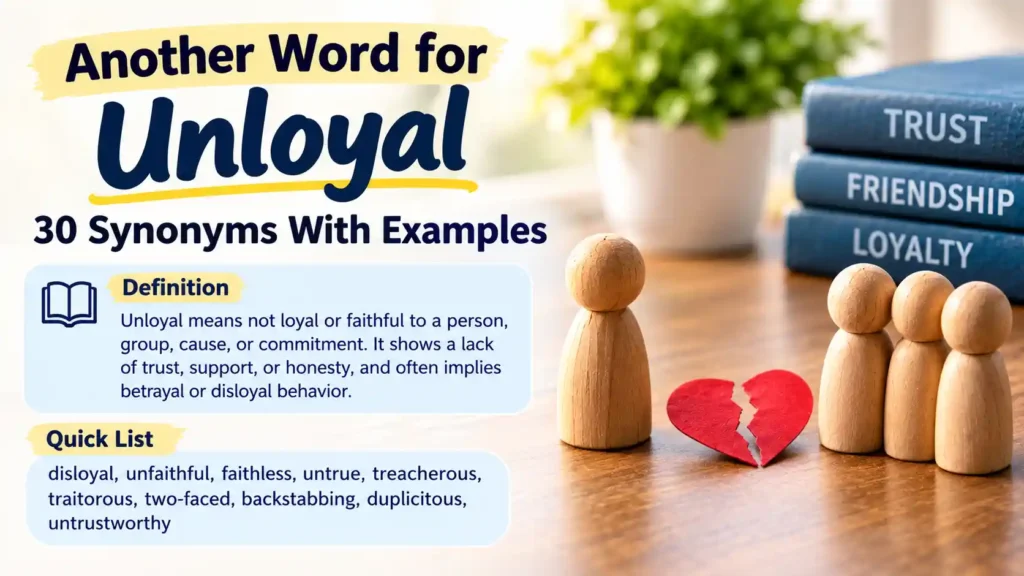
If you want another word for unloyal, the best everyday choice is disloyal. Disloyal is the standard form, and “unloyal” is rare and often treated as nonstandard. Other close alternatives are unfaithful, faithless, and untrue. Stronger words include treacherous and traitorous.
The right word depends on what the person did and who was hurt. A friend who breaks a promise is not the same as a soldier who turns on his country. Some words fit romance, some fit work or politics, and some sound formal or literary.
Quick list: disloyal, unfaithful, faithless, untrue, treacherous, traitorous, two-faced, backstabbing, duplicitous, untrustworthy
This article looks at 30 alternatives. Each one has a meaning, IPA, a usage note, and an example, so you can match the word to the context.
At a Glance: Unloyal Synonyms and Related Alternatives
| Alternative | Part of Speech | Meaning | Register / Tone | Ideal Context |
|---|---|---|---|---|
| Disloyal | Adjective | Not loyal to a person, group, or cause | Neutral | General use |
| Unfaithful | Adjective | Not loyal, especially to a partner | Neutral | Romantic relationships |
| Faithless | Adjective | Not keeping faith or trust | Formal, literary | Writing, speeches |
| Treacherous | Adjective | Likely to betray; guilty of betrayal | Strong | Serious betrayal |
| Traitorous | Adjective | Acting like a traitor | Strong, formal | Politics, war |
| Two-faced | Adjective | Showing one attitude but hiding another | Informal | Friends, coworkers |
| Backstabbing | Adjective | Betraying someone secretly | Informal, strong | Workplace, social life |
| Duplicitous | Adjective | Deceptive in words and actions | Formal | Deceit and double-dealing |
| Untrustworthy | Adjective | Not safe to trust | Neutral | Character, reliability |
| Treasonous | Adjective | Involving treason against a state | Formal, legal | Government, law |
Which Word Should You Use?
| If you want to… | Use | Why |
|---|---|---|
| Say someone is not loyal in general | disloyal | It is the standard, neutral word. |
| Describe a cheating partner | unfaithful | It is the usual word for broken romantic commitment. |
| Describe a friend who betrays you secretly | backstabbing | It stresses secrecy and personal harm. |
| Describe someone who pretends to support you | two-faced | It focuses on hiding true feelings. |
| Talk about acts against a country | treasonous | It has a legal and political meaning. |
| Describe a serious, dangerous betrayal | treacherous | It is stronger than disloyal. |
| Describe someone who changes sides | turncoat | It names the person and the switch. |
| Write in a formal or literary style | perfidious | It is elevated and rare. |
Exploring the Multiple Meanings of “Unloyal”
“Unloyal” is not a common dictionary word. Most standard sources treat disloyal as the main form, so the senses below describe disloyal and unloyal together.
1. Not Faithful to a Person or Group
- Meaning: Failing to support someone or something you owe support to.
- Explanation: This is the broadest sense. It covers friends, teams, employers, and causes, and it usually involves breaking trust, not just disagreeing.
- Example: She felt disloyal when she shared her friend’s secret.
2. Unfaithful in a Romantic Relationship
- Meaning: Breaking the trust of a partner, especially by cheating.
- Explanation: Here the word is closely tied to “unfaithful.” Disloyal can cover emotional betrayal as well as physical betrayal.
- Example: He was disloyal to his wife for years.
3. Betraying a Country or Authority
- Meaning: Acting against the government, ruler, or nation one owes allegiance to.
- Explanation: This is the oldest and most serious sense. It overlaps with words like traitorous, treasonous, and seditious.
- Example: The general was accused of being disloyal to the crown.
4. Failing to Support in Work or Business
- Meaning: Putting your own interest ahead of an employer, team, or customer relationship.
- Explanation: This sense is milder than treason. It often means leaking information, undermining a boss, or leaving for a rival.
- Example: Managers saw his comments to the press as disloyal.
5. Deceptive or Double-Dealing Behavior
- Meaning: Pretending to be on someone’s side while acting against them.
- Explanation: Here the focus is on the lie, not only the lack of support. Words like two-faced and duplicitous fit this sense.
- Example: A disloyal adviser smiled in meetings and worked against her in private.
Sources: Merriam-Webster; Collins English Dictionary; Dictionary.com; Oxford Languages
Analyzing 30 Unloyal Alternatives in Detail
Some of these words are direct synonyms of disloyal, while others are related alternatives that fit only certain situations or contexts.
Core Synonyms
1. Disloyal
IPA: /dɪsˈlɔɪəl/ (US and UK)
Definition: Not loyal; not faithful to a person, group, or cause.
- Usage: The standard form of “unloyal” and the best all-purpose choice. It is neutral and works in any context.
- Example: The coach did not trust a player who seemed disloyal to the team.
2. Unfaithful
IPA: /ʌnˈfeɪθfəl/ (US and UK)
Definition: Not true to a partner, promise, or duty; guilty of cheating.
- Usage: A close synonym, especially for romantic betrayal. It is also used for broken promises and duties.
- Example: She left him after learning he had been unfaithful.
3. Faithless
IPA: /ˈfeɪθləs/ (US and UK)
Definition: Not keeping faith; disloyal or untrue.
- Usage: A direct synonym with a formal, literary feel. It is stronger and less common in everyday speech.
- Example: The poem describes a faithless lover who vanished at night.
4. Untrue
IPA: /ʌnˈtruː/ (US and UK)
Definition: Not faithful or loyal.
- Usage: A direct synonym in this sense, but it is dated and often means “false” in modern English. Use it only where context makes the meaning clear.
- Example: He promised never to be untrue to her.
5. False
IPA: US /fɔːls/ · UK /fɔːls/
Definition: Not loyal or faithful; deceitful.
- Usage: A related alternative in the sense of “false friend” or “false-hearted.” Used alone, it usually means “not true,” so it needs context.
- Example: She learned that her false friend had been spreading rumors.
6. Treacherous
IPA: /ˈtretʃərəs/ (US and UK)
Definition: Guilty of betrayal or likely to betray.
- Usage: A stronger synonym than disloyal. It suggests betrayal that is deliberate and dangerous. It can also describe risky things like roads or waters, which is a different meaning.
- Example: The treacherous guard opened the gate to the enemy.
Betrayal and Deception Alternatives
7. Traitorous
IPA: /ˈtreɪtərəs/ (US and UK)
Definition: Characteristic of a traitor; betraying one’s country or cause.
- Usage: A strong, formal synonym, mostly for serious or political betrayal. It is too heavy for small personal faults.
- Example: The king punished the traitorous nobles.
8. Backstabbing
IPA: /ˈbækˌstæbɪŋ/ (US and UK)
Definition: Betraying someone in a secret or sneaky way.
- Usage: An informal, strong alternative. It fits workplaces and friendships where betrayal happens behind someone’s back.
- Example: Everyone knew about his backstabbing habits at the office.
9. Double-crossing
IPA: US /ˌdʌbəl ˈkrɔːsɪŋ/ · UK /ˌdʌbəl ˈkrɒsɪŋ/
Definition: Betraying someone by breaking an agreement or turning against a partner.
- Usage: A related alternative that is informal. It fits deals, plots, and crime stories more than everyday friendship.
- Example: The double-crossing partner sold the plans to a rival.
10. Two-faced
IPA: /ˌtuː ˈfeɪst/ (US and UK)
Definition: Insincere; saying one thing to a person and another behind their back.
- Usage: An informal, related alternative. It focuses on hypocrisy more than on open betrayal.
- Example: She was two-faced, praising him in public and mocking him in private.
11. Duplicitous
IPA: US /duːˈplɪsɪtəs/ · UK /djuːˈplɪsɪtəs/
Definition: Deceitful in speech or conduct, especially by acting in two different ways.
- Usage: A formal, related alternative. It stresses lying and double-dealing, not just lack of support.
- Example: The duplicitous manager promised loyalty while planning to leave.
12. Deceitful
IPA: /dɪˈsiːtfəl/ (US and UK)
Definition: Willing to lie or mislead.
- Usage: A related alternative. A deceitful person can be disloyal, but deceit and disloyalty are not the same thing.
- Example: His deceitful reports hid the real problem.
Personal Relationship and Reliability Alternatives
13. Cheating
IPA: /ˈtʃiːtɪŋ/ (US and UK)
Definition: Being sexually or romantically unfaithful; also, acting dishonestly.
- Usage: An informal word for romantic disloyalty. It has other meanings, such as breaking rules in games or tests.
- Example: She broke up with him because he was cheating.
14. Adulterous
IPA: /əˈdʌltərəs/ (US and UK)
Definition: Having sex with someone other than one’s spouse.
- Usage: A formal, narrow alternative. It applies only to marriage and has legal and religious overtones.
- Example: The novel is about an adulterous affair in a small town.
15. Inconstant
IPA: US /ɪnˈkɑːnstənt/ · UK /ɪnˈkɒnstənt/
Definition: Changeable; not steady in affection or loyalty.
- Usage: A formal, related alternative. It suggests an unsteady heart more than a deliberate betrayal.
- Example: Poets often write about inconstant lovers.
16. Fickle
IPA: /ˈfɪkəl/ (US and UK)
Definition: Changing often in loyalty, interest, or affection.
- Usage: A related alternative. A fickle person is unreliable, not necessarily a traitor.
- Example: Fans can be fickle when a team starts losing.
17. Unreliable
IPA: /ˌʌnrɪˈlaɪəbəl/ (US and UK)
Definition: Not able to be depended on.
- Usage: A weak, related alternative. It describes lack of dependability and does not imply betrayal.
- Example: He was a likable but unreliable friend.
18. Untrustworthy
IPA: US /ʌnˈtrʌstˌwɜːrði/ · UK /ʌnˈtrʌstˌwɜːði/
Definition: Not deserving of trust.
- Usage: A related alternative that is broader than disloyal. Someone can be untrustworthy with money or facts without being disloyal.
- Example: The committee found him untrustworthy after the leak.
Political and Group-Loyalty Alternatives
19. Treasonous
IPA: /ˈtriːzənəs/ (US and UK)
Definition: Involving or amounting to treason.
- Usage: A formal alternative, narrower than disloyal. It refers to acts against a state or ruler.
- Example: Leaking the war plans was a treasonous act.
20. Seditious
IPA: /sɪˈdɪʃəs/ (US and UK)
Definition: Inciting people to rebel against authority.
- Usage: A formal, related alternative. It concerns stirring up rebellion, not just personal betrayal.
- Example: The paper was shut down for printing seditious articles.
21. Mutinous
IPA: /ˈmjuːtɪnəs/ (US and UK)
Definition: Refusing to obey authority, especially in the military or a crew.
- Usage: A related alternative. It describes open rebellion, which is different from secret betrayal.
- Example: The mutinous crew took over the ship.
22. Subversive
IPA: US /səbˈvɜːrsɪv/ · UK /səbˈvɜːsɪv/
Definition: Seeking to weaken or overthrow a system or authority.
- Usage: A related alternative. It can be neutral or even positive in discussions of ideas, so context matters.
- Example: The group was accused of subversive activity.
23. Turncoat
IPA: US /ˈtɜːrnkoʊt/ · UK /ˈtɜːnkəʊt/
Definition: A person who switches sides or abandons a party or cause.
- Usage: A noun, so it names the person rather than describing the behavior. It is informal, strong, and fits politics and sports.
- Example: Voters called him a turncoat after he joined the other party.
24. Renegade
IPA: /ˈrenɪɡeɪd/ (US and UK)
Definition: A person who deserts a group, party, or set of beliefs.
- Usage: A related noun. It can sound negative, but it can also describe a bold rule-breaker, so the tone depends on context.
- Example: The renegade officer left the army and joined the rebels.
Formal, Literary, and Noun Alternatives
25. Perfidious
IPA: US /pərˈfɪdiəs/ · UK /pəˈfɪdiəs/
Definition: Deliberately faithless; treacherous.
- Usage: A direct but rare and formal synonym, found in literature and history writing. It sounds odd in casual speech.
- Example: Historians describe the perfidious ally who broke the treaty.
26. Recreant
IPA: /ˈrekriənt/ (US and UK)
Definition: Disloyal or cowardly; one who gives up a cause or duty.
- Usage: An old-fashioned literary word. It can be an adjective or a noun and often suggests cowardice as well as disloyalty.
- Example: The knight was called a recreant for abandoning his lord.
27. Apostate
IPA: US /əˈpɑːsteɪt/ · UK /əˈpɒsteɪt/
Definition: A person who abandons a religion, cause, or principle.
- Usage: A related alternative that is more specific. It is used mainly for religion and strong beliefs.
- Example: The community treated him as an apostate after he left the faith.
28. Disaffected
IPA: /ˌdɪsəˈfektɪd/ (US and UK)
Definition: No longer satisfied with or loyal to a leader, group, or system.
- Usage: A related alternative. It describes lost loyalty and discontent, not always active betrayal.
- Example: Disaffected members quietly left the party.
29. Traitor
IPA: US /ˈtreɪtər/ · UK /ˈtreɪtə/
Definition: A person who betrays a country, group, or trust.
- Usage: A noun for a person, not an adjective like disloyal. It is strong and best saved for serious betrayal.
- Example: He was called a traitor for selling secrets to the enemy.
30. Quisling
IPA: /ˈkwɪzlɪŋ/ (US and UK)
Definition: A person who helps an enemy occupying their own country.
- Usage: A narrow, strongly negative related noun. It refers to collaboration with an enemy occupier, so it does not suit everyday disloyalty.
- Example: After the war, villagers named him a quisling.
Sources: Merriam-Webster; Collins English Dictionary and Collins Thesaurus; Dictionary.com; Oxford Languages
Disloyal vs. Unfaithful vs. Treacherous vs. Traitorous
These four words overlap, but they are not interchangeable.
| Word | Main Focus | Typical Use | Strength |
|---|---|---|---|
| Disloyal | Lack of loyalty | Friends, work, teams, causes | Medium |
| Unfaithful | Broken commitment | Romantic partners, promises | Medium |
| Treacherous | Deliberate, dangerous betrayal | Serious betrayal; also dangerous places | Strong |
| Traitorous | Betraying a country or cause | Politics, war | Strong |
A coworker who criticizes the team in public is disloyal. A husband who cheats is unfaithful. An ally who opens the gates to the enemy is treacherous or traitorous.
Sources: Merriam-Webster; Collins English Dictionary; Dictionary.com
Unloyal and Opposite/Paired Word Pairs
| Word | Paired Word | Note |
|---|---|---|
| Disloyal | Loyal | The main opposite. |
| Unfaithful | Faithful | Used for partners and promises. |
| Treacherous | Trustworthy | Contrasts betrayal with reliability. |
| Traitorous | Patriotic | Works in national contexts, but not a perfect opposite. |
| Fickle | Steadfast | Contrasts changeable loyalty with firm loyalty. |
| Duplicitous | Sincere | Contrasts deceit with honesty. |
| Mutinous | Obedient | Contrasts rebellion with following orders. |
The opposite of disloyal is loyal, and most other pairs follow the same idea. Choose the pair that matches the specific word, because “faithful” fits “unfaithful” better than “loyal” does in a romantic setting.
Sources: Merriam-Webster; Collins Thesaurus; Dictionary.com
Common Word Partners of “Unloyal”
Because “unloyal” is rare, these patterns use the standard form disloyal.
| Pattern | Common Partners | Example |
|---|---|---|
| disloyal + noun | employee, friend, partner, soldier, subject, behavior, act | The company fired a disloyal employee. |
| be/feel/seem + disloyal | be disloyal, feel disloyal, seem disloyal | He felt disloyal for taking the other job. |
| disloyal to + noun | disloyal to the team, to a friend, to the crown | She was never disloyal to her friends. |
| accused/seen as + disloyal | accused of being disloyal, seen as disloyal | The minister was seen as disloyal. |
| adverb + disloyal | openly disloyal, deeply disloyal, politically disloyal | The speech was openly disloyal. |
Sources: Collins English Dictionary; Oxford Languages; Merriam-Webster
Idiomatic Phrases Featuring “Unloyal”
No fixed idioms contain “unloyal” or “disloyal” themselves. These established expressions describe disloyalty instead.
1. Stab someone in the back
- Meaning: To betray someone who trusts you.
- Example: I never thought my best friend would stab me in the back.
2. Turn one’s coat
- Meaning: To change sides, especially for gain. This is the base of the word “turncoat.”
- Example: He turned his coat and joined the winning side.
3. Bite the hand that feeds you
- Meaning: To harm someone who helps or supports you.
- Example: Attacking the boss who hired him was biting the hand that fed him.
4. A snake in the grass
- Meaning: A person who seems friendly but is secretly dangerous or untrustworthy.
- Example: The new partner turned out to be a snake in the grass.
Sources: Merriam-Webster; Collins English Dictionary; Cambridge Dictionary
Word Formation of “Unloyal”
Etymology & Structure
“Unloyal” is built from the English prefix un- (“not”) and loyal. It is rare, and dictionaries treat disloyal as the standard form. Disloyal comes from the prefix dis- and loyal, and it came into English through Old French desloial. Loyal itself comes from Old French loial (“legal, faithful”), which goes back to Latin lēgālis (“of the law”).
Date and History
Loyal entered English around the early 16th century, and disloyal followed from the French form. Exact first-use dates differ between sources, so check Etymonline or the OED before quoting a specific year.
Word Class Variations
- Adjective: disloyal (rare variant: unloyal)
- Noun: disloyalty
- Adverb: disloyally
- Related: loyal, loyalty, loyalist
Sources: Etymonline; Merriam-Webster; Oxford English Dictionary
Common Word-Choice Mistakes
- “Unloyal friend”: use disloyal friend in standard writing.
- “Disloyal with my team”: use disloyal to my team.
- “A disloyalty person”: use a disloyal person; disloyalty is the noun.
- “The cheating soldier”: use disloyal or traitorous for a soldier; cheating usually means romantic or rule-breaking behavior.
- “A treasonous friend”: use treacherous or disloyal; treasonous belongs to acts against a state.
- “A perfidious coworker” in casual speech: use backstabbing or two-faced; perfidious is formal and literary.
- “An unfaithful employee”: use disloyal; unfaithful mainly describes romantic partners and promises.
Frequently Asked Questions
1. What is the closest synonym for unloyal?
The closest synonym is disloyal. It is the standard form of the word.
2. Is “unloyal” a real word?
It appears occasionally, but it is rare, and most writers and dictionaries prefer disloyal. Use disloyal in formal writing.
3. What is the difference between disloyal and unfaithful?
Disloyal is broad and covers friends, work, and causes. Unfaithful is most often used for romantic partners.
4. What is a formal alternative?
Perfidious, faithless, and treacherous are formal. Treasonous is formal and legal.
5. What is a literary alternative?
Recreant and faithless are literary. Perfidious also appears often in historical writing.
6. What is an informal alternative?
Two-faced and backstabbing are informal and common in everyday speech.
7. What is the opposite of unloyal?
The opposite is loyal. For partners, faithful is also common.
8. Can disloyal be used for people?
Yes. It describes people and their actions, such as a disloyal friend or a disloyal act.
9. Is treacherous the same as disloyal?
Not exactly. Treacherous is stronger and suggests deliberate, dangerous betrayal. It can also describe risky things like treacherous roads.
10. Which word is best for betraying a country?
Treasonous and traitorous are the best choices. Use traitor for the person.
Conclusion
The closest alternative to “unloyal” is disloyal, the standard form in dictionaries. Other common choices are unfaithful, faithless, and untrue. Stronger words like treacherous and traitorous describe serious betrayal.
Context decides the best word. Unfaithful fits a romantic partner, two-faced fits a friend who hides their true feelings, and treasonous fits acts against a country. Formal words like perfidious suit writing, while informal words like backstabbing suit conversation.
To choose the right word, ask who was betrayed, how serious it was, and how formal your writing is. Then pick the alternative that matches that situation.

Hi, I’m Anam, a dedicated writer and curious researcher who believes learning should be simple, useful, and enjoyable. At VistoraDaily, I explore general knowledge, everyday questions, fascinating facts, and helpful information, creating clear content that inspires readers to discover something new.