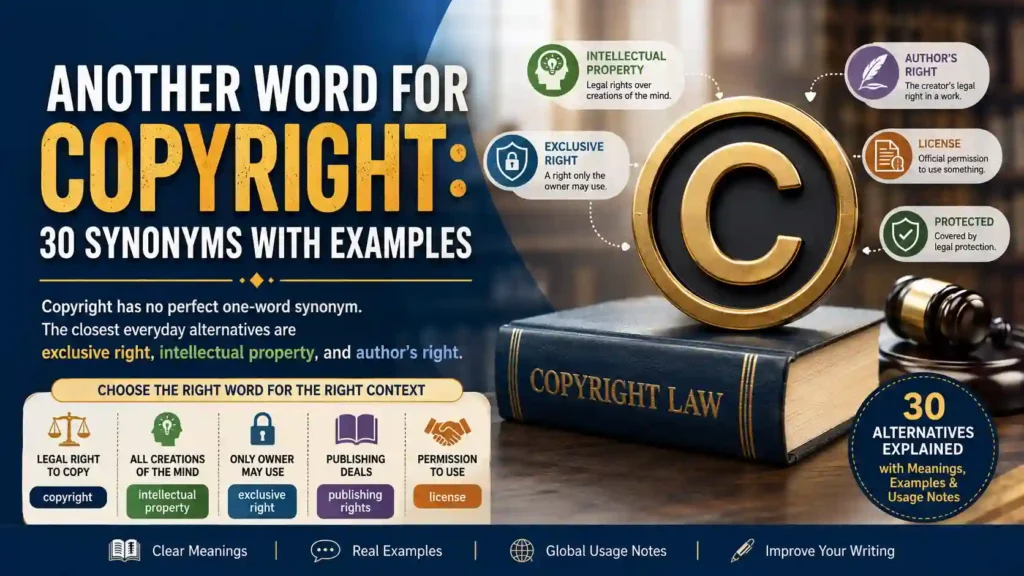
Copyright has no perfect one-word synonym. The closest everyday alternatives are exclusive right, intellectual property, and author’s right. Each fits a slightly different situation. As a verb, “copyright” can often be replaced by register, protect, or secure. As an adjective, “copyrighted” can often be replaced by protected.
The best alternative depends on what you mean. You might mean the legal right to copy a work, a broader group of legal protections, permission to use a work, or the notice printed on a page. This article covers each of these areas.
Quick list: intellectual property, exclusive right, author’s right, literary property, reproduction right, publishing rights, rights, license, protected, register
Below, you will find 30 alternatives with meanings, IPA, usage notes, examples, and context. Some are close synonyms. Others are related terms that overlap with copyright but do not mean the same thing, and each entry says which kind it is. This is a language guide, not legal advice.
At a Glance: Copyright Synonyms and Related Alternatives
| Alternative | Part of Speech | Meaning | Register / Tone | Ideal Context |
|---|---|---|---|---|
| intellectual property | noun | Legal rights over creations of the mind | Formal | Law, business, policy |
| exclusive right | noun | A right only the owner may use | Formal | Legal writing, contracts |
| author’s right | noun | The creator’s legal right in a work | Formal, international | Civil-law countries, EU texts |
| literary property | noun | An author’s ownership of written work | Formal, dated | Legal history |
| reproduction right | noun | The right to make copies | Formal, technical | Licensing, law |
| publishing rights | noun | The right to publish a work | Neutral, professional | Book and music deals |
| ownership | noun | Legal possession of something | Neutral | General use |
| license | noun | Official permission to use something | Neutral | Contracts, software |
| protected | adjective | Covered by legal protection | Neutral | Describing works |
| register | verb | To record officially | Neutral | Filing a claim |
Which Word Should You Use?
| If you want to… | Use | Why |
|---|---|---|
| Talk about the legal right to copy a creative work | copyright | It is the exact legal term. |
| Talk about all creations of the mind, including inventions and brands | intellectual property | It is broader than copyright. |
| Stress that only the owner may copy or sell a work | exclusive right | It names the main power copyright gives. |
| Discuss book, film, or music deals | publishing rights | It focuses on who may publish. |
| Give someone permission to use your work | license | It describes permission, not ownership. |
| Protect a brand name or logo | trademark | Copyright is not the usual tool for names. |
| Protect an invention | patent | Patents cover inventions, not creative works. |
| Say a work cannot be freely copied | protected | It is simple and clear. |
Exploring the Multiple Meanings of “Copyright”
1. The Legal Right
- Meaning: The exclusive legal right to reproduce, publish, or sell an original work.
- Explanation: This is the main sense. It covers books, music, films, art, and similar works. Merriam-Webster’s legal definition lists literary, musical, dramatic, artistic, and architectural works.
- Example: His family still holds the copyright to his songs.
2. Protected Status
- Meaning: The state of a work being covered by this right.
- Explanation: This sense is used in phrases such as “under copyright” and “out of copyright.” It tells you if a work can be copied freely.
- Example: The book is still under copyright.
3. To Secure the Right (Verb)
- Meaning: To obtain copyright protection for a work.
- Explanation: The verb is common in legal and publishing writing. Its past form, “copyrighted,” is also used as an adjective.
- Example: She copyrighted her novel before sending it to publishers.
4. Describing a Work (Adjective)
- Meaning: Relating to, or protected by, copyright.
- Explanation: It often appears before another noun, as in “copyright date” or “copyright law.”
- Example: The copyright date is printed on the second page.
5. The Symbol or Notice
- Meaning: The mark © or a statement showing that a work has an owner.
- Explanation: Dictionary.com notes that © is the symbol for copyright. People often say “the copyright” when they mean the notice itself.
- Example: Check the copyright on the back of the box.
Sources: Merriam-Webster; Dictionary.com (including Collins English Dictionary)
Analyzing 30 Copyright Alternatives in Detail
Some alternatives below are close synonyms, while others are related terms that fit only certain contexts. Each Usage note says which kind it is.
Close Noun Alternatives
1. Intellectual property
IPA: US /ˌɪntəˈlɛktʃuəl ˈprɑːpərti/ · UK /ˌɪntəˈlɛktjuəl ˈprɒpəti/
Definition: Legal rights over things created by the mind, such as inventions, writing, designs, and brand names.
- Usage: Related, not exact. It is a broader category that includes copyright, patents, and trademarks. Formal.
- Example: The company spent years defending its intellectual property.
2. Exclusive right
IPA: (US and UK) /ɪkˈskluːsɪv raɪt/
Definition: A right that belongs only to one person or group.
- Usage: A close description of what copyright gives. It is more general, so it can also describe patents or trade rights. Formal.
- Example: The author has the exclusive right to sell the book.
3. Author’s right
IPA: US /ˈɔːθərz raɪt/ · UK /ˈɔːθəz raɪt/
Definition: The legal right a creator holds in their work.
- Usage: A close synonym in international contexts. It translates terms like French droit d’auteur, and it often puts more weight on the creator than “copyright” does. It is less common in everyday English.
- Example: The treaty protects an author’s right across many countries.
4. Literary property
IPA: US /ˈlɪtəˌrɛri ˈprɑːpərti/ · UK /ˈlɪtərəri ˈprɒpəti/
Definition: An author’s ownership of a written work.
- Usage: A dated legal term. It is narrower than copyright because it is about written works. Today “copyright” is the normal word.
- Example: Early lawyers argued about literary property in printed books.
5. Reproduction right
IPA: (US and UK) /ˌriːprəˈdʌkʃən raɪt/
Definition: The right to make copies of a work.
- Usage: It names one part of copyright, not the whole. It is technical and used in licensing and law.
- Example: The publisher bought the reproduction right for the photograph.
Rights, Permission, and Money
6. Publishing rights
IPA: (US and UK) /ˈpʌblɪʃɪŋ raɪts/
Definition: The legal right to publish a work.
- Usage: Related. It names a part of copyright and is common in book and music deals. It is usually plural.
- Example: The studio sold the publishing rights to a larger company.
7. Performing rights
IPA: US /pərˈfɔːrmɪŋ raɪts/ · UK /pəˈfɔːmɪŋ raɪts/
Definition: The right to perform a work, such as music or a play, in public.
- Usage: Related. It covers only performance, not copying or publishing.
- Example: The radio station pays for the performing rights to the songs it plays.
8. License
IPA: (US and UK) /ˈlaɪsəns/
Definition: Official permission to do or use something.
- Usage: Related, not a synonym. A license gives someone permission to use a work. Copyright is the owner’s right.
- Example: The school bought a license to show the film.
9. Royalty
IPA: (US and UK) /ˈrɔɪəlti/
Definition: A payment made to an author, composer, or owner each time their work is sold or used.
- Usage: Related, not a synonym. It is the money paid, not the right.
- Example: The singer earns a royalty from every download.
10. Ownership
IPA: US /ˈoʊnərʃɪp/ · UK /ˈəʊnəʃɪp/
Definition: The fact of owning something.
- Usage: A broad everyday alternative. It does not say what kind of right is owned.
- Example: The two writers argued over ownership of the script.
11. Proprietary right
IPA: US /prəˈpraɪəteri raɪt/ · UK /prəˈpraɪətri raɪt/
Definition: A legal right of ownership over something.
- Usage: Formal and broad. Copyright is one type of proprietary right.
- Example: The contract protects the firm’s proprietary rights in the design.
Related Legal Protections
12. Patent
IPA: US /ˈpætnt/ · UK /ˈpeɪtnt/
Definition: A legal right that stops others from making or selling an invention.
- Usage: Related, not a synonym. Patents protect inventions, while copyright protects creative works.
- Example: The engineer applied for a patent on her new engine.
13. Trademark
IPA: US /ˈtreɪdˌmɑːrk/ · UK /ˈtreɪdmɑːk/
Definition: A word, symbol, or design that identifies a company’s goods.
- Usage: Related, not a synonym. It protects brand identity, not creative works.
- Example: The company registered its logo as a trademark.
14. Moral rights
IPA: US /ˈmɔːrəl raɪts/ · UK /ˈmɒrəl raɪts/
Definition: A creator’s right to be named as the author and to object to harmful changes to a work.
- Usage: Related. Moral rights sit alongside copyright in many countries. They are about credit and respect, not money.
- Example: The painter used her moral rights to object to the edit.
15. Trade secret
IPA: (US and UK) /ˌtreɪd ˈsiːkrət/
Definition: Private business information that gives a company an advantage.
- Usage: Related, not a synonym. It protects secret information, not public works.
- Example: The recipe is a trade secret.
Verb Alternatives
16. Register
IPA: US /ˈrɛdʒɪstər/ · UK /ˈrɛdʒɪstə/
Definition: To record something officially.
- Usage: A good alternative when you mean filing a claim to copyright. It is not a full synonym of “copyright” as a verb.
- Example: She registered her novel with the copyright office.
17. Protect
IPA: (US and UK) /prəˈtɛkt/
Definition: To keep something safe from harm or misuse.
- Usage: A simple, general alternative. It does not mention copyright by name.
- Example: Writers can protect their work by registering it.
18. Secure
IPA: US /sɪˈkjʊr/ · UK /sɪˈkjʊə/
Definition: To get or make certain of something.
- Usage: Close to the dictionary wording “to secure a copyright on.” It is formal.
- Example: The studio secured the rights to the book.
19. Claim
IPA: (US and UK) /kleɪm/
Definition: To say that something belongs to you.
- Usage: Related. It suggests a statement of ownership, not legal approval.
- Example: The artist claimed the design as her own.
20. Reserve
IPA: US /rɪˈzɜːrv/ · UK /rɪˈzɜːv/
Definition: To keep a right for yourself.
- Usage: Related. It appears in the phrase “all rights reserved.”
- Example: The publisher reserves the right to reprint the book.
Adjective Alternatives
21. Protected
IPA: (US and UK) /prəˈtɛktɪd/
Definition: Covered by legal or other protection.
- Usage: The closest everyday alternative to the adjective “copyrighted.” It is less specific, because a work can be protected in other ways.
- Example: The photos on this site are protected.
22. Proprietary
IPA: US /prəˈpraɪəˌteri/ · UK /prəˈpraɪətri/
Definition: Owned by a person or company and not free for others to use.
- Usage: Related. It covers more than copyright, such as software or methods. Formal and business-focused.
- Example: The software is proprietary and cannot be copied.
23. In copyright
IPA: US /ɪn ˈkɑːpiraɪt/ · UK /ɪn ˈkɒpiraɪt/
Definition: Still covered by copyright.
- Usage: A set phrase, not a single word. It is common in libraries and archives.
- Example: Most books from the last fifty years are still in copyright.
24. Licensed
IPA: (US and UK) /ˈlaɪsənst/
Definition: Used with official permission.
- Usage: Related. It tells you permission exists. It does not say who owns the copyright.
- Example: The game uses licensed music.
25. Restricted
IPA: (US and UK) /rɪˈstrɪktɪd/
Definition: Limited by rules.
- Usage: A loose, general alternative. A restricted work may be limited by copyright or by other rules.
- Example: The archive keeps restricted material in a separate room.
Notices, Symbols, and Everyday Shortcuts
26. Copyright notice
IPA: US /ˈkɑːpiraɪt ˈnoʊtɪs/ · UK /ˈkɒpiraɪt ˈnəʊtɪs/
Definition: A statement, often with ©, that shows who owns a work.
- Usage: Related. It names the notice, not the right itself.
- Example: The copyright notice appears at the bottom of the page.
27. All rights reserved
IPA: US /ɔːl raɪts rɪˈzɜːrvd/ · UK /ɔːl raɪts rɪˈzɜːvd/
Definition: A phrase that says the owner keeps every right in the work.
- Usage: A fixed phrase, not a synonym. It usually appears next to a copyright notice.
- Example: The book ends with the words “All rights reserved.”
28. Rights
IPA: (US and UK) /raɪts/
Definition: Legal claims to use or control something.
- Usage: A short, informal-to-neutral shortcut in deals, as in “film rights.” It is broader than copyright.
- Example: The director bought the film rights to the novel.
29. Attribution
IPA: (US and UK) /ˌætrɪˈbjuːʃən/
Definition: Naming the person who created a work.
- Usage: Related, not a synonym. It is about giving credit. A work can require credit even when it can be copied freely.
- Example: The license allows free use, but it requires attribution.
30. Copyright symbol
IPA: US /ˈkɑːpiraɪt ˈsɪmbəl/ · UK /ˈkɒpiraɪt ˈsɪmbəl/
Definition: The mark © used to show copyright.
- Usage: Related. It names the sign, not the right.
- Example: Type the copyright symbol before the year and the owner’s name.
Sources: Merriam-Webster; Dictionary.com (including Collins English Dictionary); U.S. Copyright Office; U.S. Patent and Trademark Office; World Intellectual Property Organization
Copyright vs. Patent vs. Trademark
People often mix these three words. They protect different things.
| Term | What it protects | Typical example |
|---|---|---|
| Copyright | Original creative works | A novel, song, or photograph |
| Patent | Inventions | A new type of engine |
| Trademark | Names, logos, and symbols that identify a brand | A company logo |
A single product can use all three. A video game, for example, can have copyrighted music, a patented technology, and a trademarked name.
Sources: Merriam-Webster; U.S. Patent and Trademark Office; U.S.
Copyright: Opposite and Paired Word Pairs
| Word | Paired Word | Note |
|---|---|---|
| copyright | public domain | Public domain works belong to no one and anyone may use them. |
| copyright | fair use | Fair use is a legal limit on the owner’s control. |
| copyright | copyleft | Copyleft licenses let others share and change a work under set rules. |
| copyright | patent | Both are legal rights, but they cover different things. |
| copyright | trademark | Both protect something, but trademark protects brand identity. |
| copyright holder | licensee | The holder owns the right and the licensee has permission to use it. |
The closest contrast is public domain, which describes works that are free to use. The other pairs are contrasts or commonly linked terms.
Sources: Merriam-Webster; Dictionary.com
Common Word Partners of “Copyright”
| Pattern | Common Partners | Example |
|---|---|---|
| verb + copyright | hold, own, register, claim, infringe | She owns the copyright to every photo. |
| copyright + noun | holder, owner, law, notice, protection, infringement | The copyright holder sued the company. |
| adjective + copyright | exclusive, valid, expired | The copyright has expired. |
| copyright + preposition | on, to, in | The copyright on this book has expired. |
| preposition + copyright | under, out of | The film is out of copyright. |
Sources: Merriam-Webster; Dictionary.com; Collins Dictionary
Idiomatic Phrases Featuring “Copyright”
“Copyright” has few true idioms. The phrases below are established expressions, meaning they are used in fixed ways, but they are not idioms in the strict sense.
1. Under copyright / in copyright
- Meaning: Still protected by copyright, so it cannot be freely copied.
- Example: The song is still under copyright, so you need permission to use it.
2. Out of copyright
- Meaning: No longer protected by copyright, so it can be freely used.
- Example: Many old novels are out of copyright and free to read online.
3. Copyright infringement
- Meaning: Using a protected work without permission in a way the law does not allow.
- Example: Selling copies of the film without permission is copyright infringement.
4. No copyright intended
- Meaning: A casual online disclaimer, often placed on videos or posts that use someone else’s material.
- Example: The video ended with “No copyright intended,” but the label still removed it. Writing this note does not replace getting permission.
Sources: Merriam-Webster; Dictionary.com; Collins Dictionary
Word Formation of “Copyright”
Etymology & Structure
“Copyright” is a compound of two words: copy and right. The word copy comes from Old French copier and Medieval Latin copiare, which come from Latin copia, meaning “plenty.” The word right comes from Old English riht, meaning something that is morally or legally due. The literal sense is “the right to copy.”
Date and History
Etymonline dates the noun to 1729 and the verb sense “to get a copyright” to 1806. Merriam-Webster gives 1735 as the first known use. The dates differ because dictionaries use different evidence.
Word Class Variations
- Noun: copyright
- Verb: copyright, copyrighted, copyrighting
- Adjective: copyright (as in “copyright law”), copyrighted
- Related forms: copyrightable, copyrightability, copyrighter
Sources: Etymonline; Merriam-Webster; Dictionary.com
Common Word-Choice Mistakes
Copywrite: copyright. “Copywrite” is a different word. To copywrite means to write advertising text, and a person who does it is a copywriter.
I patented my song: I copyrighted my song. Patents protect inventions. Songs are protected by copyright.
I copyrighted my company name: I trademarked my company name. Brand names are usually protected by trademark.
I bought a copyright for this song: I own the copyright to this song. “Copyright” is usually an uncountable legal idea, so “the copyright to” is more natural.
Royalty-free means copyright-free: Royalty-free means you do not pay each time you use the work. The owner still holds the copyright.
Intellectual property means copyright: Intellectual property is the larger group. Copyright is one part of it.
No copyright intended gives permission: It does not. Only the owner or a valid license can give permission.
Frequently Asked Questions
What is the closest synonym for copyright?
There is no exact one-word synonym. “Exclusive right” and “author’s right” are the closest, depending on the context.
Is intellectual property the same as copyright?
No. Intellectual property is a wider term that includes copyright, patents, and trademarks.
What is a formal alternative to copyright?
“Exclusive right” or “proprietary right” are formal choices. In legal writing, “author’s right” is also used.
What is an older alternative?
“Literary property” is an older legal term for an author’s ownership of written work.
What is the opposite of copyright?
The closest contrast is “public domain,” which describes works anyone may use. Another contrast is “copyleft,” which allows sharing under set terms.
What is the difference between copyright and a license?
Copyright is the owner’s right. A license is permission from the owner to use the work.
What is the difference between copyright and trademark?
Copyright protects creative works. A trademark protects names, logos, and symbols that identify a brand.
Can copyright be used as a verb?
Yes. It means to secure a copyright on something. The past form “copyrighted” is also common.
How long does copyright last?
It depends on the country and the type of work. Dictionary.com notes that, in the United States, many works created on or after January 1, 1978 are protected for the author’s life plus 70 years.
What does the © symbol mean?
It is the copyright symbol. It is used in a notice to show who owns a work.
Conclusion
The closest alternatives to “copyright” are “exclusive right,” “author’s right,” and “intellectual property.” None is a perfect match. “Intellectual property” is broader, and “exclusive right” is more general.
Context decides the best word. Use “license” for permission, “royalty” for payment, “patent” for inventions, and “trademark” for brands. For a verb, try “register,” “protect,” or “secure.” For an adjective, “protected” is the simplest choice.
To choose well, ask what you really mean. Are you talking about the right, the permission, the payment, the notice, or the protection? Once you know, the right word is usually clear.

Hi, I’m Sophia a passionate writer and curious learner who enjoys exploring fascinating facts, everyday questions, and interesting discoveries. At VistoraDaily, I share clear, reliable, and engaging general knowledge content to help readers learn something new and understand the world better.