
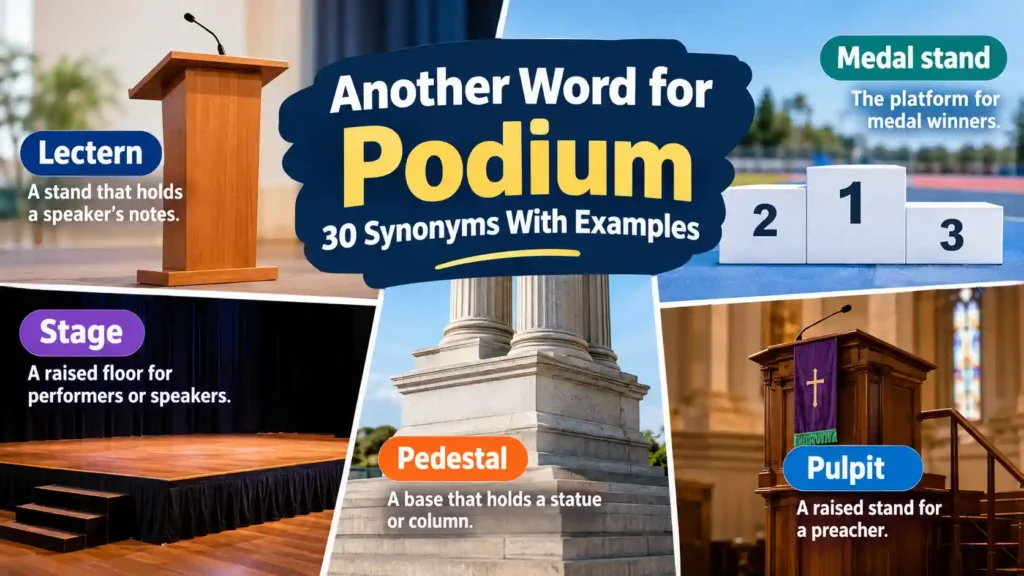
Another word for podium is rostrum, lectern, or dais. These are the closest everyday alternatives, but each one fits a slightly different meaning. For example, a podium can be a raised platform, a stand for notes, a conductor’s platform, a winners’ stand in sports, or a low base in architecture.
Because the word has many meanings, the best alternative depends on context. Rostrum and dais fit the platform, while lectern fits the stand. In sports, medal stand is clearer, and in architecture, plinth is the better choice.
Quick list: rostrum, lectern, dais, platform, stage, stand, pulpit, soapbox, medal stand, plinth
This article looks at 30 alternatives, and each one has a meaning, IPA, usage note, and example. Some are direct synonyms, while others are related words that fit only certain contexts. The usage notes make this clear, so you can pick the right word quickly.
At a Glance: Podium Synonyms and Related Alternatives
The table below shows ten of the most useful options, so you can compare them before reading the details.
| Alternative | Part of Speech | Meaning | Register / Tone | Ideal Context |
|---|---|---|---|---|
| Rostrum | Noun | Raised platform for speaking or conducting | Formal | Speeches, ceremonies, orchestras |
| Lectern | Noun | Stand with a sloping top for notes | Neutral to formal | Talks, lessons, church readings |
| Dais | Noun | Raised platform at the end of a room | Formal | Weddings, banquets, official events |
| Platform | Noun | Raised flat surface for a speaker or performer | Neutral | Any public event |
| Stage | Noun | Raised area for performers | Neutral | Theater, concerts, large events |
| Pulpit | Noun | Raised stand in a church | Formal, religious | Sermons, religious services |
| Soapbox | Noun | Box used for informal speeches | Informal | Street speeches, strong opinions |
| Medal stand | Noun | Stand where medalists receive medals | Neutral, sports | Olympics and other competitions |
| Plinth | Noun | Base for a statue or column | Technical | Architecture, monuments |
| Riser | Noun | One of several low platforms at different heights | Neutral | Choirs, bands, stage design |
Which Word Should You Use?
Use this table when you need a quick choice. It matches each situation to the word that fits best.
| If you want to… | Use | Why |
|---|---|---|
| Name the platform a speaker stands on | Rostrum or dais | Both mean a raised platform, and both sound formal. |
| Name the stand that holds notes | Lectern | It is the exact word for the stand. |
| Talk about a general raised area for speakers | Platform | It is neutral, so it works almost anywhere. |
| Talk about a place for performers | Stage | It suggests a show, not just a talk. |
| Talk about the place where winners stand | Medal stand | It is clear and specific for sports. |
| Talk about a base for a statue | Plinth or pedestal | Both name bases, so they do not fit people. |
| Describe a church speaker’s stand | Pulpit | It is the standard word for religious settings. |
| Describe someone sharing strong opinions | Soapbox | It is informal and can sound critical. |
Exploring the Multiple Meanings of “Podium”
Podium has five main senses. Each one points to a different set of synonyms, so it helps to know them first.
1. The Speaker’s Platform
- Meaning: A raised platform on which a speaker stands.
- Explanation: This is the oldest everyday sense of the word. The platform lifts the speaker, so the audience can see and hear them clearly. Rostrum and dais are the closest synonyms here.
- Example: The mayor walked up to the podium and then thanked the crowd.
2. The Stand for Notes
- Meaning: A stand with a sloping top that holds a speaker’s notes or papers.
- Explanation: In American English, people often call this a podium. However, many careful writers prefer lectern for the stand and podium for the platform. Both uses appear in dictionaries, so neither is wrong.
- Example: She placed her notes on the podium and then adjusted the microphone.
3. The Conductor’s Platform
- Meaning: A small raised platform for an orchestra or choir conductor.
- Explanation: The platform lets every musician see the conductor, so the group can play together. Rostrum is also used for this sense.
- Example: The conductor stepped onto the podium before she raised her baton.
4. The Winners’ Stand in Sports
- Meaning: A stepped platform where the top finishers receive their medals.
- Explanation: This sense also gives us the phrase “podium finish,” which means finishing in the top three. Medal stand is a clear alternative, although it names only the physical stand.
- Example: All three runners smiled on the podium while the anthem played.
5. A Base in Architecture
- Meaning: A low wall or platform that forms the base of a building or structure.
- Explanation: This sense comes from the word’s history, because the Latin word meant a raised base or balcony. Today it is mainly a technical term in architecture.
- Example: The temple stands on a tall stone podium, so visitors must climb steps to enter.
Sources: Merriam-Webster, Collins Dictionary, Dictionary.com, Etymonline
Analyzing 30 Podium Alternatives in Detail
Some of these words are close synonyms of podium, but others are related words that fit only one sense. Therefore, each usage note says whether the word is a direct synonym or a related alternative.
Group 1: Core Speaking Platforms
1. Rostrum
IPA: US /ˈrɑːstrəm/ · UK /ˈrɒstrəm/
Definition: A raised platform for public speaking, conducting, or presenting awards.
Usage: Rostrum is a close synonym for the platform sense of podium. It is formal and especially common in British English.
Example: The president moved to the rostrum to deliver his speech.
2. Lectern
IPA: US /ˈlɛktərn/ · UK /ˈlɛktən/
Definition: A stand with a sloping top that holds a speaker’s notes or book.
Usage: Lectern is a close alternative when podium means a stand for notes. It does not refer to a raised platform.
Example: The teacher placed her notes on the lectern before speaking.
3. Dais
IPA: US /ˈdeɪəs/ · UK /ˈdeɪɪs/
Definition: A raised platform at one end of a room or hall.
Usage: Dais is a formal synonym for a raised speaking platform, often used for honored guests.
Example: The bride and groom sat on the dais during the reception.
4. Platform
IPA: US /ˈplætfɔːrm/ · UK /ˈplætfɔːm/
Definition: A raised, flat surface where speakers or performers stand.
Usage: Platform is a direct, neutral alternative to podium and suits most situations.
Example: He stood on the platform so everyone could see him.
5. Stage
IPA: /steɪdʒ/
Definition: A raised area where speakers or performers appear.
Usage: Stage is a related alternative, especially for concerts, presentations, and public events.
Example: The speaker walked onto the stage and greeted the audience.
6. Stand
IPA: /stænd/
Definition: A structure that supports or holds a person or object.
Usage: Stand is a general term that can describe a support for notes or equipment. However, it is less precise than podium.
Example: She placed her laptop on the stand before beginning her talk.
Sources: Merriam-Webster, Collins Dictionary, Dictionary.com, and Etymonline.
Group 2: Political and Historic Speaking Places
7. Tribune
IPA: /ˈtrɪbjuːn/
Definition: A raised platform used by speakers, especially in ancient Rome.
Usage: Tribune is a historical or literary alternative to podium. It is more common in history writing than everyday conversation.
Example: The orator climbed the tribune, and the crowd became silent.
8. Bema
IPA: /ˈbiːmə/
Definition: A raised platform used by speakers in ancient Greece or readers in some places of worship.
Usage: Bema is a technical historical term related to podium. It is mainly used in historical and religious contexts.
Example: The speaker stood on the bema while the assembly listened.
9. Hustings
IPA: /ˈhʌstɪŋz/
Definition: A political campaign or the process of campaigning, originally associated with a platform for candidates.
Usage: Hustings is mainly used in British English. Today, it usually refers to political campaigning rather than a physical platform.
Example: The candidate spent weeks on the hustings before the election.
10. Soapbox
IPA: US /ˈsoʊpbɑːks/ · UK /ˈsəʊpbɒks/
Definition: A box used as a platform for informal speeches or a way to express strong opinions.
Usage: Soapbox is an informal, related alternative. The phrase “get on your soapbox” often describes someone sharing strong opinions, sometimes in a critical way.
Example: He stood on a soapbox in the park to discuss local issues.
11. Stump
IPA: /stʌmp/
Definition: A place or occasion for political campaign speeches.
Usage: Stump is commonly used in American political language, especially in the phrase “on the stump.” It refers to campaigning, not a physical stand for notes.
Example: The senator was on the stump all week before the election.
Sources: Merriam-Webster, Collins Dictionary, Dictionary.com, and Etymonline.
Group 3: Religious Speaking Places
12. Pulpit
IPA: (US and UK) /ˈpʊlpɪt/
Definition: A raised stand in a church from which a preacher speaks.
- Usage: It is the standard word for a religious setting. In other contexts it is figurative, as in “bully pulpit.” It is a related alternative, not a general synonym.
- Example: The priest stepped up to the pulpit and then began the sermon.
13. Ambo
IPA: US /ˈæmboʊ/ · UK /ˈæmbəʊ/
Definition: A raised stand in some churches from which Scripture is read.
- Usage: It is a technical Christian term and a related alternative. It is rare in everyday English, so most readers will not know it.
- Example: A volunteer read the passage from the ambo while the congregation stood.
14. Minbar
IPA: US /ˈmɪnbɑːr/ · UK /ˈmɪnbɑː/
Definition: A stepped pulpit in a mosque from which the imam gives a sermon.
- Usage: It is a related alternative used only for mosques. Therefore, it is not a synonym in general speech.
- Example: The imam climbed the minbar, then he delivered the Friday sermon.
Group 4: Bases and Architectural Terms
15. Plinth
IPA: (US and UK) /plɪnθ/
Definition: A heavy base or slab that supports a statue, column, or vase.
- Usage: It is a related alternative for the architectural sense. However, it does not fit speakers.
- Example: The statue stands on a granite plinth, so it rises above the square.
16. Pedestal
IPA: (US and UK) /ˈpɛdɪstəl/
Definition: A base that supports a statue, column, or vase.
- Usage: It is related to the architectural sense only, and it does not mean a place for speakers. Figuratively, “put someone on a pedestal” means to admire them too much.
- Example: The vase sat on a marble pedestal because the owner wanted it to stand out.
17. Base
IPA: (US and UK) /beɪs/
Definition: The bottom part of something that supports it.
- Usage: It is a plain, general word. It can replace podium in the architectural sense, but it lacks the specific meaning.
- Example: The tower has a wide stone base, so it stays steady in strong winds.
18. Stylobate
IPA: (US and UK) /ˈstaɪləbeɪt/
Definition: The continuous platform on which the columns of a classical building stand.
- Usage: It is a technical, related term. It is not an exact synonym, because a podium is a base for a whole building or structure.
- Example: The columns of the Greek temple rise from the stylobate.
19. Socle
IPA: US /ˈsoʊkəl/ · UK /ˈsəʊkəl/
Definition: A low plain block or base for a wall, column, or statue.
- Usage: It is a technical, related term, and it appears mostly in architecture and art writing.
- Example: The sculpture rests on a simple socle, so the base does not distract from the art.
Group 5: Sports and Competition
20. Medal stand
IPA: (US and UK) /ˈmɛdl stænd/
Definition: A stand where medalists stand to receive their medals.
- Usage: It is a direct synonym for the sports sense, and it is used mostly in American English.
- Example: The three swimmers stood together on the medal stand while the flags rose.
21. Winners’ stand
IPA: US /ˈwɪnərz stænd/ · UK /ˈwɪnəz stænd/
Definition: A platform where the top finishers stand during an awards ceremony.
- Usage: It is a direct synonym for the sports sense, and it is easy to understand. It is also common in international sports writing.
- Example: She waved to the crowd from the winners’ stand after she received her medal.
22. Top-three finish
IPA: US /tɑːp θriː ˈfɪnɪʃ/ · UK /tɒp θriː ˈfɪnɪʃ/
Definition: A result in first, second, or third place.
- Usage: It is a related alternative. It replaces “podium finish,” but it does not replace the stand itself.
- Example: The team earned a top-three finish this season, so fans were thrilled.
23. Medal position
IPA: (US and UK) /ˈmɛdl pəˈzɪʃən/
Definition: A place in a competition that earns a medal.
- Usage: It is a related alternative. It is used in sports reports when an athlete is placed first, second, or third.
- Example: He held a medal position until the final lap, but then he slipped to fourth.
Group 6: Platforms for Performers and Viewers
24. Riser
IPA: US /ˈraɪzər/ · UK /ˈraɪzə/
Definition: A low platform used to place people at different heights.
Usage: Risers are common for choirs, bands, and group photos, but they are not usually used by individual speakers.
Example: The choir stood on risers so everyone could be seen.
25. Bandstand
IPA: /ˈbændstænd/
Definition: A platform, often covered by a roof, where a band performs outdoors.
Usage: A bandstand suits musical performances but is not generally used for speeches.
Example: The town band performed on the bandstand while families watched.
26. Reviewing Stand
IPA: /rɪˈvjuːɪŋ stænd/
Definition: A platform where officials or guests watch a parade or ceremony.
Usage: It is designed for viewing events rather than delivering speeches.
Example: The general watched the parade from the reviewing stand.
27. Viewing Platform
IPA: US /ˈvjuːɪŋ ˈplætfɔːrm/ · UK /ˈvjuːɪŋ ˈplætfɔːm/
Definition: A raised area that allows people to view a landscape or event.
Usage: It is related to a podium through its raised structure, but it is not used specifically for speakers.
Example: Visitors climbed the viewing platform to see the valley.
28. Grandstand
IPA: /ˈɡrænstænd/
Definition: The main seating area at a sports ground.
Usage: A grandstand is for spectators, not for public speaking.
Example: Fans in the grandstand cheered for the winning team.
29. Terrace
IPA: /ˈtɛrəs/
Definition: A flat, raised area or a level of seating.
Usage: A terrace is loosely related to a podium because both can be raised areas, but it is rarely a direct synonym.
Example: Guests watched the ceremony from the terrace.
30. Balcony
IPA: /ˈbælkəni/
Definition: A platform extending from the wall of a building.
Usage: A balcony is not a direct synonym for podium, although someone may give a speech from one.
Example: The leader waved to the crowd from the balcony.
Sources: Merriam-Webster, Collins Dictionary, Dictionary.com, and Etymonline.
Podium vs. Lectern vs. Rostrum vs. Dais
These four words are often mixed up. Traditional usage separates them, but everyday speech does not always follow the rules.
How the Four Words Differ
| Word | What it is | Where the speaker is |
|---|---|---|
| Podium | A raised platform (traditional), or a stand for notes (common American use) | On it, or behind it |
| Lectern | A stand with a sloping top for notes | Behind it |
| Rostrum | A raised platform for speaking or conducting | On it |
| Dais | A raised platform, often at the end of a hall | On it, often with guests |
A Simple Rule to Remember
If you stand on it, it is a podium, rostrum, or dais. If you stand behind it, it is a lectern. However, many Americans say podium for the stand as well, so dictionaries record both uses.
Why Rostrum Means “Beak”
“Rostrum” has an interesting history because it comes from the Latin word for “beak.” In the Roman Forum, the speakers’ platform was decorated with the beaks of captured ships, so the name stuck.
Sources: Merriam-Webster, Collins Dictionary, Dictionary.com, Etymonline
Podium and Opposite/Paired Word Pairs
Podium has no true antonym, so the pairs below are contrasts or words that often appear with it.
| Word | Paired Word | Note |
|---|---|---|
| Podium | Audience | The speaker and the listeners. |
| Podium | Floor | The raised place and the ground level. |
| Podium | Orchestra | The conductor leads the group from the podium. |
| On the podium | Off the podium | Finishing in the top three or not. |
| Podium finish | Also-ran | A medalist and a competitor who did not place. |
| Gold | Silver / Bronze | The three podium places. |
| Top step | Lower step | The winner’s place compared with the others. |
These pairs show how podium works as a place of attention. It raises one person above a group, whether that is a speaker above an audience or a winner above other competitors. Because the word has no single opposite, the best contrast depends on the sense.
Sources: Merriam-Webster, Collins Dictionary
Common Word Partners of “Podium”
The table below shows how podium usually appears in real sentences. Notice that the verbs and prepositions change with the sense.
| Pattern | Common Partners | Example |
|---|---|---|
| Verb + podium | approach, take, mount, step up to, leave | She approached the podium, then she cleared her throat. |
| Preposition + podium | at, behind, on, from | He spoke from behind the podium. |
| Adjective + podium | Olympic, top, winner’s | She stood on the top step of the Olympic podium. |
| Podium + noun | finish, place, position, ceremony, speaker | He earned a podium finish in the race. |
| Noun + podium | conductor’s, speaker’s | The conductor’s podium was raised above the orchestra. |
Sources: Merriam-Webster, Collins Dictionary
Idiomatic Phrases Featuring “Podium”
Podium has few true idioms, so the phrases below are established expressions. They are common in speech and sports writing, but they are not idioms in the strict sense.
1. Take the podium
- Meaning: To step up and begin speaking, or to take the main role at an event.
- Example: The guest of honor took the podium and then thanked everyone for coming.
2. Podium finish
- Meaning: A result in first, second, or third place in a race or contest.
- Example: The young driver was thrilled with her first podium finish.
3. Make the podium
- Meaning: To place among the top three competitors.
- Example: He trained for years because he wanted to make the podium.
4. From the podium
- Meaning: In an official speaking position, such as when announcing a decision or message.
- Example: The decision was announced from the podium at the end of the meeting.
Sources: Merriam-Webster, Collins Dictionary, Dictionary.com
Word Formation of “Podium”
The word has a long history, and it still shows its roots today.
Etymology & Structure
“Podium” comes from Latin podium, meaning an elevated place or balcony. The Latin word comes from Greek podion, a small foot or base, which in turn comes from pous (genitive podos), “foot.” Because of this root, podium is related to words such as tripod and podiatry.
Date and History
According to Etymonline, the word entered English in the 1700s with an architectural meaning, a continuous base or pedestal. The sense of a speaker’s or conductor’s platform came later, and the sports sense is more recent still. Since exact dates for the later senses differ by source, check Etymonline or Merriam-Webster before you cite one.
Word Class Variations
- Noun: podium (plural: podiums or podia)
- Verb (informal, sports): to podium, meaning to finish in the top three. This use appears in sports reporting, but not every dictionary records it.
- Related words with the same root: tripod, octopus, podiatry
Sources: Etymonline, Merriam-Webster, Collins Dictionary
Common Word-Choice Mistakes
Learners often mix up podium with similar words. These corrections cover the most realistic errors, and each one explains why.
- Mounted the lectern: stepped onto the podium, because a lectern is a stand and not a platform.
- Spoke from a pedestal: spoke from a podium, because a pedestal supports a statue and not a speaker.
- The band played on the podium: the band played on the stage or bandstand.
- The CEO spoke from the pulpit: the CEO spoke from the podium, since pulpit suits religious settings or figurative use.
- She won a podium: she earned a podium finish, or she finished on the podium.
- He won the hustings: he did well on the campaign trail, because hustings means the campaign and not the prize.
- He gave a speech from a soapbox at the awards dinner: he gave a speech from the podium, since soapbox sounds informal and a little critical.
FAQs
What is the closest synonym for podium?
Rostrum is the closest synonym for the platform sense. Dais is also very close, so either one works in formal writing.
What is the difference between a podium and a lectern?
A podium is traditionally a platform you stand on, while a lectern is a stand you stand behind. However, in American English, podium is often used for the lectern too.
Is a dais the same as a podium?
Not exactly. A dais is a raised platform, and it often has seats or tables for guests of honor. A podium, on the other hand, is usually for one speaker.
What is a formal alternative to podium?
Rostrum is a formal choice, and dais is also formal. Both work well in speeches and ceremony programs.
What is a figurative alternative to podium?
Soapbox and pulpit work figuratively. For example, “bully pulpit” is a well-known expression for a position that gives someone a chance to speak out.
What is the plural of podium?
Both podiums and podia are accepted. Podiums is more common in everyday use, while podia appears more in formal writing.
Can podium refer to sports?
Yes. It can mean the stand where winners receive medals, or it can mean a top-three finish. “Podium finish” is a standard expression.
Is there an opposite of podium?
No single word is the opposite. Instead, the contrast depends on the meaning, so floor, audience, and also-ran can all work.
Can podium mean a conductor’s platform?
Yes. A conductor’s platform is a recognized sense of the word. Rostrum is also used, so you can choose either one.
Where does the word podium come from?
It comes from Latin podium, meaning an elevated place. The Latin word comes from Greek, where it meant a small foot or base.
Conclusion
The closest alternatives to podium are rostrum, lectern, and dais. Rostrum and dais fit the platform sense, while lectern fits the stand that holds notes. For other meanings, medal stand, plinth, and pedestal are more exact.
Context matters because podium has several meanings. A speaker’s platform, a conductor’s stand, a winners’ stand, and an architectural base each call for a different word. As a result, the wrong choice can confuse readers or sound odd.

Hi, I’m Sophia a passionate writer and curious learner who enjoys exploring fascinating facts, everyday questions, and interesting discoveries. At VistoraDaily, I share clear, reliable, and engaging general knowledge content to help readers learn something new and understand the world better.