
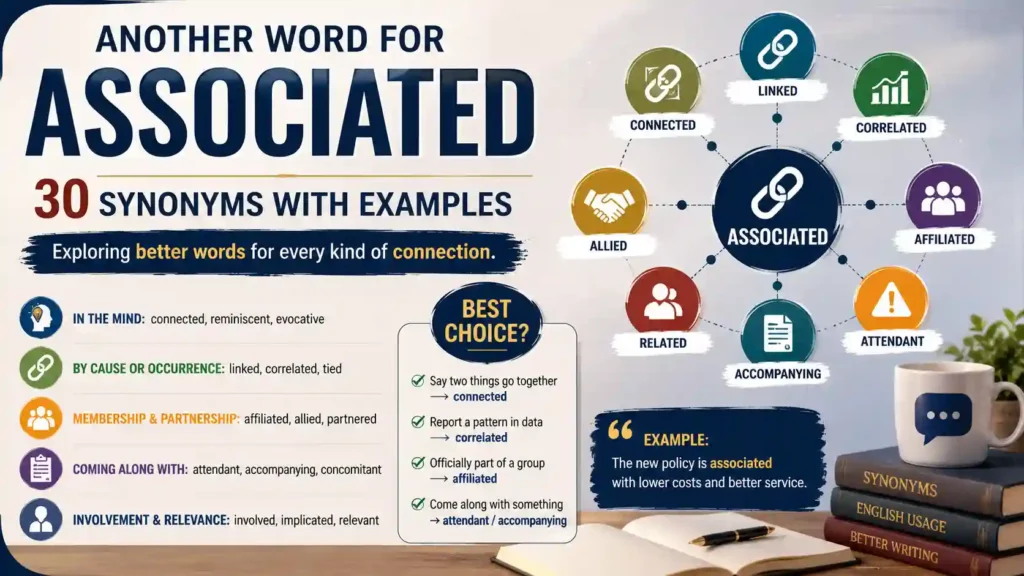
The closest everyday alternatives to “associated” are connected, linked, and related. They work in most sentences where “associated” means that two things go together, as in “Researchers link heart disease to poor sleep.” The best choice depends on what kind of connection you mean.
“Associated” covers several ideas: a link in the mind, a link between facts or events, membership in a group, and extra things that come with a main thing. Each idea has its own better-fitting words, such as correlated, affiliated, attendant, and accompanying.
Quick list: connected, linked, related, tied, correlated, affiliated, attendant, accompanying, involved.
This article looks at 30 alternatives. Each has a definition, IPA, a usage note, and an example, and we group the words by meaning and context.
At a Glance: Associated Synonyms and Related Alternatives
| Alternative | Part of Speech | Meaning | Register / Tone | Ideal Context |
|---|---|---|---|---|
| connected | adjective | joined or having a link | Neutral | Everyday writing and speech |
| linked | adjective | having a clear link to something else | Neutral | News, health, research |
| related | adjective | belonging to the same group or topic | Neutral | General comparisons |
| tied | adjective | firmly joined to something | Neutral to informal | Money, results, causes |
| correlated | adjective | changing together in a measurable way | Formal, technical | Statistics, science |
| affiliated | adjective | officially joined to a larger group | Formal | Organizations, schools, clubs |
| allied | adjective | joined with others for a shared goal | Formal | Politics, military, business |
| attendant | adjective | coming along with something as a result | Formal | Risks, costs, problems |
| accompanying | adjective | going along with something | Neutral to formal | Documents, symptoms, details |
| involved | adjective | taking part in or connected to a situation | Neutral | People and events |
Which Word Should You Use?
| If you want to… | Use | Why |
|---|---|---|
| Say two things simply go together | connected | It is the most general and natural choice. |
| Report a study finding without claiming cause | correlated | It names a pattern in data, not a cause. |
| Describe costs or risks that come with a choice | attendant | It means “following as a result.” |
| Describe items that come with a main item | accompanying | It suits documents, symptoms, and details. |
| Show official membership in a group | affiliated | It points to a formal relationship. |
| Describe groups working toward the same goal | allied | It stresses shared purpose. |
| Say a person is tied to wrongdoing | implicated | It suggests that evidence places a person inside something bad. |
| Say something brings a memory or feeling to mind | evocative | It describes mental or emotional links. |
Exploring the Multiple Meanings of “Associated”
1. Linked in the Mind
- Meaning: Connected in thought, memory, or feeling.
- Explanation: This sense is about what people think of, not about facts in the world. Because of experience or culture, people can associate a smell, a color, or a song with a place or person.
- Example: Many people associate the smell of pine with winter holidays.
2. Connected by Cause or Occurrence
- Meaning: Linked to something else, often because the two appear together or one affects the other.
- Explanation: This is the most common use in news and research. It shows a link without always proving that one thing causes the other.
- Example: Researchers associate long hours of sitting with back pain.
3. Joined to a Group or Organization
- Meaning: Officially connected to a larger body, company, or institution.
- Explanation: Here “associated” describes a formal relationship, such as a partner company or a member of a group. It is common in names and official descriptions.
- Example: The school maintains an association with a nearby university.
4. Keeping Company With Someone
- Meaning: Spending time with or being seen with a person or group.
- Explanation: This sense comes from the verb “associate.” It often appears with “with,” and the tone depends on the context. It can suggest guilt or a bad influence.
- Example: He associated with several local business owners.
5. Coming Along With Something
- Meaning: Naturally attached to a main thing, activity, or result.
- Explanation: This sense is common in business and technical writing. It refers to extra costs, tasks, or effects that come with a main item.
- Example: Please review the associated fees before you sign.
Sources: Merriam-Webster; Collins Dictionary; Dictionary.com.
Analyzing 30 Associated Alternatives in Detail
Some of these words are direct synonyms of “associated,” while others fit only certain contexts, and each usage note says which.
Group 1: Core Everyday Synonyms
1. Connected
IPA: /kəˈnɛktɪd/ (US and UK)
Definition: Joined together or having a link.
- Usage: This is the closest everyday synonym. It works for ideas, events, people, and objects, and fits senses 1, 2, and 3.
- Example: The same witness connects the two cases.
2. Linked
IPA: /lɪŋkt/ (US and UK)
Definition: Having a connection to something else.
- Usage: A direct synonym for sense 2. It is very common in news and health writing, and it can suggest a real but sometimes unproven link.
- Example: Doctors have linked the illness to a certain virus.
3. Related
IPA: /rɪˈleɪtɪd/ (US and UK)
Definition: Connected by family, subject, cause, or type.
- Usage: A direct synonym when you mean “in the same area or category.” It is broader and less specific than “linked.”
- Example: Stress and sleep problems are closely related.
4. Tied
IPA: /taɪd/ (US and UK)
Definition: Closely and firmly connected to something.
- Usage: A direct synonym with a stronger, more fixed feeling than “linked.” Writers often use it with “to” for money, results, and causes. It is more informal than “connected.”
- Example: The company ties her bonus to sales results.
5. Attached
IPA: /əˈtætʃt/ (US and UK)
Definition: Joined to something or emotionally connected to it.
- Usage: This is only a partial match. It fits sense 3 or sense 5 when something belongs to a larger thing, and it can show emotional closeness.
- Example: The company attaches a small fee to this service.
Group 2: Formal and Technical Alternatives
6. Correlated
IPA: US /ˈkɔːrəleɪtɪd/ · UK /ˈkɒrəleɪtɪd/
Definition: Having a mutual relationship in which one thing tends to change when the other does.
- Usage: A technical alternative to sense 2. It names a pattern in data and does not claim that one thing causes the other.
- Example: Height and weight correlate positively in children.
7. Interrelated
IPA: /ˌɪntərɪˈleɪtɪd/ (US and UK)
Definition: Connected to each other.
- Usage: A formal word for things that affect each other in both directions. It is stronger than “related.”
- Example: The causes of the problem are interrelated.
8. Concomitant
IPA: US /kənˈkɑːmɪtənt/ · UK /kənˈkɒmɪtənt/
Definition: Happening or existing at the same time as something else.
- Usage: A formal, rare word for sense 5. It suits medical, legal, and academic writing, and it is too stiff for everyday speech.
- Example: The report described the disease and its concomitant symptoms.
9. Attendant
IPA: /əˈtɛndənt/ (US and UK)
Definition: Accompanying or following as a result.
- Usage: A formal alternative for sense 5, mostly used with risks, costs, and problems. It suggests the thing comes from the main action.
- Example: Starting a business has attendant risks.
10. Accompanying
IPA: /əˈkʌmpənɪɪŋ/ (US and UK)
Definition: Going along with something else.
- Usage: A good alternative for sense 5. It sounds clear and professional, and it works for documents, symptoms, and details.
- Example: Read the accompanying notes before you start.
Group 3: Membership and Partnership
11. Affiliated
IPA: /əˈfɪlieɪtɪd/ (US and UK)
Definition: Officially connected to or part of a larger organization.
- Usage: The best formal alternative for sense 3. It points to an official relationship, not just a casual link.
- Example: The clinic is affiliated with the city hospital.
12. Allied
IPA: /əˈlaɪd/, also /ˈælaɪd/ (US and UK)
Definition: Joined with others for a shared purpose.
- Usage: This is a related alternative, not an exact synonym. It adds the idea of working together toward a goal. It is common in politics, business, and military writing.
- Example: The two companies became allied in the fight for lower prices.
13. Partnered
IPA: US /ˈpɑːrtnərd/ · UK /ˈpɑːtnəd/
Definition: Working together as partners.
- Usage: A related alternative for sense 3. It suggests an active business or project relationship and often appears in the phrase “partnered with.”
- Example: The museum partnered with a local school.
14. United
IPA: /juˈnaɪtɪd/ (US and UK)
Definition: Joined together as one group or for one purpose.
- Usage: A related alternative that goes beyond “associated.” It means the parts act as one, so use it only when the connection is strong.
- Example: One local council unites the towns.
15. Joined
IPA: /dʒɔɪnd/ (US and UK)
Definition: Brought together or become a member of something.
- Usage: A simple related alternative for sense 3. It focuses on the act of becoming part of something and does not describe ongoing association as well as “affiliated.”
- Example: She joined the club last year.
Group 4: Mental and Symbolic Links
16. Synonymous
IPA: US /sɪˈnɑːnɪməs/ · UK /sɪˈnɒnɪməs/
Definition: So closely connected that one stands for the other.
- Usage: This is stronger than “associated.” It means the connection is so close that two things seem almost the same, and writers often use it with “with.”
- Example: The brand name became synonymous with quality.
17. Reminiscent
IPA: /ˌrɛmɪˈnɪsənt/ (US and UK)
Definition: Making you think of something else.
- Usage: A related alternative for sense 1. It describes a thing that calls up another in the mind. Use it for resemblance or memory, not for factual links.
- Example: The song is reminiscent of the music of the 1970s.
18. Suggestive
IPA: /səˈdʒɛstɪv/ (US and UK)
Definition: Making you think of a particular idea or meaning.
- Usage: A related alternative for sense 1, more formal than “reminiscent.” The word can also mean “hinting at something improper,” so check the context.
- Example: The pattern is suggestive of a larger problem.
19. Evocative
IPA: US /ɪˈvɑːkətɪv/ · UK /ɪˈvɒkətɪv/
Definition: Bringing strong images, memories, or feelings to mind.
- Usage: A related, more literary alternative for sense 1. It stresses emotional power.
- Example: The smell of bread is evocative of her grandmother’s kitchen.
20. Symbolic
IPA: US /sɪmˈbɑːlɪk/ · UK /sɪmˈbɒlɪk/
Definition: Serving as a sign or symbol of something.
- Usage: A related alternative for sense 1. It means a thing stands for an idea, as with colors, objects, and gestures.
- Example: The dove is symbolic of peace.
Group 5: Involvement, Relevance, and Close Ties
21. Relevant
IPA: /ˈrɛləvənt/ (US and UK)
Definition: Connected to the matter being discussed.
- Usage: A related alternative, not an exact synonym. It means the connection matters for the topic at hand.
- Example: Please include only relevant information.
22. Involved
IPA: US /ɪnˈvɑːlvd/ · UK /ɪnˈvɒlvd/
Definition: Taking part in or connected with a situation.
- Usage: A good alternative for sense 4 when people are linked to an event or activity. It is neutral and common.
- Example: The project involved several experts.
23. Implicated
IPA: /ˈɪmplɪkeɪtɪd/ (US and UK)
Definition: Connected to something wrong or harmful, according to evidence.
- Usage: A related alternative with a negative tone. Use it only for blame, crime, or wrongdoing, not for neutral links.
- Example: The report implicated two officials in the scandal.
24. Bound
IPA: /baʊnd/ (US and UK)
Definition: Tied or joined by duty, law, or a strong link.
- Usage: A related alternative. It is closest to “associated” in phrases like “bound up with,” and it suggests a link that is hard to break.
- Example: The farm’s success is bound up with the weather.
25. Coupled
IPA: /ˈkʌpəld/ (US and UK)
Definition: Joined together or happening along with something else.
- Usage: A related alternative for sense 5. It usually appears in the phrase “coupled with” and adds the idea that two factors work together.
- Example: High prices, coupled with low pay, made life hard.
Group 6: Descriptive and Literary Alternatives
26. Intertwined
IPA: US /ˌɪntərˈtwaɪnd/ · UK /ˌɪntəˈtwaɪnd/
Definition: Twisted or woven together.
- Usage: A figurative alternative. It describes connections so close that the parts are hard to separate, and it is stronger than “associated.”
- Example: Their stories are intertwined.
27. Entangled
IPA: /ɪnˈtæŋɡəld/ (US and UK)
Definition: Caught up in a complicated connection.
- Usage: A related alternative with a negative or complicated feeling. It does not suit neutral links.
- Example: A legal dispute entangled the company.
28. Inseparable
IPA: /ɪnˈsɛpərəbəl/ (US and UK)
Definition: Impossible to divide or keep apart.
- Usage: A related alternative. It describes the strongest kind of connection, so it is not an everyday synonym for “associated.”
- Example: Good health and good sleep are inseparable.
29. Kindred
IPA: /ˈkɪndrɪd/ (US and UK)
Definition: Similar in nature or closely related.
- Usage: A literary related alternative. It suggests a natural likeness or shared spirit and is rare in everyday writing.
- Example: The two poets share a kindred style.
30. Akin
IPA: /əˈkɪn/ (US and UK)
Definition: Similar or closely related in character.
- Usage: A related alternative that usually takes “to” after it. It points to likeness more than to an actual link, and it is slightly formal.
- Example: Her feeling was akin to relief.
Sources: Merriam-Webster; Collins Dictionary and Collins Thesaurus; Dictionary.com; Etymonline.
Associated vs. Related vs. Linked vs. Correlated
These four words often appear in news and research, and they show different strengths of connection.
| Word | What it tells the reader | Typical use |
|---|---|---|
| associated | Two things appear together or connect in some way | General statements and research summaries |
| related | Two things belong to the same group or subject | Topics, categories, families |
| linked | Someone has found or claimed a specific link | News, health, investigations |
| correlated | Two measures change together in data | Statistics and science |
None of these words alone proves that one thing causes the other. To claim a cause, writers use words such as “causes,” “leads to,” or “results in,” and only when evidence supports it.
Sources: Merriam-Webster; Collins Dictionary; Dictionary.com.
Associated and Opposite/Paired Word Pairs
| Word | Paired Word | Note |
|---|---|---|
| associated | unrelated | The most natural opposite for sense 2. |
| associated | unconnected | A good opposite for general links. |
| associated | independent | Fits when one thing does not depend on another. |
| associated | dissociated | A formal opposite meaning “separated from,” and it often takes “from.” |
| connected | disconnected | A common pair for objects, ideas, and services. |
| affiliated | independent | Works for organizations without an official parent group. |
| related | unrelated | A very common pair in ordinary writing. |
“Associated” has no single perfect opposite. The best pair depends on the sense: “unrelated” for facts and ideas, “dissociated” for formal separation, and “independent” for organizations.
Sources: Merriam-Webster; Collins Dictionary; Dictionary.com.
Common Word Partners of “Associated”
| Pattern | Common Partners | Example |
|---|---|---|
| associated + with | with + a person, thing, place, or idea | People associate the name with a famous painter. |
| adverb + associated | closely, strongly, commonly, widely, traditionally | Many cultures traditionally associate red with good luck. |
| negatively / positively + associated | negatively, positively (statistics) | Hours of sleep were positively associated with test scores. |
| risks / problems + associated | risks, symptoms, side effects, complications | List the side effects associated with the medicine. |
| associated + noun | fees, risks, problems, symptoms, companies | We will explain the associated fees. |
| be / become / get + associated | be, become, get (with) | He did not want people to associate him with the scandal. |
Sources: Collins Dictionary; Merriam-Webster; Dictionary.com.
Idiomatic Phrases Featuring “Associated”
“Associated” has few true idioms. The items below are established expressions, not figurative idioms.
1. Associated with
- Meaning: Connected to or linked with something or someone.
- Example: People associate the festival with the harvest season.
2. Associated costs
- Meaning: Extra costs that come with a main item or action, as in business and finance.
- Example: Ask the seller about any associated costs before you buy.
3. The Associated Press
- Meaning: The name of a major news organization in the United States, founded in 1846 and often shortened to AP. Here “associated” refers to a group of members working together.
- Example: The Associated Press first reported the story.
4. Guilt by association
- Meaning: Judging a person as guilty or bad because of the people they connect with. This expression uses the noun “association,” not “associated.”
- Example: People blamed her unfairly through guilt by association.
Sources: Merriam-Webster; Collins Dictionary; Dictionary.com; The Associated Press (company information).
Word Formation of “Associated”
Etymology & Structure
“Associated” comes from the verb “associate,” which comes from Latin associatus, the past participle of associare, meaning “to join with.” The Latin word combines ad- (“to”) and sociare (“to join”), from socius (“companion”). In English, the ending -ed turns the verb into a past participle and an adjective.
Date and History
Merriam-Webster dates the adjective “associate” to the 14th century and the verb to the 15th century. Dates for specific senses vary by source, so check a current dictionary before quoting an exact year.
Word Class Variations
- Verb: associate, associates, associating, associated
- Noun: associate (a partner or colleague), association
- Adjective: associated, associate (as in “associate professor”), associative
- Related negatives: dissociate (formal), disassociate (a variant), unassociated
There is no common adverb form for “associated.”
Sources: Etymonline; Merriam-Webster; Collins Dictionary.
Common Word-Choice Mistakes
Associated to: associated with.
Smoking is correlated to cancer: smoking is correlated with cancer (or linked to cancer).
Disassociated from the group: dissociated from the group (the more standard form).
Assosiated: associated (the correct spelling has two s’s and one c).
Costs affiliated with the project: costs associated with the project (“affiliated” is for official membership, not costs).
Ice cream sales rise with drowning, so ice cream causes drowning: association does not prove cause, so do not claim that one thing causes the other.
An accompanying friend: a friend who accompanies you (“accompanying” usually describes things, not people, in this sense).
Frequently Asked Questions
What is the closest synonym for “associated”?
“Connected” and “linked” are the closest everyday synonyms. “Related” also works when you mean the same group or subject.
What is a formal alternative to “associated”?
“Affiliated” works for official membership, and “attendant” or “concomitant” work for things that come with something else. “Correlated” is a formal choice for data.
What is the difference between “associated” and “correlated”?
“Correlated” describes a measurable pattern in data. “Associated” is broader and can describe any kind of link.
Does “associated with” mean cause?
No. It says two things appear together or connect in some way, and it does not prove that one causes the other.
What is the opposite of “associated”?
“Unrelated” and “unconnected” are the most common opposites. “Dissociated” is a more formal choice.
Can “associated” be used for people?
Yes. You can say a person is associated with a group, company, or idea. Be careful with the tone, because the phrase can suggest guilt in some contexts.
What is a good alternative for “associated costs”?
“Attendant costs” is a formal option, and “accompanying costs” is a clearer everyday one. “Related costs” also works.
Is “associated” the same as “affiliated”?
Not exactly. “Affiliated” means officially joined to a larger body, while “associated” can be a looser link.
What is a literary alternative to “associated”?
“Kindred,” “intertwined,” and “evocative” work in more descriptive writing, depending on the sense.
What does “associated” mean in the Associated Press?
It refers to a group of members who work together, which is the original idea behind the news cooperative.
Conclusion
The closest everyday alternatives to “associated” are “connected,” “linked,” and “related.” They work in most sentences where two things go together, and they are clear for any reader.
Context decides the best word. “Correlated” suits data, “affiliated” suits official groups, “attendant” and “accompanying” suit things that come with something else, and “reminiscent” or “evocative” suit memory and feeling.
To choose well, first decide which sense you mean: a mental link, a factual link, membership, or something that comes along with another thing. Then pick the word that fits that sense and avoid words that claim more than you mean, such as “synonymous” or “inseparable.”

Hi, I’m Sophia a passionate writer and curious learner who enjoys exploring fascinating facts, everyday questions, and interesting discoveries. At VistoraDaily, I share clear, reliable, and engaging general knowledge content to help readers learn something new and understand the world better.