
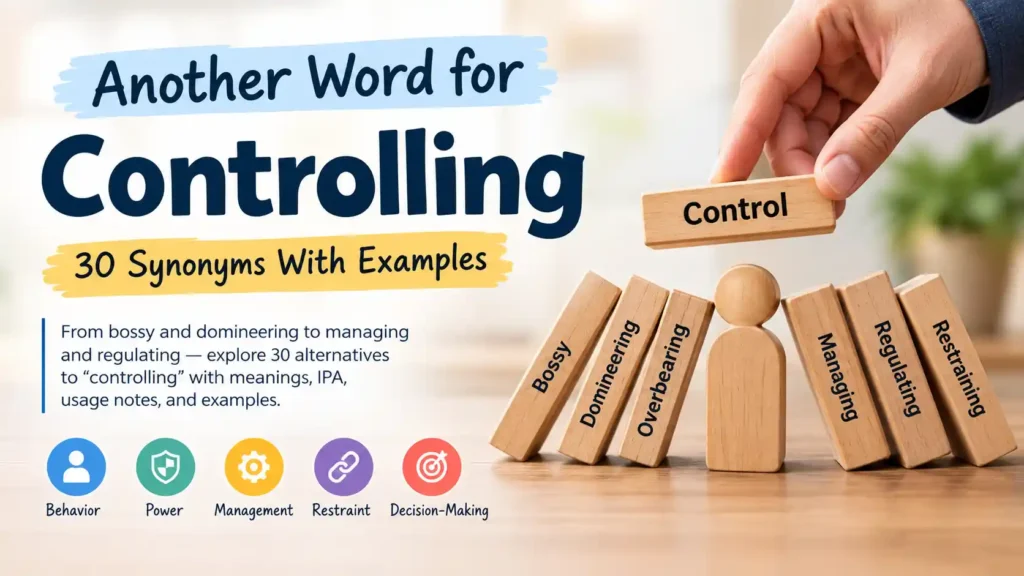
Another word for controlling depends on how you use it. For a person who likes to boss others around, bossy, domineering, and overbearing are common alternatives. When something has the final say, such as a “controlling interest,” deciding, determining, and governing may fit better. For managing or limiting something, consider managing, directing, regulating, or restraining, depending on the context.
“Controlling” covers several areas of meaning: personality and behavior, power and authority, management, restraint, and decision-making. Each alternative below fits some of these areas better than others. A word that works for a harsh boss may sound odd when you are talking about costs or a machine.
Quick list: bossy, domineering, overbearing, authoritarian, manipulative, micromanaging, managing, regulating, restraining, determining
This article looks at 30 alternatives, with meanings, IPA, usage notes, examples, and context. Some are close synonyms. Others are related words that fit only one sense of “controlling,” and the usage notes say which is which.
At a Glance: Controlling Synonyms and Related Alternatives
| Alternative | Part of Speech | Meaning | Register / Tone | Ideal Context |
|---|---|---|---|---|
| Bossy | Adjective | Fond of giving orders | Informal, mildly negative | Everyday talk about people |
| Domineering | Adjective | Forcing your will on others | Neutral to formal, negative | Bosses, parents, partners |
| Overbearing | Adjective | Harshly dominating | Neutral to formal, negative | Relatives, managers, personalities |
| Authoritarian | Adjective | Demanding strict obedience | Formal, negative | Leaders, governments, parenting styles |
| Manipulative | Adjective | Steering others by clever or unfair tricks | Neutral, negative | Relationships, workplaces |
| Micromanaging | Verb form / adjective | Controlling every small detail of others’ work | Informal to neutral, negative | Offices, teams |
| Managing | Verb form | Handling or running something | Neutral | Business, daily tasks |
| Regulating | Verb form | Controlling by rules or adjustment | Formal, technical | Law, science, machines |
| Restraining | Verb form | Holding back or keeping in check | Neutral to formal | Emotions, behavior, force |
| Determining | Adjective / verb form | Deciding or having a deciding effect | Formal | Factors, causes, outcomes |
Which Word Should You Use?
| If you want to… | Use | Why |
|---|---|---|
| Describe someone who gives too many orders, in a casual way | Bossy | It is simple, common, and not very harsh. |
| Describe someone who forces their will on others | Domineering | It stresses power over other people. |
| Describe a leader who demands strict obedience | Authoritarian | It is the standard word for rigid, top-down authority. |
| Describe a manager who checks every small detail | Micromanaging | It names the exact workplace behavior. |
| Describe someone who steers others by tricks or pressure | Manipulative | It points to hidden or unfair influence, not open orders. |
| Talk about running a task, budget, or team | Managing | It is neutral and has no negative tone. |
| Talk about keeping feelings or actions in check | Restraining | It fits self-control and holding back. |
| Talk about the factor that settles the result | Determining | It fits formal writing about causes and outcomes. |
Exploring the Multiple Meanings of “Controlling”
1. Domineering or Over-Directing Others
- Meaning: Having a strong need to control other people’s choices and actions.
- Explanation: This is the most common sense of the adjective in everyday English. It is usually negative and is often used about parents, partners, and bosses. It describes a habit of behavior, not a single act.
- Example: Her controlling manager wanted to approve every email before it was sent.
2. Having the Power to Decide or Determine
- Meaning: Holding enough power or influence to decide an outcome.
- Explanation: In this sense the word is neutral. It appears in fixed phrases such as “controlling interest” and “controlling factor.” It does not describe personality.
- Example: The investor bought a controlling interest in the company.
3. Managing or Directing Something
- Meaning: Running, regulating, or guiding a process, amount, or situation.
- Explanation: Here “controlling” is a verb form (the present participle of “control”). It is neutral and can refer to money, quality, traffic, or any process that needs management.
- Example: The company is controlling costs by buying in bulk.
4. Restraining or Holding Back
- Meaning: Keeping something from growing, spreading, or showing.
- Explanation: This sense covers feelings, behavior, and things in nature. It suggests effort and limits.
- Example: He had trouble controlling his temper during the argument.
5. Operating a Machine or Device
- Meaning: Making a machine, vehicle, or device work in the way you want.
- Explanation: This is a practical, technical sense. It is about handling or operating something, and it has no negative tone.
- Example: She was controlling the drone with a small remote.
Sources: Merriam-Webster; Collins English Dictionary; Dictionary.com; Oxford Learner’s Dictionaries.
Analyzing 30 Controlling Alternatives in Detail
Some of these alternatives are close synonyms, while others are related words that match only one sense of “controlling,” and each usage note says which is which.
Group 1: Everyday Words for a Person Who Likes to Control Others
1. Bossy
IPA: US /ˈbɔːsi/ · UK /ˈbɒsi/
Definition: Fond of giving orders to other people.
- Usage: A close, informal synonym for the personality sense of “controlling.” It is milder than “controlling” and often used about children or friends.
- Example: My bossy cousin told everyone where to stand for the photo.
2. Domineering
IPA: US /ˌdɑːməˈnɪrɪŋ/ · UK /ˌdɒmɪˈnɪərɪŋ/
Definition: Using your power to rule over others in a forceful way.
- Usage: A close synonym for the personality sense of “controlling.” It is stronger than “bossy” and suggests the person wants to be in charge all the time.
- Example: His domineering father decided everything about his career.
3. Overbearing
IPA: US /ˌoʊvərˈbɛrɪŋ/ · UK /ˌəʊvəˈbeərɪŋ/
Definition: Acting in a harsh, forceful way that makes others feel pressed down.
- Usage: A close synonym for the personality sense. It stresses the heavy, unpleasant feeling of being around the person. It is common for parents, relatives, and bosses.
- Example: Her overbearing mother called six times a day to check on her.
4. Dominating
IPA: US /ˈdɑːməˌneɪtɪŋ/ · UK /ˈdɒmɪneɪtɪŋ/
Definition: Having the most power or influence over others.
- Usage: A related alternative. For a person it is close to “controlling,” but it can also mean simply being the strongest or most noticeable, with no unfair intent.
- Example: A dominating speaker can leave no room for other voices in a meeting.
5. Imperious
IPA: US /ɪmˈpɪriəs/ · UK /ɪmˈpɪəriəs/
Definition: Acting in a proud, commanding way that expects to be obeyed.
- Usage: A formal, somewhat literary alternative. It adds a sense of pride and superiority that “controlling” does not always carry.
- Example: The imperious director waved away every suggestion.
Group 2: Strict and Power-Based Alternatives
6. Authoritarian
IPA: US /əˌθɔːrəˈtɛriən/ · UK /ɔːˌθɒrɪˈteəriən/
Definition: Demanding strict obedience to authority and giving little freedom.
- Usage: A formal alternative for people or systems that rule by strict rules. It is more about authority and rules than about personal habits.
- Example: The school had an authoritarian head teacher who punished small mistakes.
7. Autocratic
IPA: (US and UK) /ˌɔːtəˈkrætɪk/
Definition: Ruling with complete power and not asking others for their views.
- Usage: A formal, related alternative. It fits leaders and management styles in which one person makes all the decisions. It is narrower than “controlling.”
- Example: The autocratic owner never asked the staff for ideas.
8. Dictatorial
IPA: (US and UK) /ˌdɪktəˈtɔːriəl/
Definition: Acting like a dictator, giving orders without allowing disagreement.
- Usage: A strong, negative alternative. It is more extreme than “controlling” and is often used with a touch of exaggeration about bosses or relatives.
- Example: His dictatorial style left no room for questions.
9. Tyrannical
IPA: (US and UK) /tɪˈrænɪkəl/
Definition: Using power in a cruel, unfair way.
- Usage: A related alternative that is much stronger than “controlling.” It suggests cruelty and abuse of power, so it should not be used for ordinary bossy behavior.
- Example: The tyrannical ruler punished anyone who spoke against him.
10. Heavy-handed
IPA: (US and UK) /ˌhɛviˈhændɪd/
Definition: Using more force or authority than is needed.
- Usage: A related alternative that describes how control is used, often by governments, managers, or rules. It suggests a clumsy, forceful approach.
- Example: The company’s heavy-handed rules made employees unhappy.
Group 3: Controlling Behavior in Relationships and Work
11. Manipulative
IPA: US /məˈnɪpjələtɪv/ · UK /məˈnɪpjʊlətɪv/
Definition: Influencing others unfairly through pressure, guilt, or tricks.
- Usage: A related alternative that describes hidden or unfair influence rather than open orders.
- Example: He was manipulative, making his friends feel guilty whenever they made their own plans.
12. Micromanaging
IPA: US /ˈmaɪkroʊˌmænɪdʒɪŋ/ · UK /ˈmaɪkrəʊˌmænɪdʒɪŋ/
Definition: Controlling every small detail of other people’s work.
- Usage: A close synonym in workplace settings. It suggests excessive checking and a lack of trust.
- Example: My micromanaging boss wants to review every report before I send it.
13. Coercive
IPA: US /koʊˈɜːrsɪv/ · UK /kəʊˈɜːsɪv/
Definition: Using force or threats to make someone act a certain way.
- Usage: A stronger, formal alternative that emphasizes pressure or threats.
- Example: The report described coercive tactics used to keep workers from leaving.
14. Possessive
IPA: (US and UK) /pəˈzɛsɪv/
Definition: Wanting someone’s attention or loyalty exclusively.
- Usage: A related alternative often associated with jealousy. A possessive person may try to control whom their partner sees.
- Example: Her possessive boyfriend did not want her to meet her friends.
15. Smothering
IPA: (US and UK) /ˈsmʌðərɪŋ/
Definition: Giving excessive care, attention, or protection.
- Usage: A related alternative for overprotective behavior in relationships or families. It suggests that too much attention limits another person’s freedom.
- Example: Her smothering concern made it difficult for him to make his own choices.
Group 4: Managing, Operating, and Directing
16. Managing
IPA: (US and UK) /ˈmænɪdʒɪŋ/
Definition: Handling, running, or being in charge of something.
- Usage: A close, neutral synonym for the verb sense of “controlling.” It has no negative tone, and it is a safe choice for work and daily tasks.
- Example: She is managing the project budget carefully.
17. Directing
IPA: US /dəˈrɛktɪŋ/ · UK /dɪˈrɛktɪŋ/
Definition: Guiding or being in charge of how something is done.
- Usage: A neutral alternative. It fits leadership, film, traffic, and projects, and it stresses guidance over limits.
- Example: He is directing the team through a difficult launch.
18. Operating
IPA: US /ˈɑːpəˌreɪtɪŋ/ · UK /ˈɒpəreɪtɪŋ/
Definition: Making a machine or system work.
- Usage: A close alternative for the machine sense of “controlling.” It cannot be used for people or personality.
- Example: She is operating the crane from a small cabin.
19. Steering
IPA: US /ˈstɪrɪŋ/ · UK /ˈstɪərɪŋ/
Definition: Guiding the direction of a vehicle, a conversation, or a process.
- Usage: A related alternative. It fits vehicles and also figurative uses, such as guiding a talk or a plan. It suggests gentle control and not force.
- Example: The teacher was steering the discussion toward the main point.
20. Overseeing
IPA: US /ˌoʊvərˈsiːɪŋ/ · UK /ˌəʊvəˈsiːɪŋ/
Definition: Watching over work or people to make sure things are done properly.
- Usage: A neutral, slightly formal alternative. It is about supervision and does not suggest that the person is forceful or unfair.
- Example: A senior engineer is overseeing the repair work.
Group 5: Restraining, Limiting, and Keeping in Check
21. Regulating
IPA: US /ˈrɛɡjəˌleɪtɪŋ/ · UK /ˈrɛɡjʊleɪtɪŋ/
Definition: Controlling something by rules or by making adjustments.
- Usage: A formal, close alternative for the sense of managing systems, amounts, or industries. It fits law, science, and machines.
- Example: The thermostat is regulating the temperature of the room.
22. Restraining
IPA: (US and UK) /rɪˈstreɪnɪŋ/
Definition: Holding back or keeping someone or something under control.
- Usage: A close alternative for the sense of controlling feelings or actions. It suggests effort, and it can also describe physical holding back.
- Example: He was restraining his anger and kept his voice calm.
23. Curbing
IPA: US /ˈkɜːrbɪŋ/ · UK /ˈkɜːbɪŋ/
Definition: Putting a limit on something that is growing or getting worse.
- Usage: A close alternative for controlling spread, spending, or bad habits. It is a common word in news and business writing.
- Example: The city is curbing noise at night with new rules.
24. Restricting
IPA: (US and UK) /rɪˈstrɪktɪŋ/
Definition: Keeping something within limits.
- Usage: A related alternative. It points to limits and rules, not to managing or guiding, and it can describe either people or things.
- Example: The new law is restricting the sale of certain chemicals.
25. Containing
IPA: (US and UK) /kənˈteɪnɪŋ/
Definition: Keeping something from spreading or getting out of control.
- Usage: A related alternative for the sense of limiting spread, such as a fire, disease, or crisis. It does not fit the personality sense.
- Example: Firefighters are containing the fire before it reaches the town.
Group 6: Deciding and Determining
26. Determining
IPA: US /dɪˈtɜːrmɪnɪŋ/ · UK /dɪˈtɜːmɪnɪŋ/
Definition: Settling or deciding what will happen or how something will turn out.
- Usage: A close, formal alternative for the “controlling factor” sense. It points to what shapes an outcome.
- Example: Cost is the determining factor in our decision.
27. Deciding
IPA: (US and UK) /dɪˈsaɪdɪŋ/
Definition: Having the power to settle a question or result.
- Usage: A close alternative for the “controlling factor” sense. It is simple and common, and it is easiest to use before a noun, as in “deciding vote.”
- Example: The deciding vote came from the youngest board member.
28. Governing
IPA: US /ˈɡʌvərnɪŋ/ · UK /ˈɡʌvənɪŋ/
Definition: Having the authority to make rules and decisions.
- Usage: A formal, related alternative. It fits groups, boards, and principles that set the rules, such as a “governing body.”
- Example: The governing board approved the new policy.
29. Ruling
IPA: (US and UK) /ˈruːlɪŋ/
Definition: Having the highest authority or the strongest influence.
- Usage: A related alternative. It fits power and influence, such as a “ruling party” or “ruling class,” but it is not a general replacement for “controlling.”
- Example: The ruling party holds most of the seats in parliament.
30. Decisive
IPA: (US and UK) /dɪˈsaɪsɪv/
Definition: Settling a result or having a strong effect on how things end.
- Usage: A related alternative for the “controlling factor” sense. It does not apply to personality, and it can also mean “able to decide quickly,” which is a different sense.
- Example: The final goal was the decisive moment of the game.
Sources: Merriam-Webster; Collins English Dictionary and Thesaurus; Dictionary.com; Oxford Learner’s Dictionaries.
Controlling vs. Domineering vs. Manipulative vs. Bossy
These four words are often mixed up when describing people. They describe different styles of control.
| Word | What the person does | Strength |
|---|---|---|
| Bossy | Gives orders freely, often in small matters | Mild |
| Controlling | Tries to direct other people’s choices and actions | Medium |
| Domineering | Forces their will on others and expects to win | Strong |
| Manipulative | Influences others through hidden pressure or tricks | Varies; focuses on method, not volume |
A bossy person is easy to spot because they say what they want. A manipulative person may never give an order at all. “Controlling” sits in the middle and works well when you want a general word.
Sources: Merriam-Webster; Collins English Dictionary; Dictionary.com.
Controlling and Opposite/Paired Word Pairs
| Word | Paired Word | Note |
|---|---|---|
| Controlling | Easygoing | A natural opposite for personality. |
| Controlling | Laid-back | A common informal contrast. |
| Controlling | Permissive | Often used for parenting or rules. |
| Controlling | Hands-off | Common in management language. |
| Controlling | Trusting | Contrasts control with giving others freedom. |
| Domineering | Submissive | Describes opposite roles in a power relationship. |
| Micromanaging | Delegating | Contrasts holding on to tasks with handing them over. |
| Controlling (a person) | Controlled (a person) | Pairs the one who controls with the one who is controlled. |
“Controlling” has no single perfect opposite because it has several senses. For personality, words such as “easygoing” and “relaxed” fit best. For management, “hands-off” and “delegating” are more natural.
Sources: Merriam-Webster; Collins Thesaurus; Dictionary.com.
Common Word Partners of “Controlling”
| Pattern | Common Partners | Example |
|---|---|---|
| controlling + person | parent, partner, boss, husband, mother | His controlling partner checked his phone every day. |
| controlling + behavior | behavior, tendencies, personality | She noticed her friend’s controlling behavior. |
| controlling + business term | interest, stake, shareholder | The family keeps a controlling stake in the firm. |
| controlling + factor/influence | factor, influence, authority | Price was the controlling factor in the choice. |
| controlling + noun (as a verb form) | costs, spending, the spread, weeds, pests | The farm is controlling pests without chemicals. |
| controlling + feelings | anger, temper, emotions, impulses | He is learning about controlling his temper. |
| controlling + device or thing | the ball, a drone, the temperature | The player is controlling the ball well. |
| adverb + controlling | very, overly, too, extremely | She felt her manager was overly controlling. |
Sources: Collins English Dictionary; Oxford Collocations Dictionary; Merriam-Webster.
Idiomatic Phrases Featuring “Controlling”
“Controlling” has no widely used idioms of its own. The following are strongly established expressions and legal or business terms, not idioms.
1. Controlling interest
- Meaning: Enough ownership in a company (usually more than half of its voting shares) to control its decisions.
- Example: The founder sold some shares but kept a controlling interest.
2. Controlling factor
- Meaning: The most important thing that decides how something turns out.
- Example: Weather is often the controlling factor in a farmer’s success.
3. Controlling precedent
- Meaning: In law, an earlier ruling that a court must follow.
- Example: The lawyer argued that an older case was a controlling precedent.
4. Controlling or coercive behavior
- Meaning: A legal and social-work term for a pattern of acts meant to dominate and limit another person, especially in a close relationship.
- Example: Support groups help people who have experienced controlling or coercive behavior.
Sources: Merriam-Webster; Collins English Dictionary; Cambridge Dictionary; UK Serious Crime Act 2015 (legislation.gov.uk).
Word Formation of “Controlling”
Etymology & Structure
“Controlling” is made from the verb control plus the ending -ing. Control comes from Anglo-French contreroller, which goes back to Medieval Latin contrarotulus, meaning a “counter-roll,” a duplicate record kept to check accounts. The idea of checking led over time to the idea of holding power over something.
Date and History
According to Etymonline, the verb appears in English in the early 1400s with the sense of checking or verifying accounts. The broader senses of holding power over or restraining developed later. The adjective “controlling,” used for a person who dominates others, is now the most common everyday use.
Word Class Variations
- Verb: control, controls, controlled, controlling
- Noun: control, controller, controllability
- Adjective: controlling, controlled, controllable, uncontrollable
- Adverb: controllably, uncontrollably
Sources: Etymonline; Merriam-Webster; Oxford English Dictionary.
Common Word-Choice Mistakes
Wrong: “The dominating mother ruined his day.” Better: “The domineering (or controlling) mother.” Dominating often just means strongest, not unfair.
Wrong: “A dominant boss who checks every email.” Better: “A domineering or micromanaging boss.” Dominant means most important or strongest, with no negative tone.
Wrong: “She is an authority father.” Better: “She is an authoritarian father.” Authority is a noun.
Wrong: “A deciding interest in the company.” Better: “A controlling interest in the company.” This is a fixed expression.
Wrong: “The pilot is overbearing the plane.” Better: “The pilot is controlling (or flying) the plane.” Overbearing describes people and is not used for machines.
Wrong: “He was restricting his anger.” Better: “He was controlling (or restraining) his anger.” Restricting suits rules and limits more than emotions.
Wrong: “A managing boss” to mean a boss who is too controlling. Better: “A micromanaging boss.” Managing is neutral.
Frequently Asked Questions
What is the closest synonym for controlling?
For a person, the closest synonyms are domineering, bossy, and overbearing. For managing something, managing and regulating are closest.
What is a formal alternative to controlling?
Authoritarian, autocratic, and regulating are common formal options. Determining is formal for the “deciding” sense.
What is the difference between controlling and bossy?
Bossy is milder and mostly about giving orders. Controlling is stronger and suggests trying to direct people’s choices and lives.
Is controlling the same as manipulative?
No. A controlling person tries to direct others, often openly. A manipulative person influences others by hidden or unfair methods.
What is the opposite of controlling?
For personality, easygoing, laid-back, and permissive fit well. For management, hands-off is common.
Can controlling be used for things, not just people?
Yes. It can describe costs, spread, machines, or factors, as in “controlling costs” or “controlling factor.”
What does “controlling interest” mean?
It means owning enough of a company, usually over half of the voting shares, to control its decisions.
Is controlling always negative?
For people, it usually is. For things, as in “controlling costs” or “controlling a machine,” it is neutral or even positive.
What is a milder word than domineering?
Bossy is milder, and overbearing is a little less strong in tone.
What does “controlling or coercive behavior” mean?
It is a legal and social-work term for repeated acts meant to dominate or limit another person, especially in a close relationship.
Conclusion
The closest everyday alternatives to “controlling” are bossy, domineering, and overbearing for people, and managing, regulating, and restraining for actions. Words such as determining and deciding fit when something has the final say.
Context decides everything. A word that fits a harsh boss may not fit a budget, and a word for a machine will not fit a personality. Strength also matters: bossy is mild, domineering is strong, and tyrannical is extreme.
To choose the right word, first decide which sense you mean: a person’s behavior, a power to decide, managing a process, or holding something back. Then pick the word whose tone matches the situation.

Hi, I’m Sophia a passionate writer and curious learner who enjoys exploring fascinating facts, everyday questions, and interesting discoveries. At VistoraDaily, I share clear, reliable, and engaging general knowledge content to help readers learn something new and understand the world better.