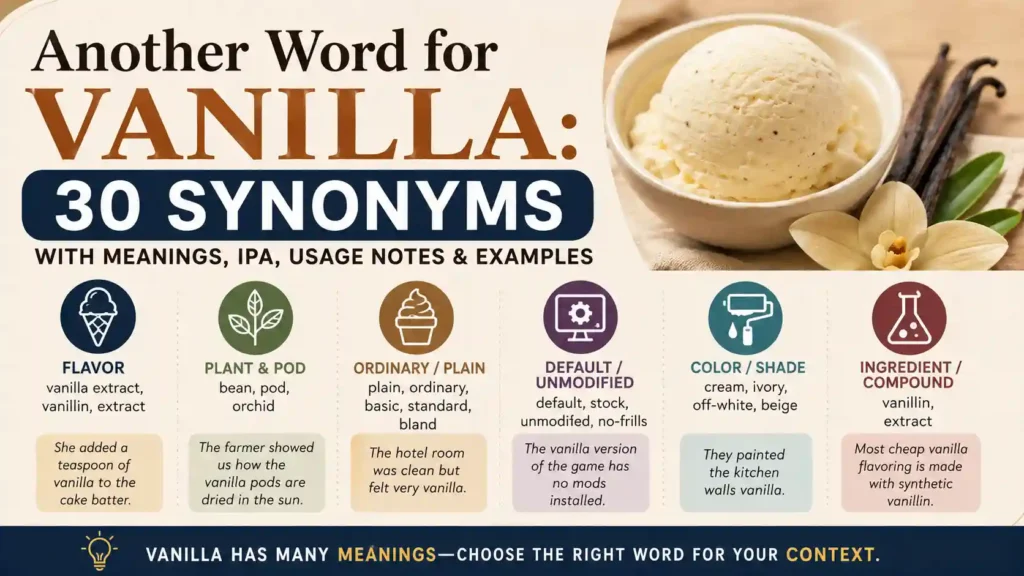
The closest everyday alternatives to “vanilla” are plain, ordinary, basic, and standard. These fit the most common modern sense of the word: something simple, with no special features. If you mean the flavor, “vanilla” has no true synonym, but “vanilla extract” and “vanillin” name related things. If you mean the color, “cream” and “ivory” are close.
The best alternative depends on what you mean. “Vanilla” can describe a flavor, a pale color, a dull or conventional person or product, or the default version of a program or product. A word that fits one meaning can sound wrong in another.
Quick list: plain, ordinary, basic, standard, bland, conventional, default, mainstream, cream, ivory
This article looks at 30 alternatives. Each has a meaning, IPA, a usage note, and an example, and the groups follow the different senses of “vanilla.”
At a Glance: Vanilla Synonyms and Related Alternatives
| Alternative | Part of Speech | Meaning | Register / Tone | Ideal Context |
|---|---|---|---|---|
| Plain | adjective | Simple, with nothing added | Neutral | Food, design, products |
| Ordinary | adjective | Not special or unusual | Neutral | Everyday descriptions |
| Basic | adjective | Simple, with only essential features | Neutral | Products, plans, skills |
| Standard | adjective | Normal or usual for its type | Neutral to formal | Models, versions, practices |
| Bland | adjective | Lacking strong flavor or interest | Neutral, often negative | Food, writing, personalities |
| Conventional | adjective | Following accepted customs | Formal to neutral | Ideas, styles, behavior |
| Mainstream | adjective | Accepted by most people | Neutral | Culture, taste, media |
| Default | adjective/noun | The setting used unless changed | Technical to neutral | Software, settings |
| Cream | noun/adjective | A pale yellowish-white color | Neutral | Paint, fabric, fashion |
| Ivory | noun/adjective | A creamy off-white color | Neutral to elegant | Design, weddings, interiors |
Which Word Should You Use?
| If you want to… | Use | Why |
|---|---|---|
| Describe something simple with nothing added | plain | It is the closest everyday match for “plain vanilla.” |
| Say something is not special in any way | ordinary | It is neutral and works for people, places, and things. |
| Say a product has only the essential features | basic | It points to a simple version, not a dull one. |
| Criticize something as boring | bland | It suggests a lack of flavor or character. |
| Describe safe, traditional taste | conventional | It focuses on following accepted norms. |
| Describe the unchanged version of software or a product | default | It fits technical settings better than “plain.” |
| Describe a pale yellowish-white color | cream | It names a real color shade. |
| Name the flavor compound or flavoring | vanillin, extract | “Vanilla” itself is the right word for the flavor. |
Exploring the Multiple Meanings of “Vanilla”
1. The Flavor and Flavoring
- Meaning: A flavoring made from the pods of a tropical orchid.
- Explanation: This is the original sense, commonly used for ice cream, cakes, and sweets. Related terms include “vanilla extract.”
- Example: She added a teaspoon of vanilla to the cake batter.
2. The Plant and Pod
- Meaning: A climbing orchid or its long, thin pod used to make flavoring.
- Explanation: “Vanilla” can refer to both the plant and its cured pod, often called a vanilla bean.
- Example: The farmer showed us how the vanilla pods are dried.
3. Flavored With Vanilla
- Meaning: Having the taste or scent of vanilla.
- Explanation: As an adjective, “vanilla” describes the flavor or aroma of food and products.
- Example: I ordered a vanilla milkshake.
4. Plain, Ordinary, or Conventional
- Meaning: Basic, standard, or lacking special features.
- Explanation: This meaning developed from vanilla being viewed as a common or default flavor. It can be neutral or mildly negative.
- Example: The hotel room was clean but felt very vanilla.
5. Default or Unmodified Version
- Meaning: The original version without changes, add-ons, or custom features.
- Explanation: This use is common in technology, gaming, and finance.
- Example: The vanilla version of the game has no mods installed.
6. A Pale Cream Color
Example: They painted the kitchen walls vanilla.
Meaning: A soft, pale yellowish-white shade.
Explanation: This color is commonly used for paint, clothing, and interior design.
Analyzing 30 Vanilla Alternatives in Detail
Some alternatives below are direct synonyms for the “plain or ordinary” sense of “vanilla,” while others are related words that fit only one context, such as color, technology, or flavor.
Group 1: Plain and Ordinary Alternatives
1. Plain
IPA: /pleɪn/ (US and UK)
Definition: Simple and not decorated, flavored, or complicated.
- Usage: The closest everyday synonym for the “ordinary” sense. It is neutral and works for food, clothing, and design.
- Example: He ordered a plain bagel with no toppings.
2. Ordinary
IPA: US /ˈɔːrdəneri/ · UK /ˈɔːdnri/
Definition: Normal, with nothing special or unusual about it.
- Usage: A direct synonym for the “not special” sense. It can sound neutral or slightly dismissive depending on tone.
- Example: It was just an ordinary day at the office.
3. Basic
IPA: /ˈbeɪsɪk/ (US and UK)
Definition: Forming the simple starting point, with only essential features.
- Usage: A good match for “vanilla” when describing a simple product or version. In casual speech, “basic” can also describe a person who follows trends, which “vanilla” does not necessarily mean.
- Example: The basic model comes without a screen protector.
4. Standard
IPA: US /ˈstændərd/ · UK /ˈstændəd/
Definition: Normal and expected for its type.
- Usage: A close synonym for the “default version” sense. It is more formal and less negative than “vanilla.”
- Example: The standard package includes two charging cables.
5. Simple
IPA: /ˈsɪmpəl/ (US and UK)
Definition: Easy to understand, with few parts or features.
- Usage: A related alternative. It stresses lack of complexity, not lack of excitement, so it is gentler than “vanilla.”
- Example: She chose a simple black dress.
6. Regular
IPA: US /ˈreɡjələr/ · UK /ˈreɡjʊlə/
Definition: Normal, usual, or of the standard kind.
- Usage: Common in everyday speech for the unmodified version of something, such as a “regular coffee.” It is less critical than “vanilla.”
- Example: I’ll have a regular latte, not the large one.
Group 2: Bland and Unexciting Alternatives
7. Bland
IPA: /blænd/ (US and UK)
Definition: Lacking strong flavor, character, or interest.
- Usage: A close match when “vanilla” is used as a mild criticism. It is more negative than “plain.”
- Example: The soup was bland without any salt.
8. Dull
IPA: /dʌl/ (US and UK)
Definition: Not interesting or exciting.
- Usage: A stronger, more openly negative alternative. It fits people, events, and writing.
- Example: The speech was long and dull.
9. Unremarkable
IPA: US /ˌʌnrɪˈmɑːrkəbəl/ · UK /ˌʌnrɪˈmɑːkəbl/
Definition: Not special or worth noticing.
- Usage: A more formal synonym for the “ordinary” sense. It is calm and fairly neutral in tone.
- Example: The movie was unremarkable, but the acting was fine.
10. Run-of-the-mill
IPA: US /ˌrʌn əv ðə ˈmɪl/ · UK /ˌrʌn əv ðə ˈmɪl/
Definition: Ordinary and not special in any way.
- Usage: An informal compound adjective that matches the “ordinary” sense of “vanilla.” It often carries mild disappointment.
- Example: It was a run-of-the-mill restaurant with a standard menu.
11. Nondescript
IPA: US /ˌnɑːndɪˈskrɪpt/ · UK /ˈnɒndɪskrɪpt/
Definition: Having no special features that make it easy to describe or remember.
- Usage: A related alternative. It stresses forgettable appearance, so it suits buildings, clothes, and people more than ideas.
- Example: He wore a nondescript gray jacket.
12. Mundane
IPA: /mʌnˈdeɪn/ (US and UK)
Definition: Ordinary and lacking interest, as part of everyday life.
- Usage: A related alternative. It describes routine tasks and daily life more than products or flavors.
- Example: She tried to make her mundane routine more fun.
Group 3: Conventional and Mainstream Alternatives
13. Conventional
IPA: US /kənˈvenʃənəl/ · UK /kənˈvenʃənl/
Definition: Following accepted or traditional ways of doing things.
- Usage: A good match for “vanilla” when it means unadventurous or traditional. It is more formal and less casual than “vanilla.”
- Example: They chose a conventional design for the new building.
14. Traditional
IPA: US /trəˈdɪʃənəl/ · UK /trəˈdɪʃənl/
Definition: Following customs or beliefs passed down over time.
- Usage: A related alternative. It is more positive than “vanilla” and suggests respect for old customs, not boredom.
- Example: The restaurant serves traditional recipes.
15. Mainstream
IPA: /ˈmeɪnstriːm/ (US and UK)
Definition: Accepted or followed by most people.
- Usage: A good match when “vanilla” means popular and not unusual. It is neutral, though some speakers use it to suggest lack of originality.
- Example: His music is too mainstream for me.
16. Safe
IPA: /seɪf/ (US and UK)
Definition: Avoiding risk or anything unusual.
- Usage: A related alternative that fits creative choices such as “a safe choice” or “a safe design.” It means low-risk, not tasteless.
- Example: The director made a safe, predictable film.
17. Unadventurous
IPA: /ˌʌnədˈventʃərəs/ (US and UK)
Definition: Not willing to try new or different things.
- Usage: A fairly direct synonym when “vanilla” describes people’s tastes or habits. It is clearly critical.
- Example: Her cooking was unadventurous, with the same five dishes each week.
18. Middle-of-the-road
IPA: US /ˌmɪdl əv ðə ˈroʊd/ · UK /ˌmɪdl əv ðə ˈrəʊd/
Definition: Moderate and avoiding extremes.
- Usage: A related alternative. It suits music, opinions, and products that try to please everyone and take no strong position.
- Example: The band plays middle-of-the-road pop.
Group 4: Default and Unmodified Alternatives (Technology, Business, Gaming)
19. Default
IPA: /dɪˈfɔːlt/ (US and UK)
Definition: The option or setting used automatically unless it is changed.
- Usage: The best match for the technical sense of “vanilla.” It names the starting setting, not the quality.
- Example: The default settings are fine for most users.
20. Stock
IPA: US /stɑːk/ · UK /stɒk/
Definition: Standard and not customized or modified.
- Usage: A close synonym in cars, software, and gaming, where it means “as it came from the maker.”
- Example: The car still has its stock wheels.
21. Unmodified
IPA: US /ʌnˈmɑːdɪfaɪd/ · UK /ʌnˈmɒdɪfaɪd/
Definition: Not changed from the original form.
- Usage: A direct, neutral synonym for the technical “vanilla” sense, such as “vanilla software.” It is formal and precise.
- Example: Run the unmodified version first, then compare the results.
22. No-frills
IPA: US /ˌnoʊ ˈfrɪlz/ · UK /ˌnəʊ ˈfrɪlz/
Definition: Offering only basic features, without extras.
- Usage: A related alternative for services and products. It often sounds positive because it suggests low cost and honesty.
- Example: It is a no-frills airline with cheap tickets.
23. Generic
IPA: /dʒəˈnerɪk/ (US and UK)
Definition: Not specific or special, and general in nature.
- Usage: A related alternative. It means without a particular brand or character and can sound negative about quality or style.
- Example: The reply was a generic message with no personal details.
24. Bare-bones
IPA: US /ˌber ˈboʊnz/ · UK /ˌbeə ˈbəʊnz/
Definition: Including only what is absolutely necessary.
- Usage: A related alternative that is more extreme than “basic.” It suggests the minimum, which may feel too little.
- Example: The apartment was bare-bones, with just a bed and a table.
Group 5: Color and Shade Alternatives
25. Cream
IPA: /kriːm/ (US and UK)
Definition: A pale yellowish-white color.
- Usage: The closest color alternative to “vanilla” when it names a soft, warm off-white shade.
- Example: She wore a cream sweater and brown boots.
26. Ivory
IPA: /ˈaɪvəri/ (US and UK)
Definition: A creamy white color, like the color of elephant tusks.
- Usage: A related color word, slightly more formal and elegant than “cream.”
- Example: The invitations were printed on ivory paper.
27. Off-white
IPA: US /ˌɔːf ˈwaɪt/ · UK /ˌɒf ˈwaɪt/
Definition: A white color with a slight tint of gray or yellow.
- Usage: A general color term that covers “vanilla” but is less specific about the warm tone.
- Example: The off-white curtains made the room feel calm.
28. Beige
IPA: /beɪʒ/ (US and UK)
Definition: A pale brownish-yellow color.
- Usage: A related color word. It is darker and browner than vanilla, so it is not an exact match. “Beige” also suggests dullness in a figurative sense.
- Example: The walls were beige and the carpet was gray.
Group 6: Flavor and Ingredient Terms
29. Vanillin
IPA: /vəˈnɪlɪn/ (US and UK)
Definition: The main chemical compound that gives vanilla its taste and smell.
- Usage: A related technical term, not a synonym. It names the compound in vanilla pods and the one made artificially for food and perfume.
- Example: Most cheap vanilla flavoring is made with synthetic vanillin.
30. Extract
IPA: /ˈekstrækt/ (US and UK)
Definition: A concentrated substance taken from a plant, used for flavor.
- Usage: A related term, not a synonym. It works only in the phrase “vanilla extract” or when context makes the flavor clear. In the UK, “vanilla essence” is also common.
- Example: Add a spoonful of extract to the cookie dough.
Sources: Merriam-Webster; Collins English Dictionary; Dictionary.com; Oxford Learner’s Dictionaries
Vanilla vs. Plain vs. Default: Which Sense Fits?
These three words overlap but are not the same. The table shows how they differ.
| Word | Core idea | Tone | Typical use |
|---|---|---|---|
| Vanilla | Ordinary or unmodified, sometimes dull | Casual, can be mildly negative | “A vanilla design,” “vanilla software” |
| Plain | Simple, with nothing added | Neutral | “Plain yogurt,” “a plain dress” |
| Default | The setting or option used unless changed | Technical, neutral | “Default language,” “default option” |
“Vanilla” is the most flexible of the three, which is why it is often used in business and tech. A “plain vanilla loan” is a loan with standard terms, and “vanilla JavaScript” means JavaScript without extra libraries. In ordinary speech, “plain” is safer because it does not suggest criticism.
Sources: Merriam-Webster; Collins English Dictionary; Dictionary.com
Vanilla and Opposite/Paired Word Pairs
| Word | Paired Word | Note |
|---|---|---|
| Vanilla | Chocolate | The classic ice cream pair, and a common comparison in food choices |
| Vanilla | introduced | Contrasts the ordinary with the unusual |
| Vanilla | Adventurous | Used for tastes, habits, and choices |
| Vanilla | Customized | Contrasts the default version with one that has been changed |
| Vanilla | Modded | Common in gaming, where “modded” means changed with user-made additions |
| Plain | Fancy | A common everyday contrast for food, clothes, and design |
“Vanilla” has no single exact antonym because its meanings are so different.In the flavor sense, vanilla is often paired with chocolate or strawberry as one of several flavor choices. In the “ordinary” sense, its opposites include words like “introduced,” “adventurous,” and “fancy.” In technology, its natural contrast is “customized” or “modded.”
Sources: Merriam-Webster; Collins English Dictionary; Dictionary.com
Common Word Partners of “Vanilla”
| Pattern | Common Partners | Example |
|---|---|---|
| vanilla + noun (flavor/food) | extract, bean, pod, ice cream, custard, essence, latte | She stirred vanilla extract into the custard. |
| vanilla + noun (scent) | candle, perfume, scent, fragrance | The room smelled of vanilla candles. |
| adjective + vanilla | pure, real, plain, French | They use real vanilla in their ice cream. |
| vanilla + noun (default sense) | version, option, setup, install, game | He prefers the vanilla version of the game. |
| vanilla + noun (technical) | JavaScript, option, loan | The project uses vanilla JavaScript. |
| vanilla + noun (color) | walls, shade, paint | The bedroom was painted in a soft vanilla shade. |
Sources: Collins English Dictionary; Merriam-Webster; Dictionary.com
Idiomatic Phrases Featuring “Vanilla”
“Vanilla” has few true idioms. The items below are strongly established expressions, and “plain vanilla” is the closest to an idiom.
1. Plain vanilla
- Meaning: Basic, standard, and without extra features. It is often used in business and finance.
- Example: The bank offered a plain vanilla savings account.
2. French vanilla
- Meaning: A rich vanilla flavor, usually made with egg yolks, or a pale yellow-cream shade. It is a flavor and color term, not an idiom.
- Example: She ordered French vanilla ice cream.
3. Vanilla option
- Meaning: A standard financial option with no special conditions. It is a technical expression used mainly in finance.
- Example: The trader explained how a vanilla option works.
4. The vanilla version
- Meaning: The unmodified or standard form of a product, program, or game.
- Example: The vanilla version doesn’t include any extra levels.
Sources: Merriam-Webster; Collins English Dictionary; Dictionary.com
Word Formation of “Vanilla”
Etymology & Structure
“Vanilla” comes from Spanish vainilla, meaning “little pod.” It is a diminutive of vaina, meaning “sheath” or “pod,” which comes from Latin vagina, meaning “sheath.” The word describes the long, thin shape of the plant’s seed pod.
Date and History
The word entered English in the 1660s, borrowed from Spanish as the name of the flavoring and the plant. The figurative sense of “plain” or “ordinary” appeared later, in the 20th century, probably from the idea that vanilla is the basic, default ice cream flavor.
Word Class Variations
- Noun: vanilla (the flavoring, the plant, the pod)
- Adjective: vanilla (flavored with vanilla; plain or ordinary)
- Related forms: vanillin (noun, the main flavor compound), vanilla-flavored (adjective)
“Vanilla” is not normally used as a verb or an adverb.
Sources: Etymonline; Merriam-Webster; Collins English Dictionary
Common Word-Choice Mistakes
Plain vanilla person: ordinary person (or “plain” person). “Vanilla person” is informal and can sound rude.
Vanilla beige: use “cream” or “ivory.” “Beige” is browner than vanilla.
Standard vanilla design: either “standard design” or “vanilla design.” Using both is repetitive.
Vanilla extract = vanillin: not the same thing. Extract is the liquid flavoring, and vanillin is one compound in it.
A vanilla dessert is plain: not always. It means the dessert tastes like vanilla, not that it is boring.
Default and bland: not interchangeable. “Default” is a technical setting. “Bland” describes taste or interest.
Vanilla software: say “the vanilla version” or “vanilla install” for clarity.
Frequently Asked Questions
1. What is the closest synonym for vanilla?
For the “ordinary” sense, the closest synonyms are “plain,” “ordinary,” and “basic.” For the flavor itself, there is no true synonym.
2. Is “vanilla” an insult?
It can be. When used for people or ideas, it often suggests that something is boring or unadventurous. For products or software, it is usually neutral.
3. What is a formal alternative to vanilla?
“Conventional,” “standard,” and “unremarkable” work well in formal writing.
4. What is a good word for vanilla in technology?
“Default,” “stock,” and “unmodified” fit best, since they mean the original, unchanged version.
5. What is the difference between vanilla and plain?
“Plain” simply means without additions and is neutral. “Vanilla” adds a casual tone and may suggest lack of excitement.
6. What color is vanilla?
It is a pale, warm yellowish-white, close to cream. It is slightly warmer than ivory in many paint ranges, though color names vary by brand.
7. What is the opposite of vanilla?
It depends on the meaning. For the “ordinary” sense, opposites include “ introduced,” “adventurous,” and “fancy.” In technology, the contrast is “customized” or “modded.”
8. Why is vanilla used to mean “ordinary”?
It is most likely because vanilla is seen as the basic, default ice cream flavor. The figurative meaning grew from that idea.
9. Is vanillin the same as vanilla?
No. Vanillin is the main flavor compound in vanilla and is also made synthetically. Vanilla itself comes from the orchid pod.
10. What does “plain vanilla” mean in business?
It means a standard product with no special features, such as a plain vanilla loan or a plain vanilla bond.
Conclusion
The most useful alternatives to “vanilla” are “plain,” “ordinary,” “basic,” and “standard.” For something dull, words such as “bland” and “dull” are a good fit. When describing something traditional, “conventional” and “mainstream” work well. If you mean the unchanged version of a product or program, “default,” “stock,” and “unmodified” are the clearest choices.
Context matters because “vanilla” has several meanings. The flavor, the color, the ordinary sense, and the default version each call for different words. A color word like “cream” would be wrong for a dull speech, and “bland” would be wrong for a software setting.
To choose the right alternative, first decide which meaning you need. Then think about tone: “plain” and “standard” are neutral, while “bland” and “unadventurous” are critical. Matching the word to both meaning and tone will make your writing clearer.

Hi, I’m Sophia a passionate writer and curious learner who enjoys exploring fascinating facts, everyday questions, and interesting discoveries. At VistoraDaily, I share clear, reliable, and engaging general knowledge content to help readers learn something new and understand the world better.