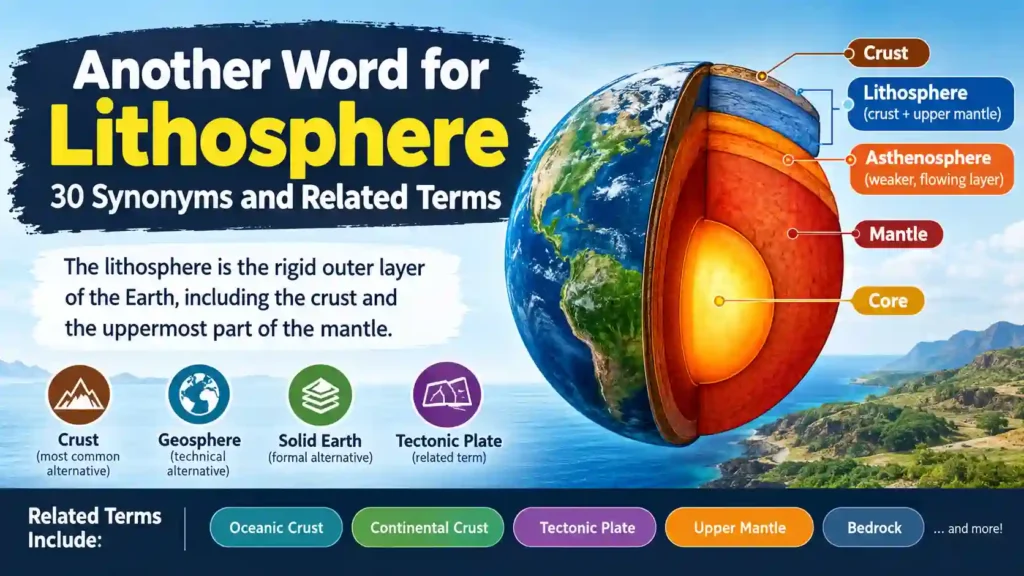
“Lithosphere” is a science word, so it has no perfect everyday synonym. The closest common alternative is crust, and the closest technical alternatives are geosphere and solid Earth. The right choice depends on what you mean. Do you mean the rigid outer shell of the planet? The rocky part of Earth compared with water, air, and life? Or the moving plates on the surface?
In strict science, the lithosphere is not the same as the crust. It includes the crust and the uppermost part of the mantle. For that reason, many words in this list are related alternatives rather than exact synonyms. Each entry says which kind it is.
Quick list: crust, geosphere, solid Earth, petrosphere, outer shell, oceanic crust, continental crust, tectonic plate, upper mantle, bedrock
This article looks at 30 alternatives. Each has a meaning, IPA pronunciation, a usage note, and an example. You will also find tables, word pairs, common partners, word history, and answers to common questions.
At a Glance: Lithosphere Synonyms and Related Alternatives
| Alternative | Part of Speech | Meaning | Register / Tone | Ideal Context |
|---|---|---|---|---|
| Crust | noun | The thin outer layer of the Earth | Neutral, common | School, general writing |
| Geosphere | noun | The rock, mineral, and landform part of the Earth system | Technical | Earth science, climate science |
| Solid Earth | noun phrase | The solid part of the planet, as opposed to oceans and air | Neutral to technical | Science writing |
| Petrosphere | noun | A rare term for the rocky outer part of the Earth | Rare, technical | Specialist or older texts |
| Outer shell | noun phrase | The hard outer layer of a planet | Informal to neutral | Simple explanations |
| Oceanic crust | noun phrase | The crust beneath the oceans | Technical | Geology, plate tectonics |
| Continental crust | noun phrase | The crust that forms the continents | Technical | Geology, mountain studies |
| Tectonic plate | noun phrase | A large moving slab of lithosphere | Technical, widely known | Earthquakes, plate movement |
| Lithospheric mantle | noun phrase | The uppermost mantle that is part of the lithosphere | Highly technical | Geophysics |
| Bedrock | noun | Solid rock beneath soil | Neutral | Construction, geology |
Which Word Should You Use?
| If you want to… | Use | Why |
|---|---|---|
| Talk about the Earth’s outer layer in simple words | crust | It is the most familiar word, but it is narrower than lithosphere. |
| Describe the rigid outer layer without technical terms | outer shell | It is easy to picture and suits beginners. |
| Contrast rock with water, air, and life | geosphere | It fits the “spheres of the Earth” model. |
| Describe the solid planet as a whole | solid Earth | It is the plain phrase scientists use for the solid body. |
| Talk about the moving pieces on the surface | tectonic plate | Plates are pieces of the lithosphere. |
| Name the soft layer just below the lithosphere | asthenosphere | It is the neighboring layer, not a synonym. |
| Talk about rock underneath soil | bedrock | It means solid rock below loose material. |
| Use a rare formal synonym | petrosphere | It is closest in meaning but little used. |
Exploring the Multiple Meanings of “Lithosphere”
1. The Rigid Outer Shell of the Earth
- Meaning: The outer part of the solid Earth, made of the crust and the uppermost mantle.
- Explanation: This is the main scientific meaning. It is defined by how the rock behaves (it is rigid), not only by what it is made of. Merriam-Webster describes it as usually about 60 miles (100 kilometers) thick. The thickness varies by place.
- Example: The lithosphere is broken into large plates that move very slowly.
2. The Solid Part of Any Planet or Moon
- Meaning: The solid, rocky outer part of a celestial body.
- Explanation: The word is not only used for Earth. Scientists also describe the lithospheres of Mars, the Moon, and other rocky bodies.
- Example: Mars has a thick lithosphere that does not break into moving plates the way Earth’s does.
3. The Rock Part of the Earth System
- Meaning: The solid-ground part of Earth, listed with the hydrosphere, atmosphere, and biosphere.
- Explanation: In school science, “lithosphere” often stands for rocks, minerals, and land. Here it is a simple label, and the exact depth does not matter.
- Example: Volcanoes show how the lithosphere can affect the atmosphere.
4. The Strong Layer Above the Asthenosphere
- Meaning: The cold, strong outer layer that sits on top of a weaker, flowing layer.
- Explanation: Scientists use this meaning when they study how Earth’s layers bend and move. It is the contrast with the asthenosphere that matters here.
- Example: The heavy ice sheet pressed down on the lithosphere beneath it.
Sources: Merriam-Webster (lithosphere); Etymonline (lithosphere); U.S. Geological Survey educational materials on Earth’s structure.
Analyzing 30 Lithosphere Alternatives in Detail
Only a few of these words are close synonyms. Most are parts of the lithosphere, neighboring layers, or related terms, and each entry says which.
Group 1: Closest Alternatives
1. Crust
IPA: /krʌst/
Definition: The thin, hard outer layer of Earth.
- Usage: The closest everyday alternative, but narrower than lithosphere because lithosphere also includes the uppermost mantle.
- Example: Earthquakes happen when the crust suddenly slips along a fault.
2. Geosphere
IPA: US /ˈdʒiːoʊˌsfɪr/ · UK /ˈdʒiːəʊsfɪə/
Definition: The rocky part of Earth’s system, including rocks, minerals, soil, and landforms.
- Usage: A technical alternative that can be broader than lithosphere, depending on the scientific context.
- Example: The geosphere, hydrosphere, and atmosphere interact continuously.
3. Solid Earth
IPA: US /ˈsɑːlɪd ɜːrθ/ · UK /ˈsɒlɪd ɜːθ/
Definition: The solid body of Earth, excluding its oceans and atmosphere.
- Usage: A broad scientific expression that includes more than the lithosphere.
- Example: Satellites help scientists measure movements of the solid Earth.
4. Petrosphere
IPA: US /ˈpɛtrəˌsfɪr/ · UK /ˈpɛtrəsfɪə/
Definition: A rare term associated with Earth’s rocky outer region.
- Usage: This uncommon word is a near-alternative, but lithosphere is more widely recognized.
- Example: The old geology text used petrosphere to describe Earth’s rocky exterior.
5. Outer Shell
IPA: US /ˈaʊtər ʃɛl/ · UK /ˈaʊtə ʃɛl/
Definition: The hard outermost layer of a planet.
- Usage: This simple descriptive phrase helps explain the lithosphere to beginners.
- Example: Earth’s rigid outer shell is divided into large plates.
Group 2: Parts of the Lithosphere
6. Oceanic Crust
IPA: US /ˌoʊʃiˈænɪk krʌst/ · UK /ˌəʊʃiˈænɪk krʌst/
Definition: The crust beneath the oceans.
- Usage: It is part of the lithosphere, not a synonym for the entire layer.
- Example: Oceanic crust forms where magma rises at mid-ocean ridges.
7. Continental Crust
IPA: US /ˌkɑːntɪˈnɛntl krʌst/ · UK /ˌkɒntɪˈnɛntl krʌst/
Definition: The crust that forms the continents.
- Usage: It is generally thicker than oceanic crust and forms part of the continental lithosphere.
- Example: Mountains rise where pieces of continental crust collide.
8. Lithospheric Mantle
IPA: US /ˌlɪθəˈsfɪrɪk ˈmæntl/ · UK /ˌlɪθəˈsfɛrɪk ˈmæntl/
Definition: The rigid uppermost mantle included in the lithosphere.
- Usage: This technical term is common in geophysics.
- Example: The lithospheric mantle is cooler and stronger than the underlying rock.
9. Upper Mantle
IPA: US /ˈʌpər ˈmæntl/ · UK /ˈʌpə ˈmæntl/
Definition: The mantle region directly beneath Earth’s crust.
- Usage: Only its rigid upper portion belongs to the lithosphere.
- Example: Heat from the upper mantle helps drive plate movement.
10. Tectonic Plate
IPA: US /tɛkˈtɑːnɪk pleɪt/ · UK /tɛkˈtɒnɪk pleɪt/
Definition: A large, moving section of the lithosphere.
- Usage: Use this term when discussing plate movement, boundaries, or earthquakes.
- Example: The Indian Plate moves slowly northward.
11. Craton
IPA: US /ˈkreɪtɑːn/ · UK /ˈkreɪtɒn/
Definition: An ancient, stable part of a continent’s crust and upper mantle.
Example: Cratons have remained stable for billions of years.
Usage: This geological term describes stable regions of continental lithosphere, not the entire lithosphere.
Group 3: Neighboring Layers (Contrast Terms)
12. Asthenosphere
IPA: US /æsˈθɛnəˌsfɪr/ · UK /æsˈθɛnəsfɪə/
Definition: The weaker, slowly flowing layer of the upper mantle beneath the lithosphere.
- Usage: Not a synonym. It is the layer the lithosphere sits on, and the two are often contrasted.
- Example: Plates glide over the asthenosphere very slowly.
13. Mantle
IPA: (US and UK) /ˈmæntl/
Definition: The thick layer of hot rock between the Earth’s crust and core.
- Usage: Not a synonym. The mantle is much larger than the lithosphere, and only its top part belongs to the lithosphere.
- Example: Hot rock in the mantle rises and sinks over millions of years.
14. Moho
IPA: US /ˈmoʊhoʊ/ · UK /ˈməʊhəʊ/
Definition: The boundary between the Earth’s crust and the mantle.
- Usage: A technical boundary term, not a synonym. Short for Mohorovičić discontinuity, named after the Croatian scientist Andrija Mohorovičić. The Moho lies inside the lithosphere, not at its base.
- Example: Seismic waves change speed when they cross the Moho.
15. Core
IPA: US /kɔːr/ · UK /kɔː/
Definition: The center of the Earth, made mostly of iron and nickel.
- Usage: Not a synonym. The core is the deepest layer, far below the lithosphere. It is included here as a contrast term.
- Example: The lithosphere is thin compared with the size of the core.
Group 4: The Earth’s Other Spheres
16. Hydrosphere
IPA: US /ˈhaɪdrəˌsfɪr/ · UK /ˈhaɪdrəsfɪə/
Definition: All the water on or near the Earth’s surface.
- Usage: Not a synonym. It is the water counterpart to the lithosphere in the “spheres” model.
- Example: Rivers move material from the lithosphere into the hydrosphere.
17. Atmosphere
IPA: US /ˈætməsˌfɪr/ · UK /ˈætməsfɪə/
Definition: The layer of gases around the Earth.
- Usage: Not a synonym. It is the air counterpart to the lithosphere.
- Example: Volcanic gases rise from the lithosphere into the atmosphere.
18. Biosphere
IPA: US /ˈbaɪəˌsfɪr/ · UK /ˈbaɪəsfɪə/
Definition: The part of the Earth where living things exist.
- Usage: Not a synonym. It is the life counterpart to the lithosphere.
- Example: Plants in the biosphere break down rock at the surface of the lithosphere.
19. Cryosphere
IPA: US /ˈkraɪəˌsfɪr/ · UK /ˈkraɪəsfɪə/
Definition: The frozen parts of the Earth, such as ice sheets, glaciers, and sea ice.
- Usage: Not a synonym. It is used in climate science alongside lithosphere.
- Example: Heavy ice in the cryosphere can press the lithosphere downward.
20. Pedosphere
IPA: US /ˈpɛdəˌsfɪr/ · UK /ˈpɛdəsfɪə/
Definition: The soil layer of the Earth’s surface.
- Usage: Not a synonym. The pedosphere is a thin layer at the top of the lithosphere where rock, air, water, and life meet. From Greek pedon, “soil.”
- Example: Farmers depend on the pedosphere, not the deep lithosphere.
Group 5: Everyday Words for Solid Ground
21. Ground
IPA: (US and UK) /ɡraʊnd/
Definition: The solid surface of the Earth.
- Usage: A very casual, loosely related word. It refers to the surface only, not to a deep layer.
- Example: The ground shook during the earthquake.
22. Land
IPA: (US and UK) /lænd/
Definition: The dry part of the Earth’s surface, as opposed to the sea.
- Usage: A loose everyday alternative. It excludes the ocean floor, which the lithosphere includes.
- Example: Most of the land on Earth sits on continental crust.
23. Bedrock
IPA: US /ˈbɛdˌrɑːk/ · UK /ˈbɛdrɒk/
Definition: The solid rock that lies under soil and loose material.
- Usage: A related term for solid rock close to the surface. It is much thinner than the lithosphere.
- Example: Engineers dug down to the bedrock before building the tower.
24. Rock
IPA: US /rɑːk/ · UK /rɒk/
Definition: The hard natural material that makes up much of the Earth.
- Usage: A basic related word for the material, not for the layer.
- Example: The lithosphere is mostly cold, hard rock.
25. Terra Firma
IPA: US /ˌtɛrə ˈfɜːrmə/ · UK /ˌtɛrə ˈfɜːmə/
Definition: Dry land, from Latin for “firm land.”
- Usage: A loose, literary-sounding alternative. It means dry land as opposed to water or air, not the scientific layer.
- Example: After days at sea, the sailors were glad to stand on terra firma.
Group 6: Surface and Rock-Material Terms
26. Regolith
IPA: US /ˈrɛɡəˌlɪθ/ · UK /ˈrɛɡəlɪθ/
Definition: The layer of loose rock, dust, and broken material covering solid rock.
- Usage: A related term for the loose surface layer only. It comes from Greek words meaning “blanket” and “rock.” It is also used for the Moon’s surface.
- Example: Astronauts walked across the Moon’s gray regolith.
27. Strata
IPA: US /ˈstreɪtə/ · UK /ˈstrɑːtə/
Definition: Layers of rock, especially sedimentary rock (plural of stratum).
- Usage: A related word for visible rock layers, usually near the surface. It is not a name for the lithosphere.
- Example: The cliff showed strata laid down over millions of years.
28. Landmass
IPA: (US and UK) /ˈlændmæs/
Definition: A large area of land, such as a continent.
- Usage: A loose related word. It describes land areas, not a layer of the Earth.
- Example: Africa is a huge landmass built on continental crust.
29. Seafloor
IPA: US /ˈsiːˌflɔːr/ · UK /ˈsiːflɔː/
Definition: The bottom of the ocean.
- Usage: A related term. The seafloor is the top of the oceanic lithosphere, which is why “land” alone does not match lithosphere.
- Example: New seafloor forms where plates pull apart.
30. Earth’s Surface
IPA: US /ɜːrθs ˈsɜːrfɪs/ · UK /ɜːθs ˈsɜːfɪs/
Definition: The outer face of the planet, where rock, water, and air meet.
- Usage: A loose related phrase. It describes the outside boundary, not the whole thick layer.
- Example: Mountains, valleys, and plains are shapes on Earth’s surface.
Sources: Merriam-Webster (lithosphere and related entries); Etymonline (lithosphere, litho-); U.S. Geological Survey educational materials; Encyclopaedia Britannica (Earth’s structure).
Lithosphere vs. Crust vs. Mantle vs. Asthenosphere
Many people mix these words up because Earth can be divided in two ways. The crust and mantle are layers defined by what they are made of. The lithosphere and asthenosphere are layers defined by how the rock behaves.
| Term | How it is defined | What it includes | Behavior |
|---|---|---|---|
| Crust | By composition (what it is made of) | The thin outer rock layer | Brittle |
| Mantle | By composition | The thick layer between crust and core | Mostly solid, but flows over long times |
| Lithosphere | By behavior (strength) | Crust plus the uppermost mantle | Rigid, breaks into plates |
| Asthenosphere | By behavior | A weaker part of the upper mantle | Soft and slowly flowing |
So the lithosphere cuts across the crust–mantle boundary. That is why crust is a close alternative but not an exact one.
Sources: Merriam-Webster (lithosphere); U.S. Geological Survey educational materials on Earth’s structure; Encyclopaedia Britannica.
Lithosphere and Opposite/Paired Word Pairs
| Word | Paired Word | Note |
|---|---|---|
| Lithosphere | Asthenosphere | The rigid layer and the weaker layer beneath it. |
| Lithosphere | Hydrosphere | Rock and land versus water. |
| Lithosphere | Atmosphere | Solid Earth versus air. |
| Lithosphere | Biosphere | Rock versus living things. |
| Oceanic lithosphere | Continental lithosphere | The two main types, differing in thickness and age. |
| Crust | Mantle | Outer layer versus the thick layer below. |
Lithosphere has no true opposite. Its natural partners are the other “spheres” of the Earth, and its main scientific contrast is the asthenosphere. These pairs show up often in textbooks because they help students see how Earth’s parts fit together.
Sources: Merriam-Webster (lithosphere); U.S. Geological Survey educational materials; Encyclopaedia Britannica.
Common Word Partners of “Lithosphere”
| Pattern | Common Partners | Example |
|---|---|---|
| adjective + lithosphere | oceanic, continental, rigid, thick, thin, cold | Oceanic lithosphere is generally younger than continental lithosphere. |
| lithosphere + verb | cools, thickens, bends, breaks, subducts | The lithosphere bends under the weight of a large volcano. |
| noun + of the lithosphere | thickness, base, structure, strength | The thickness of the lithosphere varies from place to place. |
| preposition + lithosphere | beneath, below, within, through | Magma rises through the lithosphere. |
| lithosphere + and + noun | asthenosphere, atmosphere, hydrosphere | Scientists study the lithosphere and asthenosphere together. |
| lithospheric + noun | plate, mantle, thickness | Lithospheric plates move a few centimeters each year. |
Sources: Merriam-Webster (lithosphere example sentences); U.S. Geological Survey educational materials.
Idiomatic Phrases Featuring “Lithosphere”
Lithosphere is a scientific term, so it has no true idioms. The expressions below are established scientific phrases, not figures of speech.
1. The lithosphere–asthenosphere boundary
- Meaning: The zone where rigid lithosphere changes into the weaker, flowing asthenosphere. Scientists often shorten it to “LAB.”
- Example: Seismic waves slow down near the lithosphere–asthenosphere boundary.
2. The spheres of the Earth
- Meaning: A common way to describe Earth’s main systems: lithosphere, hydrosphere, atmosphere, and biosphere.
- Example: A volcanic eruption affects all the spheres of the Earth.
3. Oceanic lithosphere
- Meaning: The lithosphere beneath the oceans, made of oceanic crust and the uppermost mantle below it.
- Example: Oceanic lithosphere sinks back into the mantle at subduction zones.
Sources: Merriam-Webster (lithosphere); U.S. Geological Survey educational materials; Encyclopaedia Britannica.
Word Formation of “Lithosphere”
Etymology & Structure
Lithosphere is built from litho-, meaning “stone” or “rock,” and sphere. Litho- comes from Greek lithos, “stone.” Sphere goes back through Latin sphaera to Greek sphaira, meaning “globe” or “ball.” Etymonline says the English word came from, or was modeled on, German Lithosphäre.
Date and History
Etymonline dates the English word to 1881, and notes that the German form appeared in the 1870s. Merriam-Webster gives 1887 as the first known use. Dictionaries use different evidence, so the dates differ slightly. Both point to the late nineteenth century.
Word Class Variations
- Noun: lithosphere (plural: lithospheres)
- Adjective: lithospheric
- Related derivatives built on the same root include lithology and lithograph.
- There is no common verb or adverb form.
Sources: Etymonline (lithosphere, litho-, sphere); Merriam-Webster (lithosphere).
Common Word-Choice Mistakes
- The lithosphere is the same as the crust: the lithosphere includes the crust and the uppermost mantle.
- The lithosphere is only the land: it also includes the rock under the oceans.
- Lithospere or lithosfere: the correct spelling is lithosphere.
- Lithosphere plates: use lithospheric plates, or simply tectonic plates.
- The lithosphere is the soft layer: the soft, flowing layer is the asthenosphere.
- The lithosphere is the atmosphere: the atmosphere is the air, and the lithosphere is rock.
- Plates move on the core: plates move over the asthenosphere, not the core.
Frequently Asked Questions
What is the closest synonym for lithosphere?
There is no perfect synonym. Crust is the most common everyday alternative, and geosphere or petrosphere are closer technical options.
Is the lithosphere the same as the crust?
No. The lithosphere includes the crust and the uppermost part of the mantle.
What is a simple way to describe the lithosphere?
Call it the rigid outer shell of the Earth. It is broken into large pieces called plates.
What is the difference between the lithosphere and the asthenosphere?
The lithosphere is rigid and breaks into plates. The asthenosphere lies beneath it and is weaker, so it flows slowly.
Is there a formal alternative to lithosphere?
Geosphere and solid Earth are formal options. Check how each source defines them, because their meanings can be broader than lithosphere.
Is “petrosphere” a good synonym?
It is close in meaning, but it is rare. Lithosphere is the safer word.
What is the opposite of lithosphere?
It has no true opposite. Its usual partners are the hydrosphere, atmosphere, and biosphere, and its main contrast is the asthenosphere.
Does the lithosphere include the ocean floor?
Yes. The oceanic lithosphere lies beneath the seafloor.
How thick is the lithosphere?
Merriam-Webster gives about 60 miles (100 kilometers) as a usual figure. The thickness varies from place to place.
Can the word be used for other planets?
Yes. Scientists use it for any rocky planet or moon with a solid outer layer.
Conclusion
The closest everyday alternative to lithosphere is crust. For science writing, geosphere, solid Earth, and tectonic plate are common choices. Petrosphere is a rare near-synonym. Many other words in this list name parts of the lithosphere or neighboring layers rather than replacing it.
Context decides which word fits. The crust is only the top part of the lithosphere. The mantle and asthenosphere are different layers. The hydrosphere, atmosphere, and biosphere are Earth’s other systems. Using these words carefully keeps your meaning clear.
To choose the right word, first decide what you mean. To choose the right word, start with what you mean. Crust or outer shell works well when you want the outer layer in simple terms, and tectonic plates fits the moving pieces. When you mean the full rigid layer, lithosphere is the right word.

Hi, I’m Anam, a dedicated writer and curious researcher who believes learning should be simple, useful, and enjoyable. At VistoraDaily, I explore general knowledge, everyday questions, fascinating facts, and helpful information, creating clear content that inspires readers to discover something new.