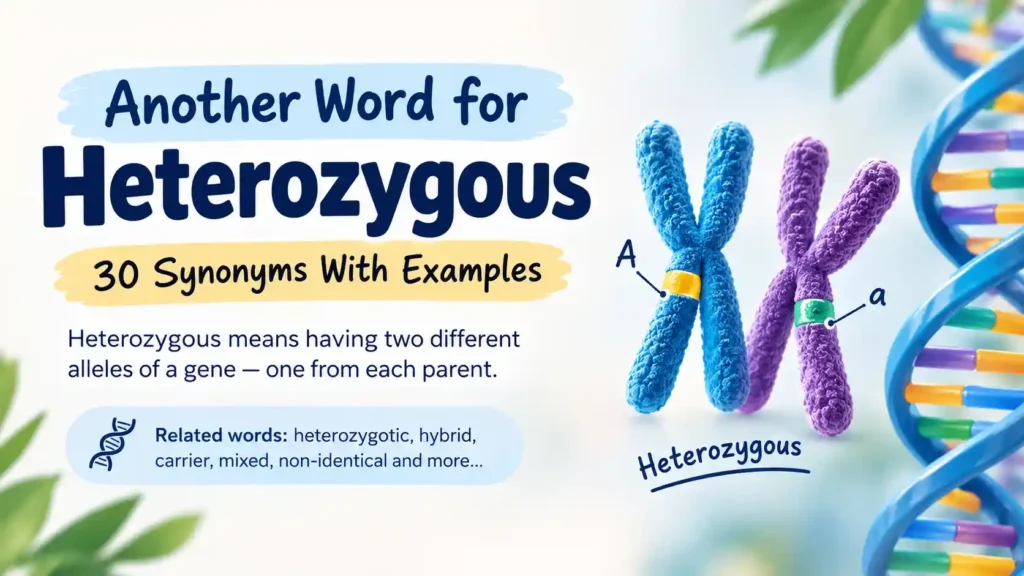
Heterozygous has no perfect everyday synonym, because it is a precise genetics term. The closest words are hybrid (for an organism with mixed genetic parents), carrier (for someone who has one copy of a recessive trait), and mixed. In plain English, mixed, heterogeneous, and varied are the nearest general alternatives.
The right choice depends on meaning and context. In genetics, the word describes an organism with two different versions of a gene. In everyday writing, people may only mean “mixed” or “made of different parts.”
Quick list: heterozygote, hybrid, carrier, crossbred, mixed, blended, heterogeneous, diverse, varied, dissimilar
This article looks at 30 alternatives with meanings, IPA, usage notes, examples, and context. Some are close genetics terms, while others are general words for “mixed” or “different.”
At a Glance: Heterozygous Synonyms and Related Alternatives
| Alternative | Part of Speech | Meaning | Register / Tone | Ideal Context |
|---|---|---|---|---|
| Heterozygote | noun | An organism with two different alleles of a gene | Technical | Genetics, biology |
| Hybrid | noun, adjective | Produced from genetically different parents | Neutral to technical | Biology, farming, general use |
| Monohybrid | noun, adjective | Heterozygous for one gene | Technical | Genetics lessons |
| Carrier | noun | A person with one copy of a recessive trait | Neutral, medical | Health, family genetics |
| Crossbred | adjective | Produced by breeding different varieties | Neutral | Animals, plants |
| Mixed | adjective | Made of different kinds | Everyday | General writing |
| Heterogeneous | adjective | Made of unlike parts | Formal | Science, statistics |
| Diverse | adjective | Showing variety | Neutral | General, social topics |
| Dissimilar | adjective | Not alike | Neutral to formal | Comparisons |
| Variable | adjective | Likely to differ or change | Neutral, technical | Science, data |
Which Word Should You Use?
| If you want to… | Use | Why |
|---|---|---|
| Name a person or organism with two different alleles | heterozygote | It is the exact noun form |
| Describe offspring of two different parent types | hybrid | It is common in biology and farming |
| Describe someone who carries one copy of a recessive condition | carrier | It is clear and widely used in medicine |
| Describe animals or plants bred from different varieties | crossbred | It focuses on breeding |
| Say a group has unlike parts, without technical language | mixed | It is simple and natural |
| Describe a data set or population with many different elements | heterogeneous | It is a formal science word |
| Describe a gene with several common forms in a population | polymorphic | It is a related but different idea |
| Describe having only one copy of a gene | hemizygous | It is the correct contrast term, not a synonym |
Exploring the Multiple Meanings of “Heterozygous”
Heterozygous has one core meaning, but it is used in several slightly different ways.
1. Different alleles at one gene
- Meaning: Having two different alleles (versions) of a particular gene.
- Explanation: This is the basic sense. One allele comes from each parent. The word is always about a specific gene, not the whole organism at once.
- Example: A plant that is heterozygous for flower color has one allele for purple and one for white.
2. Different alleles at several genes
- Meaning: Having two different alleles at more than one gene.
- Explanation: People may say an organism is heterozygous at several genes. This does not mean it is heterozygous everywhere.
- Example: The offspring were heterozygous for both seed shape and seed color.
3. Compound heterozygous
- Meaning: Having two different faulty alleles of the same gene.
- Explanation: This term is common in medicine. Each allele has a different change, but both can affect how the gene works.
- Example: The child was compound heterozygous for two different changes in the same gene.
4. Heterozygous carrier state
- Meaning: Having one copy of a recessive allele, so that the trait often does not appear.
- Explanation: This sense is common in health discussions. If a heterozygous person shows a trait depends on how the gene works.
- Example: Both parents were heterozygous for the allele, so each child had a 25 percent chance of inheriting the condition.
Sources: Merriam-Webster; Dictionary.com; Collins Dictionary; National Human Genome Research Institute glossary
Analyzing 30 Heterozygous Alternatives in Detail
Some of these words are close genetics terms, while others are general or related alternatives that only partly match the meaning of heterozygous.
Group 1: Closest Genetics Terms
1. Heterozygote
IPA: US /ˌhɛtəroʊˈzaɪɡoʊt/ · UK /ˌhɛtərəʊˈzaɪɡəʊt/
Definition: An organism that has two different alleles of a gene.
- Usage: This is the noun form of heterozygous. It is the closest technical match.
- Example: A heterozygote has one dominant and one recessive allele.
2. Hybrid
IPA: (US and UK) /ˈhaɪbrɪd/
Definition: An offspring of parents that differ genetically, such as two varieties or species.
- Usage: In genetics, a hybrid is often heterozygous, but the words are not identical. Hybrid can also describe crosses between species, which heterozygous does not.
- Example: The hybrid plant had one tall and one short allele.
3. Monohybrid
IPA: US /ˌmɑːnoʊˈhaɪbrɪd/ · UK /ˌmɒnəʊˈhaɪbrɪd/
Definition: An offspring that is heterozygous for one particular gene.
- Usage: This is a technical term from basic genetics, especially “monohybrid cross.” It is narrower than heterozygous because it names a single gene.
- Example: The class studied a monohybrid cross with pea plants.
4. Carrier
IPA: US /ˈkæriər/ · UK /ˈkæriə/
Definition: A person who has one copy of a recessive allele and usually does not show the condition.
- Usage: This is a related alternative, not a full synonym. It applies only when the allele is recessive and linked to a trait or condition.
- Example: She learned she was a carrier of the gene.
5. Crossbred
IPA: US /ˈkrɔːsbrɛd/ · UK /ˈkrɒsbrɛd/
Definition: Produced by breeding two different breeds or varieties.
- Usage: This is a related alternative. Crossbred animals are often heterozygous, but the word describes the parentage, not the alleles.
- Example: The farmer kept a crossbred herd.
6. Hybridized
IPA: (US and UK) /ˈhaɪbrɪdaɪzd/
Definition: Produced by crossing different types.
- Usage: This is a related alternative used for plants, animals, and sometimes DNA. It describes the process, not the genetic state.
- Example: The hybridized corn grew well in dry soil.
Group 2: Related Genetics and Biology Terms
7. Polymorphic
IPA: US /ˌpɑːliˈmɔːrfɪk/ · UK /ˌpɒliˈmɔːfɪk/
Definition: Occurring in several different forms.
- Usage: This is a related alternative, not a synonym. A gene is polymorphic when a population has several versions of it. A single person can still be heterozygous or homozygous.
- Example: The blood group gene is polymorphic in humans.
8. Hemizygous
IPA: (US and UK) /ˌhɛmiˈzaɪɡəs/
Definition: Having only one copy of a gene instead of two.
- Usage: This is not a synonym. It is a related contrast term, often used for genes on the X chromosome in males.
- Example: Males are hemizygous for most genes on the X chromosome.
9. Mosaic
IPA: US /moʊˈzeɪɪk/ · UK /məʊˈzeɪɪk/
Definition: Made up of cells with different genetic makeup in one organism.
- Usage: This is a related alternative, not a synonym. A mosaic organism has different cell types genetically, while a heterozygous organism has the same two alleles in its cells.
- Example: The doctor said the patient was a genetic mosaic.
10. Heteromorphic
IPA: US /ˌhɛtəroʊˈmɔːrfɪk/ · UK /ˌhɛtərəʊˈmɔːfɪk/
Definition: Having different forms, such as a pair of chromosomes that differ in shape or size.
- Usage: This is a related technical term. It is about form, not about alleles, so it does not mean heterozygous.
- Example: The X and Y chromosomes are a heteromorphic pair.
Group 3: Mixed and Blended Words
11. Mixed
IPA: (US and UK) /mɪkst/
Definition: Made up of different kinds or parts.
- Usage: This is the simplest everyday alternative. It works in general writing, but it is much less precise than heterozygous.
- Example: The group had a mixed genetic background.
12. Blended
IPA: (US and UK) /ˈblɛndɪd/
Definition: Combined so that the parts are hard to separate.
- Usage: This is a loose, general alternative. It suggests smooth combination, which is not how alleles work, since they stay separate.
- Example: The new variety had a blended appearance.
13. Composite
IPA: US /kəmˈpɑːzɪt/ · UK /ˈkɒmpəzɪt/
Definition: Made up of several parts or elements.
- Usage: This is a formal general word. It fits in descriptions but is not a genetics term.
- Example: The sample was a composite of several sources.
14. Intermixed
IPA: US /ˌɪntərˈmɪkst/ · UK /ˌɪntəˈmɪkst/
Definition: Mixed together.
- Usage: This is a general alternative for things that are blended together, often in groups.
- Example: Different gene variants were intermixed across the population.
15. Heterologous
IPA: US /ˌhɛtəˈrɑːləɡəs/ · UK /ˌhɛtəˈrɒləɡəs/
Definition: Derived from a different species or source.
- Usage: This is a related technical word, not a synonym. It is used in biology and medicine for material from another organism.
- Example: The scientists used a heterologous protein.
Group 4: Different in Kind
16. Heterogeneous
IPA: US /ˌhɛtəroʊˈdʒiːniəs/ · UK /ˌhɛtərəʊˈdʒiːniəs/
Definition: Made up of parts that are different in kind.
- Usage: This is the best formal general alternative. It describes groups or mixtures, not an individual’s alleles.
- Example: The population was genetically heterogeneous.
17. Dissimilar
IPA: US /dɪˈsɪmɪlər/ · UK /dɪˈsɪmɪlə/
Definition: Not alike.
- Usage: This is a general word for two things that differ. It matches the “different” idea in the hetero- part of heterozygous.
- Example: The two alleles are dissimilar.
18. Disparate
IPA: (US and UK) /ˈdɪspərət/
Definition: Clearly different and not alike.
- Usage: This is a formal word that stresses a large difference. It is stronger than heterozygous implies.
- Example: The samples came from disparate groups.
19. Distinct
IPA: (US and UK) /dɪˈstɪŋkt/
Definition: Clearly different or separate.
- Usage: This is a general word for things that can be told apart. It suits two different alleles well.
- Example: Each parent passed on a distinct allele.
20. Differing
IPA: (US and UK) /ˈdɪfərɪŋ/
Definition: Not the same.
- Usage: This is a simple everyday alternative that works for alleles in plain explanations.
- Example: The child received two differing versions of the gene.
Group 5: Varied and Diverse Words
21. Diverse
IPA: US /daɪˈvɜːrs/ · UK /daɪˈvɜːs/
Definition: Showing a lot of variety.
- Usage: This is a general word for populations or groups. It describes variety across many members, not one individual.
- Example: The population is genetically diverse.
22. Varied
IPA: US /ˈvɛrid/ · UK /ˈveərid/
Definition: Having different kinds or forms.
- Usage: This is an easy everyday alternative for groups or traits.
- Example: The offspring showed varied traits.
23. Assorted
IPA: US /əˈsɔːrtɪd/ · UK /əˈsɔːtɪd/
Definition: Made up of different kinds.
- Usage: This is a casual general word. It is rarely used in scientific writing.
- Example: The garden had assorted varieties of beans.
24. Variegated
IPA: US /ˈvɛriəɡeɪtɪd/ · UK /ˈveəriəɡeɪtɪd/
Definition: Marked with patches of different colors.
- Usage: This is a related word for visible color patterns in plants and animals. It describes appearance, not genetics.
- Example: The plant had variegated leaves.
25. Multiform
IPA: US /ˈmʌltifɔːrm/ · UK /ˈmʌltifɔːm/
Definition: Having many forms.
- Usage: This is a literary or formal related word. It does not mean having two different alleles.
- Example: The gene appears in multiform versions.
Group 6: Formal and Contrast Words
26. Heterotypic
IPA: US /ˌhɛtəroʊˈtɪpɪk/ · UK /ˌhɛtərəʊˈtɪpɪk/
Definition: Of a different type.
- Usage: This is a related scientific word. It is not a synonym for heterozygous.
- Example: The cells showed heterotypic interactions.
27. Variable
IPA: US /ˈvɛriəbəl/ · UK /ˈveəriəbəl/
Definition: Likely to change or differ.
- Usage: This is a general word used in science for traits or genes that differ between individuals. It does not describe one person’s two alleles.
- Example: Eye color is a variable trait.
28. Divergent
IPA: US /daɪˈvɜːrdʒənt/ · UK /daɪˈvɜːdʒənt/
Definition: Moving apart or becoming different.
- Usage: This is a related formal word. It suits groups or lineages that become different over time.
- Example: The two populations followed divergent paths.
29. Contrasting
IPA: US /kənˈtræstɪŋ/ · UK /kənˈtrɑːstɪŋ/
Definition: Strikingly different when compared.
- Usage: This is a general word for clear differences. It fits “contrasting alleles” in simple teaching.
- Example: Contrasting alleles decide the trait.
30. Nonuniform
IPA: US /ˌnɑːnˈjuːnɪfɔːrm/ · UK /ˌnɒnˈjuːnɪfɔːm/
Definition: Not the same throughout.
- Usage: This is a formal general word. It describes groups or samples that vary, not an organism’s alleles.
- Example: The results were nonuniform across the group.
Sources: Merriam-Webster; Collins Dictionary and Thesaurus; Dictionary.com; Oxford Languages; National Human Genome Research Institute glossary
Heterozygous vs. Homozygous vs. Hemizygous
These three words describe how many alleles of a gene a person has and how they compare.
| Term | Meaning | Allele Pair Example | Typical Context |
|---|---|---|---|
| Heterozygous | Two different alleles | Aa | Most genes in most organisms |
| Homozygous | Two identical alleles | AA or aa | Most genes in most organisms |
| Hemizygous | Only one allele | A (single copy) | X-linked genes in males |
Heterozygous and homozygous are true opposites. Hemizygous is a separate case and is not an opposite of either.
Sources: Merriam-Webster; National Human Genome Research Institute glossary
Heterozygous and Opposite/Paired Word Pairs
| Word | Paired Word | Note |
|---|---|---|
| Heterozygous | Homozygous | The true opposite |
| Heterozygote | Homozygote | The noun forms |
| Heterozygosity | Homozygosity | The noun for the state |
| Heterozygous | Hemizygous | A contrast, not an opposite |
| Dominant | Recessive | Often paired with heterozygous in explanations |
| Heterogeneous | Homogeneous | General opposites |
The hetero- and homo- pairs are the most natural ones. Dominant and recessive are not opposites of heterozygous, but they often appear next to it when people explain how traits are inherited.
Sources: Merriam-Webster; Dictionary.com; Collins Dictionary
Common Word Partners of “Heterozygous”
| Pattern | Common Partners | Example |
|---|---|---|
| heterozygous + noun | genotype, mutation, allele, carrier, parent, individual | Both parents were heterozygous carriers. |
| heterozygous for + noun | a gene, an allele, a mutation, a trait | The patient is heterozygous for the mutation. |
| compound + heterozygous | compound heterozygous mutations | The test showed compound heterozygous variants. |
| be/become + heterozygous | be heterozygous, remain heterozygous | The offspring were heterozygous. |
| heterozygous + state | heterozygous state | The trait appears only in the heterozygous state. |
Sources: Merriam-Webster; Collins Dictionary; National Human Genome Research Institute glossary
Idiomatic Phrases Featuring “Heterozygous”
Heterozygous has no true idioms. The expressions below are established scientific terms, not figures of speech.
1. Heterozygous for (a gene)
- Meaning: Having two different alleles of that gene.
- Example: She is heterozygous for the cystic fibrosis gene.
2. Compound heterozygous
- Meaning: Having two different changes in the same gene.
- Example: The disease can occur when a person is compound heterozygous.
3. Heterozygote advantage
- Meaning: A situation in which being heterozygous gives a survival benefit over being homozygous.
- Example: Sickle cell trait is a classic example of heterozygote advantage in areas with malaria.
4. Loss of heterozygosity
- Meaning: A change in which a cell that had two different alleles ends up with only one type.
- Example: Loss of heterozygosity is studied in some cancers.
Sources: Merriam-Webster; National Human Genome Research Institute glossary; National Cancer Institute dictionary
Word Formation of “Heterozygous”
Etymology & Structure
Heterozygous is built from three parts. Hetero- comes from Greek heteros, meaning “other” or “different.” Zyg- relates to Greek zygon, “yoke,” and zygotos, “yoked.” The ending -ous makes it an adjective. The word describes an organism whose two alleles are “yoked” together but differ.
Date and History
The word appeared in the early 1900s, when modern genetics was starting. The terms heterozygote and homozygote are generally credited to British biologist William Bateson, around 1902.
Word Class Variations
- Adjective: heterozygous
- Noun: heterozygote, heterozygosity
- Adverb: heterozygously (rare)
- Opposite adjective: homozygous
Sources: Etymonline; Merriam-Webster; Dictionary.com
Common Word-Choice Mistakes
A heterozygous: use “a heterozygote” when you need a noun.
Heterogeneous alleles: use “heterozygous” for alleles and “heterogeneous” for mixed groups.
Heterozygous for two genes (when you mean one pair): say “two different alleles of the same gene.”
Heterozygous means hybrid in every case: a hybrid can come from different species, but “heterozygous” is only about alleles.
The opposite of heterozygous is hemizygous: the opposite is “homozygous.”
Heterozygous people (for sexual orientation): use “heterosexual,” which is a different word.
She is heterozygous: add the gene, as in “She is heterozygous for the gene.”
Frequently Asked Questions
What is the closest synonym for heterozygous?
There is no exact synonym. Heterozygote is the noun form, and hybrid is a related term in genetics.
What is the opposite of heterozygous?
Homozygous. It means having two identical alleles of a gene.
Is heterozygous the same as being a carrier?
Not always. A carrier is heterozygous for a recessive allele that usually does not show, but a person can be heterozygous without carrying a harmful trait.
What is the difference between heterozygous and hemizygous?
Heterozygous means two different alleles. Hemizygous means only one copy of a gene is present.
Is hybrid a synonym for heterozygous?
Only in some cases. A hybrid is often heterozygous, but the word can also describe a cross between species.
What is a formal alternative to heterozygous?
Heterogeneous is formal, but it describes mixed groups, not alleles.
Can heterozygous be used for people?
Yes. It applies to people, animals, plants, and any organism with two copies of a gene.
Does heterozygous mean a trait will show?
Not always. It depends on if the alleles are dominant, recessive, or something else.
What does compound heterozygous mean?
It means having two different changes in the same gene, one on each copy.
Can I use heterozygous outside science?
It is a technical word, so everyday writing usually uses “mixed” or “varied” instead.
Conclusion
Heterozygous has no exact synonym, but heterozygote, hybrid, and carrier come closest in genetics. For everyday meaning, mixed, varied, and heterogeneous are the easiest alternatives.
Context decides which word fits. Some words describe alleles, some describe breeding, and others only describe mixtures or differences. Related terms like polymorphic, hemizygous, and mosaic should not be treated as synonyms.
To choose the right word, first ask if you mean two alleles, a mixed group, or a cross between parents. Then pick the word that matches that meaning.

Hi, I’m Sophia a passionate writer and curious learner who enjoys exploring fascinating facts, everyday questions, and interesting discoveries. At VistoraDaily, I share clear, reliable, and engaging general knowledge content to help readers learn something new and understand the world better.