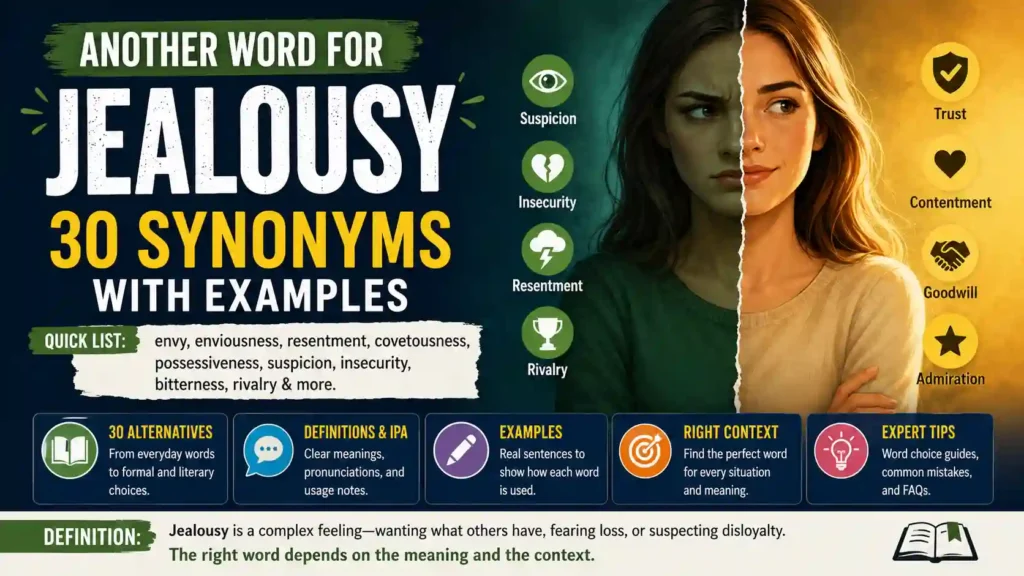
The closest everyday alternative to jealousy is envy. Other common choices are enviousness, resentment, covetousness, and possessiveness.
Which one fits depends on what you mean. Jealousy can describe wanting what another person has, fearing you will lose someone to a rival, or suspecting that someone has been unfaithful.
Each meaning calls for a different word. Envy fits a person who wants a colleague’s success. Possessiveness or suspicion fits a person who fears losing a partner. Rivalry fits a fight over the same prize.
Quick list: envy, enviousness, resentment, covetousness, possessiveness, suspicion, insecurity, bitterness, rivalry
This article looks at 30 alternatives to jealousy. Each one has a definition, IPA pronunciation, a usage note, and an example sentence. Some are direct synonyms and some are related words that fit only certain contexts. The notes say which is which.
At a Glance: Jealousy Synonyms and Related Alternatives
| Alternative | Part of Speech | Meaning | Register / Tone | Ideal Context |
|---|---|---|---|---|
| Envy | noun, verb | Wanting what another person has | Neutral to negative | Success, possessions, talent |
| Enviousness | noun | The state of feeling envy | Slightly formal | Describing a person’s trait |
| Resentment | noun | Bitter anger at unfair treatment or another’s luck | Neutral to negative | Workplace, family conflict |
| Covetousness | noun | Strong desire for what belongs to another | Formal | Property, wealth, moral writing |
| Possessiveness | noun | Wish to control or keep someone for oneself | Neutral to negative | Romantic relationships |
| Suspicion | noun | Feeling that someone may be doing wrong | Neutral | Fear of unfaithfulness |
| Insecurity | noun | Lack of confidence or safety | Neutral | Root cause of relationship jealousy |
| Rivalry | noun | Competition for the same thing | Neutral | Siblings, sports, careers |
| Bitterness | noun | Long-held anger and disappointment | Emotional | After being passed over |
| Heartburning | noun | Bitter envy or discontent | Dated, literary | Older or literary writing |
Which Word Should You Use?
| If you want to… | Use | Why |
|---|---|---|
| Describe wanting a friend’s success | envy | It is the closest everyday synonym for this sense. |
| Describe anger at someone’s good luck | resentment | It stresses anger and a sense of unfairness. |
| Describe fear of losing a partner | possessiveness or insecurity | These name the behavior or the fear behind it. |
| Describe doubts about a partner’s loyalty | suspicion | It focuses on the belief that something is wrong. |
| Describe competition between siblings or coworkers | rivalry | It names the situation, not just the feeling. |
| Write in a formal or moral tone | covetousness | It sounds serious and is tied to wanting others’ property. |
| Describe an old, lasting hurt | grudge or bitterness | Both suggest feelings held over time. |
| Describe careful guarding of something | vigilance or protectiveness | These match the older “watchful” sense of jealous. |
Exploring the Multiple Meanings of “Jealousy”
1. Envy of Another Person’s Advantage
- Meaning: A resentful feeling toward someone who has something you want.
- Explanation: This is the most common modern sense. Many people use it interchangeably with envy, though some writers prefer to keep the two words apart (see the explainer below).
- Example: Her jealousy grew when her friend won the scholarship.
2. Fear of Losing Affection or Attention
- Meaning: Worry that another person is taking the love or attention you want to keep.
- Explanation: Here you already have something and fear losing it. This is the classic sense behind sibling jealousy and jealousy between friends.
- Example: The older child felt jealousy when the baby got all the attention.
3. Suspicion of Unfaithfulness
- Meaning: Suspicion or anger caused by a belief that a partner is disloyal.
- Explanation: This is the romantic sense. The feeling may be based on fact, or it may come from insecurity alone.
- Example: His jealousy led him to check her messages every night.
4. Watchful Guarding (Formal or Dated)
- Meaning: Close, protective watchfulness over something valued.
- Explanation: This older sense survives mostly in the adjective and adverb, as in “jealously guarded.” The noun is rarely used this way today.
- Example: The family kept the recipe with jealousy for three generations.
5. Zeal for Exclusive Devotion (Religious Use)
- Meaning: In religious writing, a demand for exclusive loyalty, as in the phrase “a jealous God.”
- Explanation: This sense reflects the word’s roots in zeal. It is not about envy or suspicion.
- Example: Scholars discuss the idea of divine jealousy in the Hebrew Bible.
Sources: Merriam-Webster; Collins English Dictionary; Dictionary.com; Etymonline.
Analyzing 30 Jealousy Alternatives in Detail
Some alternatives below are direct synonyms of jealousy, while others are related words that fit only certain senses or contexts, and each entry says which it is.
Core Everyday Alternatives
1. Envy
IPA: /ˈɛnvi/ (US and UK)
Definition: A painful or resentful awareness of another person’s advantage, together with a wish to have it.
- Usage: This is the closest everyday synonym. It fits the “wanting what others have” sense but not the fear of losing a partner.
- Example: He couldn’t hide his envy when she got the promotion.
2. Enviousness
IPA: /ˈɛnviəsnəs/ (US and UK)
Definition: The quality or state of feeling envy.
- Usage: A direct synonym that is slightly more formal and less common. It often describes a trait instead of a single moment.
- Example: Her enviousness made it hard to enjoy her friends’ good news.
3. Resentment
IPA: /rɪˈzɛntmənt/ (US and UK)
Definition: A bitter feeling of anger caused by unfair treatment or by another person’s good fortune.
- Usage: A related alternative. It fits when jealousy includes anger or a sense of injustice. It does not cover romantic fear.
- Example: Resentment built up when others got credit for his work.
4. Bitterness
IPA: US /ˈbɪtərnəs/ · UK /ˈbɪtənəs/
Definition: Deep, lasting anger and disappointment.
- Usage: A related alternative that describes what jealousy can turn into over time. It carries more pain than envy does.
- Example: Years of bitterness over his brother’s success hurt their relationship.
5. Covetousness
IPA: US /ˈkʌvətəsnəs/ · UK /ˈkʌvɪtəsnəs/
Definition: A strong desire to have something that belongs to someone else.
- Usage: A formal, close synonym for the “wanting what others have” sense. It usually applies to property or status, not to partners.
- Example: The king’s covetousness led him to seize his neighbor’s land.
Romantic and Relationship Alternatives
6. Possessiveness
IPA: /pəˈzɛsɪvnəs/ (US and UK)
Definition: A strong wish to control or keep someone or something for oneself.
- Usage: A close match for romantic jealousy, but it names a behavior or trait, not the feeling itself. A person can be possessive without admitting jealousy.
- Example: His possessiveness made her feel she could not see her friends.
7. Suspicion
IPA: /səˈspɪʃən/ (US and UK)
Definition: A feeling or belief that someone may have done something wrong.
- Usage: A related alternative that matches the “suspected unfaithfulness” sense. It does not fit envy.
- Example: Her suspicion grew when he kept hiding his phone.
8. Distrust
IPA: /dɪsˈtrʌst/ (US and UK)
Definition: A lack of trust or confidence in someone.
- Usage: A related alternative. It can cause jealousy or result from it, but it does not include the wanting or fearing of loss.
- Example: Distrust slowly damaged their marriage.
9. Insecurity
IPA: US /ˌɪnsɪˈkjʊrəti/ · UK /ˌɪnsɪˈkjʊərəti/
Definition: A lack of confidence or a feeling of being unsafe about oneself or a relationship.
- Usage: A related alternative that often names the root cause of jealousy. It is not a synonym, but it explains a lot of jealous behavior.
- Example: His jealousy came from deep insecurity about his own worth.
10. Clinginess
IPA: /ˈklɪŋinəs/ (US and UK)
Definition: A tendency to hold on too tightly to another person.
- Usage: An informal, related word for behavior that jealousy can produce. It is not a synonym.
- Example: Her clinginess grew after she began to fear he would leave.
Rivalry and Competition Alternatives
11. Rivalry
IPA: /ˈraɪvəlri/ (US and UK)
Definition: Competition between people or groups who want the same thing.
- Usage: A related alternative. It names the situation that causes jealousy, not the emotion itself.
- Example: Rivalry between the sisters made family dinners tense.
12. Competitiveness
IPA: US /kəmˈpɛtətɪvnəs/ · UK /kəmˈpetɪtɪvnəs/
Definition: A strong wish to win or to do better than others.
- Usage: A related word. It can be positive or neutral, while jealousy is almost always negative.
- Example: His competitiveness turned to jealousy when a new player joined the team.
13. Spite
IPA: /spaɪt/ (US and UK)
Definition: A wish to hurt or annoy someone, often because of a grudge.
- Usage: A related alternative. Jealousy can lead to spite, but spite is about harming others, not wanting what they have.
- Example: She told the story out of spite after seeing him with another woman.
14. Ill will
IPA: /ˌɪl ˈwɪl/ (US and UK)
Definition: An unfriendly or hostile feeling toward someone.
- Usage: A related alternative. It is a general term for dislike and has no sense of wanting or fearing loss.
- Example: He felt no ill will toward the winner, even though he was disappointed.
15. Grudge
IPA: /ɡrʌdʒ/ (US and UK)
Definition: A feeling of resentment kept for a long time because of a past wrong.
- Usage: A related alternative, often used in the phrase “bear a grudge.” It is about past offense, not current wanting.
- Example: He held a grudge against his cousin for years after the inheritance.
Wanting and Discontent Alternatives
16. Longing
IPA: US /ˈlɔːŋɪŋ/ · UK /ˈlɒŋɪŋ/
Definition: A strong, lasting wish for something.
- Usage: A related alternative that captures the “wanting” part of envy without the bitterness. It is softer than jealousy.
- Example: She looked at the vacation photos with longing.
17. Discontent
IPA: /ˌdɪskənˈtɛnt/ (US and UK)
Definition: Unhappiness with what one has or with one’s situation.
- Usage: A related alternative. It describes the dissatisfaction that often feeds jealousy.
- Example: Discontent grew in him as his friends bought new houses.
18. Pique
IPA: /piːk/ (US and UK)
Definition: A feeling of irritation or resentment, usually from hurt pride.
- Usage: A related and slightly literary alternative. It is a mild, short-lived feeling, weaker than jealousy.
- Example: In a fit of pique, she left the party when her rival was praised.
19. Chagrin
IPA: US /ʃəˈɡrɪn/ · UK /ˈʃæɡrɪn/
Definition: Annoyance or distress caused by failure or disappointment.
- Usage: A weak, related alternative. It may appear alongside jealousy when someone else succeeds, but it is not a synonym.
- Example: To his chagrin, his rival got the job.
Formal and Literary Alternatives
20. Heartburning
IPA: US /ˈhɑːrtˌbɜːrnɪŋ/ · UK /ˈhɑːtˌbɜːnɪŋ/
Definition: A feeling of bitter envy, jealousy, or discontent.
- Usage: A dated, literary synonym. It is rare in modern speech but fits older or stylized writing.
- Example: The old rivalry still caused heartburning between the two families.
21. Rancor
IPA: US /ˈræŋkər/ · UK /ˈræŋkə/ (spelled rancour in British English)
Definition: Bitter, deep-seated ill will.
- Usage: A formal, related alternative. It suggests hatred that has lasted a long time, which is stronger than ordinary jealousy.
- Example: The debate was filled with rancor.
22. Animosity
IPA: US /ˌænəˈmɑːsəti/ · UK /ˌænɪˈmɒsəti/
Definition: Strong dislike or hostility.
- Usage: A formal, related alternative. It describes open hostility between people, not the wanting or fearing that defines jealousy.
- Example: Professional jealousy led to animosity between the two doctors.
23. Malice
IPA: /ˈmælɪs/ (US and UK)
Definition: A desire to cause harm or suffering to others.
- Usage: A related and stronger word. Jealousy can lead to malice, but malice itself involves a wish to harm.
- Example: She spread the rumor with obvious malice.
24. Enmity
IPA: US /ˈɛnməti/ · UK /ˈɛnmɪti/
Definition: A deep, lasting feeling of hostility between people.
- Usage: A formal, related alternative used for serious, long-term conflict. It does not mean jealousy, though jealousy can cause it.
- Example: Jealousy over the throne created lasting enmity between the brothers.
Watchfulness and Devotion Alternatives
25. Zeal
IPA: /ziːl/ (US and UK)
Definition: Great energy or eagerness for a cause or goal.
- Usage: An etymological relative rather than a modern synonym. The older sense of jealous meant “zealous,” which is why the words are connected.
- Example: The guards protected the gate with zeal.
26. Vigilance
IPA: /ˈvɪdʒɪləns/ (US and UK)
Definition: Careful watchfulness for possible danger or trouble.
- Usage: A related alternative for the older “watchful guarding” sense. It does not describe an emotion like envy.
- Example: The town showed great vigilance in protecting its water supply.
27. Protectiveness
IPA: /prəˈtɛktɪvnəs/ (US and UK)
Definition: A strong wish to keep someone or something safe.
- Usage: A related alternative. It can overlap with possessive jealousy, but protectiveness is usually kinder and based on care.
- Example: His protectiveness of his little sister sometimes looked like jealousy.
28. Wariness
IPA: US /ˈwɛrinəs/ · UK /ˈweərinəs/
Definition: Caution about possible danger or problems.
- Usage: A related alternative. It fits when jealousy takes the form of watching someone closely, but it has no sense of wanting.
- Example: Her wariness around his coworker was obvious.
29. Solicitude
IPA: US /səˈlɪsɪtuːd/ · UK /səˈlɪsɪtjuːd/
Definition: Care or concern for someone’s well-being.
- Usage: A formal, related alternative linked to the old meaning of jealous as “solicitous.” It is not used for the modern feeling of jealousy.
- Example: The nurse watched over the patient with great solicitude.
30. Devotion
IPA: US /dɪˈvoʊʃən/ · UK /dɪˈvəʊʃən/
Definition: Strong love, loyalty, or commitment.
- Usage: A related word for the religious sense, where a “jealous God” demands exclusive devotion. It does not describe envy or suspicion.
- Example: The prophet warned the people to keep their devotion to one God.
Sources: Merriam-Webster; Collins English Dictionary and Collins Thesaurus; Dictionary.com; Etymonline.
Jealousy vs. Envy vs. Covetousness
These three words are close, and dictionaries often use one to define another. In careful writing, they are sometimes kept apart.
| Word | Core idea | Number of people | Typical example |
|---|---|---|---|
| Jealousy | Fear of losing something or someone to a rival, or anger at a rival | Often three: you, the person you care about, and a rival | “She felt jealousy when her partner danced with someone else.” |
| Envy | Wanting what another person has | Two: you and the person with the advantage | “He felt envy at his neighbor’s new car.” |
| Covetousness | Strong desire for something that belongs to another | Two: you and the owner | “Covetousness drove him to take the jewels.” |
In everyday English, people use jealous where careful writers would use envious. Saying “I’m jealous of your vacation” is common and accepted. Dictionaries list the “envious” sense as a standard meaning of jealousy. If you want to be precise, use envy for wanting what someone has and jealousy for protecting what you already have.
Sources: Merriam-Webster (usage notes on jealous and envious); Collins English Dictionary; Dictionary.com.
Jealousy and Opposite/Paired Word Pairs
| Word | Paired Word | Note |
|---|---|---|
| Jealousy | Trust | Trust is the main opposite in relationships. |
| Jealousy | Contentment | Being satisfied with what you have reduces envy. |
| Jealousy | Generosity | A generous person shares instead of resenting. |
| Jealousy | Admiration | Admiration celebrates another’s success without bitterness. |
| Jealousy | Goodwill | Goodwill is the friendly opposite of ill will and resentment. |
| Jealousy | Envy | A common pair, often used together for emphasis. |
| Jealousy | Rivalry | The two often appear together, as in “jealousy and rivalry.” |
Jealousy does not have one perfect antonym, because it covers several different feelings. Trust is the best opposite in love and friendship, while contentment and admiration work better when jealousy means envy. Words like envy and rivalry are better treated as common partners than as true opposites.
Sources: Merriam-Webster; Collins Thesaurus; Dictionary.com.
Common Word Partners of “Jealousy”
| Pattern | Common Partners | Example |
|---|---|---|
| adjective + jealousy | petty, intense, professional, sexual, romantic, sibling | Professional jealousy can damage a team. |
| verb + jealousy | feel, show, cause, provoke, arouse | His success provoked jealousy in his colleagues. |
| jealousy + preposition | of, toward, over, between | There was constant jealousy between the two sisters. |
| noun + of + jealousy | pang, twinge, fit, streak, surge | She felt a pang of jealousy at the news. |
| be + verb + by jealousy | consumed, driven, eaten up | He was consumed by jealousy. |
| green with jealousy | (fixed pattern) | They were green with jealousy over the new car. |
Sources: Collins English Dictionary; Merriam-Webster; Dictionary.com.
Idiomatic Phrases Featuring “Jealousy”
Jealousy has few true idioms. The entries below are established expressions or fixed phrases, and the first two are the best known.
1. Green with jealousy
- Meaning: Very jealous or envious, so much that it shows.
- Example: When she saw his new car, she was green with jealousy.
2. The green-eyed monster
- Meaning: A nickname for jealousy. The phrase comes from Shakespeare’s Othello and is not an everyday synonym.
- Example: The green-eyed monster appeared when his friend got the lead role.
3. Eaten up with jealousy
- Meaning: Completely overcome by jealous feelings.
- Example: She was eaten up with jealousy over her sister’s success.
4. Jealously guarded
- Meaning: Kept or protected with great care, often secretly. This expression uses the adverb form of the keyword.
- Example: The recipe is a jealously guarded family secret.
Sources: Merriam-Webster; Collins English Dictionary; Dictionary.com.
Word Formation of “Jealousy”
Etymology & Structure
Jealousy is formed from the adjective jealous plus the noun suffix -y. Jealous came into English from Old French gelos, which came from Late Latin zelosus. That word comes from Latin zelus and, before that, from Greek zēlos, meaning “zeal” or “jealousy.” This is why jealous and zealous are related.
Date and History
The word appears in English in the 13th century, according to dictionary records. In early use, jealous often meant “eager,” “protective,” or “zealous,” and the sense of envy or suspicion became more common over time.
Word Class Variations
- Noun: jealousy (plural: jealousies); jealousness (rare)
- Adjective: jealous
- Adverb: jealously
- Verb: none (there is no standard verb to jealous)
Sources: Etymonline; Merriam-Webster; Collins English Dictionary.
Common Word-Choice Mistakes
- She is jealousy of her sister: She is jealous of her sister. (Jealous is the adjective.)
- He has a lot of jealous: He has a lot of jealousy. (Jealousy is the noun.)
- I envy of your job: I envy your job, or I am envious of your job. (Envy as a verb takes a direct object.)
- I’m envy: I’m envious. (Envy is a noun and verb, not an adjective.)
- He felt covetousness when his girlfriend talked to others: He felt jealousy. (Covetousness is about wanting property, not fearing loss in love.)
- She felt a rivalry toward him: She felt jealous of him, or There was a rivalry between them. (Rivalry names a situation, not a private feeling.)
- Jealous for her success: Jealous of her success. (Jealous normally takes of.)
Frequently Asked Questions
1. What is the closest synonym for jealousy?
Envy is the closest everyday synonym, especially when you mean wanting what someone else has.
2. What is the difference between jealousy and envy?
In strict usage, envy is wanting what someone has, while jealousy is fearing the loss of something you already have. In everyday speech the two are often used interchangeably.
3. What is a formal alternative to jealousy?
Covetousness and enviousness are formal choices. Rancor and animosity are formal too, but they describe hostility, not the wanting itself.
4. What is a literary alternative to jealousy?
Heartburning is an older, literary word for jealous or envious feeling. “The green-eyed monster” is a famous figurative nickname.
5. What is the opposite of jealousy?
There is no single opposite. Trust works for relationships, and contentment or admiration work when jealousy means envy.
6. Can jealousy be a good thing?
Most dictionaries treat jealousy as a negative feeling. The older sense of “watchful protectiveness” is neutral or positive, but it is rare in modern use.
7. Is jealousy the same as possessiveness?
No. Jealousy is a feeling, while possessiveness is a pattern of behavior. A possessive person often feels jealous, but not always.
8. Does jealousy have a verb form?
No. English has no standard verb to jealous. Use feel jealous or envy.
9. Why are “jealous” and “zealous” related?
Both come from the Greek word zēlos, meaning “zeal.” Early English use of jealous often meant “zealous” or “eager.”
10. Can jealousy mean fear of being replaced?
Yes. This is a standard sense, common among siblings, friends, and partners who fear losing someone’s attention or love.
Conclusion
The closest everyday alternatives to jealousy are envy, enviousness, resentment, and covetousness. For romantic or family situations, possessiveness, suspicion, and insecurity often fit better. Words like rivalry, bitterness, and grudge describe the conflict or long-term feelings that jealousy can create.
Jealousy has several meanings, so context decides the best word. Envy is about wanting what someone has, while jealousy in the strict sense is about fear of loss. Some related words, such as zeal and vigilance, belong to older senses and do not describe modern jealous feelings.
To choose the right word, ask what the feeling is about. When someone feels unhappy about another person’s success, envy or resentment may be the right choice. In relationships, possessiveness, suspicion, or insecurity can describe similar feelings. For formal writing, covetousness or animosity may be more appropriate.

Hi, I’m Anam, a dedicated writer and curious researcher who believes learning should be simple, useful, and enjoyable. At VistoraDaily, I explore general knowledge, everyday questions, fascinating facts, and helpful information, creating clear content that inspires readers to discover something new.