
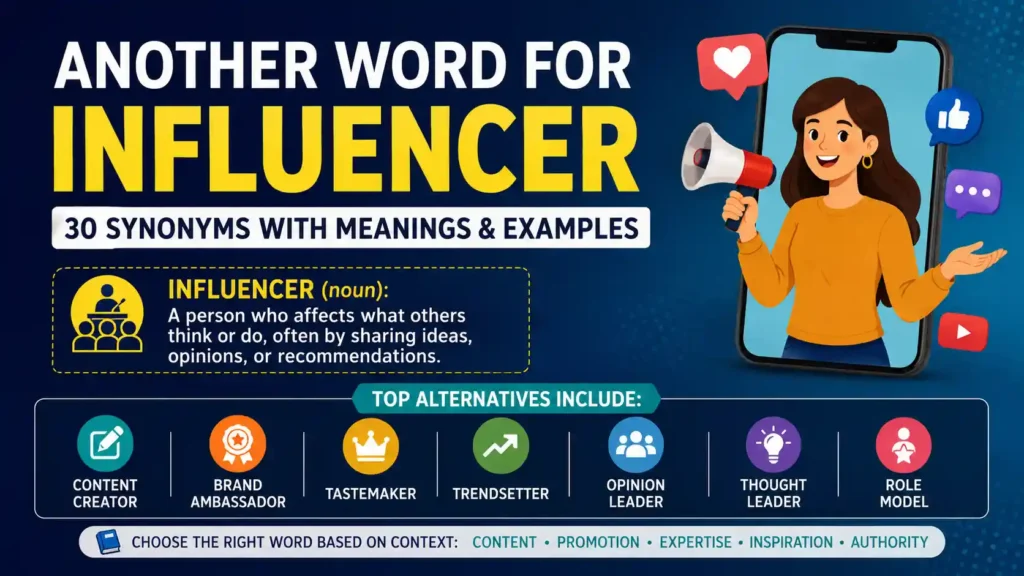
Another word for influencer depends on what kind of influence you mean. For someone who posts online, the closest everyday alternatives are content creator, creator, and social media personality.
For someone who shapes opinions or decisions more broadly, good choices include opinion leader, tastemaker, trendsetter, and thought leader.
“Influencer” has two main uses: a person who guides what others think or do, and a person with an online audience who promotes products. The best synonym changes with each.
A fitness vlogger, a company spokesperson, and a respected expert all influence people, but each needs a different word.
Quick list: content creator, creator, social media personality, vlogger, brand ambassador, tastemaker, trendsetter, opinion leader, thought leader, role model.
At a Glance: Influencer Synonyms and Related Alternatives
| Alternative | Part of Speech | Meaning | Register / Tone | Ideal Context |
|---|---|---|---|---|
| Content creator | noun | Person who makes online videos, posts, or articles | Neutral, modern | Social media, careers, job titles |
| Creator | noun | Short form of content creator | Neutral, informal | Platforms, everyday speech |
| Social media personality | noun | Person known mainly for their online presence | Neutral, slightly formal | News, general writing |
| Brand ambassador | noun | Person who represents and promotes a brand | Business, positive | Marketing, long-term deals |
| Tastemaker | noun | Person whose choices shape what becomes popular | Neutral to formal | Fashion, food, music, culture |
| Trendsetter | noun | Person who starts a new fashion or habit | Neutral, positive | Fashion, lifestyle, culture |
| Opinion leader | noun | Person whose views sway a group | Formal, academic | Marketing, media, social science |
| Thought leader | noun | Respected expert whose ideas guide others | Business, sometimes ironic | Professional fields |
| Role model | noun | Person others look up to and copy | Neutral, positive | Education, parenting, youth |
| Endorser | noun | Person who publicly supports a product | Formal, business | Advertising, legal contexts |
Which Word Should You Use?
| If you want to… | Use | Why |
|---|---|---|
| Describe someone who makes videos or posts online | content creator | It names the work and sounds neutral and professional. |
| Describe someone paid to represent one brand | brand ambassador | It suggests a lasting relationship with a single company. |
| Describe someone who makes things become popular | tastemaker | It focuses on shaping taste, not on follower counts. |
| Describe someone who starts new styles | trendsetter | It fits fashion and lifestyle. |
| Write about people who sway group opinions | opinion leader | It is the standard term in marketing and communication studies. |
| Describe a respected expert others follow | thought leader | It points to ideas and expertise, not fame. |
| Describe someone young people admire | role model | It focuses on character and behavior. |
| Describe someone insincerely promoting products | shill | It is negative and implies dishonesty. |
Exploring the Multiple Meanings of “Influencer”
1. A person who affects what others think or do
- Meaning: One who exerts influence; a person who inspires or guides the actions of others.
- Explanation: This is the broad, original sense. It applies to teachers, leaders, friends, writers, and anyone whose words or example change how others act. No social media is involved.
- Example: Her grandmother was the biggest influencer in her decision to study medicine.
2. A social media figure who promotes products
- Meaning: A person with a large online following who can shape buying choices, often through sponsored posts.
- Explanation: This is the most common meaning today. Here the word usually means audience size plus the ability to affect purchases. Many are paid by brands, so the word often suggests marketing.
- Example: The hotel invited a travel influencer to stay for free and post about the trip.
3. A key person who shapes decisions in a field
- Meaning: A person whose opinion carries weight with buyers, voters, or colleagues in a business, political, or professional setting.
- Explanation: In marketing and business, “key influencer” often describes someone who does not make the final decision but strongly guides it, such as an engineer whose advice leads a company to choose a product.
- Example: Before buying the software, the manager asked the IT team, who were the main influencers in the process.
Sources: Merriam-Webster (influencer, influence); Collins Dictionary; Cambridge Dictionary.
Analyzing 30 Influencer Alternatives in Detail
Some of these words are close synonyms. Others are related alternatives that fit only certain situations, and each Usage note says which is which.
Group 1: Core Modern Alternatives (Online Creators)
1. Content Creator
IPA: US /ˈkɑːn.tent kriˈeɪ.t̬ɚ/ · UK /ˈkɒn.tent kriˈeɪ.tə/
Definition: A person who creates videos, posts, or articles for an online audience.
Usage: A close, neutral alternative to influencer. It focuses on creating content rather than influencing buying decisions.
Example: She became a full-time content creator.
2. Creator
IPA: US /kriˈeɪ.t̬ɚ/ · UK /kriˈeɪ.tə/
Definition: A person who makes something, especially online content.
Usage: Creator is a shorter term often used on social media platforms. It can describe people who make different types of content.
Example: The platform pays creators for their work.
3. Vlogger
IPA: US /ˈvlɑː.ɡɚ/ · UK /ˈvlɒɡ.ə/
Definition: A person who regularly publishes videos online.
Usage: Vlogger is a related term for influencers who focus on video content. However, not every vlogger influences an audience’s choices.
Example: The travel vlogger shared videos of her trip.
4. Blogger
IPA: US /ˈblɑː.ɡɚ/ · UK /ˈblɒɡ.ə/
Definition: A person who writes and publishes blog posts.
Usage: Blogger is suitable for people who share written content online. Some bloggers also influence their readers’ opinions and purchases.
Example: The food blogger recommended a new restaurant.
5. Social Media Personality
IPA: US /ˈsoʊ.ʃəl ˈmiː.di.ə ˌpɝː.səˈnæl.ə.t̬i/ · UK /ˈsəʊ.ʃəl ˈmiː.di.ə ˌpɜː.səˈnæl.ɪ.ti/
Definition: A person known mainly for their social media activity.
Usage: This term is a neutral alternative to influencer, especially in news articles and formal writing.
Example: The social media personality has millions of followers.
6. Streamer
IPA: US /ˈstriː.mɚ/ · UK /ˈstriː.mə/
Definition: A person who broadcasts live video online.
Usage: Streamer describes people who host live broadcasts, often about gaming, entertainment, or everyday activities.
Example: The streamer answered questions during her live session.
Group 2: Marketing and Brand Terms
7. Brand ambassador
IPA: US /ˌbrænd æmˈbæs.ə.dɚ/ · UK /ˌbrænd æmˈbæs.ə.də/
Definition: A person hired to represent a brand and encourage people to buy its products.
- Usage: A related alternative. It suggests a formal, usually longer relationship with one brand, while an influencer might post about many.
- Example: The sportswear company named the runner as its brand ambassador for two years.
8. Endorser
IPA: US /ɪnˈdɔːr.sɚ/ · UK /ɪnˈdɔː.sə/
Definition: A person who publicly gives support or approval to a product, idea, or candidate.
- Usage: A formal, related alternative. It appears often in advertising and law, where the focus is on public approval of a product.
- Example: The skin-care brand listed a well-known doctor as an endorser.
9. Affiliate
IPA: (US and UK) /əˈfɪl.i.ət/
Definition: A person or business linked to a larger organization, including someone who earns a commission for sales they bring in.
- Usage: A related alternative, used in online marketing. An affiliate earns money from sales made through their link. Many influencers are affiliates, but the words are not interchangeable.
- Example: As an affiliate, he earned a small payment for every sale made through his link.
10. Tastemaker
IPA: US /ˈteɪstˌmeɪ.kɚ/ · UK /ˈteɪstˌmeɪ.kə/
Definition: A person who decides or influences what becomes fashionable or popular.
- Usage: A close synonym for people with cultural influence. It describes impact on taste, not follower numbers, so it also fits critics, editors, and DJs.
- Example: The magazine editor was a tastemaker whose picks sold out in days.
11. Trendsetter
IPA: US /ˈtrendˌset̬.ɚ/ · UK /ˈtrendˌset.ə/
Definition: A person who starts a new fashion or style that others follow.
- Usage: A close synonym when the influence shows up as style or habits. It is almost always positive.
- Example: She was a trendsetter, and soon half the school wore the same jacket.
Group 3: Power Over Opinions and Decisions
12. Opinion leader
IPA: US /əˈpɪn.jən ˈliː.dɚ/ · UK /əˈpɪn.jən ˈliː.də/
Definition: A person whose views strongly affect the opinions or choices of others.
- Usage: A close synonym for sense 1 and sense 3. It is a formal, academic term used in marketing and media studies.
- Example: Companies often send new products to opinion leaders first.
13. Persuader
IPA: US /pɚˈsweɪ.dɚ/ · UK /pəˈsweɪ.də/
Definition: A person who gets others to do or believe something by giving reasons or appeals.
- Usage: A related alternative. It focuses on the act of convincing, not on fame or audience size.
- Example: He was a gifted persuader who could win over any crowd.
14. Power broker
IPA: US /ˈpaʊ.ɚ ˌbroʊ.kɚ/ · UK /ˈpaʊ.ə ˌbrəʊ.kə/
Definition: A person who has great influence over political or business decisions.
- Usage: A related alternative that fits politics and business, not social media. It suggests behind-the-scenes control.
- Example: The mayor met with the city’s most powerful power broker before the vote.
15. Kingmaker
IPA: US /ˈkɪŋˌmeɪ.kɚ/ · UK /ˈkɪŋˌmeɪ.kə/
Definition: A person with enough influence to decide who gets a position of power.
- Usage: A figurative, related alternative, mostly for politics. It describes influence over who wins, which is stronger than ordinary influence.
- Example: The union leader was called a kingmaker in the party’s leadership race.
16. Lobbyist
IPA: US /ˈlɑː.bi.ɪst/ · UK /ˈlɒb.i.ɪst/
Definition: A person who tries to influence lawmakers on behalf of a group or cause.
- Usage: A related alternative limited to government and politics. It describes a specific job and should not be used for social media figures.
- Example: A lobbyist for the energy industry spoke with several senators.
Group 4: Experts and Authorities
17. Thought leader
IPA: US /ˈθɔːt ˌliː.dɚ/ · UK /ˈθɔːt ˌliː.də/
Definition: A person whose ideas and expertise are respected and followed in a particular field.
- Usage: A related alternative for professional settings. It suggests expertise, not just popularity. It can sound self-important, and some writers use it with irony.
- Example: She became a thought leader in renewable energy after publishing her research.
18. Pundit
IPA: (US and UK) /ˈpʌn.dɪt/
Definition: A person who gives opinions on a subject, especially in the media.
- Usage: A related alternative for commentators on politics, sports, or economics. It is neutral, but can be mildly critical when the person sounds overconfident.
- Example: Political pundits argued about the poll results all evening.
19. Authority
IPA: US /əˈθɔːr.ə.t̬i/ · UK /ɔːˈθɒr.ɪ.ti/
Definition: A person with expert knowledge on a subject.
- Usage: A related alternative for experts whom others trust. Note that “authority” also means official power, so the sense depends on the sentence.
- Example: She is a leading authority on bird migration.
20. Commentator
IPA: US /ˈkɑː.mən.teɪ.t̬ɚ/ · UK /ˈkɒm.ən.teɪ.tə/
Definition: A person who explains or gives opinions on events, especially in media.
- Usage: A related alternative for people who comment on news, sports, or culture. It describes the role, not the amount of influence.
- Example: The sports commentator predicted an easy win.
Group 5: Role Models and Inspirational Figures
21. Role model
IPA: US /ˈroʊl ˌmɑː.dəl/ · UK /ˈrəʊl ˌmɒd.əl/
Definition: A person whose behavior or success others try to copy.
- Usage: A related alternative that emphasizes admired character. It fits sense 1 best, and it is almost always positive.
- Example: The young players saw the captain as a role model.
22. Mentor
IPA: US /ˈmen.tɔːr/ · UK /ˈmen.tɔː/
Definition: An experienced person who gives advice and guidance to a less experienced one.
- Usage: A related alternative for a personal, one-to-one relationship. An influencer reaches many people, while a mentor guides a few.
- Example: Her mentor taught her how to run a small business.
23. Icon
IPA: US /ˈaɪ.kɑːn/ · UK /ˈaɪ.kɒn/
Definition: A person widely admired as a symbol of something.
- Usage: A related alternative that is stronger than “influencer.” It suggests lasting fame and cultural importance.
- Example: The singer became a fashion icon in the 1980s.
24. Idol
IPA: (US and UK) /ˈaɪ.dəl/
Definition: A person who is greatly admired or loved.
- Usage: A related alternative that stresses admiration from fans, especially young ones. It says less about actual influence over choices.
- Example: The teenager hung posters of her musical idol on her wall.
25. Trailblazer
IPA: US /ˈtreɪlˌbleɪ.zɚ/ · UK /ˈtreɪlˌbleɪ.zə/
Definition: A person who does something new that others later follow.
- Usage: A related alternative that is figurative and positive. It describes someone who leads the way, not someone who sells or promotes.
- Example: She was a trailblazer for women in engineering.
Group 6: Promotion, Advocacy, and Celebrity Terms
26. Promoter
IPA: US /prəˈmoʊ.t̬ɚ/ · UK /prəˈməʊ.tə/
Definition: A person who supports or advertises a product, cause, or event.
- Usage: A related alternative that is neutral and describes the activity. It is plainer than “influencer” and has no social media meaning by default.
- Example: A local promoter helped advertise the music festival.
27. Spokesperson
IPA: US /ˈspoʊksˌpɝː.sən/ · UK /ˈspəʊksˌpɜː.sən/
Definition: A person who speaks officially for a group, company, or cause.
- Usage: A related alternative that is more formal. A spokesperson represents an organization’s official position, while an influencer usually speaks in a personal voice.
- Example: The company’s spokesperson answered questions from reporters.
28. Advocate
IPA: (US and UK) /ˈæd.və.kət/
Definition: A person who publicly supports a cause, idea, or policy.
- Usage: A related alternative for people who push for a cause. As a noun it fits issues like health or the environment better than product marketing.
- Example: She is a well-known advocate for clean water.
29. Shill
IPA: (US and UK) /ʃɪl/
Definition: A person who publicly praises something without revealing that they are paid or connected to it.
- Usage: A negative, related alternative. It accuses the person of dishonest promotion, so do not use it as a neutral synonym.
- Example: Fans accused the star of being a shill after he praised the product without saying he was paid.
30. Celebrity
IPA: US /səˈleb.rə.t̬i/ · UK /səˈleb.rɪ.ti/
Definition: A famous person, especially in entertainment or sport.
- Usage: A related alternative, not a synonym. A celebrity is known for fame, while an influencer is known for sway over an audience. Some people are both.
- Example: The celebrity appeared in the advertisement, but few viewers bought the product.
Sources: Merriam-Webster; Collins Dictionary; Cambridge Dictionary; Dictionary.com.
Influencer vs. Content Creator vs. Celebrity
These three words overlap, but each focuses on something different.
| Word | Main focus | Typical question it answers | Example |
|---|---|---|---|
| Influencer | Power to affect what an audience thinks or buys | Who can sway people? | A beauty influencer whose product picks sell out |
| Content creator | The work of making content | Who makes the material? | A filmmaker who posts short films online |
| Celebrity | Fame | Who is widely known? | A film star known across the world |
A person can fit all three. A creator who makes cooking videos, has a large audience that follows her advice, and becomes famous outside the internet is a creator, an influencer, and a celebrity. Choose the word that matches the point you want to make: skill (creator), sway (influencer), or fame (celebrity).
Sources: Merriam-Webster; Collins Dictionary.
Influencer and Opposite/Paired Word Pairs
| Word | Paired Word | Note |
|---|---|---|
| Influencer | Follower | The usual partner. Followers are the people who watch and listen to an influencer. |
| Influencer | Audience | Describes the group an influencer reaches. |
| Influencer | Brand | Brands often work with influencers to reach new customers. |
| Influencer | Fan | A fan admires a person, while a follower may only keep up with their posts. |
| Influencer | Critic | A critic judges or questions the claims an influencer makes. |
| Influencer | Skeptic | Someone who does not trust what an influencer promotes. |
“Influencer” has no true antonym in dictionaries. The closest pair is follower, which describes the audience, not the opposite meaning. Pairs like “influencer and critic” show contrast in role, not a strict opposite.
Sources: Merriam-Webster; Collins Dictionary.
Common Word Partners of “Influencer”
| Pattern | Common Partners | Example |
|---|---|---|
| [topic] + influencer | fashion, beauty, fitness, travel, food, gaming | The fitness influencer shared her morning routine. |
| adjective + influencer | popular, top, well-known, leading, paid | A well-known influencer posted about the new phone. |
| verb + influencer | become, hire, partner with, follow, sponsor | The brand decided to partner with a local influencer. |
| influencer + noun | campaign, partnership, collaboration, event | The shop planned an influencer event for the launch. |
| influencer + verb | promotes, recommends, posts, shares, endorses | The influencer recommends products she uses herself. |
Sources: Collins Dictionary; Cambridge Dictionary; Merriam-Webster.
Idiomatic Phrases Featuring “Influencer”
“Influencer” has no true idioms. It is a fairly modern word, so the expressions below are established terms, not idioms, and each is widely used.
1. Influencer marketing
- Meaning: A kind of marketing where brands work with influencers to promote products to their followers.
- Example: The company spends part of its budget on influencer marketing instead of television ads.
2. Micro-influencer
- Meaning: An influencer with a smaller but often closer and more loyal audience.
- Example: The bakery hired a micro-influencer from the neighborhood to promote its opening.
3. Key influencer
- Meaning: A person who strongly shapes an important decision or group, especially in business and marketing.
- Example: The sales team identified the key influencer on the buying committee.
4. Social media influencer
- Meaning: An influencer who builds an audience on platforms such as Instagram, TikTok, or YouTube.
- Example: The social media influencer posted a video review of the camera.
Sources: Merriam-Webster; Collins Dictionary; Cambridge Dictionary.
Word Formation of “Influencer”
Etymology & Structure
“Influencer” is built from the verb influence plus the suffix -er, which means “one who does something.” Influence comes through Old French from Medieval Latin influentia, from Latin influere, “to flow in” (in- “in” + fluere “to flow”). The word first referred to a celestial fluid believed to flow from the stars and affect people.
Date and History
Merriam-Webster dates the first known use of “influence” to the 14th century, and gives 1662 as the first known use of “influencer.” The social media meaning grew much later with online platforms.
Word Class Variations
- Verb: influence (influences, influenced, influencing)
- Noun: influence, influencer
- Adjective: influential
- Adverb: influentially
Sources: Merriam-Webster (influence, influencer); Etymonline (influence).
Common Word-Choice Mistakes
- She is a famous influence: She is a famous influencer. (“Influence” is the power; “influencer” is the person.)
- The actor is an influencer because he is famous: The actor is a celebrity. (Fame alone does not make an influencer.)
- The professor is a leading influencer in physics: The professor is a leading authority in physics. (Use “authority” or “thought leader” for experts.)
- He is a famous blogger who films videos: He is a famous vlogger who films videos. (“Blogger” means written content.)
- She is a brand ambassador because she posted once: She is a brand ambassador only if she has an ongoing role with the brand.
- The review was clearly from a shill, so it is neutral: A shill is not neutral. The word suggests hidden payment or bias.
- She influencers her followers: She influences her followers. (“Influence” is the verb.)
Frequently Asked Questions
What is the closest synonym for influencer?
For social media, the closest synonyms are content creator and social media personality. In a general sense, “opinion leader” is the closest.
Is a content creator the same as an influencer?
Not always. A creator makes content, while an influencer has the power to affect what an audience thinks or buys. Many people are both.
What is a formal alternative to influencer?
“Opinion leader” and “endorser” are formal choices, and “brand ambassador” suits business writing.
What is a more positive word for influencer?
“Role model,” “trendsetter,” and “tastemaker” all carry positive meanings.
What is a negative word for influencer?
“Shill” is the clearest negative term. It implies someone is secretly paid to praise a product.
What is the difference between a brand ambassador and an influencer?
A brand ambassador usually has a longer, more formal relationship with one brand. An influencer may promote many brands at different times.
Can “influencer” be used for people who are not on social media?
Yes. The word first meant anyone who influences others, and it is still used that way in business and politics.
What does micro-influencer mean?
A micro-influencer has a smaller audience than a large influencer. These audiences are often closer to the creator and more engaged.
What is the opposite of influencer?
There is no true opposite. “Follower” is the usual counterpart, and “critic” or “skeptic” describe people who question an influencer.
Is “thought leader” a good synonym?
Only in professional contexts. It means a respected expert whose ideas guide others, and it does not fit entertainment or lifestyle creators.
Conclusion
The closest everyday alternatives to “influencer” are content creator, creator, and social media personality. For influence outside social media, opinion leader, tastemaker, trendsetter, and thought leader are better fits.
The right word depends on what you want to say. Choose “creator” to stress making content, “brand ambassador” or “endorser” to stress promotion, “role model” or “mentor” to stress admiration, and “authority” or “pundit” to stress expertise. Words like “shill” carry strong negative meaning and should be used carefully.
When you pick an alternative, ask what kind of influence the person has: online audience, buying power, style, expertise, or character. The answer will point to the most accurate word.

Hi, I’m Sophia a passionate writer and curious learner who enjoys exploring fascinating facts, everyday questions, and interesting discoveries. At VistoraDaily, I share clear, reliable, and engaging general knowledge content to help readers learn something new and understand the world better.