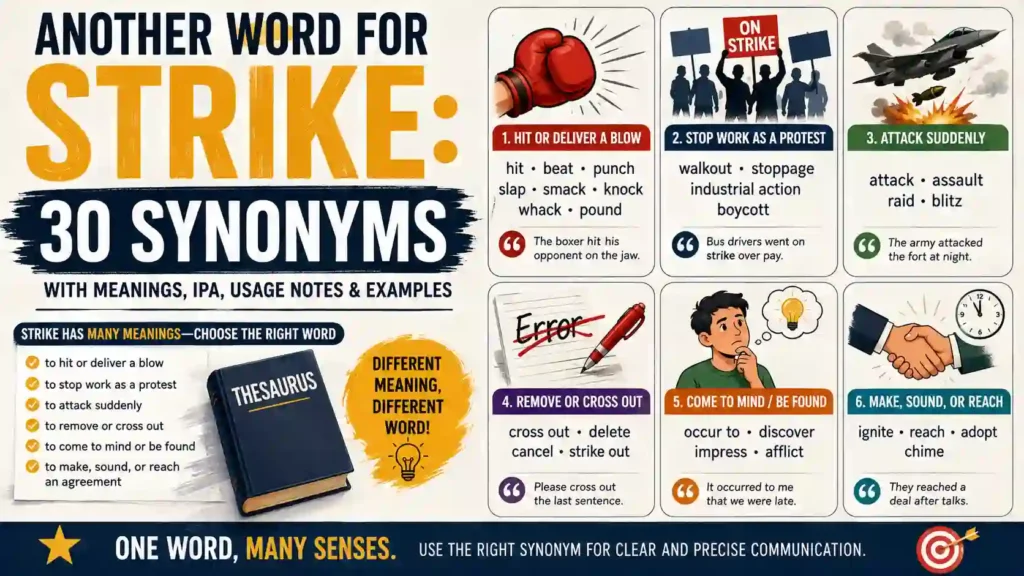
The closest everyday alternatives to “strike” are hit, beat, and punch when you mean a physical blow. They are attack or assault when the action is sudden and aimed at a target. For a work stoppage, use walkout, stoppage, or industrial action. “Strike” also means to cross something out, to find something, or to come into someone’s mind, so the right substitute depends on the sense.
Because “strike” is a verb and a noun with many separate meanings, no single word replaces it everywhere. “Hit” works for “strike the ball” but not for “strike a deal.” “Delete” works for “strike a line from the report” but not for “strike gold.” The choices below are grouped by meaning so you can pick the one that fits.
Quick list: hit, beat, punch, slap, attack, assault, walkout, stoppage, industrial action, cross out, delete, discover
This article looks at 30 alternatives, with meanings, IPA pronunciation, usage notes, and example sentences. Some are direct synonyms. Others only match one sense of “strike,” and the usage notes say so.
At a Glance: Strike Synonyms and Related Alternatives
| Alternative | Part of Speech | Meaning | Register / Tone | Ideal Context |
|---|---|---|---|---|
| Hit | verb, noun | to deliver a blow to | neutral, everyday | general physical contact |
| Beat | verb | to hit again and again | neutral, often negative | repeated blows |
| Punch | verb, noun | to hit with a closed fist | informal to neutral | fighting, sports |
| Attack | verb, noun | to use force against a person or place | neutral to formal | combat, sudden action |
| Walkout | noun | a sudden stop of work or a protest exit | neutral | labor, protests |
| Stoppage | noun | a halt in work | neutral to formal | news, labor reports |
| Industrial action | noun | organized action by workers, such as a strike | formal, mainly British | news, unions |
| Cross out | phrasal verb | to draw a line through writing | neutral | editing, lists |
| Delete | verb | to remove text or data | neutral to formal | documents, files |
| Occur to | phrasal verb | to come into one’s mind | neutral | ideas, thoughts |
Which Word Should You Use?
| If you want to… | Use | Why |
|---|---|---|
| Say someone hit a ball or a person | hit | It is the plainest, most common word. |
| Describe repeated or violent blows | beat or pound | Both show the blows were not single. |
| Describe a sudden military or police action | attack, raid | These suit news and official language. |
| Name workers refusing to work | walkout, stoppage | They are clear in reports and headlines. |
| Use a formal phrase for a labor dispute | industrial action | It is the standard term in British news and union language. |
| Remove a word from a page | cross out | It describes the act of drawing a line. |
| Remove text or a file digitally | delete | It is the normal word for screens and records. |
| Say a thought came to you | occur to | It sounds natural and polite. |
Exploring the Multiple Meanings of “Strike”
1. To Hit With Force
Meaning: To hit someone or something hard.
Explanation: This common sense can describe a person, object, or natural force such as lightning.
Example: The boxer struck his opponent on the jaw.
2. To Stop Work as a Protest
Meaning: To refuse to work, usually as a group, to demand better pay or conditions.
Explanation: As a noun, a strike means a work stoppage. As a verb, workers may strike or go on strike.
Example: Bus drivers went on strike over pay.
3. To Attack Suddenly
Meaning: To attack a person, place, or target with force, often without warning.
Explanation: This meaning is common in military and news language, such as an airstrike or missile strike.
Example: Police struck at dawn and arrested six people.
4. To Remove or Cross Out
Meaning: To delete or draw a line through something.
Explanation: This use is common in editing and legal contexts. To strike something from the record means to remove it.
Example: Please strike the last sentence from the report.
5. To Come Into the Mind or Be Found
Meaning: To suddenly occur to someone, make an impression, or discover something valuable.
Explanation: In “It struck me that…”, it introduces a sudden thought. Strike gold means to find something valuable.
Example: It struck me that nobody had answered the question.
6. To Make, Produce, or Reach
Meaning: To create, produce, or achieve something through an action.
Explanation: Phrases such as strike a match, strike a pose, strike a deal, and the clock struck twelve have different meanings.
Example: The two companies struck a deal on Friday.
Sources: Merriam-Webster, Collins English Dictionary, Dictionary.com
Analyzing 30 Strike Alternatives in Detail
Some words below are direct synonyms for one sense of “strike,” while others are related alternatives that fit only certain contexts. The usage notes say which is which.
Everyday Hitting Words
1. Hit
IPA: /hɪt/ (US and UK)
Definition: to bring a hand or object against someone or something with force.
- Usage: The closest everyday synonym for “strike” in the sense of a blow. It is neutral and fits almost any physical contact.
- Example: The ball hit the window.
2. Beat
IPA: /biːt/ (US and UK)
Definition: to hit someone or something again and again.
- Usage: A related alternative. It is not exact because “strike” can be one blow, while “beat” suggests repetition and is often negative.
- Example: He beat the dusty rug with a stick.
3. Slap
IPA: /slæp/ (US and UK)
Definition: to hit with the flat of the hand.
- Usage: A narrower alternative for a blow with an open hand. It is neutral to informal.
- Example: She slapped the table in frustration.
4. Punch
IPA: /pʌntʃ/ (US and UK)
Definition: to hit with a closed fist.
- Usage: A narrower alternative. Use it only when the blow is made with the fist.
- Example: He punched the bag for ten minutes.
5. Smack
IPA: /smæk/ (US and UK)
Definition: to hit with a sharp, loud sound.
- Usage: An informal alternative. It stresses the sound of the blow and is common in speech.
- Example: The door smacked against the wall.
6. Whack
IPA: /wæk/ (US and UK)
Definition: to hit with a sharp, heavy blow.
- Usage: An informal, slightly playful alternative. It is not formal.
- Example: He whacked the ball over the fence.
7. Knock
IPA: US /nɑːk/ · UK /nɒk/
Definition: to hit something so that it moves or makes a noise.
- Usage: A related alternative. “Knock” often suggests a lighter blow, or a blow that moves something, rather than a hard strike.
- Example: She knocked the glass off the shelf.
Forceful or Repeated Blows
8. Hammer
IPA: US /ˈhæmər/ · UK /ˈhæmə/
Definition: to hit again and again with great force.
- Usage: A figurative-leaning alternative for powerful, repeated blows. It does not suit a single light hit.
- Example: Rain hammered the roof all night.
9. Pound
IPA: /paʊnd/ (US and UK)
Definition: to hit heavily and repeatedly.
- Usage: A related alternative that stresses weight and repetition. It is common for fists, waves, and hearts.
- Example: He pounded on the door until it opened.
10. Batter
IPA: US /ˈbætər/ · UK /ˈbætə/
Definition: to hit hard and repeatedly, causing damage.
- Usage: A stronger alternative that shows damage. It often describes storms, waves, and violence.
- Example: Waves battered the small boat.
11. Bash
IPA: /bæʃ/ (US and UK)
Definition: to hit hard in a rough way.
- Usage: An informal alternative. It suggests a heavy, careless blow rather than a controlled one.
- Example: He bashed his head on the low beam.
Attack and Sudden Action
12. Attack
IPA: /əˈtæk/ (US and UK)
Definition: to use force against a person, place, or group.
- Usage: A direct synonym for the “sudden attack” sense of “strike.” It is neutral and common in news.
- Example: The army attacked the fort at night.
13. Assault
IPA: /əˈsɔːlt/ (US and UK)
Definition: to attack violently, in a military or criminal sense.
- Usage: A formal alternative with a legal and military tone. It is stronger than “hit.”
- Example: Police charged him with assaulting a guard.
14. Raid
IPA: /reɪd/ (US and UK)
Definition: to make a sudden attack or entry, often to arrest or take something.
- Usage: A related alternative. “Raid” fits a quick, planned action, not a single blow.
- Example: Officers raided the warehouse early in the morning.
15. Blitz
IPA: /blɪts/ (US and UK)
Definition: to attack suddenly and with great force.
- Usage: A related alternative. It also appears in sports and advertising for a fast, intense effort, so check the context.
- Example: The city was blitzed from the air.
Work Stoppage Terms
16. Walkout
IPA: US /ˈwɑːkaʊt/ · UK /ˈwɔːkaʊt/
Definition: a sudden departure of workers or members, usually in protest.
- Usage: A close alternative to the noun “strike.” A walkout is often sudden and short, while a strike can be planned and last weeks.
- Example: The walkout began at noon.
17. Stoppage
IPA: US /ˈstɑːpɪdʒ/ · UK /ˈstɒpɪdʒ/
Definition: a halt in work or activity.
- Usage: A neutral, news-style alternative. It can mean a strike, but it can also describe a halt caused by a breakdown or a safety problem.
- Example: A work stoppage closed the factory.
18. Industrial action
IPA: /ɪnˈdʌstriəl ˈækʃn/ (US and UK)
Definition: organized action by workers, such as a strike, to press a demand.
- Usage: A formal alternative used mainly in British English. It is broader than “strike” and can include slowdowns and overtime bans.
- Example: The union threatened industrial action next week.
19. Boycott
IPA: US /ˈbɔɪkɑːt/ · UK /ˈbɔɪkɒt/
Definition: to refuse to buy, use, or take part in something as a protest.
- Usage: A related alternative only. A boycott is by customers or members, not by workers who stop working.
- Example: Shoppers boycotted the store.
Removing and Cancelling
20. Cross out
IPA: US /ˈkrɔːs aʊt/ · UK /ˈkrɒs aʊt/
Definition: to draw a line through writing to show it is wrong or removed.
- Usage: A direct synonym for the “strike out” sense. It is simple and visual.
- Example: He crossed out the wrong answer.
21. Delete
IPA: /dɪˈliːt/ (US and UK)
Definition: to remove written or stored material.
- Usage: A close alternative for “strike” meaning remove. It is the normal word for screens, files, and records.
- Example: Delete the old email.
22. Cancel
IPA: /ˈkænsl/ (US and UK)
Definition: to stop something that was planned or agreed.
- Usage: A related alternative for removing an item, event, or order. It is not used for crossing out words.
- Example: They canceled the meeting.
Discovery and Mental Effect
23. Discover
IPA: US /dɪˈskʌvər/ · UK /dɪˈskʌvə/
Definition: to find or learn something for the first time.
- Usage: A related alternative for “strike gold” or “strike oil,” where “strike” means find.
- Example: Miners discovered a large gold vein.
24. Occur to
IPA: US /əˈkɜːr tuː/ · UK /əˈkɜː tuː/
Definition: to come into someone’s mind.
- Usage: A close alternative to “strike” in “it struck me that…”. It is natural and less dramatic.
- Example: It never occurred to her to ask.
25. Impress
IPA: /ɪmˈpres/ (US and UK)
Definition: to make someone feel respect or admiration.
- Usage: A related alternative for “strike” in “How does the plan strike you?” It fits opinions and first impressions.
- Example: The speech impressed everyone.
26. Afflict
IPA: /əˈflɪkt/ (US and UK)
Definition: to cause pain or trouble to someone.
- Usage: A formal related alternative for disease, disaster, or suffering that “strikes” a place or person. It is not used for a blow.
- Example: A rare illness afflicted the village.
Making, Sounding, and Reaching
27. Ignite
IPA: /ɪɡˈnaɪt/ (US and UK)
Definition: to set something on fire or make it burn.
- Usage: A related alternative for “strike a match.” Use it only when the result is fire.
- Example: A spark ignited the dry grass.
28. Reach
IPA: /riːtʃ/ (US and UK)
Definition: to arrive at a result or agreement.
- Usage: A close alternative to “strike” in “strike a deal” or “strike an agreement.”
- Example: They reached an agreement after long talks.
29. Adopt
IPA: US /əˈdɑːpt/ · UK /əˈdɒpt/
Definition: to take up a manner, position, or style.
- Usage: A related alternative for “strike a pose” or “strike a tone.” It is formal-leaning.
- Example: He adopted a calm tone.
30. Chime
IPA: /tʃaɪm/ (US and UK)
Definition: to make a ringing sound, as a bell or clock does.
- Usage: A related alternative for “the clock struck three.” It describes the sound only.
- Example: The church bell chimed noon.
Sources: Merriam-Webster; Collins English Dictionary; Dictionary.com; Cambridge Dictionary
Strike vs. Walkout vs. Boycott vs. Lockout
These four words are often confused in news reports. All describe a group using pressure in a dispute, but who acts and what they stop are different.
| Term | Who acts | What stops | Example |
|---|---|---|---|
| Strike | Workers | Their own work | Nurses went on strike. |
| Walkout | Workers or members | Work or attendance, often suddenly | Students staged a walkout. |
| Boycott | Customers or members | Buying or using something | Fans boycotted the games. |
| Lockout | Employer | Workers’ access to work | The company locked out its staff. |
A strike is usually a formal, group decision by workers. A walkout is often quicker and less formal. A boycott is about not buying or using something. A lockout is the employer’s action, which is the opposite direction from a strike.
Sources: Merriam-Webster; Collins English Dictionary; Cambridge Dictionary
Strike and Opposite/Paired Word Pairs
| Word | Paired Word | Note |
|---|---|---|
| strike (hit) | miss | Natural opposite when a blow or shot does not land. |
| strike (attack) | defend | Contrasts offense with defense. |
| strike (work stoppage) | lockout | Strike is by workers, lockout by the employer. |
| strike (work stoppage) | return to work | Describes ending the action. |
| strike (remove) | keep | Contrasts removing a word with leaving it in. |
| strike (baseball) | ball | In baseball, a strike and a ball are the two calls on a pitch. |
| strike (bowling) | spare | In bowling, a strike clears all pins at once, and a spare needs two rolls. |
“Strike” does not have a single opposite because it has many meanings. Each sense pairs naturally with a different word, so choose the contrast that matches the context.
Sources: Merriam-Webster; Collins English Dictionary; Dictionary.com
Common Word Partners of “Strike”
| Pattern | Common Partners | Example |
|---|---|---|
| go/be on + strike | go on strike, be on strike | The workers went on strike. |
| strike + a + noun | strike a balance, strike a deal, strike a chord, strike a pose | She struck a balance between work and rest. |
| strike + noun (time/sound) | strike a match, strike twelve | The clock struck twelve. |
| strike + noun (find) | strike gold, strike oil | They struck oil in the 1930s. |
| adjective + strike | general strike, hunger strike, air strike | A general strike closed the city. |
| strike + out/off/down | strike out, strike off, strike down | The court struck down the law. |
| strike + someone + as | strike someone as odd/strange/fair | The offer struck him as fair. |
Sources: Collins English Dictionary; Cambridge Dictionary; Merriam-Webster
Idiomatic Phrases Featuring “Strike”
1. Strike while the iron is hot
- Meaning: to act quickly while conditions are good.
- Example: The shop is busy now, so strike while the iron is hot and launch the sale.
2. Strike a chord
- Meaning: to cause a feeling of recognition or sympathy in people.
- Example: Her story struck a chord with many parents.
3. Strike it rich
- Meaning: to suddenly become wealthy or successful.
- Example: He hoped to strike it rich in the gold fields.
4. Strike out
- Meaning: to fail, or to begin something on your own.
- Example: After years at the firm, she struck out on her own.
Sources: Merriam-Webster; Cambridge Dictionary; Collins English Dictionary
Word Formation of “Strike”
Etymology and Structure
“Strike” comes from Old English strīcan, which meant to go, flow, or move lightly, and also to stroke or rub lightly. It is linked to a Germanic root and to the English words “stroke” and “streak.” The word is a single base form, with no prefix or suffix.
Date and History
The meaning of hitting developed in Middle English, when the older idea of moving or rubbing gave way to the sense of a blow. Etymonline dates the labor sense of “stop work” to the late 1700s, with a noun use around 1810.
Word Class Variations
- Verb: strike (past: struck; past participle: struck, and sometimes stricken in set uses)
- Noun: strike (a work stoppage, a hit in baseball or bowling)
- Adjective: striking (very noticeable); stricken (affected by grief or illness)
- Adverb: strikingly
- Related forms: striker, strikebreaker, strikeout, airstrike
Sources: Etymonline; Merriam-Webster; Collins English Dictionary
Common Word-Choice Mistakes
- The workers did a strike: the workers went on strike.
- The clock hit twelve: the clock struck twelve.
- She was striked by a car: she was struck by a car.
- The idea hit to me: the idea struck me, or it occurred to me.
- They are in strike: they are on strike.
- He was stroke by lightning: he was struck by lightning.
- I will strike the mistake from the email: I will delete the mistake from the email.
Frequently Asked Questions
What is the closest synonym for “strike”?
“Hit” is the closest everyday synonym for the sense of a blow. For a work stoppage, “walkout” or “stoppage” are the nearest words.
What is a formal alternative to “strike”?
“Industrial action” is formal for a labor strike, and “assault” is formal for a violent attack. For removing text, “delete” or “expunge” suits formal writing.
What is the difference between “strike” and “hit”?
“Hit” is the plain, general word. “Strike” can sound more formal or forceful, and it has more extra meanings, such as work stoppages and finding gold.
What is the difference between a strike and a walkout?
A strike is usually a planned, group decision to stop work. A walkout is often sudden and may be short.
Is a strike the same as a boycott?
No. In a strike, workers stop working. In a boycott, people refuse to buy or use something.
What is the opposite of “strike”?
It depends on the sense. A hit can be paired with “miss,” an attack with “defend,” and a strike with a “lockout” or a return to work.
Can “strike” mean to find something?
Yes. “Strike gold” and “strike oil” mean to find them, usually by luck or effort.
What does “it struck me” mean?
It means a thought or feeling came to you suddenly. “It occurred to me” is a close alternative.
Is “stricken” the same as “struck”?
Both come from “strike,” but “stricken” is mainly used as an adjective, as in “stricken with grief.” “Struck” is the normal past tense.
What is a figurative alternative to “strike”?
“Hammer” and “batter” are figurative when used for storms, bad news, or pressure. “Afflict” is a formal figurative choice for illness or disaster.
Conclusion
The closest everyday alternatives to “strike” are “hit” for a blow, “attack” for a sudden action, “walkout” or “stoppage” for a work protest, and “cross out” or “delete” for removing text.
Because “strike” has many meanings, the best substitute depends on the sentence. “Hit” does not work for a labor dispute, and “walkout” does not work for a baseball pitch. Some alternatives, such as “boycott” and “chime,” match only one narrow meaning.
To choose the right word, first decide which sense of “strike” you mean. Then pick the alternative that fits that sense, and check its tone: informal words like “whack” and “bash,” neutral words like “hit,” or formal words like “assault” and “industrial action.”

Hi, I’m Sophia a passionate writer and curious learner who enjoys exploring fascinating facts, everyday questions, and interesting discoveries. At VistoraDaily, I share clear, reliable, and engaging general knowledge content to help readers learn something new and understand the world better.