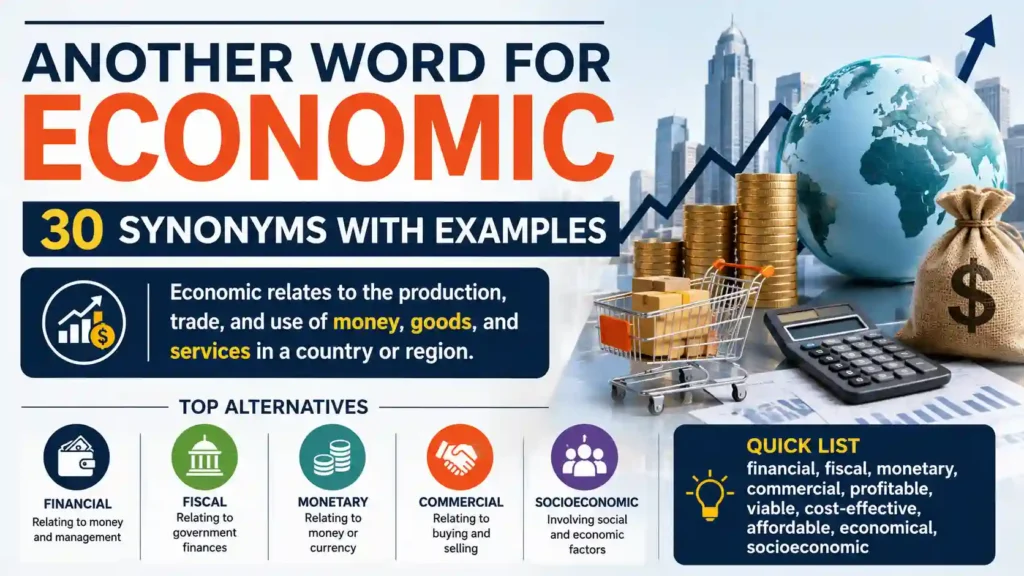
The closest everyday alternatives to “economic” are financial, fiscal, monetary, and commercial. Which one fits depends on the meaning you need. “Economic” can describe a country’s economy, a money-making plan, or something cheap to run. Each meaning has its own best replacement. For example, “economic policy” becomes “fiscal policy” or “monetary policy” when you want to be precise.
The word also covers several areas of meaning: money and trade, profit and value, low cost, and careful spending. Because “economic” and “economical” look alike, some of the best alternatives also help you avoid mixing them up.
Quick list: financial, fiscal, monetary, commercial, profitable, viable, cost-effective, affordable, economical, socioeconomic
This article looks at 30 alternatives. Each one has a meaning, IPA pronunciation, a usage note, and an example sentence. Some words are direct synonyms. Others only match one sense of “economic,” and the usage notes say which is which.
At a Glance: Economic Synonyms and Related Alternatives
| Alternative | Part of Speech | Meaning | Register / Tone | Ideal Context |
|---|---|---|---|---|
| Financial | adjective | Relating to money and how it is managed | Neutral | Banking, personal money, business |
| Fiscal | adjective | Relating to government money, taxes, and budgets | Formal | Government policy, accounting years |
| Monetary | adjective | Relating to money or currency | Formal | Central banks, money supply, interest rates |
| Commercial | adjective | Relating to buying, selling, and trade | Neutral | Business, trade, products made for profit |
| Socioeconomic | adjective | Involving both social and economic factors | Formal, academic | Research, public policy, statistics |
| Profitable | adjective | Making a profit | Neutral | Companies, projects, investments |
| Viable | adjective | Able to work or succeed, especially financially | Neutral | Business plans, projects |
| Cost-effective | adjective | Giving good results for the money spent | Neutral, business | Comparing options, budgets |
| Affordable | adjective | Not too expensive for most people to buy | Neutral, everyday | Housing, products, services |
| Economical | adjective | Saving money or resources | Neutral | Cars, appliances, spending habits |
Which Word Should You Use?
| If you want to… | Use | Why |
|---|---|---|
| Describe the money side of a company or person | financial | It is the most general and natural word for money matters. |
| Talk about government taxes and spending | fiscal | It points to public money, not private money. |
| Talk about currency, interest rates, or the money supply | monetary | It is the standard term for central bank policy. |
| Say a business plan can make money | profitable | It names the result: profit. |
| Say a plan can realistically work | viable | It stresses that the plan is possible, not just that it makes money. |
| Say something saves money when used | economical | It is the normal word for thrifty or low-running-cost things. |
| Say something is priced within reach | affordable | It focuses on if people can pay for it. |
| Describe both money and social factors together | socioeconomic | It combines the two ideas in one word. |
Exploring the Multiple Meanings of “Economic”
1. Relating to the Economy
- Meaning: Connected with a country’s production, trade, goods, and services.
- Explanation: This is the most common meaning, used for growth, policies, and financial conditions. Related words include financial, fiscal, and monetary, each with a narrower meaning.
- Example: The country faced a serious economic crisis last year.
2. Relating to the Science of Economics
- Meaning: Connected with the study of resources, production, and distribution.
- Explanation: This meaning appears in academic terms such as economic theory and economic model. Words like macroeconomic and microeconomic describe more specific areas.
- Example: She studied economic theory at university.
3. Profitable or Worth the Cost
- Meaning: Financially worthwhile or capable of covering costs.
- Explanation: In this sense, profitable and viable are useful alternatives. Something that is not economic may cost more to operate than it earns.
- Example: The bus route was no longer economic to operate.
4. Low in Cost
- Meaning: Inexpensive to buy, use, or operate.
- Explanation: This sense is sometimes used in phrases about fares or products. However, economical, affordable, or low-cost often sound more natural.
- Example: The airline offers economical fares on short routes.
5. Relating to Household Management
- Meaning: Connected with managing household resources.
- Explanation: This older meaning is now uncommon. Modern words such as frugal, thrifty, and economical better describe careful spending and resource use.
- Example: Older texts discuss the economic duties of managing a household.
Sources: Merriam-Webster; Collins Dictionary; Dictionary.com; Etymonline (the 1590s household sense, and the later 1835 sense relating to the science of economics)
Analyzing 30 Economic Alternatives in Detail
Some of these words are direct synonyms of “economic” in one of its senses, while others are related alternatives that only fit certain contexts, and each usage note says which.
Core Synonyms (Money and Trade)
1. Financial
IPA: /faɪˈnænʃəl/
Definition: Related to money, investments, or financial management.
Usage: Use it for personal, business, or company finances.
Example: The company shared its financial results.
2. Fiscal
IPA: /ˈfɪskəl/
Definition: Related to government revenue, taxes, and spending.
Usage: Best for public finance and government budgets.
Example: The government introduced a new fiscal policy.
3. Monetary
IPA: US /ˈmɑːnəˌteri/ · UK /ˈmʌnɪtri/
Definition: Related to money, currency, or its supply.
Usage: Common in discussions about interest rates and central banks.
Example: The bank changed its monetary policy.
4. Commercial
IPA: US /kəˈmɜːrʃəl/ · UK /kəˈmɜːʃəl/
Definition: Related to business, trade, or selling goods and services.
Usage: Use it when discussing business activities or trade.
Example: The new road boosted commercial activity.
5. Budgetary
IPA: US /ˈbʌdʒɪˌteri/ · UK /ˈbʌdʒɪtəri/
Definition: Related to a plan for income and spending.
Usage: Best for spending limits and financial planning.
Example: Budgetary limits delayed the project.
6. Pecuniary
IPA: US /pɪˈkjuːnieri/ · UK /pɪˈkjuːniəri/
Definition: Involving or relating to money.
Usage: A formal term often used in legal or professional contexts.
Example: He acted without expecting pecuniary gain.
Scope and Field Alternatives
7. Macroeconomic
IPA: US /ˌmækroʊˌɛkəˈnɑːmɪk/ · UK /ˌmækrəʊˌiːkəˈnɒmɪk/
Definition: Relating to the economy of a whole country or region.
- Usage: A more specific form of “economic.” Use it for large-scale topics like inflation, growth, and unemployment.
- Example: Rising prices are a major macroeconomic concern.
8. Microeconomic
IPA: US /ˌmaɪkroʊˌɛkəˈnɑːmɪk/ · UK /ˌmaɪkrəʊˌiːkəˈnɒmɪk/
Definition: Relating to the economic choices of individuals, households, and single businesses.
- Usage: A specific form of “economic” for small-scale topics, the opposite of “macroeconomic.” Mostly academic.
- Example: The course covers microeconomic ideas such as supply and demand.
9. Socioeconomic
IPA: US /ˌsoʊsioʊˌɛkəˈnɑːmɪk/ · UK /ˌsəʊsiəʊˌiːkəˈnɒmɪk/
Definition: Involving both social and economic factors, such as income, education, and job type.
- Usage: Not an exact synonym, since it adds the social side. It is common in research and policy about groups of people.
- Example: The study compared test scores across socioeconomic groups.
10. Industrial
IPA: /ɪnˈdʌstriəl/ (US and UK)
Definition: Relating to industry, which means large-scale production of goods.
- Usage: A related alternative that fits only when the topic is factories and production, as in “industrial output.” It does not mean “economic” in general.
- Example: Industrial growth was strong in the region.
11. Mercantile
IPA: US /ˈmɜːrkənˌtiːl/ · UK /ˈmɜːkəntaɪl/
Definition: Relating to trade and merchants.
- Usage: A formal, somewhat old-fashioned related alternative. It appears in history and in business names. It is not a general replacement for “economic.”
- Example: The city grew rich from mercantile activity.
Profit and Value Alternatives
12. Profitable
IPA: US /ˈprɑːfɪtəbəl/ · UK /ˈprɒfɪtəbəl/
Definition: Producing a financial gain.
- Usage: A direct synonym for “economic” in the “worth the cost” sense. It is more specific, since it names the profit itself.
- Example: The shop became profitable in its second year.
13. Lucrative
IPA: /ˈluːkrətɪv/ (US and UK)
Definition: Producing a lot of money.
- Usage: Stronger than “profitable.” It suggests a large reward, not just a gain. A close synonym for the profit sense only.
- Example: She left teaching for a more lucrative job in sales.
14. Viable
IPA: /ˈvaɪəbəl/ (US and UK)
Definition: Capable of working or succeeding.
- Usage: A related alternative. It often appears as “economically viable,” meaning it can pay its own way. By itself, it does not mention money.
- Example: The farm is no longer a viable business.
15. Cost-effective
IPA: US /ˌkɔːst ɪˈfɛktɪv/ · UK /ˌkɒst ɪˈfɛktɪv/
Definition: Giving good results for the amount of money spent.
- Usage: A close alternative for the “worth the cost” sense. It is common in business and health planning, and it compares cost with results rather than just saying something is cheap.
- Example: Fixing the old pipes was more cost-effective than replacing them.
16. Remunerative
IPA: US /rɪˈmjuːnərətɪv/ · UK /rɪˈmjuːnərətɪv/
Definition: Providing good payment.
- Usage: A formal synonym for the profit sense, used mainly for work and jobs. It is uncommon in casual speech.
- Example: Translation can be a remunerative career.
17. Gainful
IPA: /ˈɡeɪnfəl/ (US and UK)
Definition: Producing profit or pay.
- Usage: A related alternative that appears mostly in the fixed phrase “gainful employment.” It rarely replaces “economic” outside that pattern.
- Example: He found gainful work soon after graduating.
Low-Cost Alternatives
18. Economical
IPA: US /ˌɛkəˈnɑːmɪkəl/ · UK /ˌiːkəˈnɒmɪkəl/
Definition: Giving good value for money or using little.
- Usage: The closest alternative for the “low cost” sense, and the one most often confused with “economic.” Use it for things that save money, like cars, meals, and habits.
- Example: A small car is more economical to run.
19. Inexpensive
IPA: /ˌɪnɪkˈspɛnsɪv/ (US and UK)
Definition: Not costing much.
- Usage: A neutral, polite word for low price. It does not suggest poor quality, so it is useful in product descriptions.
- Example: They found an inexpensive hotel near the station.
20. Affordable
IPA: US /əˈfɔːrdəbəl/ · UK /əˈfɔːdəbəl/
Definition: Cheap enough for people to buy or pay for.
- Usage: A related alternative that focuses on if people can pay. Common in talk about housing, health care, and transport.
- Example: The city wants to build more affordable homes.
21. Cheap
IPA: /tʃiːp/ (US and UK)
Definition: Low in price. It can also mean poor in quality.
- Usage: A casual word for the “low cost” sense. It can sound negative, so “inexpensive” or “affordable” is safer when you want to be polite.
- Example: Cheap flights are easy to find in January.
22. Low-cost
IPA: US /ˌloʊ ˈkɔːst/ · UK /ˌləʊ ˈkɒst/
Definition: Costing little to buy or run.
- Usage: A neutral, business-style alternative. It is common in travel and technology. It matches the “low cost” sense of “economic” only.
- Example: The airline runs low-cost flights across Europe.
23. Budget
IPA: /ˈbʌdʒɪt/ (US and UK)
Definition: Designed to be cheap. Used before a noun.
- Usage: A related alternative that works as an adjective before a noun, as in “budget hotel.” It is informal to neutral.
- Example: They booked a budget hotel for the weekend.
Thrifty and Careful Alternatives
24. Thrifty
IPA: /ˈθrɪfti/ (US and UK)
Definition: Careful about spending money.
- Usage: A related alternative that describes people and habits. This matches the careful-spending idea behind “economical,” not the modern “economic.”
- Example: His thrifty habits helped him save for a house.
25. Frugal
IPA: /ˈfruːɡəl/ (US and UK)
Definition: Careful about spending, and avoiding waste.
- Usage: Similar to “thrifty,” with a slightly more serious tone. It describes people, meals, and lifestyles. It is not a synonym of “economic” in the policy sense.
- Example: The family lived a frugal life.
26. Sparing
IPA: US /ˈspɛrɪŋ/ · UK /ˈspeərɪŋ/
Definition: Using only a small amount.
- Usage: A loose related alternative for careful use of resources. It often appears as “sparing with” something. It is not a normal replacement for “economic.”
- Example: She was sparing with her words.
27. Prudent
IPA: /ˈpruːdənt/ (US and UK)
Definition: Careful and sensible, especially with money.
- Usage: A formal related alternative. It suggests good judgment rather than low spending, so a prudent choice is not always the cheapest one.
- Example: It is prudent to keep some money for emergencies.
Household and Material Terms
28. Domestic
IPA: /dəˈmɛstɪk/ (US and UK)
Definition: Relating to the home, or to one’s own country.
- Usage: A related alternative that echoes the old household sense of “economic.” In modern use it often means “inside the country,” as in “domestic economy.” It does not replace “economic” alone.
- Example: Domestic spending rose faster than exports.
29. Material
IPA: US /məˈtɪriəl/ · UK /məˈtɪəriəl/
Definition: Relating to physical things and money rather than ideas or feelings.
- Usage: A context-specific related alternative, as in “material conditions” or “material wealth.” It points to physical resources, not the economy as a system.
- Example: Their material needs were small, but they were happy.
30. Productive
IPA: /prəˈdʌktɪv/ (US and UK)
Definition: Making or yielding a large amount of goods or results.
- Usage: A related alternative for output, as in “a productive economy.” It describes how much is made, not the system or the money.
- Example: The region has a highly productive farming sector.
Sources: Merriam-Webster; Collins Dictionary and Collins Thesaurus; Dictionary.com
Economic vs. Economical vs. Economics
These three words come from the same root but have different jobs. Mixing them up is the most common mistake with this keyword.
| Word | Part of Speech | Main Meaning | Typical Use |
|---|---|---|---|
| Economic | adjective | Relating to the economy or to economics | economic growth, economic policy |
| Economical | adjective | Saving money or resources | an economical car, an economical meal |
| Economics | noun | The study of how money, goods, and resources are produced and used | She teaches economics. |
The two adjectives were once closer. The word “economical” kept the older sense of thrift, while “economic” today mainly means relating to the science of economics. A quick test helps. If you can replace the word with “money-saving,” use “economical.” If you mean “of the economy,” use “economic.”
Sources: Etymonline; Merriam-Webster; Collins Dictionary
Economic and Opposite/Paired Word Pairs
| Word | Paired Word | Note |
|---|---|---|
| economic | uneconomic | “Uneconomic” means not profitable or not worth the cost. It opposes the profit sense. |
| economical | wasteful | The natural opposite of “economical” when it means saving resources. |
| economic | social | Often paired in phrases like “economic and social development.” They are contrasts, not opposites. |
| economic | political | Common pair in “political and economic systems.” |
| economic | environmental | Used when weighing money against nature, as in “economic and environmental costs.” |
| macroeconomic | microeconomic | A true pair: large-scale versus small-scale. |
| profitable | unprofitable | Antonym for the profit sense of “economic.” |
“Economic” has no single opposite, because it has several senses. In the profit sense, “uneconomic” is the clearest opposite. In most other uses, “economic” is placed beside words like “social” or “political” to show different areas of life, not to show opposites.
Sources: Merriam-Webster; Collins Dictionary
Common Word Partners of “Economic”
| Pattern | Common Partners | Example |
|---|---|---|
| economic + noun (the economy) | growth, policy, crisis, recovery, downturn, activity, conditions, indicators | The report shows slow economic growth. |
| economic + noun (people and money) | hardship, inequality, status, migrants | Many families faced economic hardship. |
| economic + noun (government action) | sanctions, reform, aid, development | The country faced new economic sanctions. |
| adjective + economic | global, strong, weak, local, national | A weak economic outlook worried investors. |
| for + economic + reasons | reasons, benefits, gain | Many people move for economic reasons. |
| economic and + adjective | social, political, environmental | The plan has economic and social goals. |
Sources: Collins Dictionary; Merriam-Webster; Oxford Collocations Dictionary
Idiomatic Phrases Featuring “Economic”
“Economic” has few true idioms. The expressions below are established phrases. Only the first is a real idiom, and it uses the related word “economical.”
1. Economical with the truth
- Meaning: Not telling the whole truth, or leaving out facts in order to mislead without lying directly.
- Example: The manager was economical with the truth about the company’s debts.
2. Economic migrant
- Meaning: A person who moves to another country mainly to find work or a better income. It is an established term, not an idiom.
- Example: He came to the city as an economic migrant looking for factory work.
3. Economic miracle
- Meaning: A period of unusually fast and unexpected growth in a country’s economy. It is an established expression, not a true idiom.
- Example: Many people spoke of an economic miracle after the war.
Sources: Merriam-Webster; Collins Dictionary
Word Formation of “Economic”
Etymology & Structure
The word may be a shortened form of “economical,” or it may come from French économique or directly from Latin oeconomicus, which came from the Greek oikonomikos, meaning skilled in running a household. The Greek base is oikonomia, “household management,” from oikos, “house,” and nomos, “managing,” which comes from the verb nemein, “to manage.” In English, the adjective is built as economy plus the adjective ending -ic.
Date and History
English first used “economic” in the 1590s for matters of household management. The sense relating to the science of economics dates from 1835 and is now the main one.
Word Class Variations
- Noun: economy, economics, economist
- Adjective: economic, economical, uneconomic, noneconomic, socioeconomic, macroeconomic, microeconomic
- Adverb: economically
- Verb: economize (British spelling: economise)
Sources: Etymonline; Merriam-Webster
Common Word-Choice Mistakes
- An economic car: an economical car. Use “economical” for things that save money.
- Economical growth: economic growth. Growth of the economy takes “economic.”
- She studies economical theory: She studies economic theory.
- Fiscal crisis for any money problem: Use “financial crisis” for private or business money problems. “Fiscal” is for government finances.
- Monetary policy of a company: A company has a financial policy. “Monetary policy” belongs to central banks.
- A cheap hotel (when you want to sound polite): an inexpensive or affordable hotel.
- Viable means profitable: A viable plan can work, but it may not make a profit. Use “profitable” when profit is the point.
Frequently Asked Questions
What is the closest synonym for “economic”?
“Financial” is the most common everyday alternative. “Fiscal” and “monetary” are closer in meaning when the topic is government money or currency.
What is a formal alternative to “economic”?
“Fiscal,” “monetary,” and “pecuniary” are formal. “Socioeconomic” is formal and academic.
What is the difference between “economic” and “economical”?
“Economic” relates to the economy. “Economical” means saving money or resources.
What is another word for “economic” when it means profitable?
“Profitable,” “lucrative,” and “viable” fit this sense. “Cost-effective” fits when results are compared to cost.
What word means “economic” in the sense of low cost?
“Economical,” “inexpensive,” and “affordable” are the best choices. “Cheap” is casual and can sound negative.
What is the opposite of “economic”?
It depends on the sense. “Uneconomic” is the opposite when it means not profitable. “Wasteful” is the opposite of “economical.”
Can “economic” describe people?
Not usually. We say “economic situation” or “economic status,” but a careful person is “thrifty” or “frugal,” not “economic.”
Is “fiscal” the same as “economic”?
No. “Fiscal” is narrower and covers government taxes, spending, and debt. “Economic” covers the whole economy.
Why do “economic” and “economics” look so similar?
They share a root. “Economics” is the noun for the field of study. “Economic” is the adjective that describes things related to it.
Where does the word “economic” come from?
It comes from Greek oikonomikos, meaning skilled in managing a household.
Conclusion
The closest everyday alternatives to “economic” are “financial,” “fiscal,” “monetary,” and “commercial.” When the meaning is profit, use “profitable,” “lucrative,” or “viable.” When the meaning is low cost, use “economical,” “inexpensive,” or “affordable.”
The right word depends on which sense you mean. “Economic” can describe the economy, a plan that pays for itself, or something cheap to use. A word that fits one sense may not fit the others, such as “fiscal” for government money or “frugal” for careful people.
To choose well, first decide which sense you need. Then pick the word that names that idea most directly, and keep “economic” for matters of the economy and “economical” for saving money.

Hi, I’m Sophia a passionate writer and curious learner who enjoys exploring fascinating facts, everyday questions, and interesting discoveries. At VistoraDaily, I share clear, reliable, and engaging general knowledge content to help readers learn something new and understand the world better.