
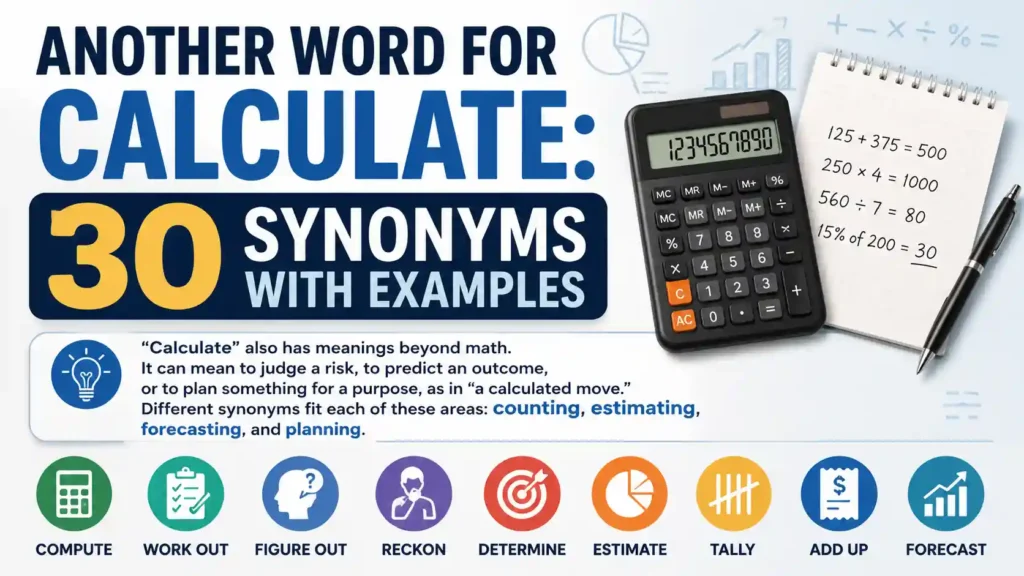
The closest everyday alternatives to “calculate” are compute, work out, figure out, and determine. They all mean to find an answer by using numbers or facts.
The best choice depends on the situation. You compute a data result, work out a bill, estimate a rough figure, and tally a score.
“Calculate” also has meanings beyond math. It can mean to judge a risk, to predict an outcome, or to plan something for a purpose, as in “a calculated move.” Different synonyms fit each of these areas: counting, estimating, forecasting, and planning.
Quick list: compute, work out, figure out, reckon, determine, estimate, tally, add up, total
At a Glance: Calculate Synonyms and Related Alternatives
| Alternative | Part of Speech | Meaning | Register / Tone | Ideal Context |
|---|---|---|---|---|
| Compute | Verb | Find a number by a math process | Neutral to formal | Data, science, finance |
| Work out | Phrasal verb | Find an answer by doing the steps | Informal to neutral | Bills, shares, schoolwork |
| Figure out | Phrasal verb | Find an answer by thinking or doing math | Informal | Everyday problems, budgets |
| Reckon | Verb | Count or calculate; also to think | Neutral (British-leaning) | Casual speech, older writing |
| Determine | Verb | Find out exactly, often by calculation | Formal | Reports, science, law |
| Estimate | Verb | Calculate roughly | Neutral | Costs, time, sizes |
| Tally | Verb | Count a total, often by marks | Neutral | Votes, scores, expenses |
| Add up | Phrasal verb | Find a sum | Informal to neutral | Money, numbers, receipts |
| Assess | Verb | Judge the amount or value of something | Formal | Risk, damage, performance |
| Forecast | Verb | Predict by studying data | Neutral to formal | Weather, sales, budgets |
Which Word Should You Use?
| If you want to… | Use | Why |
|---|---|---|
| Find an exact number with a formula | Compute | It suggests a clear, rule-based process. |
| Solve a bill or share in everyday talk | Work out | It sounds natural and shows the steps. |
| Find an answer you did not know yet | Figure out | It covers math and general problem-solving. |
| Give a rough number, not an exact one | Estimate | It tells the reader the figure is approximate. |
| Add several items into one total | Tally | It fits counting votes, points, or costs. |
| Make a firm, official finding | Determine | It sounds precise and formal. |
| Judge risk or value, not just numbers | Assess | It includes judgment as well as measurement. |
| Say what numbers suggest about the future | Forecast | It points ahead, not at the present. |
Exploring the Multiple Meanings of “Calculate”
1. Doing Math
- Meaning: To find a number or result by a mathematical process.
- Explanation: This is the main and most common sense. It works with numbers, formulas, or measurements, and the answer is usually exact. Dictionary.com lists it first, with “compute” as the matching word.
- Example: She used a spreadsheet to calculate the monthly loan payment.
2. Judging by Reasoning
- Meaning: To form an estimate or judgment using reasoning, facts, or experience.
- Explanation: There may be no formula here. You weigh facts to decide how big, likely, or risky something is. This sense appears in phrases like “calculate the odds.”
- Example: The pilot calculated how much fuel they would need if the weather turned bad.
3. Expecting or Counting On
- Meaning: To expect, predict, or depend on something happening.
- Explanation: This sense often appears with “that” or “on.” It treats the future as something you can plan around.
- Example: The company calculated that sales would double by spring.
4. Designing for a Purpose
- Meaning: To plan or design something so that it has a certain effect.
- Explanation: This sense is usually passive and followed by “to.” It often shows that an action was done on purpose.
- Example: His speech was calculated to calm the angry crowd.
5. Thinking or Supposing (Dated, Regional American)
- Meaning: To think, suppose, or guess.
- Explanation: Etymonline dates this sense to about 1830 and calls it an American use. It sounds old-fashioned today and appears mostly in historical or folk-style writing.
- Example: “I calculate we’ll reach the town by dark,” said the farmer in the old story.
Sources: Dictionary.com; Etymonline; Merriam-Webster; Collins Dictionary.
Analyzing 30 Calculate Alternatives in Detail
Some of these words are direct synonyms of “calculate,” while others are related alternatives that fit only certain meanings or situations.
Core Everyday Alternatives
1. Compute
IPA: /kəmˈpjuːt/ (US and UK)
Definition: To find a number or result using mathematical or logical methods.
- Usage: A direct synonym for the mathematical sense of “calculate.” It sounds slightly more technical and is common in science, computing, and data analysis.
- Example: The program can compute the average score in seconds.
2. Work Out
IPA: US /ˌwɝːk ˈaʊt/ · UK /ˌwɜːk ˈaʊt/
Definition: To find an answer by following steps or thinking carefully.
- Usage: A natural, everyday alternative to “calculate.” It is especially useful when discussing bills, expenses, and schoolwork.
- Example: Let’s work out how much each person owes.
3. Figure Out
IPA: US /ˌfɪɡjər ˈaʊt/ · UK /ˌfɪɡər ˈaʊt/
Definition: To find an answer or understand something.
- Usage: This informal phrase works for calculations and general problem-solving. It is broader than “calculate” because it does not always involve numbers.
- Example: I need to figure out my monthly budget.
4. Reckon
IPA: /ˈrekən/ (US and UK)
Definition: To calculate, count, or form an opinion about something.
- Usage: “Reckon” can replace “calculate” when estimating costs or totals. It is also commonly used to mean “think” in informal British and Australian English.
- Example: He reckoned the trip would cost about two hundred dollars.
5. Determine
IPA: US /dɪˈtɝːmɪn/ · UK /dɪˈtɜːmɪn/
Definition: To find out or establish something.
- Usage: A formal alternative that fits calculations based on measurements, facts, or evidence.
- Example: Engineers used the data to determine the bridge’s weight limit.
6. Count
IPA: /kaʊnt/ (US and UK)
Definition: To find the number of items or calculate a total.
- Usage: “Count” is suitable for simple numerical tasks, but it does not cover complex calculations.
- Example: The teacher counted the votes twice.
Estimating and Judging Alternatives
7. Estimate
IPA: /ˈestɪmeɪt/ (US and UK)
Definition: To form a rough or approximate judgment of a number, amount, or value.
- Usage: A close synonym for the judging sense. Use it when the answer is not exact.
- Example: Builders estimated the repair would take three weeks.
8. Approximate
IPA: US /əˈprɑːksɪmeɪt/ · UK /əˈprɒksɪmeɪt/
Definition: To find a number that is close to the true value.
- Usage: A related alternative, mostly used in science, math, and technical writing. As a verb it is less common than “estimate.”
- Example: The formula approximates the area of a curved shape.
9. Gauge
IPA: /ɡeɪdʒ/ (US and UK)
Definition: To measure or judge the size, amount, or likely result of something.
- Usage: A related alternative. It is used for judging things that are hard to count, such as mood, interest, or speed.
- Example: The survey helped the team gauge how many people would attend.
10. Assess
IPA: /əˈses/ (US and UK)
Definition: To judge or decide the amount, value, or quality of something.
- Usage: A related alternative, not an exact synonym. It leans on judgment more than math and sounds formal.
- Example: Inspectors assessed the storm damage on Monday.
11. Evaluate
IPA: /ɪˈvæljueɪt/ (US and UK)
Definition: To judge the value or quality of something after careful study.
- Usage: A related alternative. It can mean “to find the numerical value” in math, but in most uses it means judging, not calculating.
- Example: The committee will evaluate the cost of each plan.
Totaling and Counting-Up Alternatives
12. Tally
IPA: /ˈtæli/ (US and UK)
Definition: To count up a total, often by keeping a running record.
- Usage: A related alternative that fits when you are adding up many small items, such as votes, points, or expenses.
- Example: Volunteers tallied the ballots by hand.
13. Add up
IPA: /ˌæd ˈʌp/ (US and UK)
Definition: To find the total of several numbers or amounts.
- Usage: A direct synonym for the simplest kind of calculating, which is adding. It is informal and very common.
- Example: Add up the receipts before you send the report.
14. Total
IPA: US /ˈtoʊtl/ · UK /ˈtəʊtl/
Definition: To add together to reach a sum.
- Usage: A related alternative that works only for adding. It is often used with “up” (“total up”).
- Example: She totaled the bills and found a mistake.
15. Quantify
IPA: US /ˈkwɑːntɪfaɪ/ · UK /ˈkwɒntɪfaɪ/
Definition: To express or measure something as a number.
- Usage: A related alternative. It means giving a number to something, such as risk or damage, and is common in research and business.
- Example: It is hard to quantify the benefits of good teaching.
16. Tabulate
IPA: /ˈtæbjuleɪt/ (US and UK)
Definition: To arrange data or figures in a table or list.
- Usage: A related alternative. It focuses on organizing results, which often comes after calculating.
- Example: Researchers tabulated the results from all 12 schools.
Formal and Technical Alternatives
17. Ascertain
IPA: US /ˌæsərˈteɪn/ · UK /ˌæsəˈteɪn/
Definition: To find out something for certain.
- Usage: A related formal alternative. It fits official or legal writing, and it need not involve math.
- Example: Officials are trying to ascertain the exact cost.
18. Derive
IPA: /dɪˈraɪv/ (US and UK)
Definition: To obtain a result or formula from something else by reasoning.
- Usage: A related alternative, mostly used in math and science. It means working out a result from earlier facts or equations.
- Example: Students learned to derive the formula from basic rules.
19. Extrapolate
IPA: /ɪkˈstræpəleɪt/ (US and UK)
Definition: To estimate a new value by extending known facts or trends.
- Usage: A related alternative. It is narrower than “calculate” because it works from existing data toward unknown values.
- Example: Analysts extrapolated next year’s growth from the last five years.
20. Solve
IPA: US /sɑːlv/ · UK /sɒlv/
Definition: To find the answer to a problem or equation.
- Usage: A related alternative. Use it when the task is a problem or equation, not just a number.
- Example: She solved the equation in under a minute.
21. Enumerate
IPA: US /ɪˈnuːməreɪt/ · UK /ɪˈnjuːməreɪt/
Definition: To name or count items one by one.
- Usage: A related formal alternative. It stresses listing or counting separate items, not doing math.
- Example: The report enumerates every cost in the project.
Predicting and Planning Alternatives
22. Forecast
IPA: US /ˈfɔːrkæst/ · UK /ˈfɔːkɑːst/
Definition: To predict future conditions or amounts using data.
- Usage: A related alternative for the “expect” sense. Use it when calculations are aimed at the future.
- Example: The company forecasts a small rise in prices.
23. Project
IPA: /prəˈdʒekt/ (US and UK)
Definition: To estimate a future amount based on current trends.
- Usage: A related alternative used in business and science. It is not the same as the noun “project.”
- Example: Experts project that the population will grow by 5 percent.
24. Predict
IPA: /prɪˈdɪkt/ (US and UK)
Definition: To say what will happen in the future.
- Usage: A related alternative. It does not require numbers, so it is broader and less exact than “calculate.”
- Example: Nobody could predict how fast the river would rise.
25. Anticipate
IPA: /ænˈtɪsɪpeɪt/ (US and UK)
Definition: To expect something and often prepare for it.
- Usage: A related alternative that matches the sense “calculate on” or “count on.” It stresses preparation.
- Example: The shop anticipated a busy weekend and hired extra staff.
26. Plan
IPA: /plæn/ (US and UK)
Definition: To decide in advance what to do.
- Usage: A related alternative for the older sense of “to plan or devise.” It does not mean doing math.
- Example: They planned the route to save time and fuel.
Deliberate and Figurative Alternatives
27. Weigh
IPA: /weɪ/ (US and UK)
Definition: To think carefully about the good and bad sides of something.
- Usage: A figurative related alternative. It fits “calculating a risk” in the sense of judging it carefully.
- Example: He weighed the risks before signing the contract.
28. Devise
IPA: /dɪˈvaɪz/ (US and UK)
Definition: To invent or plan something using careful thought.
- Usage: A related alternative that matches the “plan or devise” sense of “calculate.” It does not involve numbers.
- Example: The team devised a plan to cut costs.
29. Design
IPA: /dɪˈzaɪn/ (US and UK)
Definition: To plan or make something for a particular purpose.
- Usage: A related alternative for the passive “calculated to” sense. “Designed to” is the usual modern equivalent.
- Example: The sign was designed to catch drivers’ attention.
30. Suppose
IPA: US /səˈpoʊz/ · UK /səˈpəʊz/
Definition: To think that something is probably true.
- Usage: A related alternative for the dated American sense “to think or guess.” It does not suggest math.
- Example: I suppose we’ll arrive by evening.
Sources: Merriam-Webster; Collins Dictionary; Dictionary.com; Etymonline.
Calculate vs. Compute vs. Estimate vs. Work Out
These four words are close, but they do not signal the same level of precision or tone.
| Word | Main Idea | Precision | Typical Setting |
|---|---|---|---|
| Calculate | Find a result using math or reasoning | Exact or reasoned | All-purpose: school, work, daily life |
| Compute | Find a result using a defined method | Exact | Data, science, computers |
| Estimate | Find a rough figure | Approximate | Budgets, plans, quick judgments |
| Work out | Find an answer by following the steps | Exact or approximate | Everyday speech, especially British English |
When you’re unsure which word fits best, calculate is a safe choice. For technical or automatic processes, use compute. If the number is approximate rather than exact, choose estimate. In everyday conversation, work out sounds more natural and friendly.
Sources: Dictionary.com; Merriam-Webster; Collins Dictionary.
Calculate and Opposite/Paired Word Pairs
| Word | Paired Word | Note |
|---|---|---|
| Calculate | Guess | Contrast: calculating uses facts or math, while guessing does not. |
| Calculate | Miscalculate | Same root: to get a calculation wrong. |
| Calculate | Recalculate | Same root: to calculate again. |
| Calculable | Incalculable | Something that can be counted versus something too great to count. |
| Calculated | Spontaneous / unplanned | A calculated action is planned; a spontaneous one is not. |
| Calculating | Impulsive | A calculating person plans; an impulsive person acts without thinking. |
| Calculate | Estimate | Related pair: an exact result versus a rough result. |
“Calculate” has no single perfect antonym, because it describes a process. The closest contrasts are words like “guess” and “ignore,” which mean not using careful thinking or numbers. The word family also contains natural pairs such as “calculable” and “incalculable.” Note that “calculating” can describe a person as cold or scheming, so it is not always a neutral word.
Sources: Merriam-Webster; Collins Dictionary; Etymonline.
Common Word Partners of “Calculate”
| Pattern | Common Partners | Example |
|---|---|---|
| calculate + noun | the cost, the total, the distance, the average, the odds, the risk | Please calculate the total cost. |
| calculate + question word | how much, how many, what | We need to calculate how many chairs to order. |
| calculate + that clause | calculate that something will happen | Experts calculate that the project will finish early. |
| adverb + calculate | carefully, quickly, roughly, accurately | She quickly calculated the tip. |
| calculate + from | calculate from the data, from a formula | The speed was calculated from the video. |
| calculate + by | by hand, by using a formula | He calculated the area by hand. |
Sources: Dictionary.com; Collins Dictionary; Cambridge Dictionary.
Idiomatic Phrases Featuring “Calculate”
“Calculate” has few true idioms. The phrases below are established expressions, and only “calculated risk” comes close to an idiom.
1. A calculated risk
- Meaning: A risk taken after weighing the possible results.
- Example: Opening the second shop was a calculated risk, but it paid off.
2. Cold and calculating
- Meaning: Describes someone who plans carefully and shows no emotion, often in a way that seems unkind.
- Example: The villain in the film is cold and calculating.
3. Calculated to (do something)
- Meaning: Designed or intended to have a certain effect.
- Example: The ad was calculated to attract young buyers.
4. Calculate on (something)
- Meaning: To depend on something happening or to plan around it.
- Example: Don’t calculate on getting a discount this year.
Sources: Merriam-Webster; Collins Dictionary; Dictionary.com.
Word Formation of “Calculate”
Etymology & Structure
“Calculate” comes from Latin calculatus, the past participle of calculare, meaning “to reckon or compute.” That verb comes from calculus, which originally meant a small pebble used as a counter. Calculus is a diminutive of calx, meaning “limestone.” The English word is built from this Latin base plus the verb ending -ate. The same root gives us “calculus” and, in the medical sense, a stone-like buildup in the body.
Date and History
Etymonline places the verb “calculate” in the 1560s, with the meaning of figuring something out by math. It notes that an earlier form, calculen, appeared in the mid-14th century from Old French calculer. The sense “to plan or devise” is recorded from the 1650s. The sense “to think or guess” appears around 1830 in American English. The adjective “calculated” is recorded from 1722 with the meaning “suited or apt” and from 1796 with the meaning “devised beforehand.”
Word Class Variations
- Verb: calculate, calculates, calculated, calculating
- Noun: calculation, calculator
- Adjective: calculable, calculated, calculating, incalculable
- Adverb: calculatedly, calculatingly
- Related derivatives: miscalculate, recalculate
- Related word from the same root: calculus
Sources: Etymonline; Dictionary.com; Merriam-Webster.
Common Word-Choice Mistakes
- Calculate about the cost: calculate the cost (no “about” is needed).
- She calculated the answer is five: she calculated that the answer is five (or “worked out that”).
- We estimated the exact total: we calculated the exact total (an estimate is never exact).
- He calculated the number of people to be 50 (when it was only a guess): he estimated the number of people to be 50.
- The calculator can predict the risk: the calculator can calculate the risk (a calculator does not predict).
- I calculate that you are tired (in modern English): I think you are tired (the “think” sense of “calculate” is dated).
- Calculated risk means a careless risk: calculated risk means a risk taken after careful thought.
Frequently Asked Questions
What is the closest synonym for “calculate”?
“Compute” is the closest synonym for the math sense. In everyday speech, “work out” and “figure out” are the most natural.
What is a formal alternative to “calculate”?
“Determine” and “ascertain” are common formal choices. “Compute” also sounds technical and formal.
What is the difference between “calculate” and “estimate”?
“Calculate” suggests a careful, usually exact result. “Estimate” means a rough result that is close but not exact.
Can “calculate” be used for people?
It can describe a person’s behavior, as in “a calculating person.” This usually means someone who plans carefully for their own gain, so it often sounds negative.
Does “calculate” always involve numbers?
No. It can also mean to judge or plan using reasoning, as in “calculate the risks” or “a calculated move.”
What is a figurative alternative to “calculate”?
“Weigh” works well when you mean thinking carefully about the good and bad sides of a choice.
What does “calculated to” mean?
It means “designed or intended to.” For example, “a statement calculated to impress” is one made on purpose to impress.
What is the opposite of “calculate”?
There is no exact opposite. “Guess” is the closest contrast, because it does not use math or careful reasoning.
Is “reckon” the same as “calculate”?
They overlap in the sense of counting or computing. “Reckon” is also very common as an informal word for “think,” which “calculate” no longer means in most modern speech.
Which alternative should I use for future numbers?
“Forecast” and “project” fit best. They show that you are using current data to say what may happen later.
Conclusion
The closest alternatives to “calculate” are “compute,” “work out,” “figure out,” and “determine.” They all describe finding a result through math or careful thought. Words like “estimate” and “approximate” show that a number is rough, while “tally” and “add up” fit when you are totaling items.
Context decides which word works best. Some alternatives, such as “forecast,” “weigh,” and “devise,” match the broader senses of “calculate”: predicting, judging, and planning. Others, such as “assess” and “evaluate,” lean toward judgment more than math. Choosing the right one makes your meaning clearer and your tone more natural.

Hi, I’m Sophia a passionate writer and curious learner who enjoys exploring fascinating facts, everyday questions, and interesting discoveries. At VistoraDaily, I share clear, reliable, and engaging general knowledge content to help readers learn something new and understand the world better.