
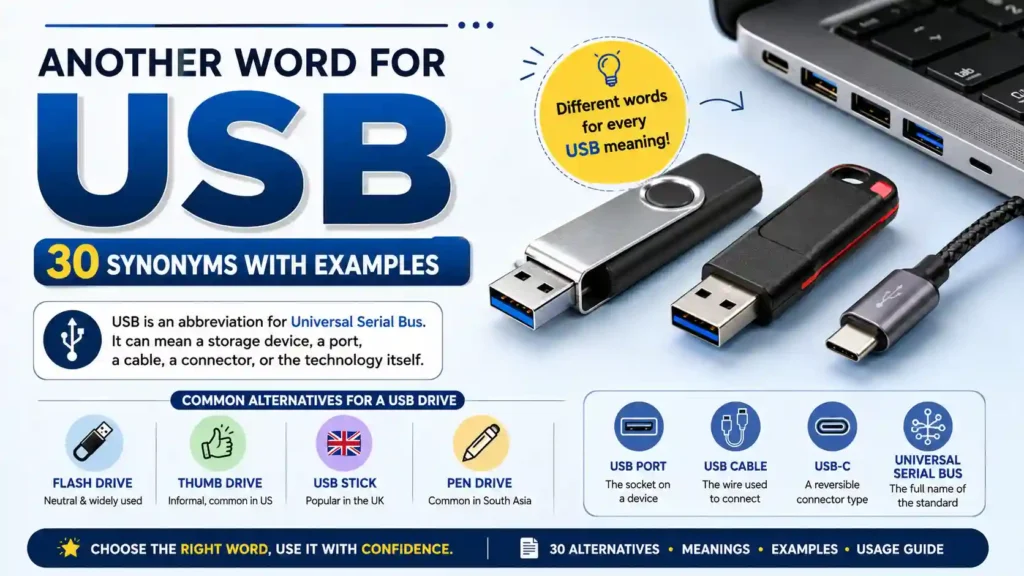
The most common other words for USB are flash drive, thumb drive, USB stick, and pen drive. All four name the small storage device you plug into a computer.
Which one people say depends on where they live and how casual the setting is. “USB” is also used for the port and the cable, and then different words fit better.
“USB” is an abbreviation, not an ordinary word, so it has no single dictionary synonym. The best alternative depends on what you mean: a storage stick, a port, a connector, a cable, or the technology itself.
Quick list: flash drive, thumb drive, USB stick, pen drive, memory stick, USB drive, USB port, USB cable, USB-C, Universal Serial Bus
This article covers 30 alternatives with meanings, IPA, usage notes, examples, and context. Some are close synonyms. Others are related terms that fit only one sense of “USB.”
At a Glance: USB Synonyms and Related Alternatives
| Alternative | Part of Speech | Meaning | Register / Tone | Ideal Context |
|---|---|---|---|---|
| flash drive | noun | Small portable storage device | Neutral | General, school, office |
| thumb drive | noun | Flash drive, named for its size | Informal | Everyday speech, mainly US |
| USB stick | noun | Flash drive | Informal, common in the UK | Casual speech, instructions |
| pen drive | noun | Flash drive | Informal | Common in South Asian English |
| USB flash drive | noun | Full technical name for the storage device | Formal | Manuals, product pages |
| memory stick | noun | Flash drive (loose use) | Informal | Casual speech |
| USB port | noun | Socket on a device | Neutral, technical | Computer help, reviews |
| USB cable | noun | Cable with USB connectors | Neutral | Charging, connecting devices |
| USB-C | noun | Small oval, reversible connector | Technical | Phones, laptops |
| Universal Serial Bus | noun | Full name of the standard | Formal | Technical writing, definitions |
Which Word Should You Use?
| If you want to… | Use | Why |
|---|---|---|
| Talk about a small storage stick in everyday speech | flash drive | It is neutral and widely understood. |
| Sound casual in American English | thumb drive | It is common and friendly in US usage. |
| Sound natural in British English | USB stick | It is a common everyday choice in the UK. |
| Be understood in South Asian English | pen drive | It is the usual term there. |
| Write a manual or product page | USB flash drive | It is complete and unambiguous. |
| Mean the socket on a laptop | USB port | “USB” alone could mean the drive or the cable. |
| Mean the wire used for charging | USB cable | It makes clear you do not mean a storage device. |
| Explain what the letters stand for | Universal Serial Bus | It is the full name. |
Exploring the Multiple Meanings of “USB”
1. The Storage Device
- Meaning: A small portable drive that plugs into a USB port.
- Explanation: This is the most common casual sense of “a USB,” as in “Do you have a USB?” The full term is USB flash drive.
- Example: Can you put the files on a USB for me?
2. The Port
- Meaning: The socket on a computer or device where USB plugs in.
- Explanation: Here “USB” is short for USB port. The context usually makes this clear, as in “The laptop has two USBs.”
- Example: My laptop has only one USB, so I need a hub.
3. The Connector or Cable
- Meaning: The plug end, or the whole cable, that uses a USB connection.
- Explanation: In casual speech, “my USB” or “a USB” can mean a charging or data cable. Saying USB cable removes any doubt.
- Example: I forgot my USB, so my phone didn’t charge.
4. The Technology Standard
- Meaning: The industry standard for connecting devices and moving data and power between them.
- Explanation: The letters stand for Universal Serial Bus. The standard is managed by the USB Implementers Forum.
- Example: USB made it easy to connect printers, keyboards, and cameras.
5. A Describing Word for Devices
- Meaning: Using or connecting by USB.
- Explanation: “USB” often works like an adjective in phrases such as USB-powered or USB-compatible.
- Example: This is a USB-powered desk fan.
Sources: Merriam-Webster; Collins English Dictionary; Dictionary.com; USB Implementers Forum (usb.org)
Analyzing 30 USB Alternatives in Detail
Some of these are close synonyms for the storage-device sense of “USB.” Others are related terms for the port, cable, or standard, and each entry says which kind it is.
Group 1: Everyday Names for a USB Drive.
1. flash drive
IPA: /flæʃ draɪv/ (US and UK)
Definition: A small portable device that stores data on flash memory and plugs into a USB port.
- Usage: The closest everyday synonym for “USB” in the storage sense. Neutral and suitable for any setting.
- Example: She saved the report on a flash drive.
2. thumb drive
IPA: /θʌm draɪv/ (US and UK)
Definition: Another name for a flash drive, from its thumb-sized shape.
- Usage: A true synonym, informal and common in US speech. It began as a brand name but is now widely generic.
- Example: He kept his tax files on a thumb drive.
3. USB stick
IPA: /ˌjuː ɛs ˈbiː stɪk/ (US and UK)
Definition: A small, stick-shaped USB flash drive.
- Usage: A direct synonym, especially common in British English and in instructions.
- Example: Please bring your slides on a USB stick.
4. pen drive
IPA: /pɛn draɪv/ (US and UK)
Definition: A small portable flash drive, named for its pen-like shape.
- Usage: A direct synonym, common in South Asian English. It has nothing to do with writing pens.
- Example: I copied the lecture notes onto my pen drive.
5. memory stick
IPA: /ˈmɛməri stɪk/ (US and UK)
Definition: A small stick-shaped device that stores data.
- Usage: Loosely used for a flash drive, but not an exact synonym. Memory Stick was originally a Sony card format, so it can cause confusion.
- Example: He handed me a memory stick with the photos on it.
6. jump drive
IPA: /dʒʌmp draɪv/ (US and UK)
Definition: An informal name for a small flash drive.
- Usage: A direct but less common synonym, mostly American. It began as a brand name and is now used generically by some speakers.
- Example: She grabbed her jump drive before the meeting.
Group 2: Technical and Formal Terms
7. USB flash drive
IPA: /ˌjuː ɛs ˈbiː flæʃ draɪv/ (US and UK)
Definition: A portable data-storage device with flash memory and a built-in USB connector.
- Usage: The full formal name for the storage sense. It is the best choice for manuals and product pages.
- Example: Insert the USB flash drive into the front port.
8. USB drive
IPA: /ˌjuː ɛs ˈbiː draɪv/ (US and UK)
Definition: A storage drive that connects through USB.
- Usage: A neutral short form of USB flash drive. It can occasionally also include USB-connected hard drives, so context matters.
- Example: Back up your files to a USB drive.
9. removable drive
IPA: US /rɪˈmuːvəbəl draɪv/ · UK /rɪˈmuːvəbəl draɪv/ (US and UK)
Definition: A storage device that can be connected and disconnected from a computer.
- Usage: A related, broader term. It includes USB drives but also external hard drives and some memory cards. Computers often use it in menus and messages.
- Example: The computer shows the USB as a removable drive.
10. portable storage device
IPA: US /ˈpɔːrtəbəl ˈstɔːrɪdʒ dɪˈvaɪs/ · UK /ˈpɔːtəbəl ˈstɔːrɪdʒ dɪˈvaɪs/
Definition: Any small device used to carry data from one place to another.
- Usage: A formal, broad term. It covers USB sticks but is not specific to them.
- Example: Employees may not connect a portable storage device to office computers.
11. USB mass storage device
IPA: /ˌjuː ɛs ˈbiː mæs ˈstɔːrɪdʒ dɪˈvaɪs/ (US and UK)
Definition: A USB device that appears to a computer as a drive for storing files.
- Usage: A technical term. It describes a type of USB device, which can include flash drives and some external disks. It is rarely used in casual speech.
- Example: The camera works as a USB mass storage device when it is plugged in.
Group 3: Port, Connector, and Cable Terms
These terms describe the physical parts of a USB connection.
12. USB port
IPA: US /ˌjuː ɛs ˈbiː pɔːrt/ · UK /ˌjuː ɛs ˈbiː pɔːt/
Definition: The socket where a USB plug connects.
- Usage: The correct term for the port sense. Not a synonym for the drive.
- Example: Plug the keyboard into any free USB port.
13. USB connector
IPA: US /ˌjuː ɛs ˈbiː kəˈnɛktər/ · UK /ˌjuː ɛs ˈbiː kəˈnɛktə/
Definition: The plug or socket shape of a USB connection.
- Usage: A technical term covering shapes like USB-A and USB-C. Related to, not the same as, the drive.
- Example: The new laptop has a different USB connector.
14. USB cable
IPA: /ˌjuː ɛs ˈbiː ˈkeɪbəl/ (US and UK)
Definition: A cable with USB connectors for data or charging.
- Usage: Use it when “USB” means the wire; clearer than saying just “USB.”
- Example: I need a longer USB cable.
15. USB plug
IPA: /ˌjuː ɛs ˈbiː plʌɡ/ (US and UK)
Definition: The end of a cable or device that goes into a port.
- Usage: A related term for the part you insert; narrower than cable.
- Example: Push the USB plug in until it fits.
16. USB-C
IPA: /ˌjuː ɛs ˈbiː ˈsiː/ (US and UK)
Definition: A small, oval, reversible USB connector type.
- Usage: Related term for one connector type, not the whole standard. It describes shape, not speed.
- Example: Most new phones charge through USB-C.
17. USB hub
IPA: /ˌjuː ɛs ˈbiː hʌb/ (US and UK)
Definition: A device that turns one USB port into several.
- Usage: A related device, not a synonym. Useful when a laptop lacks ports.
- Example: I use a USB hub for my mouse and printer.
Group 4: The Standard and Its Full Name
18. Universal Serial Bus
IPA: US /ˌjuːnɪˈvɜːrsəl ˈsɪriəl bʌs/ · UK /ˌjuːnɪˈvɜːsəl ˈsɪəriəl bʌs/
Definition: The full name of the USB standard for connecting devices to computers.
- Usage: The exact expansion of the letters. It suits definitions, textbooks, and formal writing.
- Example: USB stands for Universal Serial Bus.
19. USB standard
IPA: US /ˌjuː ɛs ˈbiː ˈstændərd/ · UK /ˌjuː ɛs ˈbiː ˈstændəd/
Definition: The set of technical rules that define how USB devices connect and communicate.
- Usage: Use it when you mean the technology and its specifications, not any one object.
- Example: The USB standard has changed many times to allow faster transfers.
20. USB interface
IPA: US /ˌjuː ɛs ˈbiː ˈɪntərfeɪs/ · UK /ˌjuː ɛs ˈbiː ˈɪntəfeɪs/
Definition: The connection point and method by which a device uses USB.
- Usage: A technical term common in product specifications. It is related, not a synonym for the drive.
- Example: The scanner has a USB interface but no wireless option.
21. serial bus
IPA: US /ˈsɪriəl bʌs/ · UK /ˈsɪəriəl bʌs/
Definition: A system that sends data one bit at a time along a shared pathway.
- Usage: A broader technical term. USB is one kind of serial bus, so this is a related category, not an exact synonym.
- Example: USB is a widely used serial bus.
Group 5: Informal and Regional Variants
22. USB key
IPA: /ˌjuː ɛs ˈbiː kiː/ (US and UK)
Definition: Another name for a USB flash drive.
- Usage: A synonym heard in some regions and in translated texts. It is less common in everyday US English.
- Example: He carried his files on a USB key.
23. flash disk
IPA: US /flæʃ dɪsk/ · UK /flæʃ dɪsk/ (US and UK)
Definition: A variant name for a flash drive.
- Usage: A synonym used in some regions. Many speakers say flash drive instead, and “disk” here is not a spinning disk.
- Example: Please bring a flash disk to the training session.
24. stick
IPA: /stɪk/ (US and UK)
Definition: Short informal form for a USB stick.
- Usage: A casual shorthand that works only when the context is clear, such as “Put it on a stick.” Alone, it is vague.
- Example: Just copy the video onto a stick and bring it over.
25. dongle
IPA: US /ˈdɑːŋɡəl/ · UK /ˈdɒŋɡəl/
Definition: A small hardware device that plugs into a port to add a function or allow access.
- Usage: A related term, not an exact synonym. Some USB-style devices, such as a Wi-Fi adapter, are called dongles. A normal storage drive is not.
- Example: The mouse connects through a tiny USB dongle.
Group 6: Related Storage Media
26. external hard drive
IPA: US /ɪkˈstɜːrnəl hɑːrd draɪv/ · UK /ɪkˈstɜːnəl hɑːd draɪv/
Definition: A larger storage device that sits outside the computer and connects by a cable.
- Usage: Related, not a synonym. It often connects by USB but is bigger and holds much more than a typical USB stick.
- Example: She backs up her photos on an external hard drive.
27. solid-state drive
IPA: US /ˌsɑːlɪd ˈsteɪt draɪv/ · UK /ˌsɒlɪd ˈsteɪt draɪv/
Definition: A storage device that uses flash memory and has no moving parts.
- Usage: Related, not a synonym. Many USB sticks use similar technology, but this term usually means faster internal or portable drives.
- Example: A solid-state drive makes my laptop start quickly.
28. SD card
IPA: US /ˌɛs ˈdiː kɑːrd/ · UK /ˌɛs ˈdiː kɑːd/
Definition: A small flat memory card used in cameras, phones, and other devices.
- Usage: Related, not a synonym. It stores data like a flash drive but needs a card slot or reader instead of a USB port.
- Example: The photos are on the SD card in the camera.
29. memory card
IPA: US /ˈmɛməri kɑːrd/ · UK /ˈmɛməri kɑːd/
Definition: A small removable card that stores digital data.
- Usage: A broader related term that includes SD cards and others. It is not another word for USB.
- Example: My phone needs a bigger memory card.
30. floppy disk
IPA: US /ˈflɑːpi dɪsk/ · UK /ˈflɒpi dɪsk/
Definition: An old removable magnetic disk once used to store and move small files.
- Usage: A historical, related term. USB flash drives largely replaced floppy disks, so this is not a modern synonym.
- Example: Years ago, we saved school projects on a floppy disk.
Sources: Merriam-Webster; Collins English Dictionary; Dictionary.com; Cambridge Dictionary; USB Implementers Forum (usb.org)
USB in Different Contexts: Drive, Port, Cable, or Standard
The word “USB” changes meaning with the sentence around it. These clues help you choose the right alternative.
| What you mean | Clue words in the sentence | Best alternative |
|---|---|---|
| The storage stick | “save,” “copy,” “bring,” “files on” | flash drive, USB stick |
| The socket | “plug into,” “free,” “front,” “rear” | USB port |
| The wire | “charge,” “long,” “replace,” “connect with” | USB cable |
| The connector shape | “oval,” “reversible,” “old type,” “new type” | USB-C, USB connector |
| The technology | “stands for,” “standard,” “specification” | Universal Serial Bus |
Sources: USB Implementers Forum (usb.org); Merriam-Webster; Collins English Dictionary
USB and Opposite/Paired Word Pairs
| Word | Paired Word | Note |
|---|---|---|
| USB drive | cloud storage | Two ways to keep files: a physical stick or online space. |
| USB cable | wireless connection | Wired versus Wi-Fi or Bluetooth. |
| USB plug | USB port | The plug goes into the port. |
| USB flash drive | external hard drive | Small and light versus larger, with more capacity. |
| insert | eject | Common actions for a USB drive. |
| USB-A | USB-C | Two connector types, not true opposites. |
“USB” has no true antonym because it names a technology, not a quality. The pairs above show contrasts and partners people commonly use. Most are alternatives, such as cloud storage, or two halves of one connection, such as plug and port.
Sources: Merriam-Webster; Collins English Dictionary; USB Implementers Forum (usb.org)
Common Word Partners of “USB”
| Pattern | Common Partners | Example |
|---|---|---|
| USB + noun | port, cable, drive, stick, hub, charger, connector | Plug the cable into a USB port. |
| verb + a USB | insert, plug in, remove, format, eject, lose | Please eject the USB before you unplug it. |
| noun + USB | bootable USB, encrypted USB, spare USB | He made a bootable USB for the install. |
| USB + hyphenated adjective | USB-powered, USB-compatible, USB-enabled | This is a USB-powered lamp. |
| USB + version | USB 2.0, USB 3.0, USB 4 | The USB 3.0 port transfers files faster. |
| preposition + USB | on a USB, to a USB, from a USB | Copy the photos to a USB. |
Sources: Collins English Dictionary; Merriam-Webster; USB Implementers Forum (usb.org)
Idiomatic Phrases Featuring “USB”
“USB” is a modern technical term, so it appears in no traditional idioms. These are established technical expressions, not true idioms.
1. plug and play
- Meaning: Able to work as soon as it is connected, without extra setup.
- Example: The USB mouse was plug and play, so I started using it right away.
2. sneakernet
- Meaning: The informal practice of moving data by physically carrying storage devices, such as USB sticks, from one place to another.
- Example: The network was down, so we used sneakernet and carried the file on a USB stick.
3. USB On-The-Go (OTG)
- Meaning: A USB feature that lets a device such as a phone act as a host for other USB devices.
- Example: With USB On-The-Go, I connected a flash drive straight to my phone.
4. hot-swappable
- Meaning: Able to be connected or disconnected while a device is still on.
- Example: USB devices are usually hot-swappable, but it is still safer to eject a drive first.
Sources: Merriam-Webster; Collins English Dictionary; Dictionary.com; USB Implementers Forum (usb.org)
Word Formation of “USB”
Etymology & Structure
“USB” is an initialism for Universal Serial Bus. It is read letter by letter (U-S-B), not as a word, which is why it is an initialism and not an acronym. Universal comes from Latin universalis, serial comes from Latin series (“row, chain”), and bus is a shortening of omnibus, which comes from Latin and means “for all.” In computing, a bus is a shared pathway that carries data.
Date and History
The USB standard was developed in the mid-1990s by a group of technology companies, and the first version (USB 1.0) was released in January 1996. USB flash drives began selling around the year 2000. The USB-C connector was introduced in 2014.
Word Class Variations
- Noun: USB, USBs (“I have two USBs in my bag”); also USB drive, USB port
- Adjective use: USB-powered, USB-compatible, USB-enabled, USB-connected
- Verb and adverb: None; “USB” is not used as a verb or adverb in standard English.
Sources: Etymonline; Merriam-Webster; Collins English Dictionary; USB Implementers Forum (usb.org)
Common Word-Choice Mistakes
- an USB: a USB. The letter U here is pronounced “you,” a consonant sound.
- Plug the USB port into the laptop: plug the USB plug (or drive) into the laptop’s USB port.
- USB-C 3.0: USB-C is a connector shape; 3.0 is a speed generation, so they are different things.
- Memory stick for every USB drive: flash drive or USB stick. Memory Stick was Sony’s own card format.
- Dongle for any USB drive: USB drive or flash drive. A dongle adds a function, such as Wi-Fi.
- UBS drive: USB drive. The letters are U-S-B.
- Universal Serial Bus drive: USB drive. Use the full name only when explaining what the letters mean.
FAQs
What is the closest synonym for USB?
Flash drive is the closest everyday synonym when “USB” means the storage device.
Is a thumb drive the same as a USB?
In casual use, yes. A thumb drive is a USB flash drive.
What is a formal term for USB?
USB flash drive is the formal name for the storage device, and Universal Serial Bus is the full name of the standard.
What do the letters in USB stand for?
Universal Serial Bus.
Is a pen drive the same as a flash drive?
Yes. “Pen drive” is a common name for a flash drive, especially in South Asian English.
Can “USB” mean a cable?
Yes, in casual speech people sometimes say “USB” for a USB cable. USB cable is clearer.
Is USB-C the same as USB?
No. USB-C is one type of USB connector. USB is the broader standard.
Conclusion
The closest everyday alternatives to “USB” are flash drive, thumb drive, USB stick, and pen drive. For a formal setting, use USB flash drive. For the technology itself, use Universal Serial Bus.
Context decides the right word because “USB” can mean a storage stick, a port, a cable, a connector shape, or the standard. Related terms such as dongle, SD card, and external hard drive are not exact synonyms.
To choose well, first ask what you are talking about: the object you carry, the socket, the wire, or the technology. Then pick the word from that group that suits your audience and tone.

Hi, I’m Anam, a dedicated writer and curious researcher who believes learning should be simple, useful, and enjoyable. At VistoraDaily, I explore general knowledge, everyday questions, fascinating facts, and helpful information, creating clear content that inspires readers to discover something new.