Another word for healed is cured, recovered, or mended. Use “cured” when treatment has removed a disease, “recovered” when a person is well again, and “mended” for a wound, bone, or broken relationship that has come right again.The best choice depends on what got better: a body, a feeling, a friendship, or a problem.
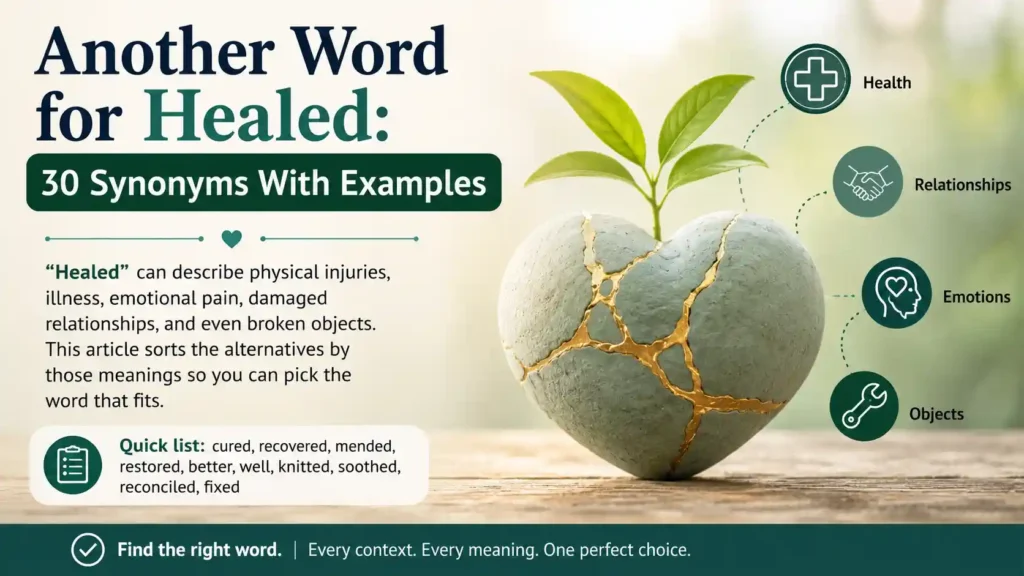
“Healed” can describe physical injuries, illness, emotional pain, damaged relationships, and even broken objects. This article sorts the alternatives by those meanings so you can pick the word that fits.
Quick list: cured, recovered, mended, restored, better, well, knitted, soothed, reconciled, fixed
Below, you will find 30 alternatives with meanings, IPA, usage notes, and example sentences. Some are close synonyms, while others only fit certain contexts, and each entry says which.
At a Glance: Healed Synonyms and Related Alternatives
| Alternative | Part of Speech | Meaning | Register / Tone | Ideal Context |
|---|---|---|---|---|
| Cured | Verb (past) / adjective | Freed from a disease | Neutral, medical | Illness, infection |
| Recovered | Verb (past) / adjective | Returned to health | Neutral | People after illness or injury |
| Mended | Verb (past) / adjective | Made whole again | Neutral, slightly informal | Bones, wounds, relationships |
| Restored | Verb (past) / adjective | Brought back to a former state | Neutral to formal | Health, order, trust |
| Better | Adjective | Improved in health | Informal, everyday | Casual talk about health |
| Well | Adjective | In good health | Informal, everyday | “Is she well again?” |
| Knitted | Verb (past) | Joined together (bones) | Slightly technical | Fractures |
| Soothed | Verb (past) / adjective | Made calmer or less painful | Gentle, neutral | Pain, feelings |
| Reconciled | Verb (past) / adjective | Brought back into friendship | Formal to neutral | Relationships |
| Fixed | Verb (past) / adjective | Repaired | Informal, everyday | Objects, problems |
Which Word Should You Use?
| If you want to… | Use | Why |
|---|---|---|
| Say a disease is gone | cured | It means the illness has been removed. |
| Say someone is healthy again | recovered | It focuses on the person’s return to normal. |
| Talk casually about getting well | better | It is the most common everyday choice. |
| Describe a broken bone | knitted or mended | Both are used for bones joining back together. |
| Describe a wound closing | closed | It describes the skin itself. |
| Describe a repaired friendship | reconciled | It means two people made peace. |
| Describe emotional recovery | got over or moved on | These fit grief and heartbreak naturally. |
| Describe a repaired object | fixed | “Healed” is rarely used for machines. |
Exploring the Multiple Meanings of “Healed”
1. Recovered from a Physical Injury
- Meaning: Having become healthy or whole again after a wound or injury.
- Explanation: This is the most common sense. The body repairs itself, often without special treatment. The focus is on the tissue, such as skin, bone, or muscle.
- Example: The cut on his hand healed within a week.
2. Cured of an Illness
- Meaning: Having become free of a disease or condition.
- Explanation: In everyday speech, “healed” can mean “cured.” In medicine, “cured” usually implies that treatment removed the disease, while “healed” describes damaged tissue. In religious writing, “healed” often means cured through faith.
- Example: After months of treatment, she felt healed.
3. Recovered Emotionally
- Meaning: Having overcome emotional pain, grief, or trauma.
- Explanation: This is a figurative use.The pain is not a physical wound, but “healed” suggests gradual, natural recovery.
- Example: It took him years, but he finally felt healed after the loss.
4. Repaired a Damaged Relationship
- Meaning: Having ended a conflict or restored friendly relations.
- Explanation: This sense is often used with words like “rift,” “breach,” or “divide.”
- Example: The two families healed their differences over dinner.
5. Repaired Damage or Harm
- Explanation: This use is figurative and often appears in news, politics, and environmental writing.
- Example: The forest healed slowly after the fire.
Sources: Merriam-Webster, Collins English Dictionary, Dictionary.com
Analyzing 30 Healed Alternatives in Detail
Some of the alternatives below are close synonyms, while others only fit certain contexts, and each Usage note says which.
Core Health Synonyms
1. Cured
IPA: US /kjʊrd/ · UK /kjʊəd/
Definition: Freed from a disease or medical condition.
- Usage: A close synonym when “healed” means freed from illness. It is stronger than “healed” and implies the disease is gone. People do not use it for wounds that close by themselves.
- Example: Antibiotics cured the infection.
2. Recovered
IPA: US /rɪˈkʌvərd/ · UK /rɪˈkʌvəd/
Definition: Returned to a normal state of health after illness or injury.
- Usage: A close synonym, neutral in tone. It is used mainly for people and animals, and works well with the preposition “from.”
- Example: He recovered from the flu in a few days.
3. Better
IPA: US /ˈbɛtər/ · UK /ˈbɛtə/
Definition: Improved in health, or no longer ill.
- Usage: An informal, everyday alternative. It is milder than “healed” and does not always mean fully well.
- Example: I’m better now, thanks for asking.
4. Well
IPA: /wɛl/ (US and UK)
Definition: In good health.
- Usage: A related adjective, not a verb. It fits phrases like “get well” or “feel well.” It is informal and common in cards and conversation.
- Example: She is finally well again after a long illness.
5. Restored
IPA: US /rɪˈstɔːrd/ · UK /rɪˈstɔːd/
Definition: Brought back to a previous or healthy condition.
- Usage: A close synonym in the phrase “restored to health.” It is a little formal and can also describe objects, buildings, and trust.
- Example: After rest and treatment, his health was fully restored.
6. Mended
IPA: /ˈmɛndɪd/ (US and UK)
Definition: Repaired, or made whole or well again.
- Usage: A close synonym for broken bones and wounds. It also works for relationships. It sounds slightly old-fashioned for illness.
- Example: The broken arm mended quickly.
Recovery Process Terms
7. Recuperated
IPA: /rɪˈkuːpəreɪtɪd/ (US and UK)
Definition: Regained health or strength after illness or exhaustion.
- Usage: A related alternative. It stresses the resting and regaining-strength phase, not the moment of being healed. It is used for people, not wounds.
- Example: She recuperated at home for two weeks after surgery.
8. Convalesced
IPA: US /ˌkɑːnvəˈlɛst/ · UK /ˌkɒnvəˈlɛst/
Definition: Spent time resting to regain health after illness or surgery.
- Usage: A formal, related alternative. It describes the recovery period, not the result. It is often used in medical or older writing.
- Example: He convalesced by the sea after his illness.
9. Rallied
IPA: /ˈrælid/ (US and UK)
Definition: Recovered strength or health after a period of weakness.
- Usage: A related alternative that suggests a sudden improvement. It does not mean full healing.
- Example: The patient rallied overnight and was awake by morning.
10. Bounced back
IPA: /ˌbaʊnst ˈbæk/ (US and UK)
Definition: Recovered quickly after a setback or illness.
- Usage: An informal phrasal verb. It suggests a fast recovery and also works for careers, businesses, and moods.
- Example: She bounced back from the injury faster than expected.
11. Pulled through
IPA: /ˌpʊld ˈθruː/ (US and UK)
Definition: Survived a serious illness or difficult period.
- Usage: An informal, related alternative. It implies the situation was serious and recovery was uncertain.
- Example: The doctors thought he might not make it, but he pulled through.
12. Rehabilitated
IPA: /ˌriːəˈbɪlɪteɪtɪd/ (US and UK)
Definition: Restored to normal function through therapy or training.
- Usage: A related, formal alternative. It fits long recoveries involving therapy, such as injuries and addiction.
- Example: The athlete was rehabilitated after a knee injury.
Wounds, Bones, and Skin
13. Knitted
IPA: /ˈnɪtɪd/ (US and UK)
Definition: Joined together, as a broken bone does while healing.
- Usage: A context-specific alternative used almost only for bones. “Knit” is also an accepted past form.
- Example: The fracture knitted well within six weeks.
14. Closed
IPA: US /kloʊzd/ · UK /kləʊzd/
Definition: Having come together so that an opening is gone, as a wound does.
- Usage: A related alternative for cuts and surgical wounds. It describes the skin only, not full recovery.
- Example: The wound closed cleanly without stitches.
15. Regenerated
IPA: /rɪˈdʒɛnəreɪtɪd/ (US and UK)
Definition: Grew back or formed again after damage.
- Usage: A related, more scientific alternative for tissue, skin, or nerves. It does not suit emotional healing.
- Example: The damaged skin regenerated over several weeks.
16. Cicatrized
IPA: /ˈsɪkətraɪzd/ (US and UK)
Definition: Healed by forming scar tissue.
- Usage: A rare, technical alternative. Use it only in medical or literary writing, since most readers will not know it.
- Example: The incision had cicatrized neatly by the time of his check-up.
17. Repaired
IPA: US /rɪˈpɛrd/ · UK /rɪˈpeəd/
Definition: Put back into good condition after damage.
- Usage: A related, neutral alternative for tissue or damage generally. It is used more for objects than for people.
- Example: The torn ligament was repaired through surgery.
18. Cleared up
IPA: US /ˌklɪrd ˈʌp/ · UK /ˌklɪəd ˈʌp/
Definition: Gone away, as an infection or skin problem does.
- Usage: An informal alternative for rashes, acne, and infections. It suggests the problem disappeared on its own or with treatment.
- Example: Her rash cleared up after a few days.
Emotional and Relational Recovery
19. Soothed
IPA: /suːðd/ (US and UK)
Definition: Made calmer or less painful.
- Usage: A related alternative that describes relief, not full healing. It fits pain, worry, and hurt feelings.
- Example: Her kind words soothed his grief.
20. Comforted
IPA: US /ˈkʌmfərtɪd/ · UK /ˈkʌmfətɪd/
Definition: Given emotional support during sadness or pain.
- Usage: A related alternative focused on support from another person. It does not mean the pain is gone.
- Example: The community comforted the grieving family.
21. Reconciled
IPA: /ˈrɛkənsaɪld/ (US and UK)
Definition: Brought back into friendly relations after a disagreement.
- Usage: A close synonym for the relationship sense of “healed.” It is neutral to formal and fits families, friends, and groups.
- Example: The two brothers reconciled after ten years of silence.
22. Moved on
IPA: US /ˌmuːvd ˈɑːn/ · UK /ˌmuːvd ˈɒn/
Definition: Stopped dwelling on a past hurt and gone forward with life.
- Usage: An informal, related alternative for breakups, loss, and old conflicts. It describes a change in attitude, not a repair.
- Example: After the divorce, she slowly moved on.
23. Got over
IPA: US /ˌɡɑːt ˈoʊvər/ · UK /ˌɡɒt ˈəʊvə/
Definition: Recovered from an illness, shock, or emotional hurt.
- Usage: An informal phrasal verb. It fits illnesses, heartbreak, and disappointment. It is a close everyday alternative to “healed” in this sense.
- Example: It took him a long time to get over the loss.
Fixing Problems and Damage
24. Fixed
IPA: /fɪkst/ (US and UK)
Definition: Repaired or put right.
- Usage: An informal, related alternative. It suits objects and problems far better than people.
- Example: The technician fixed the broken heater.
25. Remedied
IPA: /ˈrɛmədid/ (US and UK)
Definition: Corrected or put right a problem or fault.
- Usage: A formal, related alternative for errors, faults, and harmful situations. It is not used for illness in everyday speech.
- Example: The company remedied the safety problem.
26. Rectified
IPA: /ˈrɛktɪfaɪd/ (US and UK)
Definition: Corrected something wrong.
- Usage: A formal, related alternative for mistakes and errors. It is not used for physical healing.
- Example: The error was rectified within a day.
27. Resolved
IPA: US /rɪˈzɑːlvd/ · UK /rɪˈzɒlvd/
Definition: Settled or solved a conflict or problem.
- Usage: A related alternative for disputes and difficulties. It does not fit physical injuries or illness.
- Example: The dispute was resolved peacefully.
Renewal and Literary Alternatives
28. Revived
IPA: /rɪˈvaɪvd/ (US and UK)
Definition: Brought back to life, strength, or activity.
- Usage: A related alternative that suggests renewed energy, often after near collapse. It is slightly dramatic.
- Example: The cool water revived the exhausted runner.
29. Renewed
IPA: US /rɪˈnuːd/ · UK /rɪˈnjuːd/
Definition: Made new, fresh, or strong again.
- Usage: A related, slightly formal or literary alternative. It fits spirit, hope, and strength more than wounds.
- Example: She felt renewed after a long rest.
30. Made whole
IPA: US /ˌmeɪd ˈhoʊl/ · UK /ˌmeɪd ˈhəʊl/
Definition: Restored to a complete or undamaged condition.
- Usage: A formal or literary expression. It reflects the origin of “heal,” which is linked to the idea of wholeness. It is often used for spiritual or emotional restoration.
- Example: The community felt made whole again after the rebuilding.
Sources: Merriam-Webster, Collins English Dictionary, Dictionary.com, Oxford Learner’s Dictionaries
Healed vs. Cured vs. Recovered
People often use these three words as if they mean the same thing, but they point to different ideas.
| Word | What it focuses on | Typical use |
|---|---|---|
| Healed | The body or a wound repairing itself, or pain easing | Cuts, bones, feelings, relationships |
| Cured | The disease being removed, usually by treatment | Infections, diseases |
| Recovered | The person returning to normal health | People after illness, surgery, or injury |
A cut can heal, but it does not “cure.” Treatment can cure a person of an infection, yet the person may still need weeks to recover. A grieving person can heal emotionally, but people rarely describe that person as cured.
Sources: Merriam-Webster, Collins English Dictionary
Healed and Opposite or Paired Word Pairs
| Word | Paired Word | Note |
|---|---|---|
| Healed | Wounded | Used for both physical and emotional injury. |
| Healed | Injured | Common for bodies, athletes, and animals. |
| Healed | Sick / ill | Contrasts good health with illness. |
| Healed | Unhealed | A natural negative form, often used for old wounds. |
| Healed | Infected | Contrasts a closed wound with one that has an infection. |
| Healed | Broken | Works for bones, relationships, and spirits. |
| Healed | Hurt | Common for feelings. |
“Healed” has no single perfect opposite, because the opposite depends on what was damaged. “Unhealed” is the simplest direct opposite, while “wounded” and “ill” describe the condition before healing.
Sources: Merriam-Webster, Collins English Thesaurus
Common Word Partners of “Healed”
| Pattern | Common Partners | Example |
|---|---|---|
| Adverb + healed | fully, completely, properly, nicely | The scar has healed nicely. |
| Healed + preposition | from, of (more formal) | He healed from the injury. |
| Noun + healed | wound, bone, scar, cut, injury | The wound healed in a week. |
| Healed + over | healed over (wounds, scars) | The cut healed over quickly. |
| Be/feel + healed | feel healed, be healed | She no longer felt hurt; she felt healed. |
| Adjective use | a healed fracture, healed skin | The doctor checked the healed fracture. |
Sources: Collins English Dictionary, Oxford Learner’s Dictionaries
Idiomatic Phrases Featuring “Healed”
Healed itself appears in few fixed idioms, but its base verb “heal” appears in several well-established expressions.
1. Time heals all wounds
- Meaning: Pain and sadness fade as time passes.
- Example: Don’t worry about the argument now. Time heals all wounds.
2. Physician, heal thyself
- Meaning: A proverb telling people to fix their own faults before criticizing others. It comes from the Bible (Luke 4:23).
- Example: He told me to be more patient, but physician, heal thyself.
3. Heal the rift
- Meaning: To repair a serious disagreement between people or groups.
- Example: The leaders worked to heal the rift between the two parties.
4. Heal old wounds
- Meaning: To resolve past hurts or conflicts. This is an established expression, not a strict idiom.
- Example: The apology helped heal old wounds between them.
Sources: Merriam-Webster, Collins English Dictionary, Oxford Learner’s Dictionaries
Word Formation of “Healed”
Etymology & Structure
“Healed” is the past tense and past participle of the verb “heal,” made by adding the ending “-ed.” “Heal” comes from Old English hǣlan, meaning to make whole, sound, or well. It goes back to a Germanic root linked to the word for “whole.” This is why “heal” is related to “whole,” “hale,” and “health.”
Date and History
“Heal” is recorded in Old English, so it dates to before the 12th century. Its core idea of making whole has stayed in the language for roughly a thousand years.
Word Class Variations
- Verb: heal, heals, healed, healing
- Noun: healer, healing, health
- Adjective: healed (a healed wound), healing (healing powers), healable, unhealed, healthy
- Adverb: no common adverb form directly from “heal”; “healthily” comes from “healthy”
Sources: Etymonline, Merriam-Webster
Common Word-Choice Mistakes
- “The doctor healed my flu” → The doctor cured my flu, or the flu healed on its own.
- “I healed from the cold” → I recovered from the cold.
- “The wound recuperated” → The wound healed. “Recuperate” is for people.
- “The wound heeled” → The wound healed. “Heeled” is a different word.
- “My laptop healed” → My laptop was fixed.
- “She healed up the argument” → She resolved the argument, or the two reconciled.
- “He is heal now” → He is healed now. Use the past participle after “is.”
FAQs
What is the closest synonym for “healed”?
“Recovered” and “cured” are the closest, depending on meaning. “Recovered” fits people, and “cured” fits disease.
What is a casual alternative to “healed”?
“Better” and “okay again” are common in everyday speech. “Got over it” also works for emotional pain.
What is a formal alternative?
“Restored,” “recuperated,” and “convalesced” are more formal. In medical writing, “cicatrized” is used for wounds closing with scar tissue.
What is a literary alternative?
“Made whole” and “renewed” suit literary or spiritual writing.
What is the difference between “healed” and “cured”?
“Healed” usually means damaged tissue or pain has repaired. “Cured” means a disease has been removed, usually through treatment.
Can “healed” be used for emotions?
Yes. People say they feel healed after grief, trauma, or heartbreak. This is a figurative use.
Conclusion
You can use “cured,” “recovered,” and “mended” as the closest alternatives to “healed.” The right choice depends on what got better, if a disease, an injury, a feeling, or a relationship.
“Cured” fits illness, “recovered” fits people, and “knitted” fits bones. “Reconciled” suits relationships, “got over” suits emotional pain, and “fixed” suits objects and problems.
To choose well, ask yourself what was damaged and how it improved. Match the word to that meaning, then adjust the tone for formal or casual writing.

Hi, I’m Sophia a passionate writer and curious learner who enjoys exploring fascinating facts, everyday questions, and interesting discoveries. At VistoraDaily, I share clear, reliable, and engaging general knowledge content to help readers learn something new and understand the world better.